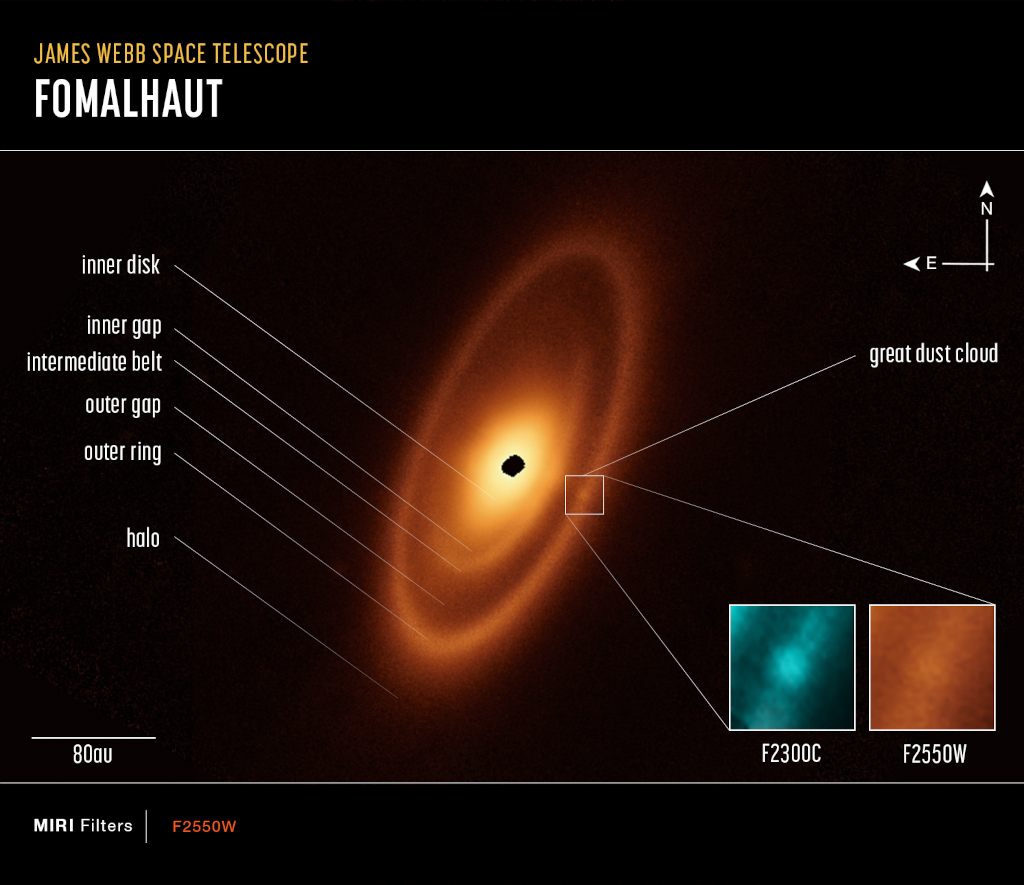
Fomalhaut is a bright star, a 25 light-year voyage from planet Earth in the direction of the constellation Piscis Austrinus. Astronomers first noticed Fomalhaut’s excess infrared emission in the 1980s. Space and ground-based telescopes have since identified the infrared emission’s source as a disk of dusty debris surrounding the hot, young star related to the ongoing formation of a planetary system. But this sharp infrared image from the James Webb Space Telescope’s MIRI camera reveals details of Fomalhaut’s debris disk never before seen, including a large dust cloud in the outer ring that is possible evidence for colliding bodies, and an inner dust disk and gap likely shaped and maintained by embedded but unseen planets. An image scale bar in au or astronomical units, the average Earth-Sun distance, appears at the lower left. Fomalhaut’s outer circumstellar dust ring lies at about twice the distance of our own Solar System’s Kuiper Belt of small icy bodies and debris beyond the orbit of Neptune. [via NASA] https://ift.tt/jQPGKNH
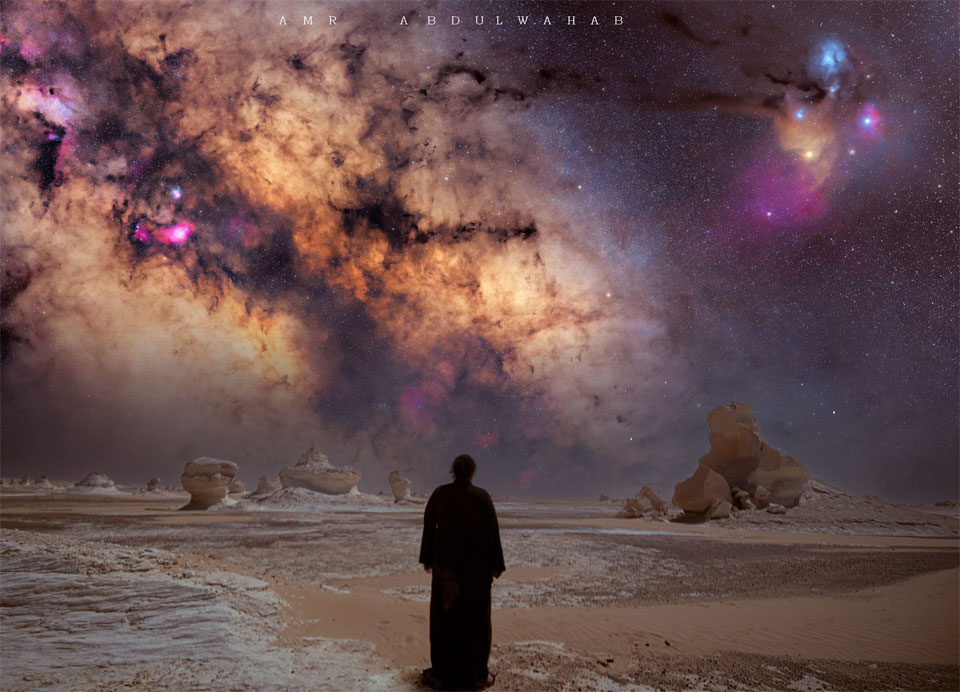
For ten years the stargazer dreamed of taking a picture like this. The dreamer knew that the White Desert National Park in Egypt’s Western Desert is a picturesque place hosting numerous chalk formations sculpted into surreal structures by a sandy wind. The dreamer knew that the sky above could be impressively dark on a clear moonless night, showing highlights such as the central band of our Milky Way Galaxy in impressive color and detail. So the dreamer invited an even more experienced astrophotographer to spend three weeks together in the desert and plan the composite images that needed to be taken and processed to create the dream image. Over three days in mid-March, the base images were taken, all with the same camera and from the same location. The impressive result is featured here, with the dreamer — proudly wearing a traditional Bedouin galabyia — pictured in the foreground. [via NASA] https://ift.tt/pOSdukt

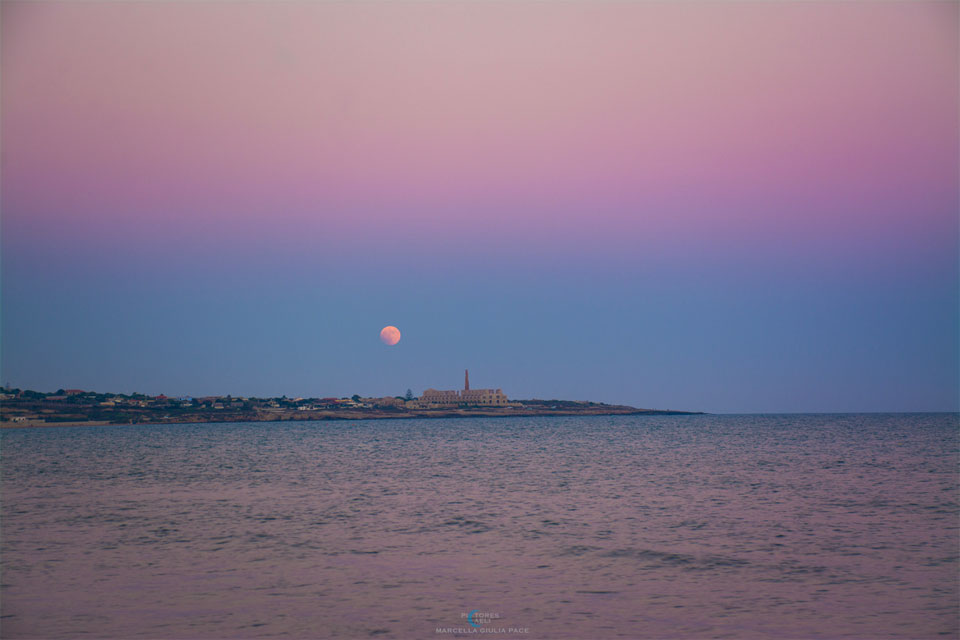
Can you find two Earth shadows in today’s image? It’s a bit tricky. To find the first shadow, observe that the top part of the atmosphere appears pink and the lower part appears blue. This is because the top half is exposed to direct sunlight, while the lower part is not. The purple area in between is known as the Belt of Venus, even though Venus can only appear on the other side of the sky, near the Sun. The blue color of the lower atmosphere is caused by the Earth blocking sunlight, creating Earth shadow number 1. Now, where is the second Earth shadow? Take a look at the Moon. Do you notice something unusual about the lower left part? That area appears unusually dark because it is in the shadow of the Earth, creating Earth shadow number 2. To be precise, the Moon was captured during a lunar eclipse. This carefully timed image was taken in Sampieri, Sicily, Italy, in July 2018. [via NASA] https://ift.tt/YhIdCPR

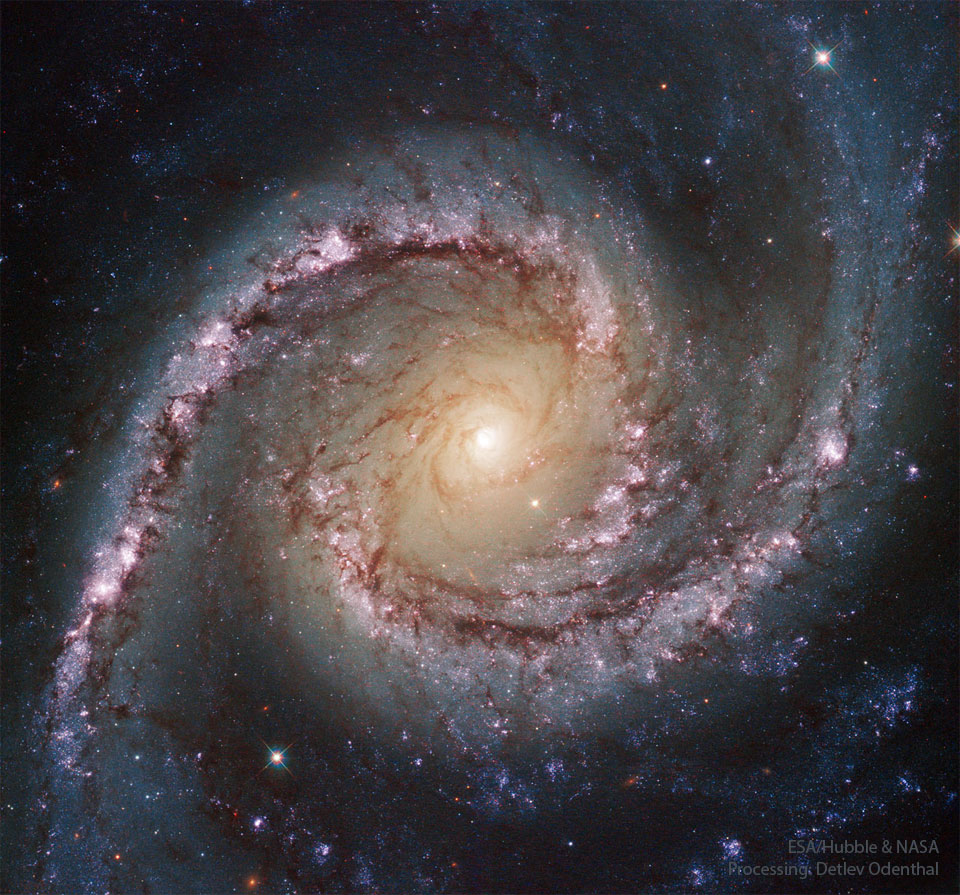
If not perfect, then this spiral galaxy is at least one of the most photogenic. An island universe containing billions of stars and situated about 40 million light-years away toward the constellation of the Dolphinfish (Dorado), NGC 1566 presents a gorgeous face-on view. Classified as a grand design spiral, NGC 1566 shows two prominent and graceful spiral arms that are traced by bright blue star clusters and dark cosmic dust lanes. Numerous Hubble Space Telescope images of NGC 1566 have been taken to study star formation, supernovas, and the spiral’s unusually active center. Some of these images, stored online in the Hubble Legacy Archive, were freely downloaded, combined, and digitally processed by an industrious amateur to create the featured image. NGC 1566’s flaring center makes the spiral one of the closest and brightest Seyfert galaxies, likely housing a central supermassive black hole wreaking havoc on surrounding stars and gas. [via NASA] https://ift.tt/o4Q2TyS

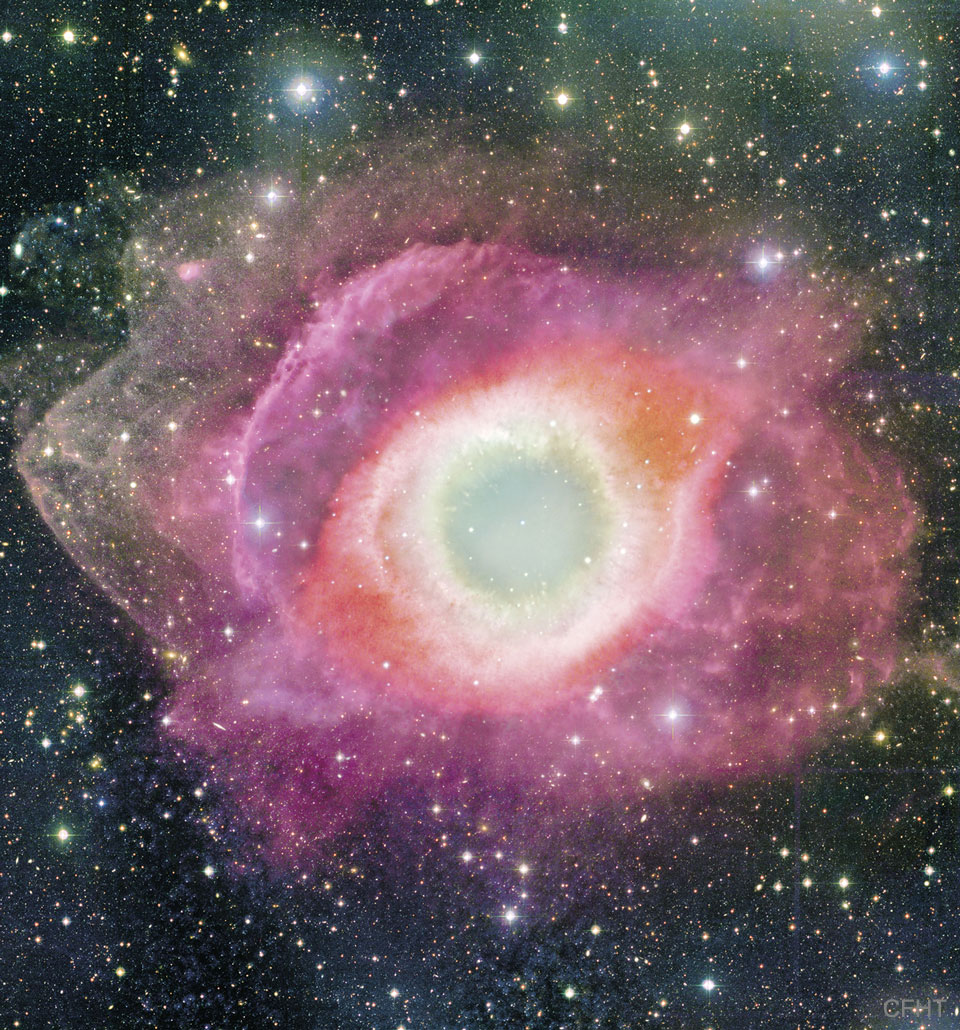
Will our Sun look like this one day? The Helix Nebula is one of brightest and closest examples of a planetary nebula, a gas cloud created at the end of the life of a Sun-like star. The outer gasses of the star expelled into space appear from our vantage point as if we are looking down a helix. The remnant central stellar core, destined to become a white dwarf star, glows in light so energetic it causes the previously expelled gas to fluoresce. The Helix Nebula, given a technical designation of NGC 7293, lies about 700 light-years away towards the constellation of the Water Bearer (Aquarius) and spans about 2.5 light-years. The featured picture was taken with the Canada-France-Hawaii Telescope (CFHT) located atop a dormant volcano in Hawaii, USA. A close-up of the inner edge of the Helix Nebula shows complex gas knots of unknown origin. [via NASA] https://ift.tt/M0SxUZu

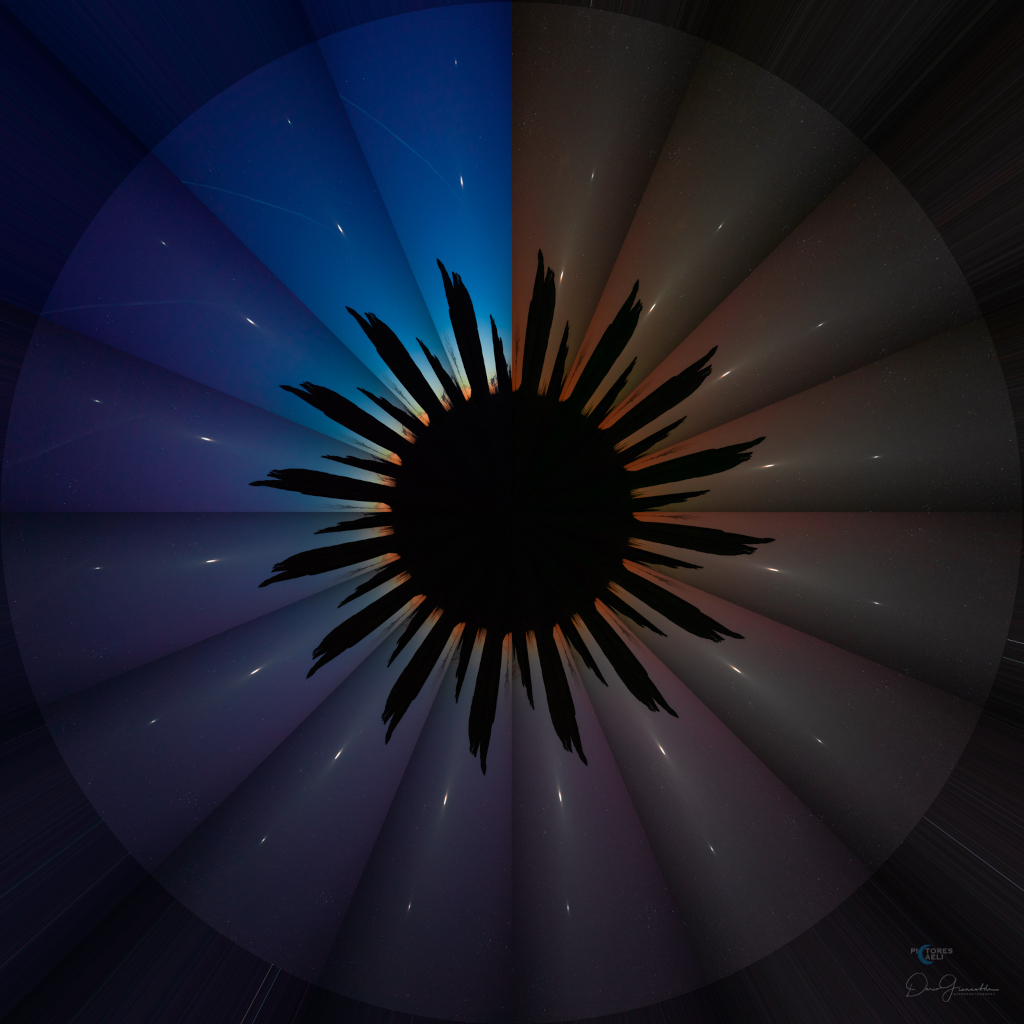
Twilight in a Flower

Transformed into the petals of a flower, 16 exposures show the passage of day into night in this creative timelapse skyscape. Start at the top and move counterclockwise to follow consecutive moments as the twilight sky turns an ever darker blue and night blossoms. Each exposure was recorded on the evening of April 22, calculated to maintain a consistent balance of light and color. Close to the western horizon on that date, a crescent Moon and Venus are the two brightest celestial beacons. Petal to petal the pair spiral closer to the flower’s center. In silhouette around the center of the twilight flower are Sicily’s megalithic rocks of Argimusco. [via NASA] https://ift.tt/62IvrC0

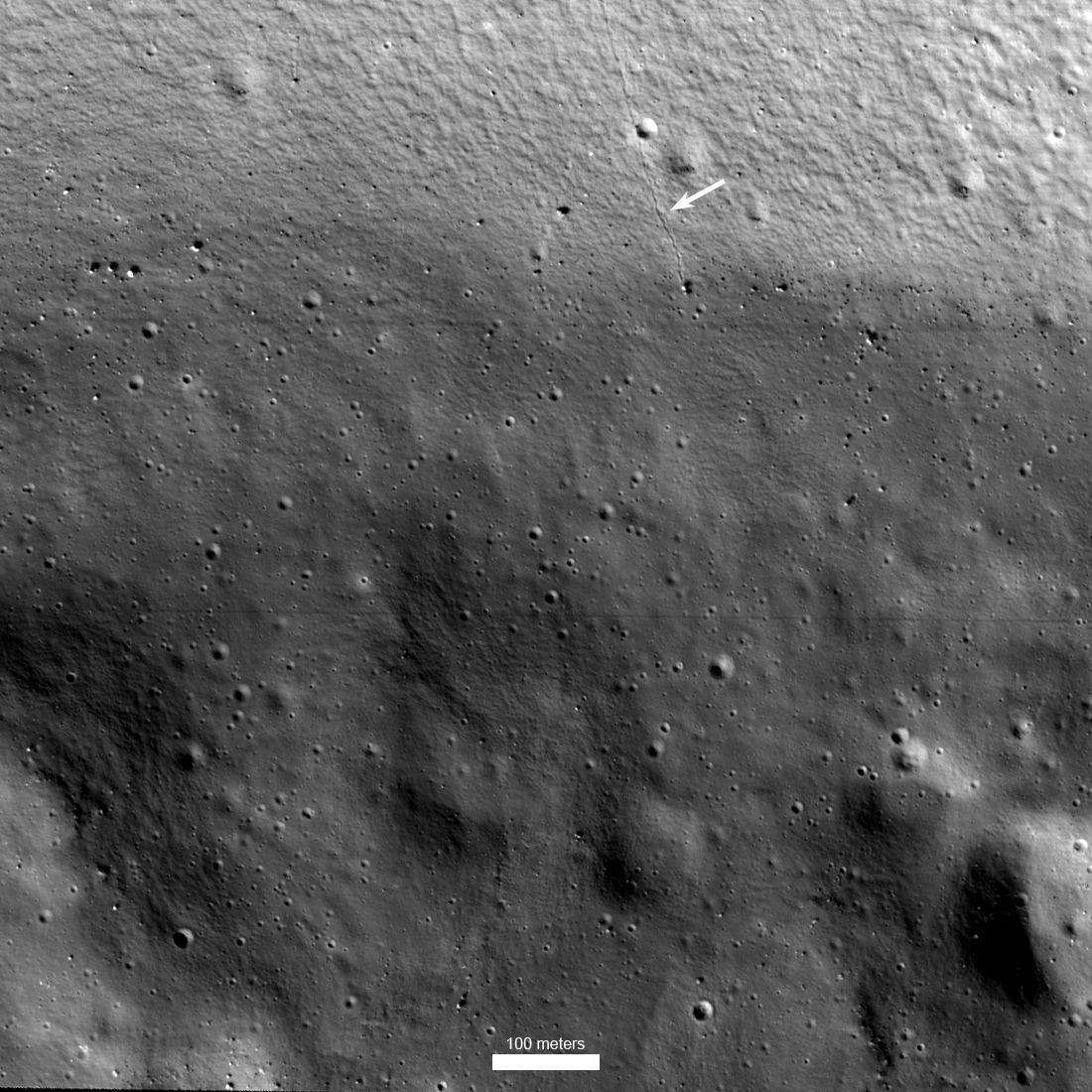
Shackleton from ShadowCam

Shackleton crater lies at the lunar south pole. Peaks along the 21 kilometer diameter are in sunlight, but Shackleton’s floor is in dark permanent shadow. Still, this image of the shadowed rim wall and floor of Shackleton crater was captured from NASA’s ShadowCam, an instrument on board the Korea Pathfinder Lunar Orbiter (KPLO) launched in August 2022. About 200 times more sensitive than, for example, the Lunar Reconnaissance Orbiter’s Narrow Angle Camera, ShadowCam was designed image the permanently shadowed regions of the lunar surface. Avoiding direct sunlight, those regions are expected to be reservoirs of water-ice and other volatiles deposited by ancient cometary impacts and useful to future Moon missions. Of course, the permanently shadowed regions are still illuminated by reflections of sunlight from nearby lunar terrain. In this stunningly detailed ShadowCam image, an arrow marks the track made by a single boulder rolling down Shackleton crater’s wall. The image scale is indicated at the bottom of the frame. [via NASA] https://ift.tt/FW8dOKy

The Galaxy, the Jet, and a Famous Black Hole

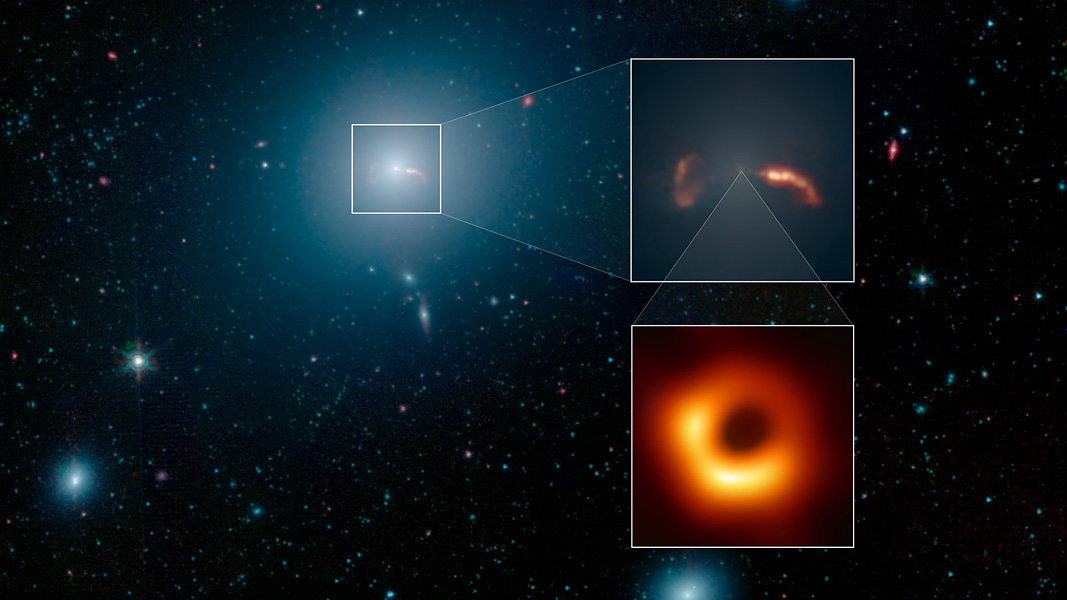
Bright elliptical galaxy Messier 87 (M87) is home to the supermassive black hole captured in 2017 by planet Earth’s Event Horizon Telescope in the first ever image of a black hole. Giant of the Virgo galaxy cluster about 55 million light-years away, M87 is the large galaxy rendered in blue hues in this infrared image from the Spitzer Space telescope. Though M87 appears mostly featureless and cloud-like, the Spitzer image does record details of relativistic jets blasting from the galaxy’s central region. Shown in the inset at top right, the jets themselves span thousands of light-years. The brighter jet seen on the right is approaching and close to our line of sight. Opposite, the shock created by the otherwise unseen receding jet lights up a fainter arc of material. Inset at bottom right, the historic black hole image is shown in context, at the center of giant galaxy and relativistic jets. Completely unresolved in the Spitzer image, the supermassive black hole surrounded by infalling material is the source of enormous energy driving the relativistic jets from the center of active galaxy M87. The Event Horizon Telescope image of M87 has now been enhanced to reveal a sharper view of the famous supermassive black hole. [via NASA] https://ift.tt/gs0XQBi

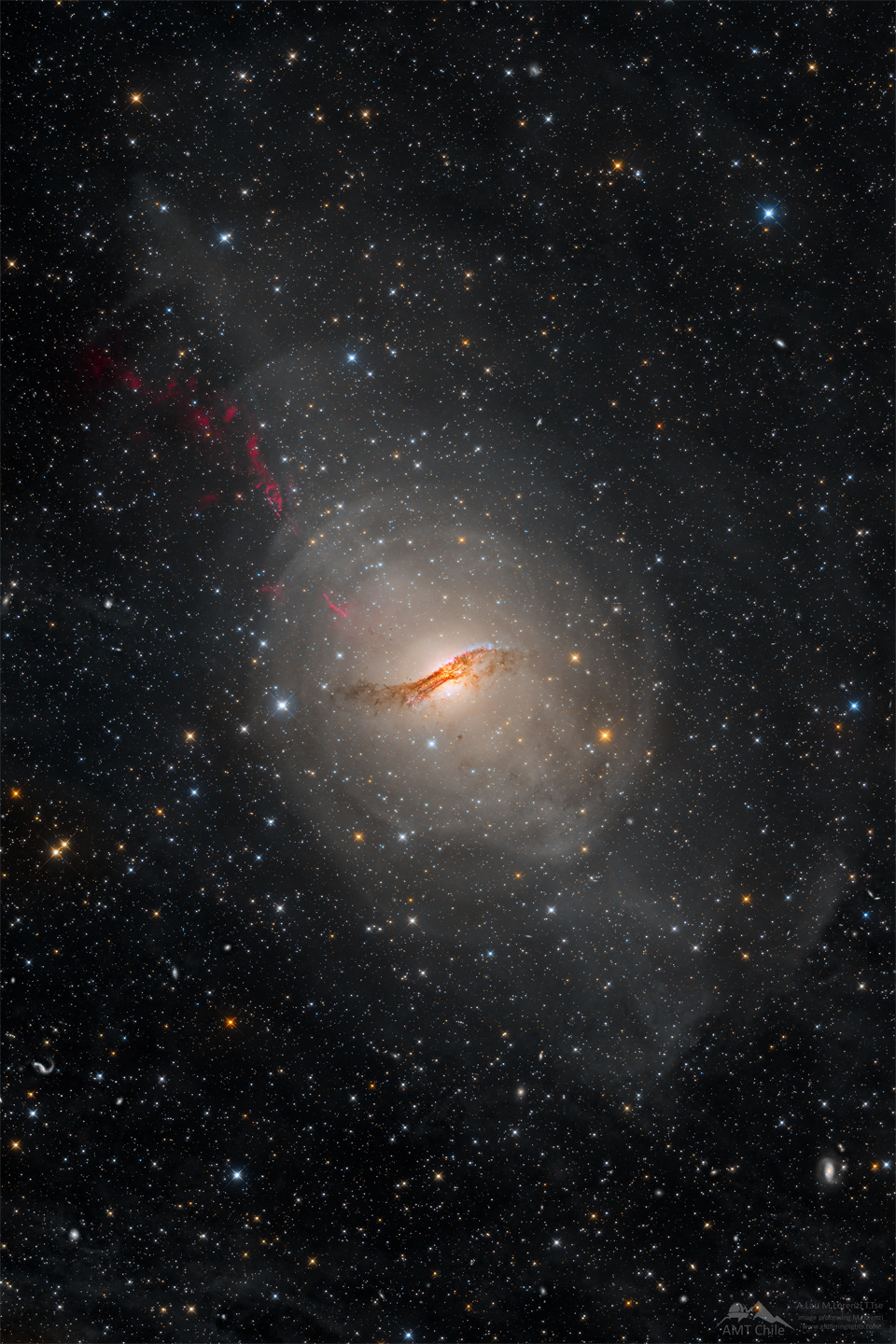
Galaxies are fascinating. In galaxies, gravity alone holds together massive collections of stars, dust, interstellar gas, stellar remnants and dark matter. Pictured is NGC 5128, better known as Centaurus A. Cen A is the fifth brightest galaxy on the sky and is located at a distance of about 12 million light years from Earth. The warped shape of Cen A is the result of a merger between an elliptical and a spiral galaxy. Its active galactic nucleus harbors a supermassive black hole that is about 55 million times more massive than our Sun. This central black hole ejects a fast jet visible in both radio and X-ray light. Filaments of the jet are visible in red in the upper left. New observations by the Event Horizon Telescope have revealed a brightening of the jet only towards its edges — but for reasons that are currently unknown and an active topic of research. [via NASA] https://ift.tt/2G6Ag79

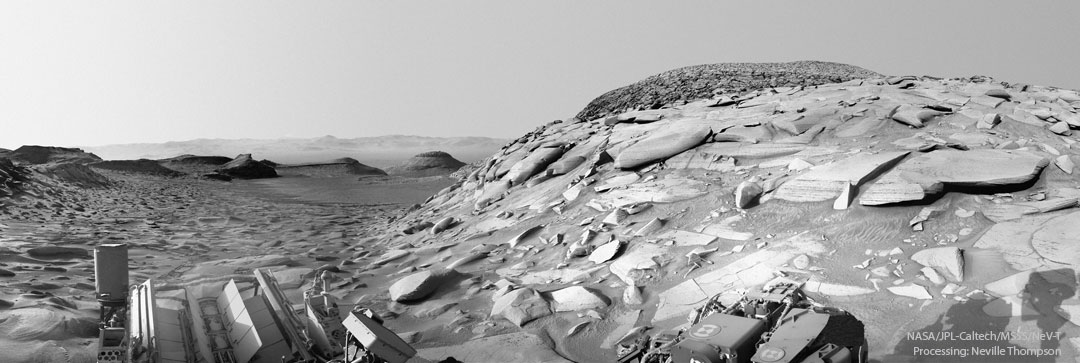
Why are there so many flat rocks on Mars? Some views of plains and hills on Mars show many rocks that are unusually flat when compared to rocks on Earth. One reason for this is a process that is common to both Mars and Earth: erosion. The carbon-dioxide wind on Mars can act like sandpaper when it blows around gritty Martian sand. This sand can create differential erosion, smoothing over some rocks, while wearing down the tops of other long-exposed stones. The featured image capturing several hills covered with flat-topped rocks was taken last month by NASA’s Curiosity Rover on Mars. This robotic rover has now been rolling across Mars for ten years and has helped uncover many details of the wet and windy past of Earth’s planetary neighbor. After taking this and other images, Curiosity carefully navigated stones and slippery sand to climb up Marker Band Valley. [via NASA] https://ift.tt/D4dMhwr