
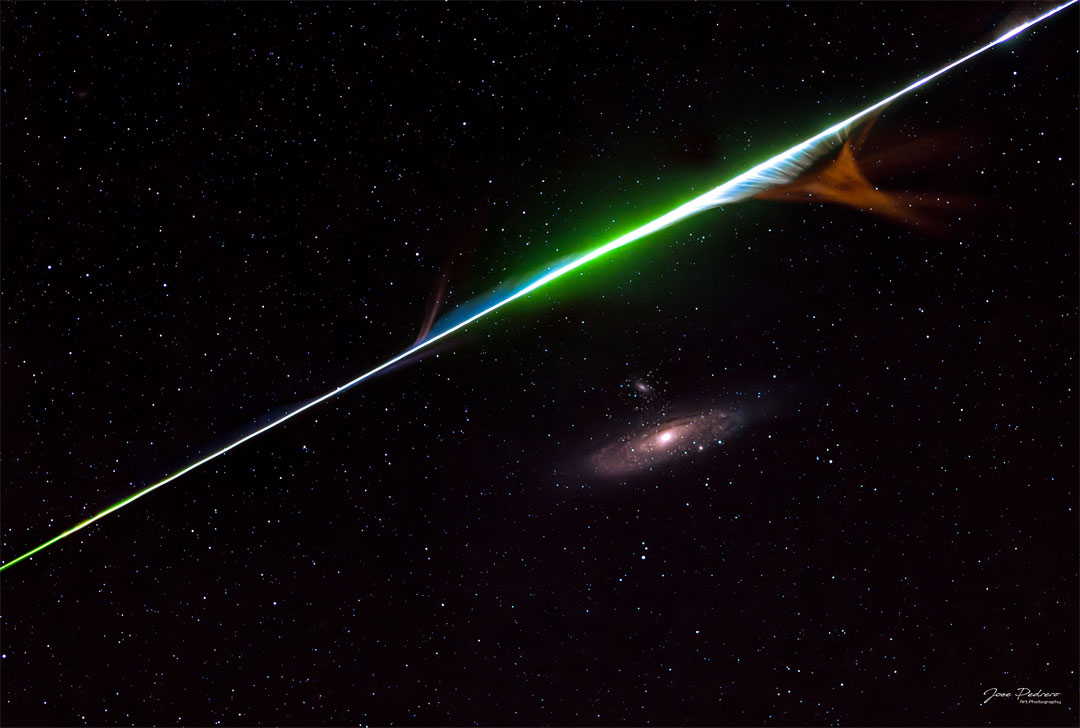
It came from outer space. It — in this case a sand-sized bit of a comet nucleus — was likely ejected many years ago from Sun-orbiting Comet Swift-Tuttle, but then continued to orbit the Sun alone. When the Earth crossed through this orbit, the piece of comet debris impacted the atmosphere of our fair planet and was seen as a meteor. This meteor deteriorated, causing gases to be emitted that glowed in colors emitted by its component elements. The featured image was taken last week from Castilla La Mancha, Spain, during the peak night of the Perseids meteor shower. The picturesque meteor streak happened to appear in the only one of 50 frames that also included the Andromeda galaxy. Stars dot the frame, each much further away than the meteor. Compared to the stars, the Andromeda galaxy (M31) is, again, much further away. [via NASA] https://ift.tt/PxFZQYS

 Rafael Bustamante