Quarter Moons

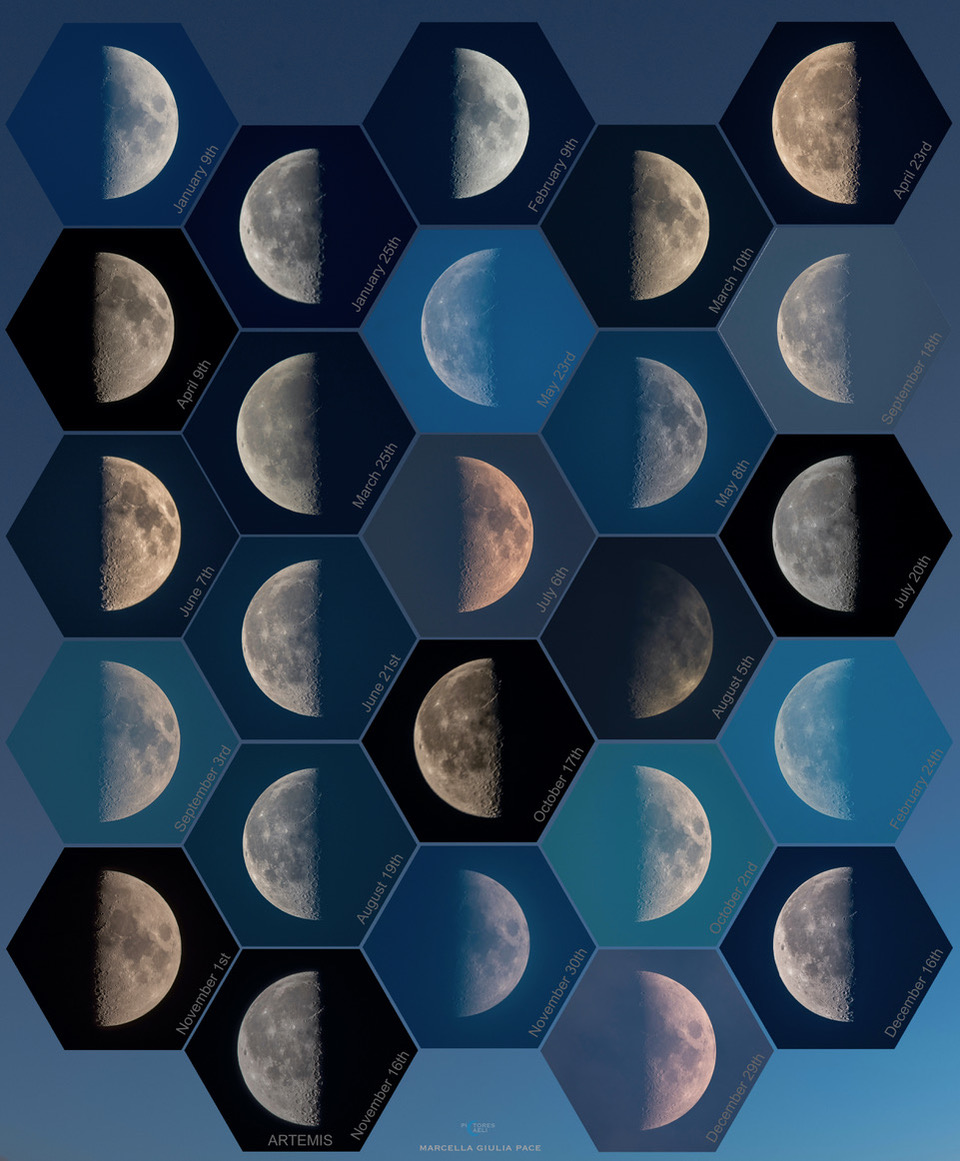
Half way between New Moon and Full Moon is the Moon’s first quarter phase. That’s a quarter of the way around its moonthly orbit. At the first quarter phase, half the Moon’s visible side is illuminated by sunlight. For the Moon’s third quarter phase, half way between Full Moon and New Moon, sunlight illuminates the other half of the visible lunar disk. At both first and third quarter phases, the terminator, or shadow line separating the lunar night and day, runs down the middle. Near the terminator, long shadows bring lunar craters and mountains in to sharp relief, making the quarter phases a good time to observe the Moon. But in case you missed some, all the quarter phases of the Moon and their calendar dates during 2022 can be found in this well-planned array of telephoto images. Of course, you can observe a first quarter Moon tonight. [via NASA] https://ift.tt/vszUCRb
Galaxies and a Comet

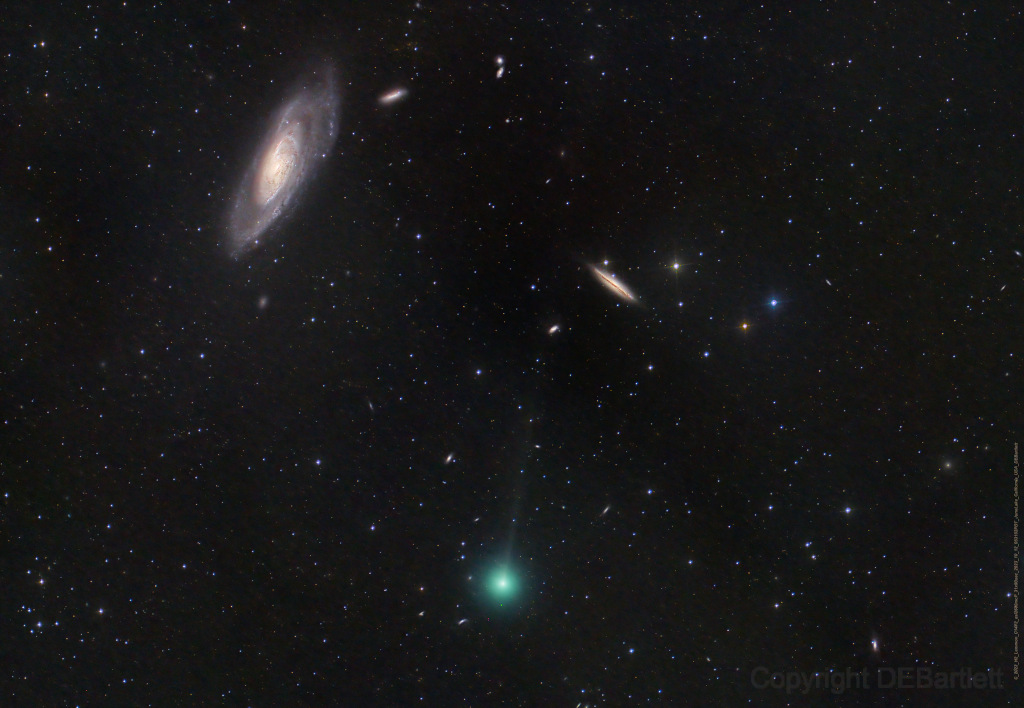
Galaxies abound in this sharp telescopic image recorded on October 12 in dark skies over June Lake, California. The celestial scene spans nearly 2 degrees within the boundaries of the well-trained northern constellation Canes Venatici. Prominent at the upper left 23.5 million light-years distant is big, beautiful spiral galaxy NGC 4258, known to some as Messier 106. Eye-catching edge-on spiral NGC 4217 is above and right of center about 60 million light-years away. Just passing through the pretty field of view is comet C/2023 H2 Lemmon, discovered last April in image data from the Mount Lemmon Survey. Here the comet sports more of a lime green coma though, along with a faint, narrow ion tail stretching toward the top of the frame. This visitor to the inner Solar System is presently less than 7 light-minutes away and still difficult to spot with binoculars, but it’s growing brighter. Comet C/2023 H2 Lemmon will reach perihelion, its closest point to the Sun, on October 29 and perigee, its closest to our fair planet, on November 10 as it transitions from morning to evening northern skies. [via NASA] https://ift.tt/ftVNBmY

A Sunrise at Sunset Point

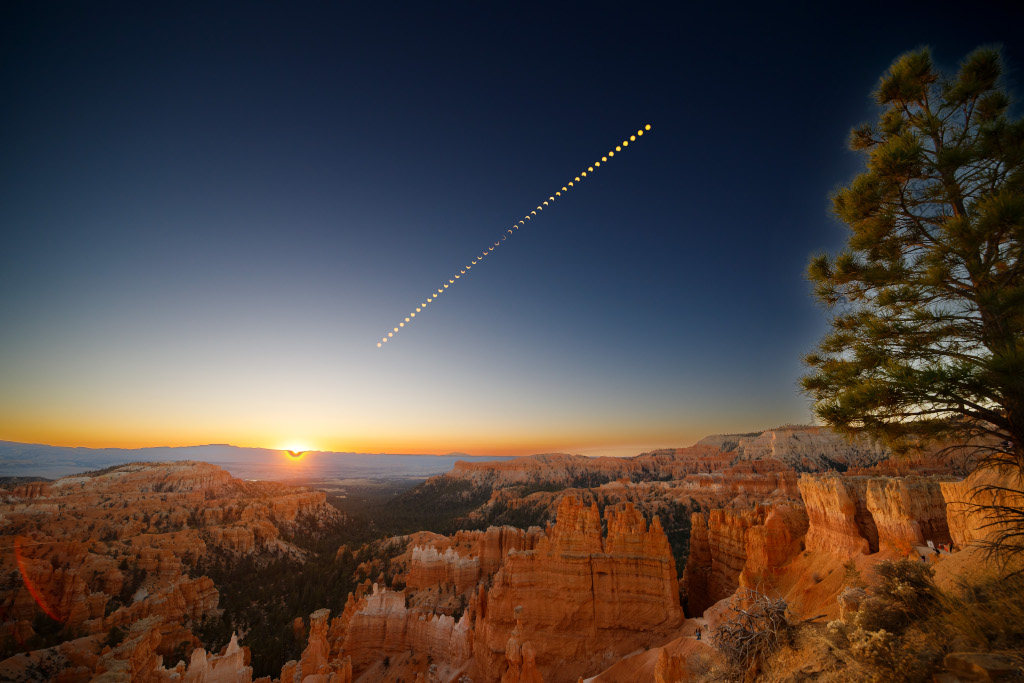
This timelapse series captured on October 14 is set against the sunrise view from Sunset Point, Bryce Canyon, planet Earth. Of course on that date the New Moon caught up with the Sun in the canyon’s morning skies. Local temperatures fell as the Moon’s shadow swept across the high altitude scene and the brilliant morning sunlight became a more subdued yellow hue cast over the reddish rocky landscape. In the timelapse series, images were taken at 2 minute intervals. The camera and solar filter were fixed to a tripod to follow the phases of the annular solar eclipse. [via NASA] https://ift.tt/UrmjwOM

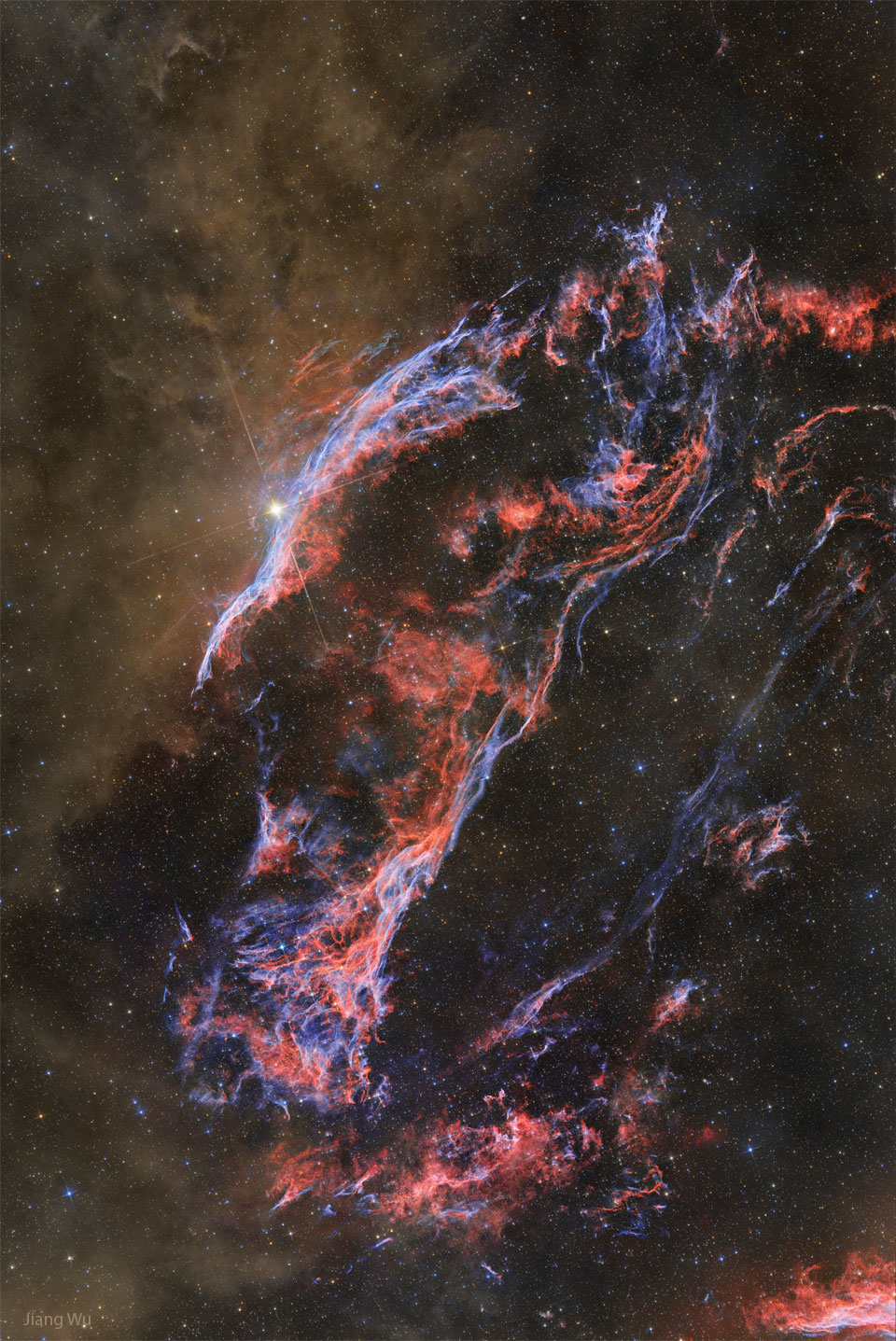
It’s so big it is easy to miss. The entire Veil Nebula spans six times the diameter of the full moon, but is so dim you need binoculars to see it. The nebula was created about 15,000 years ago when a star in the constellation of the Swan (Cygnus) exploded. The spectacular explosion would have appeared brighter than even Venus for a week – but there is no known record of it. Pictured is the western edge of the still-expanding gas cloud. Notable gas filaments include the Witch’s Broom Nebula on the upper left near the bright foreground star 52 Cygni, and Fleming’s Triangular Wisp (formerly known as Pickering’s Triangle) running diagonally up the image middle. What is rarely imaged — but seen in the featured long exposure across many color bands — is the reflecting brown dust that runs vertically up the image left, dust likely created in the cool atmospheres of massive stars. [via NASA] https://ift.tt/4TefZ0z

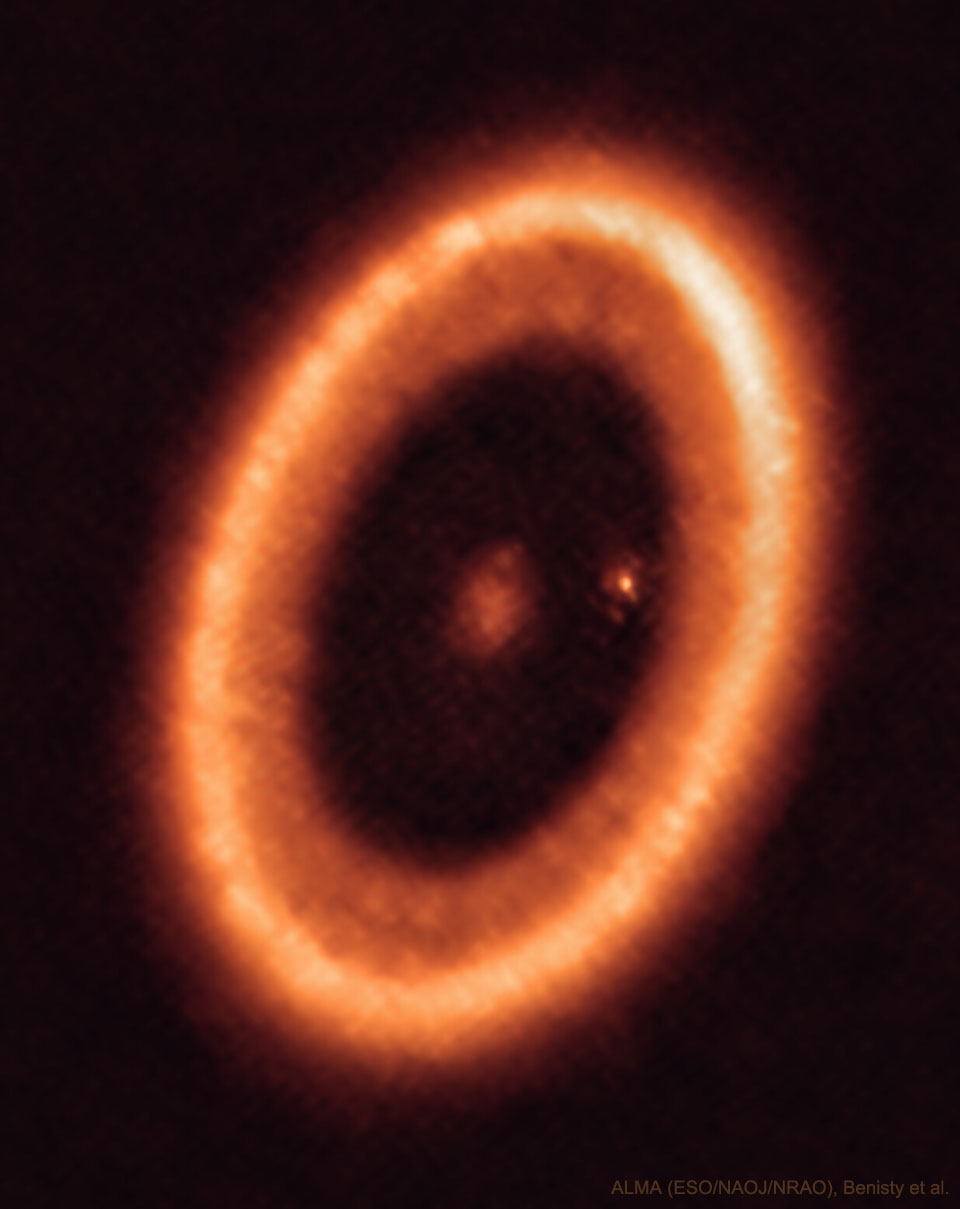
It’s not the big ring that’s attracting the most attention. Although the big planet-forming ring around the star PDS 70 is clearly imaged and itself quite interesting. It’s also not the planet on the right, just inside the big disk, that’s being talked about the most. Although the planet PDS 70c is a newly formed and, interestingly, similar in size and mass to Jupiter. It’s the fuzzy patch around the planet PDS 70c that’s causing the commotion. That fuzzy patch is thought to be a dusty disk that is now forming into moons — and that had never been seen before. The featured image was taken in 2021 by the Atacama Large Millimeter Array (ALMA) of 66 radio telescopes in the high Atacama Desert of northern Chile. Based on ALMA data, astronomers infer that the moon-forming exoplanetary disk has a radius similar to our Earth’s orbit, and may one day form three or so Luna-sized moons — not very different from our Jupiter’s four. [via NASA] https://ift.tt/PxjEn1K

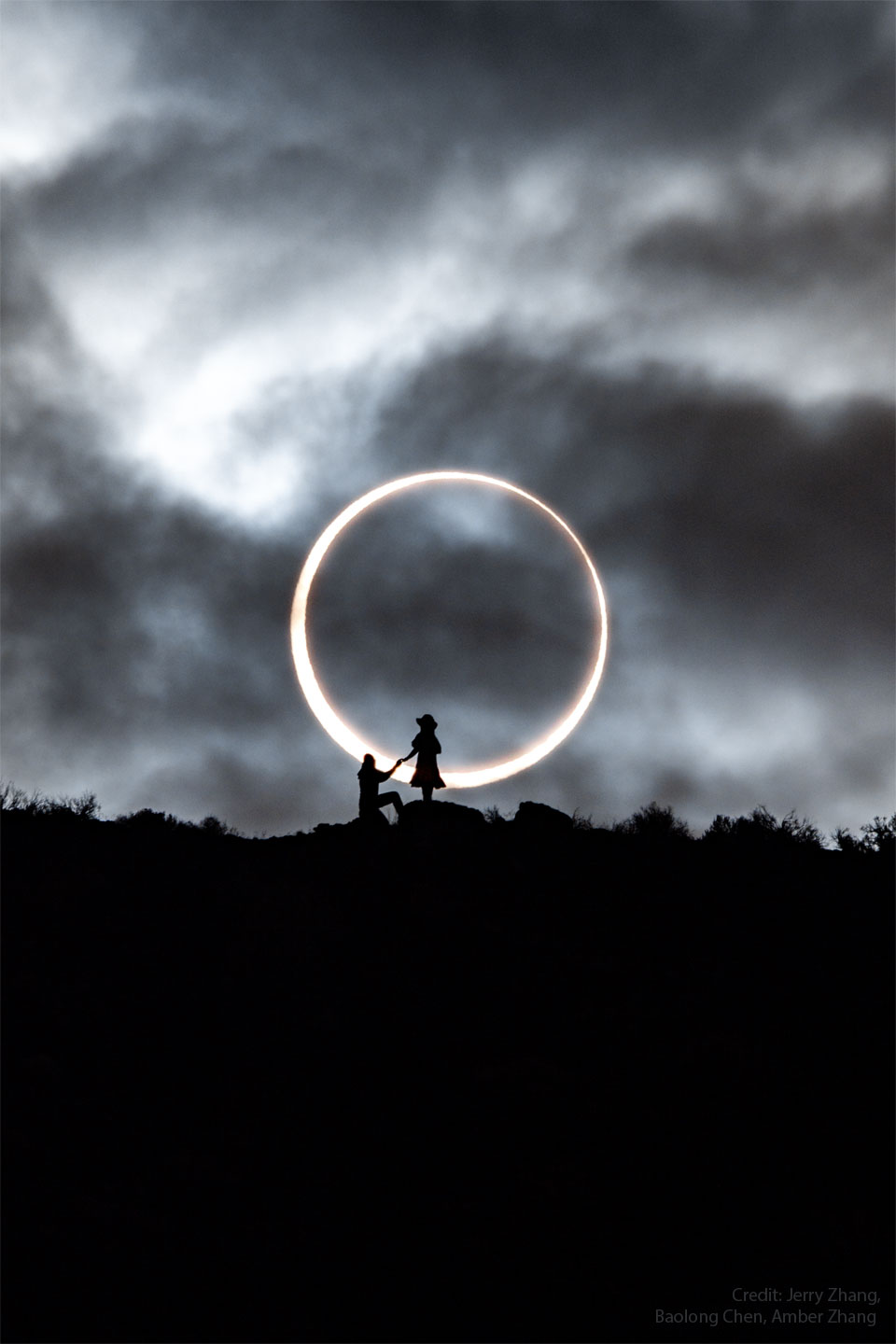
She knew everything but the question. She was well aware that there would be a complete annular eclipse of the Sun visible from their driving destination: Lake Abert in Oregon. She knew that the next ring-of-fire eclipse would occur in the USA only in 16 more years, making this a rare photographic opportunity. She was comfortable with the plan: that she and her boyfriend would appear in front of the eclipse in silhouette, sometimes alone, and sometimes together. She knew that the annular phase of this eclipse would last only a few minutes and she helped in the many hours of planning. She could see their friend who set up the camera about 400 meters away at the bottom of a ridge. What she didn’t know was the question she would be asked. But she did know the answer: «yes». [via NASA] https://ift.tt/u0KltRU

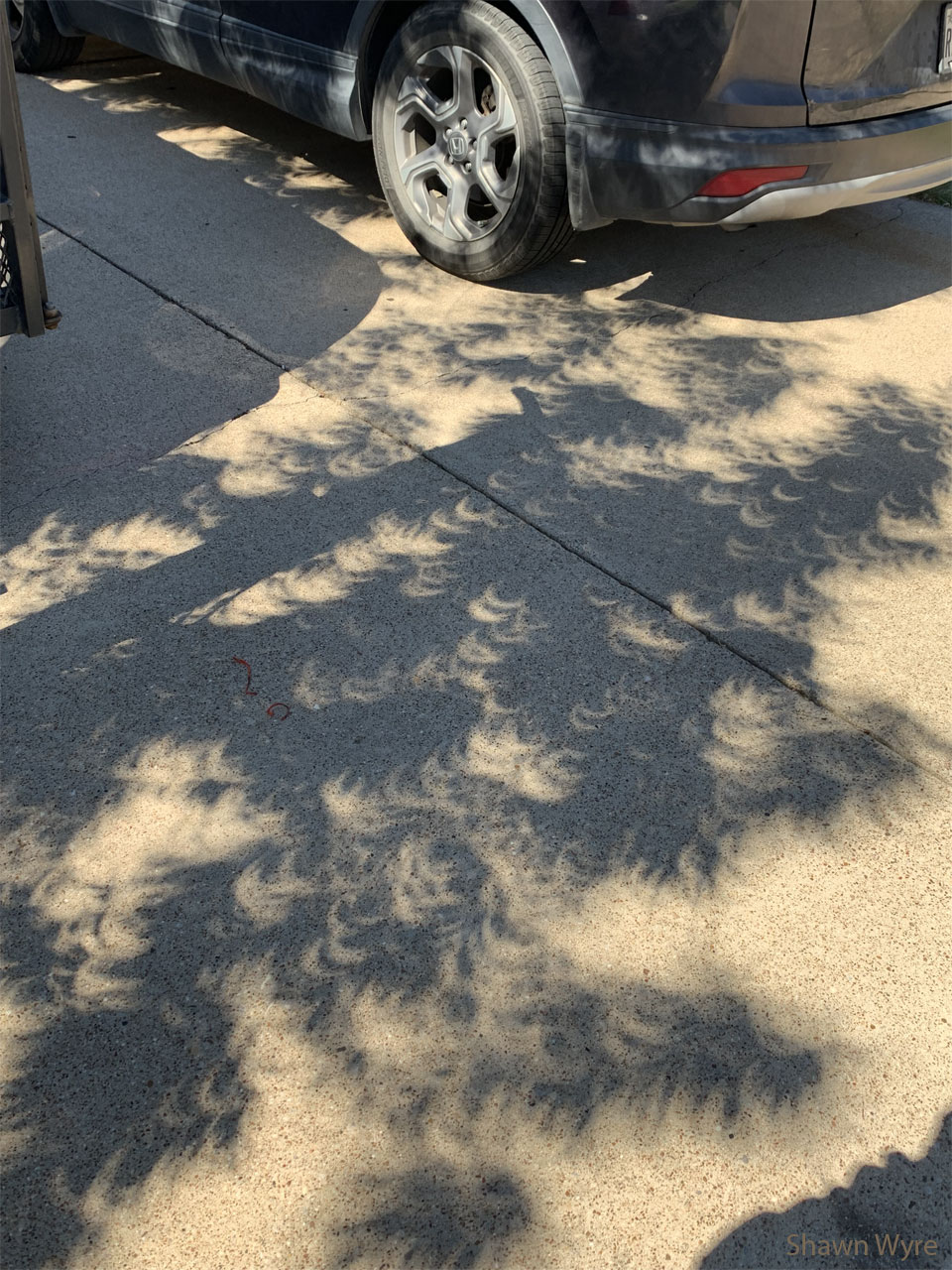
Yes, but can your tree do this? If you look closely at the ground in the featured image, you will see many images of yesterday’s solar eclipse — created by a tree. Gaps between tree leaves act like pinhole lenses and each create a small image of the partially eclipsed Sun visible in the other direction. The image was taken in Burleson, Texas, USA. Yesterday, people across the Americas were treated to a partial eclipse of the Sun, when the Moon moves in front of part of the Sun. People in a narrow band of Earth were treated to an annular eclipse, also called a ring-of-fire eclipse, when the Moon becomes completely engulfed by the Sun and sunlight streams around all of the Moon’s edges. In answer to the lede question, your tree not only can do this, but will do it every time that a visible solar eclipse passes overhead. Next April 8, a deeper, total solar eclipse will move across North America. [via NASA] https://ift.tt/ejidtSn

Circular Sun Halo

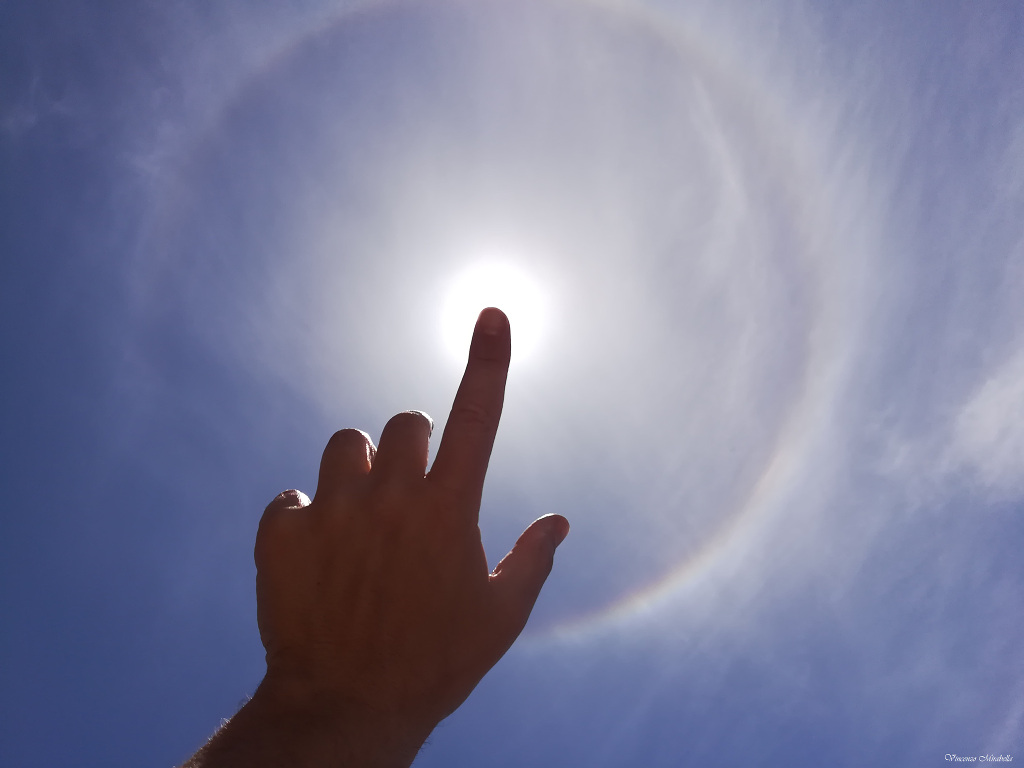
Want to see a ring around the Sun? It’s easy to do in daytime skies around the world. Created by randomly oriented ice crystals in thin high cirrus clouds, circular 22 degree halos are visible much more often than rainbows. This one was captured by smart phone photography on May 29, 2021 near Rome, Italy. Carefully blocking the Sun, for example with a finger tip, is usually all that it takes to reveal the common bright halo ring. The halo’s characteristic angular radius is about equal to the span of your hand, thumb to little finger, at the end of your outstretched arm. Want to see a ring of fire eclipse? That’s harder. The spectacular annular phase of today’s (October 14) solar eclipse, known as a ring of fire, is briefly visible only when standing along the Moon’s narrow shadow track that passes over limited parts of North, Central, and South America. The solar eclipse is partial though, when seen from broader regions throughout the Americas. [via NASA] https://ift.tt/Lctn7ms

Hydrogen Clouds of M33

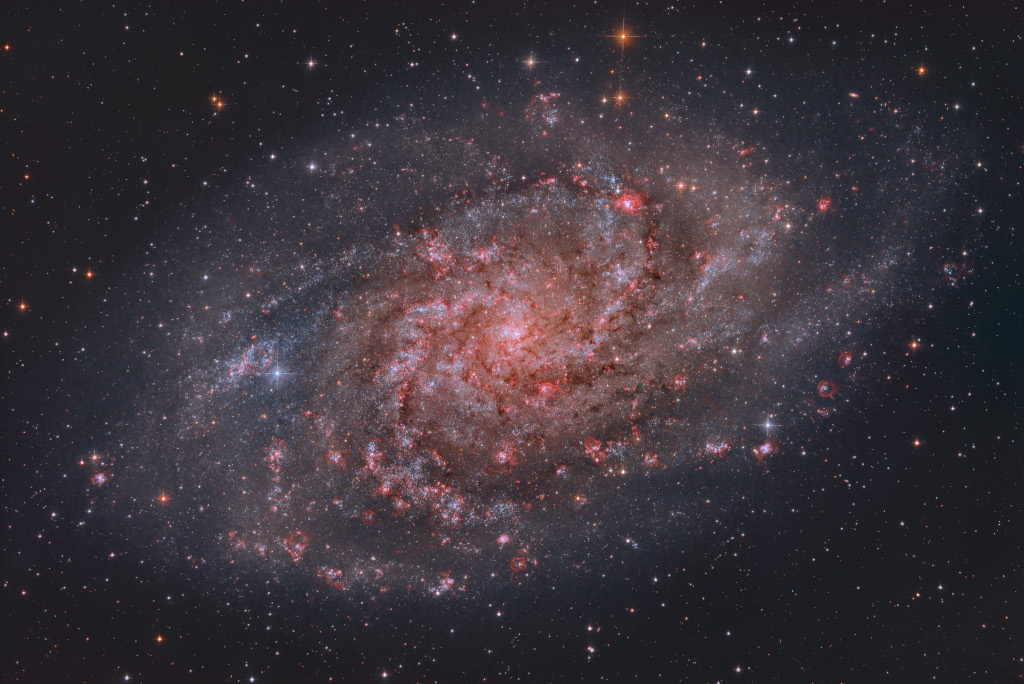
Gorgeous spiral galaxy Messier 33 seems to have more than its fair share of glowing hydrogen gas. A prominent member of the local group of galaxies, M33 is also known as the Triangulum Galaxy and lies a mere 3 million light-years away. The galaxy’s central 30,000 light-years or so are shown in this sharp galaxy portrait. The portrait features M33’s reddish ionized hydrogen clouds or HII regions. Sprawling along loose spiral arms that wind toward the core, M33’s giant HII regions are some of the largest known stellar nurseries, sites of the formation of short-lived but very massive stars. Intense ultraviolet radiation from the luminous, massive stars ionizes the surrounding hydrogen gas and ultimately produces the characteristic red glow. In this image, broadband data were combined with narrowband data recorded through a hydrogen-alpha filter. That filter transmits the light of the strongest visible hydrogen emission line. [via NASA] https://ift.tt/imqZOoF

Mu Cephei

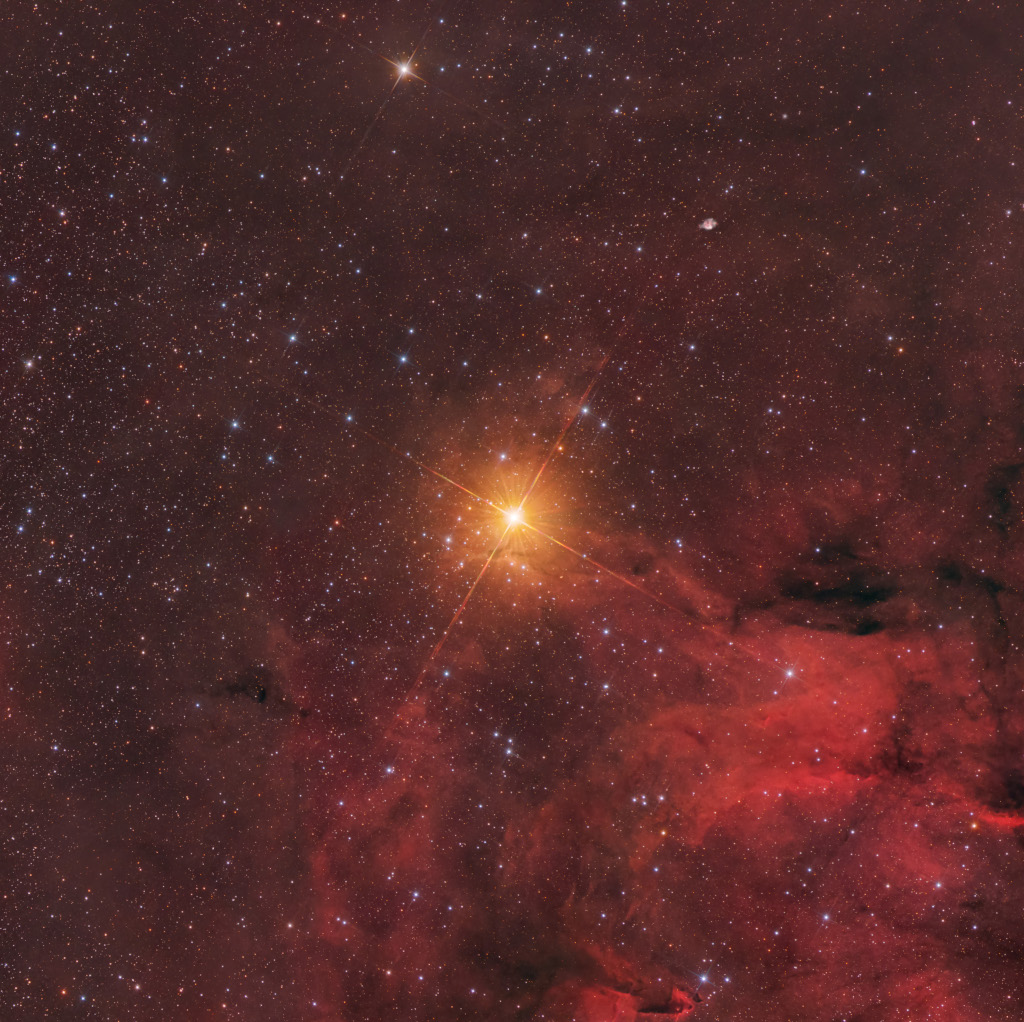
Mu Cephei is a very large star. An M-class supergiant some 1500 times the size of the Sun, it is one of the largest stars visible to the unaided eye, and even one of the largest in the entire Galaxy. If it replaced the Sun in our fair Solar System, Mu Cephei would easily engulf Mars and Jupiter. Historically known as Herschel’s Garnet Star, Mu Cephei is extremely red. Approximately 2800 light-years distant, the supergiant is seen near the edge of reddish emission nebula IC 1396 toward the royal northern constellation Cepheus in this telescopic view. Much cooler and hence redder than the Sun, this supergiant’s light is further reddened by absorption and scattering due to intervening dust within the Milky Way. A well-studied variable star understood to be in a late phase of stellar evolution, Mu Cephei is a massive star too, destined to ultimately explode as a core-collapse supernova. [via NASA] https://ift.tt/lu10BF4