Rigel and the Witch Head Nebula

By starlight, this eerie visage shines in the dark with a crooked profile evoking its popular name, the Witch Head Nebula. In fact, this entrancing telescopic portrait gives the impression that a witch has fixed her gaze on Orion’s bright supergiant star Rigel. More formally known as IC 2118, the Witch Head Nebula spans about 50 light-years and is composed of interstellar dust grains reflecting Rigel’s starlight. The color of the Witch Head Nebula is caused not only by Rigel’s intense blue light, but because the dust grains scatter blue light more efficiently than red. The same physical process causes Earth’s daytime sky to appear blue, although the scatterers in Earth’s atmosphere are molecules of nitrogen and oxygen. Rigel and this dusty cosmic crone are about 800 light-years away. You may still see a few witches in your neighborhood tonight though, so have a safe and Happy Halloween! [via NASA] https://ift.tt/qfXJ4sA

What created this huge space bubble? Blown by the wind from a star, this tantalizing, head-like apparition is cataloged as NGC 7635, but known simply as the Bubble Nebula. The featured striking view utilizes a long exposure to reveal the intricate details of this cosmic bubble and its environment. Although it looks delicate, the 10 light-year diameter bubble offers evidence of violent processes at work. Seen here above and right of the Bubble’s center, a bright hot star is embedded in the nebula’s reflecting dust. A fierce stellar wind and intense radiation from the star, which likely has a mass 10 to 20 times that of the Sun, has blasted out the structure of glowing gas against denser material in a surrounding molecular cloud. The intriguing Bubble Nebula lies a mere 11,000 light-years away toward the boastful constellation Cassiopeia. [via NASA] https://ift.tt/Yp3Wl9T

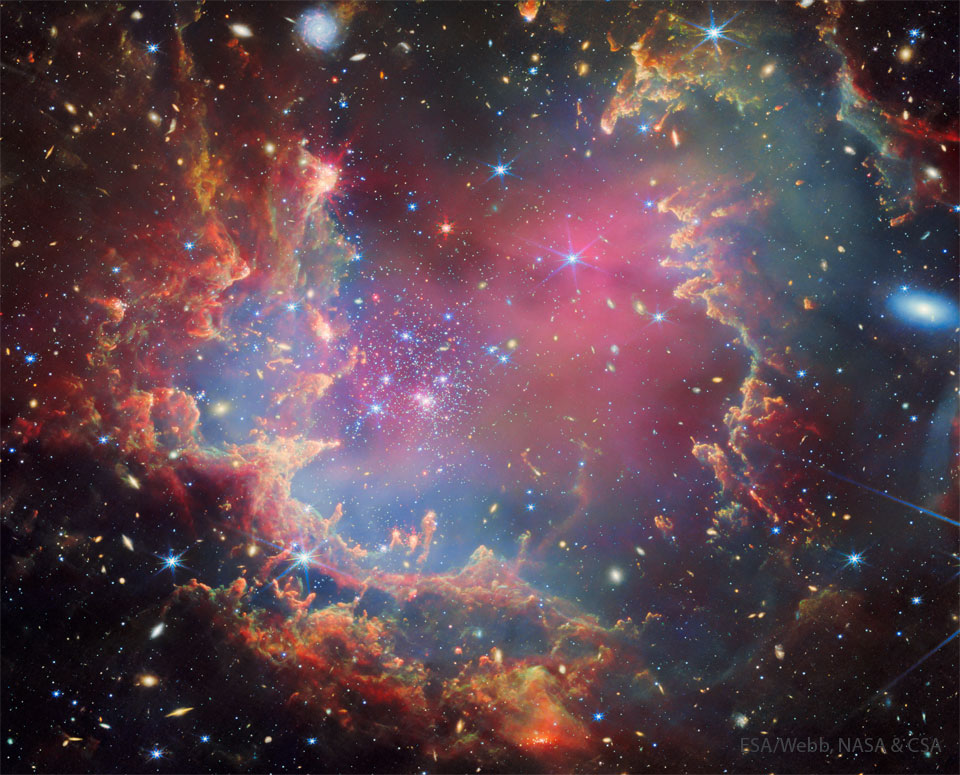
The stars are destroying the pillars. More specifically, some of the newly formed stars in the image center are emitting light so energetic that is evaporating the gas and dust in the surrounding pillars. Simultaneously, the pillars themselves are still trying to form new stars. The whole setting is the star cluster NGC 602, and this new vista was taken by the Webb Space Telescope in multiple infrared colors. In comparison, a roll-over image shows the same star cluster in visible light, taken previously by the Hubble Space Telescope. NGC 602 is located near the perimeter of the Small Magellanic Cloud (SMC), a small satellite galaxy of our Milky Way galaxy. At the estimated distance of the SMC, the featured picture spans about 200 light-years. A tantalizing assortment of background galaxies are also visible — mostly around the edges — that are at least hundreds of millions of light-years beyond. [via NASA] https://ift.tt/OAhr17e

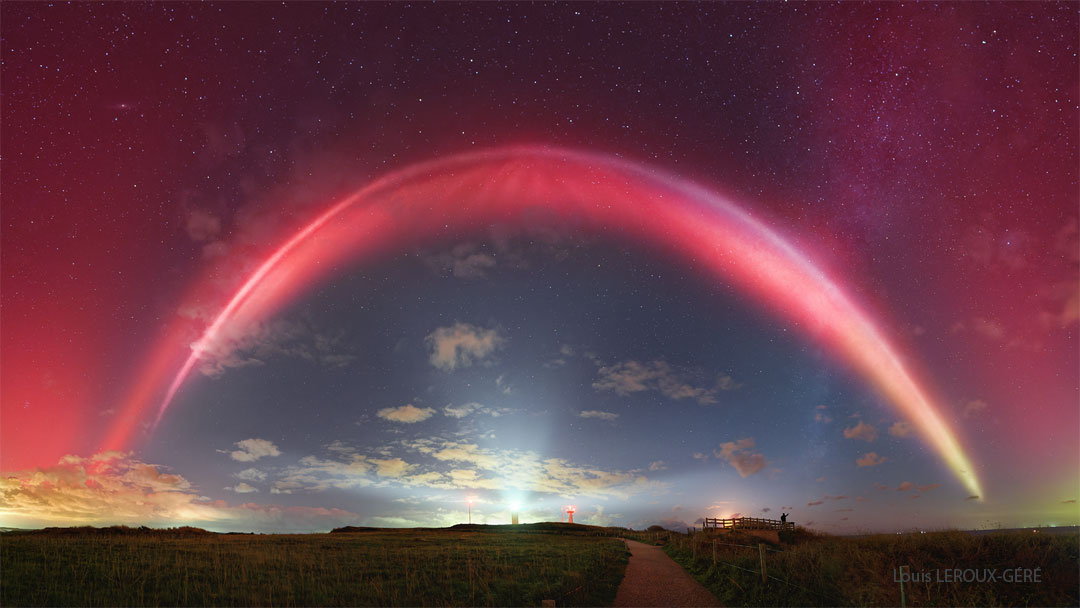
Sometimes a river of hot gas flows over your head. In this case the river created a Strong Thermal Emission Velocity Enhancement (STEVE) that glowed bright red, white, and pink. Details of how STEVEs work remain a topic of research, but recent evidence holds that their glow results from a fast-moving river of hot ions flowing over a hundred kilometers up in the Earth’s atmosphere: the ionosphere. The more expansive dull red glow might be related to the flowing STEVE, but alternatively might be a Stable Auroral Red (SAR) arc, a more general heat-related glow. The featured picture, taken earlier this month in Côte d’Opale, France, is a wide-angle digital composite made as the STEVE arc formed nearly overhead. Although the apparition lasted only a few minutes, this was long enough for the quick-thinking astrophotographer to get in the picture — can you find him? [via NASA] https://ift.tt/ytImu9L

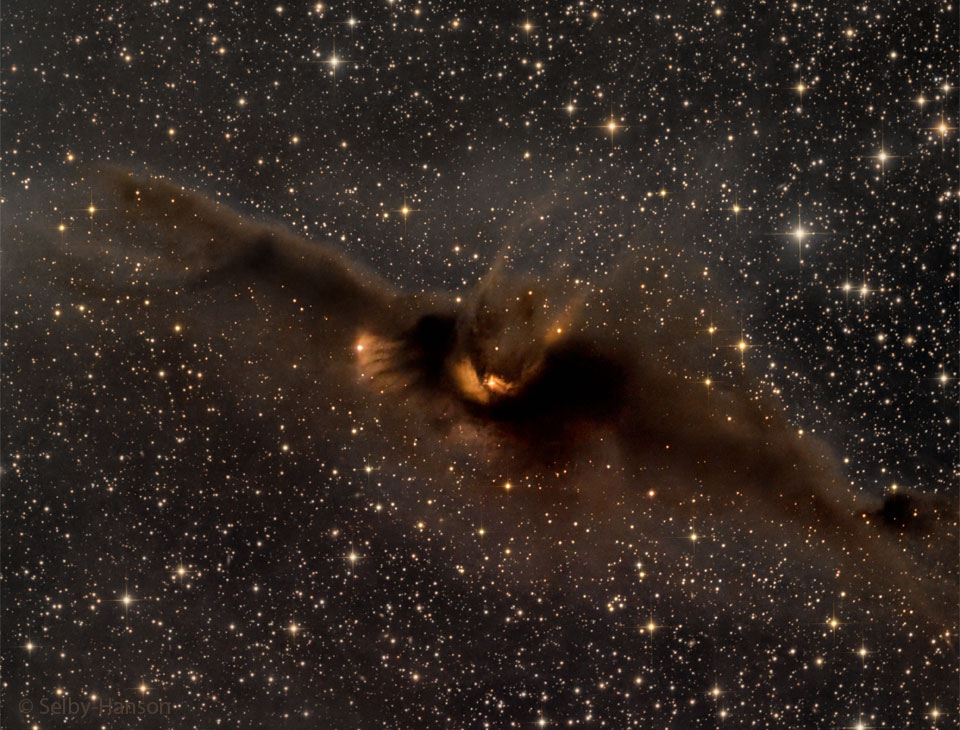
What is the most spook-tacular nebula in the galaxy? One contender is LDN 43, which bears an astonishing resemblance to a vast cosmic batflying amongst the stars on a dark Halloween night. Located about 1400 light years away in the constellation Ophiuchus, this molecular cloud is dense enough to block light not only from background stars, but from wisps of gas lit up by the nearby reflection nebulaLBN 7. Far from being a harbinger of death, this 12-light year-long filament of gas and dust is actually a stellar nursery. Glowing with eerie light, the bat is lit up from inside by dense gaseous knots that have just formed young stars. [via NASA] https://ift.tt/KRXdy7l

Phantoms in Cassiopeia

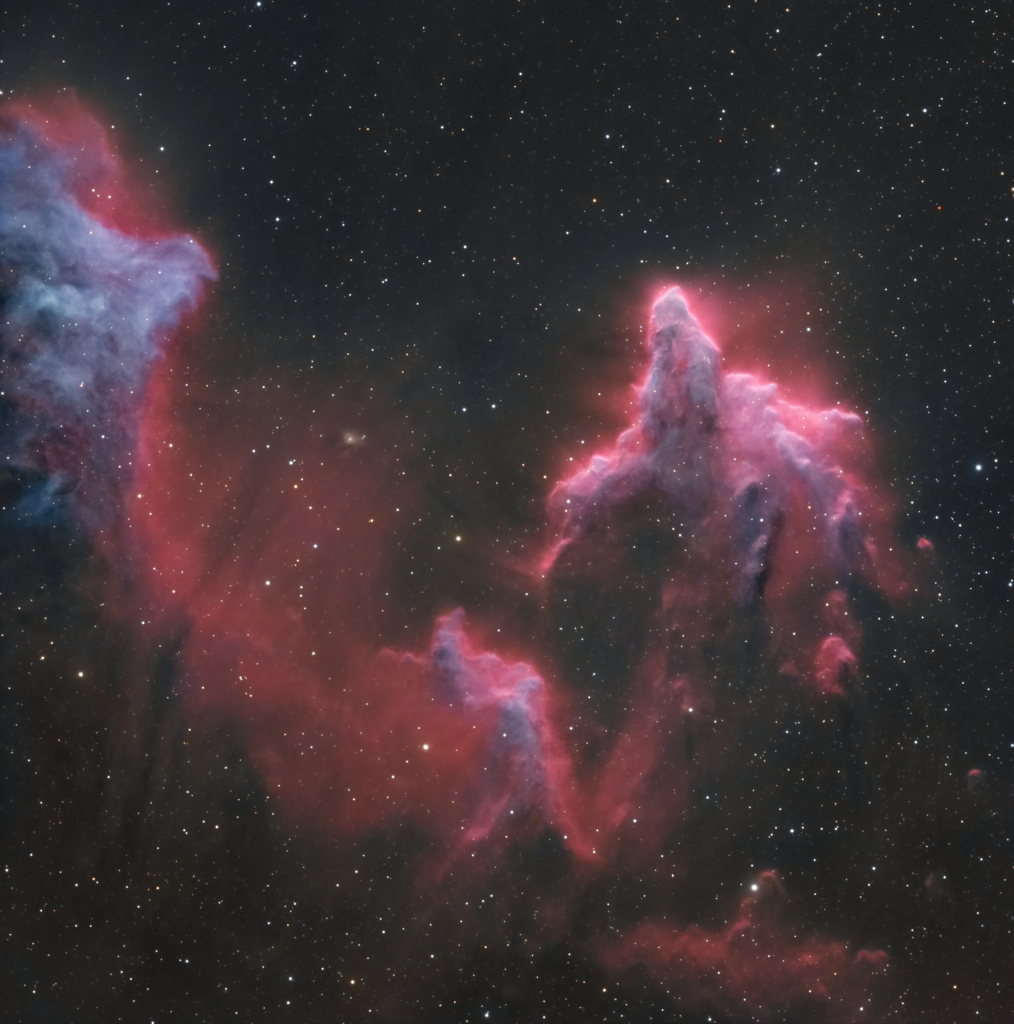
These brightly outlined flowing shapes look ghostly on a cosmic scale. A telescopic view toward the constellation Cassiopeia, the colorful skyscape features the swept-back, comet-shaped clouds IC 59 (left) and IC 63. About 600 light-years distant, the clouds aren’t actually ghosts. They are slowly disappearing though, under the influence of energetic radiation from hot, luminous star gamma Cas. Gamma Cas is physically located only 3 to 4 light-years from the nebulae and lies just above the right edge of the frame. Slightly closer to gamma Cas, IC 63 is dominated by red H-alpha light emitted as hydrogen atoms ionized by the hot star’s ultraviolet radiation recombine with electrons. Farther from the star, IC 59 shows less H-alpha emission but more of the characteristic blue tint of dust reflected star light. The field of view spans over 1 degree or 10 light-years at the estimated distance of the interstellar apparitions. [via NASA] https://ift.tt/cuyIvaH

Globular Star Cluster NGC 6752

Some 13,000 light-years away toward the southern constellation Pavo, the globular star cluster NGC 6752 roams the halo of our Milky Way galaxy. Over 10 billion years old, NGC 6752 follows clusters Omega Centauri, 47 Tucanae, and Messier 22 as the fourth brightest globular in planet Earth’s night sky. It holds over 100 thousand stars in a sphere about 100 light-years in diameter. Telescopic explorations of NGC 6752 have found that a remarkable fraction of the stars near the cluster’s core, are multiple star systems. They also reveal the presence of blue straggle stars, stars which appear to be too young and massive to exist in a cluster whose stars are all expected to be at least twice as old as the Sun. The blue stragglers are thought to be formed by star mergers and collisions in the dense stellar environment at the cluster’s core. This sharp color composite also features the cluster’s ancient red giant stars in yellowish hues. (Note: The bright, spiky blue star about 8 o’clock from the cluster center is a foreground star along the line-of-sight to NGC 6752) [via NASA] https://ift.tt/QpxEAgy

NGC 7293: The Helix Nebula

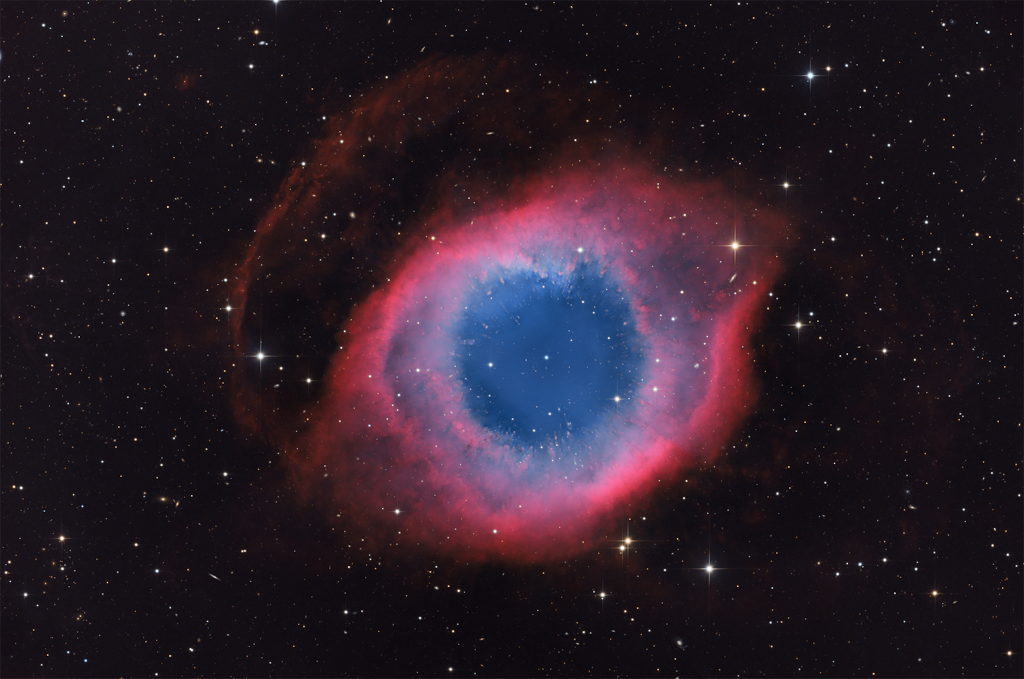
A mere seven hundred light years from Earth toward the constellation Aquarius, a star is dying. The once sun-like star’s last few thousand years have produced the Helix Nebula. Also known as NGC 7293, the cosmic Helix is a well studied and nearby example of a Planetary Nebula, typical of this final phase of stellar evolution. Combining narrow band data from emission lines of hydrogen atoms in red and oxygen atoms in blue-green hues, this deep image shows tantalizing details of the Helix, including its bright inner region about 3 light-years across. The white dot at the Helix’s center is this Planetary Nebula’s hot, dying central star. A simple looking nebula at first glance, the Helix is now understood to have a surprisingly complex geometry. [via NASA] https://ift.tt/fewL8d3

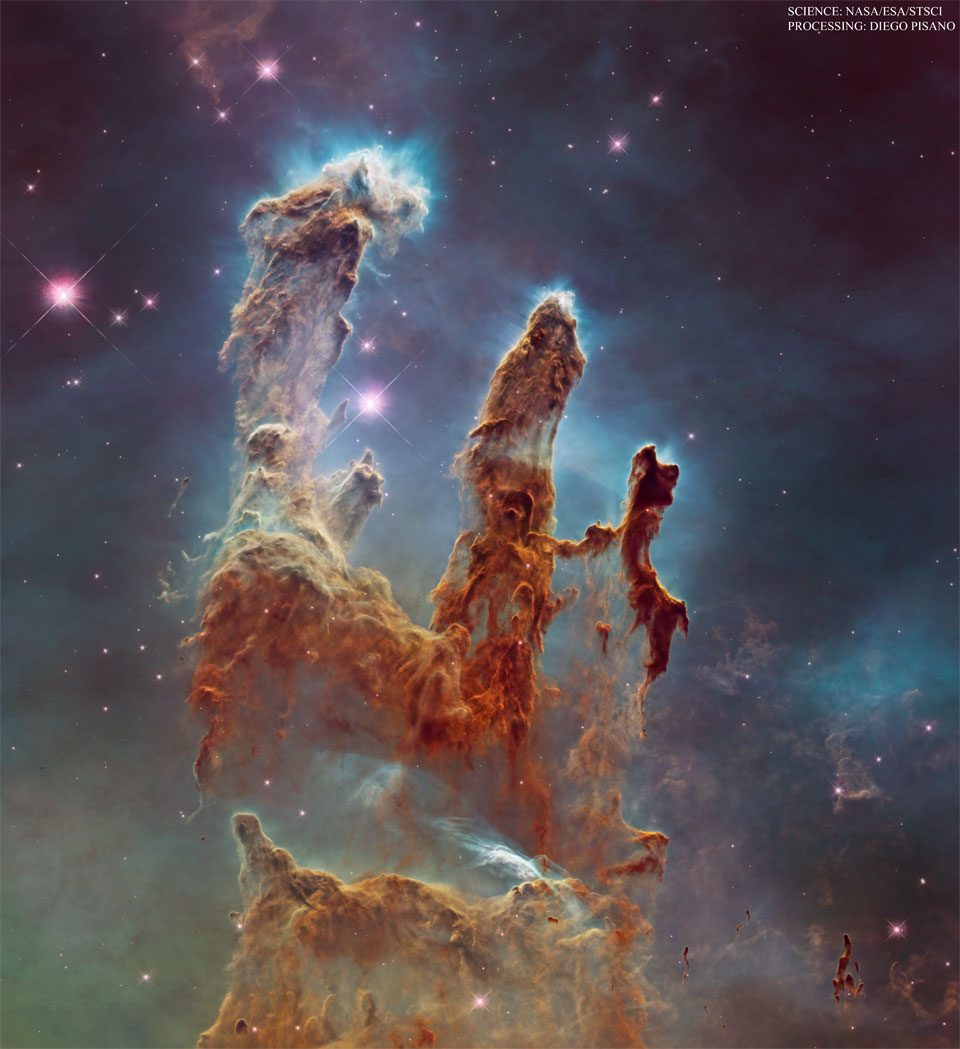
These dark pillars may look destructive, but they are creating stars. This pillar-capturing picture of the Eagle Nebula combines visible light exposures taken with the Hubble Space Telescope with infrared images taken with the James Webb Space Telescope to highlight evaporating gaseous globules (EGGs) emerging from pillars of molecular hydrogen gas and dust. The giant pillars are light years in length and are so dense that interior gas contracts gravitationally to form stars. At each pillar’s end, the intense radiation of bright young stars causes low density material to boil away, leaving stellar nurseries of dense EGGs exposed. The Eagle Nebula, associated with the open star clusterM16, lies about 7000 light years away. [via NASA] https://ift.tt/K2bfuCP

The tails of Comet Tsuchinshan-ATLAS were a sight to behold. Pictured, C/2023 A3 (Tsuchinshan–ATLAS) was captured near peak impressiveness last week over the Eastern Sierra Mountains in California, USA. The comet not only showed a bright tail, but a distinct anti-tail pointing in nearly the opposite direction. The globular star cluster M5 can be seen on the right, far in the distance. As it approached, it was unclear if this crumbling iceberg would disintegrate completely as it warmed in the bright sunlight. In reality, the comet survived to become brighter than any star in the night (magnitude -4.9), but unfortunately was then so nearly in front of the Sun that it was hard for many casual observers to locate. Whether Comet Tsuchinshan-Atlas becomes known as the Great Comet of 2024 now depends, in part, on how impressive incoming comet C/2024 S1 (ATLAS) becomes over the next two weeks. [via NASA] https://ift.tt/TWV2zUn