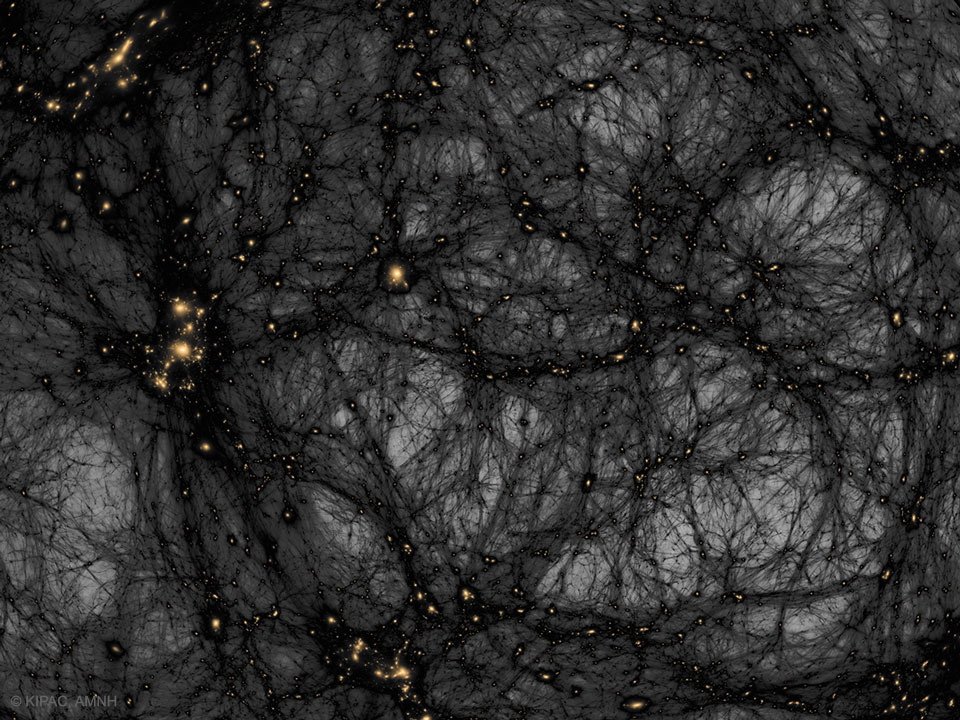
Is our universe haunted? It might look that way on this dark matter map. The gravity of unseen dark matter is the leading explanation for why galaxies rotate so fast, why galaxies orbit clusters so fast, why gravitational lenses so strongly deflect light, and why visible matter is distributed as it is both in the local universe and on the cosmicmicrowave background. The featured image from the American Museum of Natural History’s Hayden Planetarium Space Show Dark Universe highlights one example of how pervasive dark matter might haunt our universe. In this frame from a detailed computer simulation, complex filaments of dark matter, shown in black, are strewn about the universe like spider webs, while the relatively rare clumps of familiar baryonic matter are colored orange. These simulations are good statistical matches to astronomical observations. In what is perhaps a scarier turn of events, dark matter — although quite strange and in an unknown form — is no longer thought to be the strangest source of gravity in the universe. That honor now falls to dark energy, a more uniform source of repulsive gravity that seems to now dominate the expansion of the entire universe. [via NASA] https://ift.tt/1Q3u45z
Comet Tsuchinshan ATLAS Flys Away

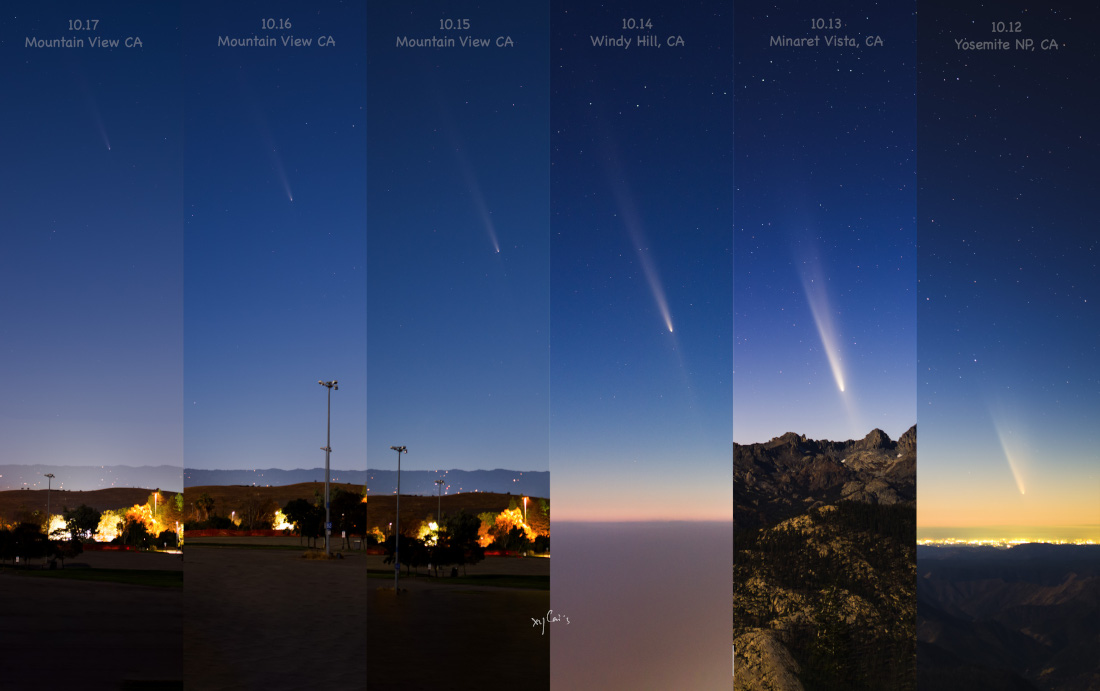
These six panels follow daily apparitions of comet C/2023 A3 Tsuchinshan-ATLAS as it moved away from our fair planet during the past week. The images were taken with the same camera and lens at the indicated dates and locations from California, planet Earth. At far right on October 12 the visitor from the distant Oort cloud was near its closest approach, some 70 million kilometers (about 4 light-minutes) away. Its bright coma and long dust tail were close on the sky to the setting Sun but still easy to spot against a bright western horizon. Over the following days, the outbound comet steadily climbs above the ecliptic and north into the darker western evening sky, but begins to fade from view. Crossing the Earth’s orbital plane around October 14, Tsuchinshan-ATLAS exhibits a noticeable antitail extended toward the western horizon. Higher in the evening sky at sunset by October 17 (far left) the comet has faded and reached a distance of around 77 million kilometers from planet Earth. Hopefully you enjoyed some of Tsuchinshan-ATLAS’s bid to become the best comet of 2024. This comet’s initial orbital period estimates were a mere 80,000 years, but in fact it may never return to the inner Solar System. [via NASA] https://ift.tt/B3DZH8L

Most of Comet Tsuchinshan ATLAS

On October 14 it was hard to capture a full view of Comet C/2023 A3 Tsuchinshan-ATLAS. Taken after the comet’s closest approach to our fair planet, this evening skyview almost does though. With two telephoto frames combined, the image stretches about 26 degrees across the sky from top to bottom, looking west from Gates Pass, Tucson, Arizona. Comet watchers that night could even identify globular star cluster M5 and the faint apparition of periodic comet 13P Olbers near the long the path of Tsuchinshan-ATLAS’s whitish dust tail above the bright comet’s coma. Due to perspective as the Earth is crossing the comet’s orbital plane, Tsuchinshan-ATLAS also has a pronounced antitail. The antitail is composed of dust previously released and fanning out away from the Sun along the comet’s orbit, visible as a needle-like extension below the bright coma toward the rugged western horizon. [via NASA] https://ift.tt/ZR3P0Mz

The Clipper and the Comet

NASA’s Europa Clipper is now headed toward an ocean world beyond Earth. The large spacecraft is tucked into the payload fairing atop the Falcon Heavy rocket in this photo, taken at Kennedy Space Center the day before the mission’s successful October 14 launch. Europa Clipper’s interplanetary voyage will first take it to Mars, then back to Earth, and then on to Jupiter on gravity assist trajectories that will allow it to enter orbit around Jupiter in April 2030. Once orbiting Jupiter, the spacecraft will fly past Europa 49 times, exploring a Jovian moon with a global subsurface ocean that may have conditions to support life. Posing in the background next to the floodlit rocket is Comet Tsuchinsan-ATLAS, about a day after the comet’s closest approach to Earth. A current darling of evening skies, the naked-eye comet is a vistor from the distant Oort cloud [via NASA] https://ift.tt/cmJC4ra

Sometimes the night sky is full of surprises. Take the sky over Lindis Pass, South Island, New Zealand one-night last week. Instead of a typically calm night sky filled with constant stars, a busy and dynamic night sky appeared. Suddenly visible were pervasive red aurora, green picket-fence aurora, a red SAR arc, a STEVE, a meteor, and the Moon. These outshone the center of our Milky Way Galaxy and both of its two satellite galaxies: the LMC and SMC. All of these were captured together on 28 exposures in five minutes, from which this panorama was composed. Auroras lit up many skies last week, as a Coronal Mass Ejection from the Sun unleashed a burst of particles toward our Earth that created colorful skies over latitudes usually too far from the Earth’s poles to see them. More generally, night skies this month have other surprises, showing not only auroras — but comets. [via NASA] https://ift.tt/tmpaRky

How bright and strange will the tails of Comet Tsuchinshan-ATLAS become? The comet has brightened dramatically over the few weeks as it passed its closest to the Sun and, just three days ago, passed its closest to the Earth. C/2023 A3 (Tsuchinshan–ATLAS) became of the brightest comets of the past century over the past few days, but was unfortunately hard to see because it was so nearly superposed on the Sun. As the comet appears to move away from the Sun, it is becoming a remarkable sight — but may soon begin to fade. The featured animated video shows how the comet’s tails have developed, as viewed from Earth, and gives one prediction about how they might further develop. As shown in the video, heavier parts of the dust tail that trails the comet have begun to appear to point in nearly the opposite direction from lighter parts of the dust tail as well as the comet’s ion tail, the blue tail that is pushed directly out from the Sun by the solar wind. [via NASA] https://ift.tt/XUD3jzu

Go outside at sunset tonight and see a comet! C/2023 A3 (Tsuchinshan–ATLAS) has become visible in the early evening sky in northern locations to the unaided eye. To see the comet, look west through a sky with a low horizon. If the sky is clear and dark enough, you will not even need binoculars — the faint tail of the comet should be visible just above the horizon for about an hour. Pictured, Comet Tsuchinshan-ATLAS was captured two nights ago over the Lincoln Memorial monument in Washington, DC, USA. With each passing day at sunset, the comet and its changing tail should be higher and higher in the sky, although exactly how bright and how long its tails will be can only be guessed. [via NASA] https://ift.tt/r4JgtGD

Did you see last night’s aurora? This question was relevant around much of the world a few days ago because a powerful auroral storm became visible unusually far from the Earth’s poles. The cause was a giant X-class solar flare on Tuesday that launched energetic electrons and protons into the Solar System, connecting to the Earth via our planet’s magnetic field. A red glow of these particles striking oxygen atoms high in Earth’s atmosphere pervades the frame, while vertical streaks dance. The featured video shows a one-hour timelapse as seen from Cortina d’Ampezzo over Alps Mountain peaks in northern Italy. Stars from our Milky Way Galaxy dot the background while streaks from airplanes and satellites punctuate the foreground. The high recent activity of our Sun is likely to continue to produce picturesque auroras over Earth during the next year or so. [via NASA] https://ift.tt/lVk0Qbv

Northern Lights, West Virginia

A gravel country lane gently winds through this colorful rural night skyscape. Captured from Monroe County in southern West Virginia on the evening of October 10, the starry sky above is a familiar sight. Shimmering curtains of aurora borealis or northern lights definitely do not make regular appearances here, though. Surprisingly vivid auroral displays were present on that night at very low latitudes around the globe, far from their usual northern and southern high latitude realms. The extensive auroral activity was evidence of a severe geomagnetic storm triggered by the impact of a coronal mass ejection (CME), an immense magnetized cloud of energetic plasma. The CME was launched toward Earth from the active Sun following a powerful X-class solar flare. [via NASA] https://ift.tt/bDvRFoc

Ring of Fire over Easter Island

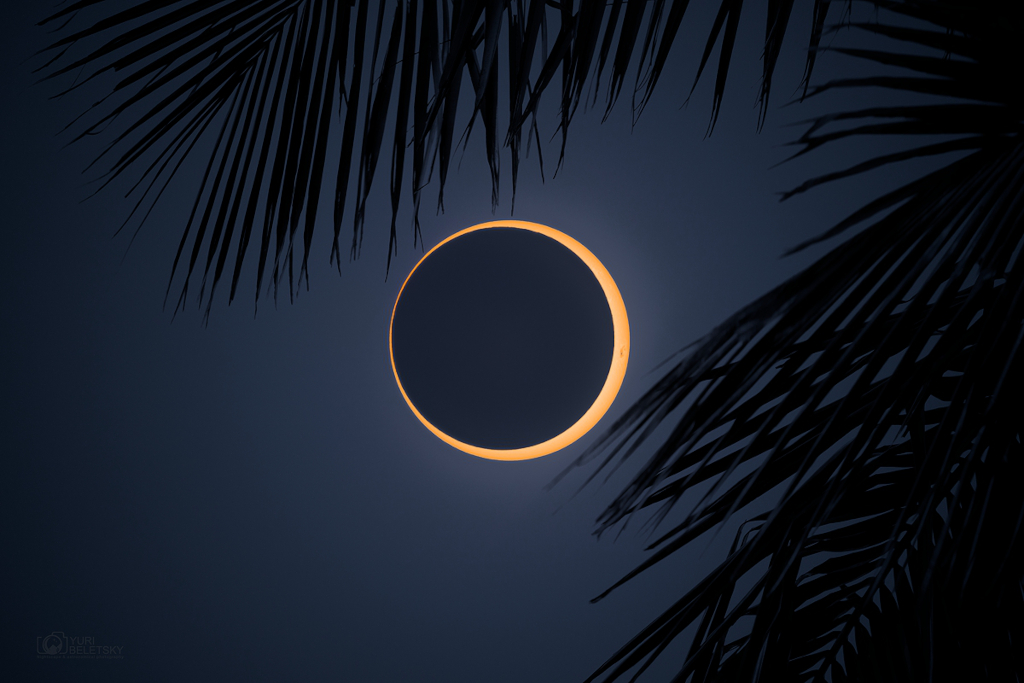
The second solar eclipse of 2024 began in the Pacific. On October 2nd the Moon’s shadow swept from west to east, with an annular eclipse visible along a narrow antumbral shadow path tracking mostly over ocean, making its only major landfall near the southern tip of South America, and then ending in the southern Atlantic. The dramatic total annular eclipse phase is known to some as a ring of fire. Also tracking across islands in the southern Pacific, the Moon’s antumbral shadow grazed Easter Island allowing denizens to follow all phases of the annular eclipse. Framed by palm tree leaves this clear island view is a stack of two images, one taken with and one taken without a solar filter near the moment of the maximum annular phase. The New Moon’s silhouette appears just off center, though still engulfed by the bright disk of the active Sun. [via NASA] https://ift.tt/GQStcUL