Five Bright Comets from SOHO

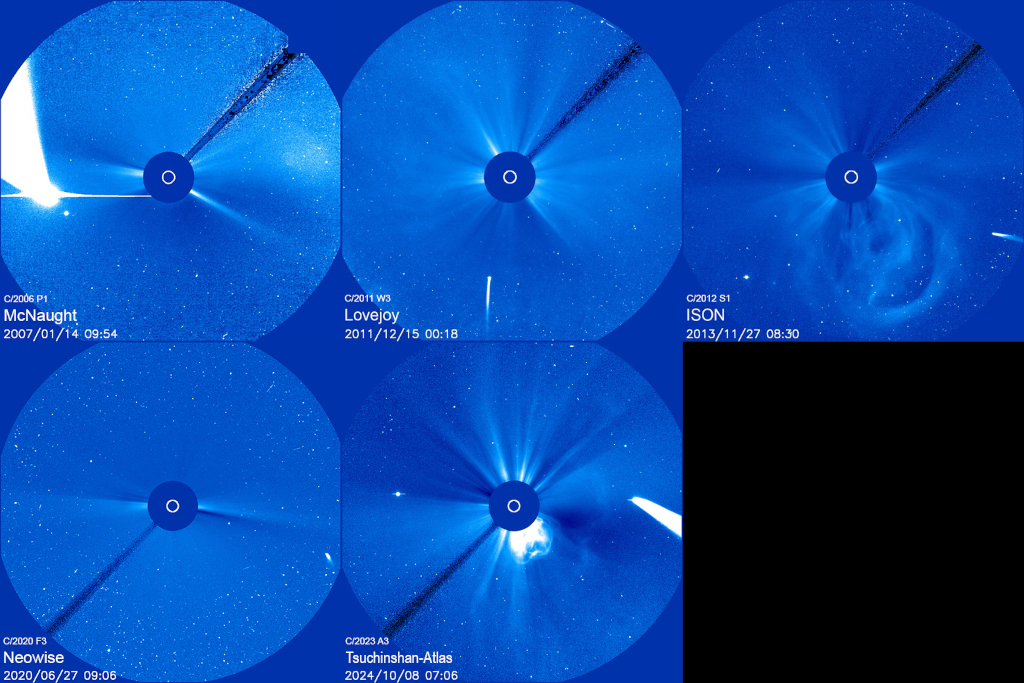
Five bright comets are compared in these panels, recorded by a coronograph on board the long-lived, sun-staring SOHO spacecraft. Arranged chronologically all are recognizable by their tailsstreamingaway from the Sun at the center of each field of view, where a direct view of the overwhelmingly bright Sun is blocked by the coronagraph’s occulting disk. Each comet was memorable for earthbound skygazers, starting at top left with Comet McNaught, the 21st century’s brightest comet (so far). C/2023 A3 Tsuchinshan-Atlas, approaching its perihelion with the active Sun at bottom center, has most recently grabbed the attention of comet watchers around the globe. By the end of October 2024, the blank 6th panel may be filled with bright sungrazer comet C/2024 S1 Atlas. … or not. [via NASA] https://ift.tt/cZ5nok8
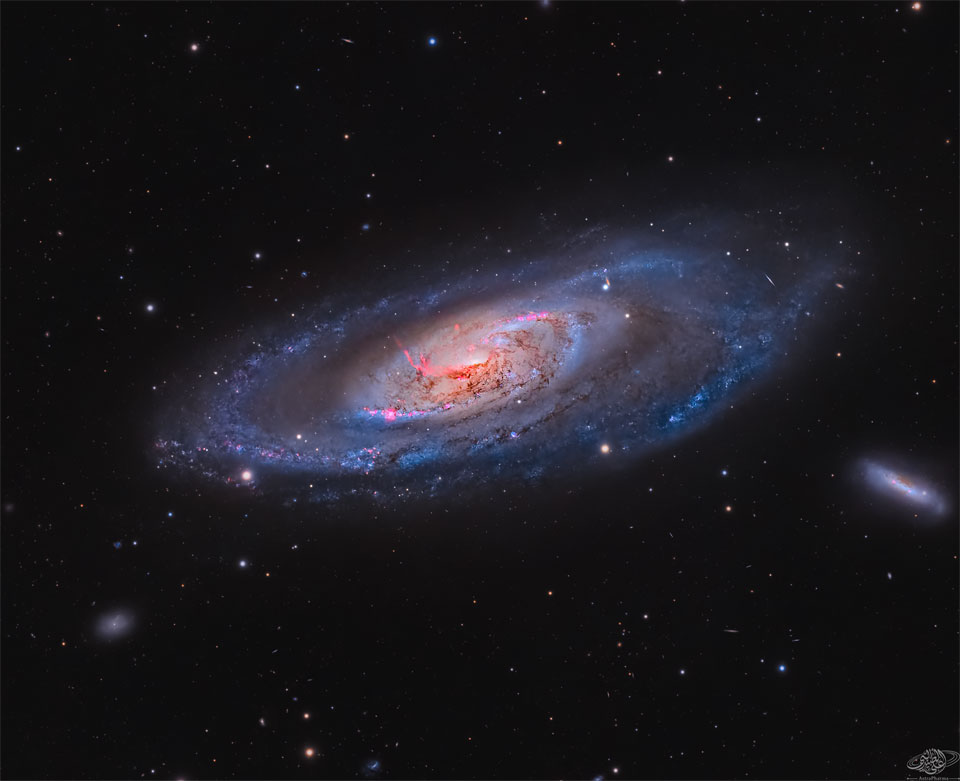

What’s happening at the center of spiral galaxy M106? A swirling disk of stars and gas, M106’s appearance is dominated by blue spiral arms and red dust lanes near the nucleus, as shown in the featured image taken from the Kuwaiti desert. The core of M106 glows brightly in radio waves and X-rays where twin jets have been found running the length of the galaxy. An unusual central glow makes M106 one of the closest examples of the Seyfert class of galaxies, where vast amounts of glowing gas are thought to be falling into a central massive black hole. M106, also designated NGC 4258, is a relatively close 23.5 million light years away, spans 60 thousand light years across, and can be seen with a small telescope towards the constellation of the Hunting Dogs (Canes Venatici). [via NASA] https://ift.tt/PzTp6ZR

Can you find the Sun? OK, but can you explain why there’s a big dark spot in the center? The spot is the Moon, and the impressive alignment shown, where the Moon lines up inside the Sun, is called an annular solar eclipse. Such an eclipse occurred just last week and was visible from a thin swath mostly in Earth’s southern hemisphere. The featured image was captured from Patagonia, Chile. When the Moon is significantly closer to the Earth and it aligns with the Sun, a total solar eclipse is then visible from parts of the Earth. Annular eclipses are slightly more common than total eclipses, but as the Moon moves slowly away from the Earth, before a billion more years, the Moon’s orbit will no longer bring it close enough for a total solar eclipse to be seen from anywhere on Earth. [via NASA] https://ift.tt/l9k2HLE

A bright comet is moving into the evening skies. C/2023 A3 (Tsuchinshan–ATLAS) has brightened and even though it is now easily visible to the unaided eye, it is so near to the Sun that it is still difficult to see. Pictured, Comet Tsuchinshan–ATLAS was captured just before sunrise from an Andes Mountain in Peru. Braving cold weather, this unusually high perch gave the astrophotographer such a low eastern horizon that the comet was obvious in the pre-dawn sky. Visible in the featured image is not only an impressively long dust tail extending over many degrees, but an impressively long and blue ion tail, too.  This month, as the comet moves out from the Sun and passes the Earth, evening observers should be able to see the huge dirty ice ball toward the west just after sunset. [via NASA] https://ift.tt/GiMuWNI

Comet McNaught, the Great Comet of 2007, grew a spectacularly long and filamentary tail. The magnificent tail spread across the sky and was visible for several days to Southern Hemisphere observers just after sunset. The amazing ion tail showed its greatest extent on long-duration, wide-angle camera exposures. During some times, just the tail itself was visible just above the horizon for many northern observers as well. Comet C/2006 P1 (McNaught), estimated to have attained a peak brightness of magnitude -5 (minus five), was caught by the comet’s discoverer in the featured image just after sunset in January 2007 from Siding Spring Observatory in Australia. Comet McNaught, the brightest comet in decades, then faded as it moved further into southern skies and away from the Sun and Earth. Over the next month, Comet Tsuchinshan–ATLAS, a candidate for the Great Comet of 2024, should display its most spectacular tails visible from the Earth. [via NASA] https://ift.tt/lXOwems

M27: Not a Comet

While hunting for comets in the skies above 18th century France, astronomer Charles Messier diligently kept a list of the things encountered during his telescopic expeditions that were definitely not comets. This is number 27 on his now famous not-a-comet list. In fact, 21st century astronomers would identify it as a planetary nebula, but it’s not a planet either, even though it may appear round and planet-like in a small telescope. Messier 27 (M27) is an excellent example of a gaseous emission nebula created as a sun-like star runs out of nuclear fuel in its core. The nebula forms as the star’s outer layers are expelled into space, with a visible glow generated by atoms excited by the dying star’s intense but invisible ultraviolet light. Known by the popular name of the Dumbbell Nebula, the beautifully symmetric interstellar gas cloud is over 2.5 light-years across and about 1,200 light-years away in the constellation Vulpecula. This impressive color image highlights details within the well-studied central region and fainter, seldom imaged features in the nebula’s outer halo. [via NASA] https://ift.tt/EnHOK8I

Comet at Moonrise

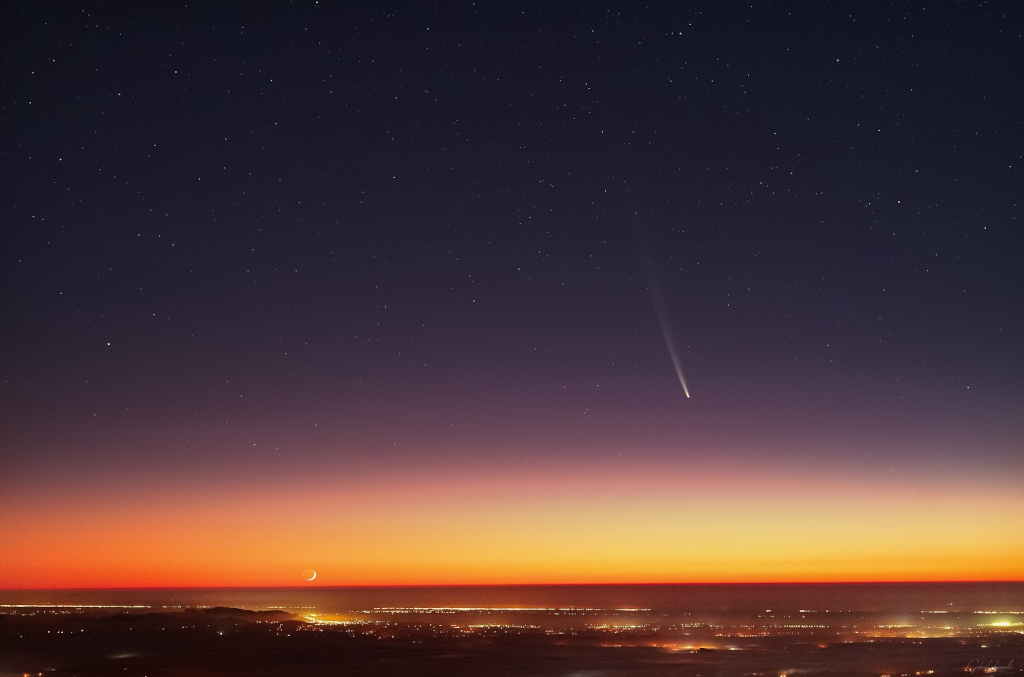
Comet C/2023 A3 (Tsuchinshan–ATLAS) is growing brighter in planet Earth’s sky. Fondly known as comet A3, this new visitor to the inner Solar System is traveling from the distant Oort cloud. The comet reached perihelion, its closest approach to the Sun, on September 27 and will reach perigee, its closest to our fair planet, on October 12, by then becoming an evening sky apparition. But comet A3 was an early morning riser on September 30 when this image was made. Its bright coma and already long tail share a pre-dawn skyscape from Praia Grande, Santa Catarina in southern Brazil with the waning crescent Moon just peeking above the eastern horizon. While the behaviour of comets is notoriously unpredictable, Tsuchinshan–ATLAS could become a comet visually rivaling C/2020 F3 (NEOWISE). Comet NEOWISE wowed skygazers in the summer of 2020. [via NASA] https://ift.tt/L5YlBip

Eclipse at Sunrise

The second solar eclipse of 2024 began in the Pacific. On October 2nd the Moon’s shadow swept from west to east, with an annular eclipse visible along a narrow antumbral shadow path tracking mostly over ocean, crossing land near the southern tip of South America, and ending in the southern Atlantic. The dramatic total annular eclipse phase is known to some as a ring of fire. Still, a partial eclipse of the Sun was experienced over a wide region. Captured at one of its earliest moments, October’s eclipsed Sun is seen just above the clouds near sunrise in this snapshot. The partially eclipsed solar disk is close to the maximum eclipse as seen from Mauna Kea Observatory Visitor Center, Island of Hawaii, planet Earth. [via NASA] https://ift.tt/XAPqF3C

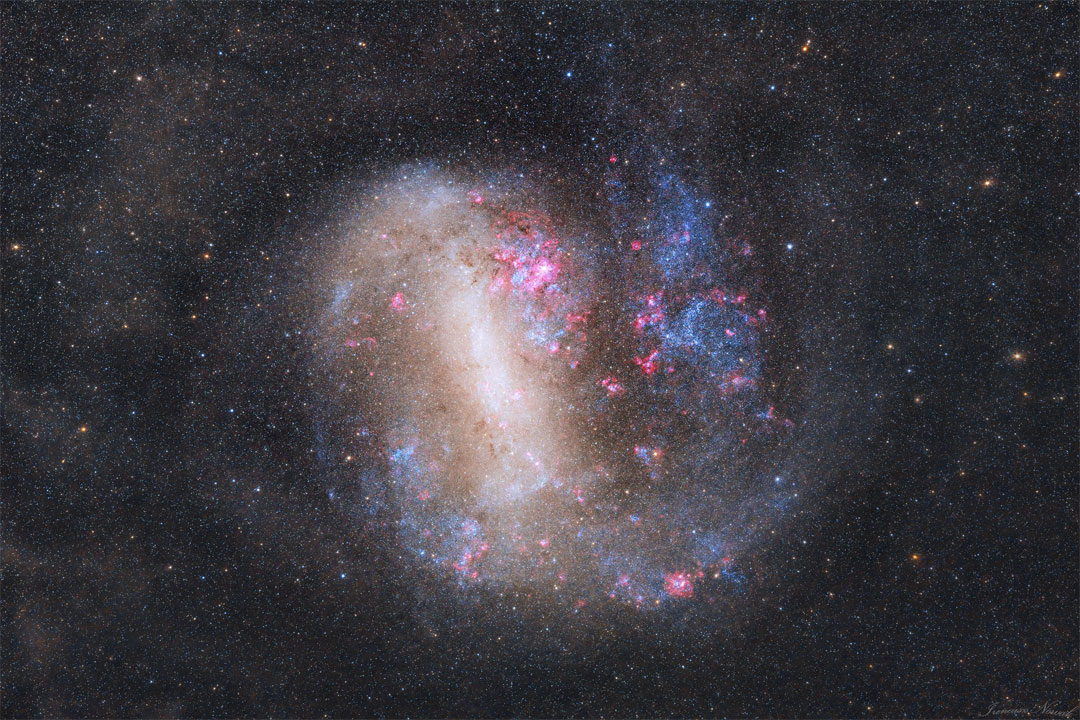
It is the largest satellite galaxy of our home Milky Way Galaxy. If you live in the south, the Large Magellanic Cloud (LMC) is quite noticeable, spanning about 10 degrees across the night sky, which is 20 times larger than the full moon towards the southern constellation of the dolphinfish (Dorado). Being only about 160,000 light years away, many details of the LMC’s structure can be seen, such as its central bar and its single spiral arm. The LMC harbors numerous stellar nurseries where new stars are being born, which appear in pink in the featured image. It is home to the Tarantula Nebula, the currently most active star forming region in the entire Local Group, a small collection of nearby galaxies dominated by the massive Andromeda and Milky Way galaxies. Studies of the LMC and the Small Magellanic Cloud (SMC) by Henrietta Swan Leavitt led to the discovery of the period-luminosity relationship of Cepheid variable stars that are used to measure distances across the nearby universe. [via NASA] https://ift.tt/beBhvom

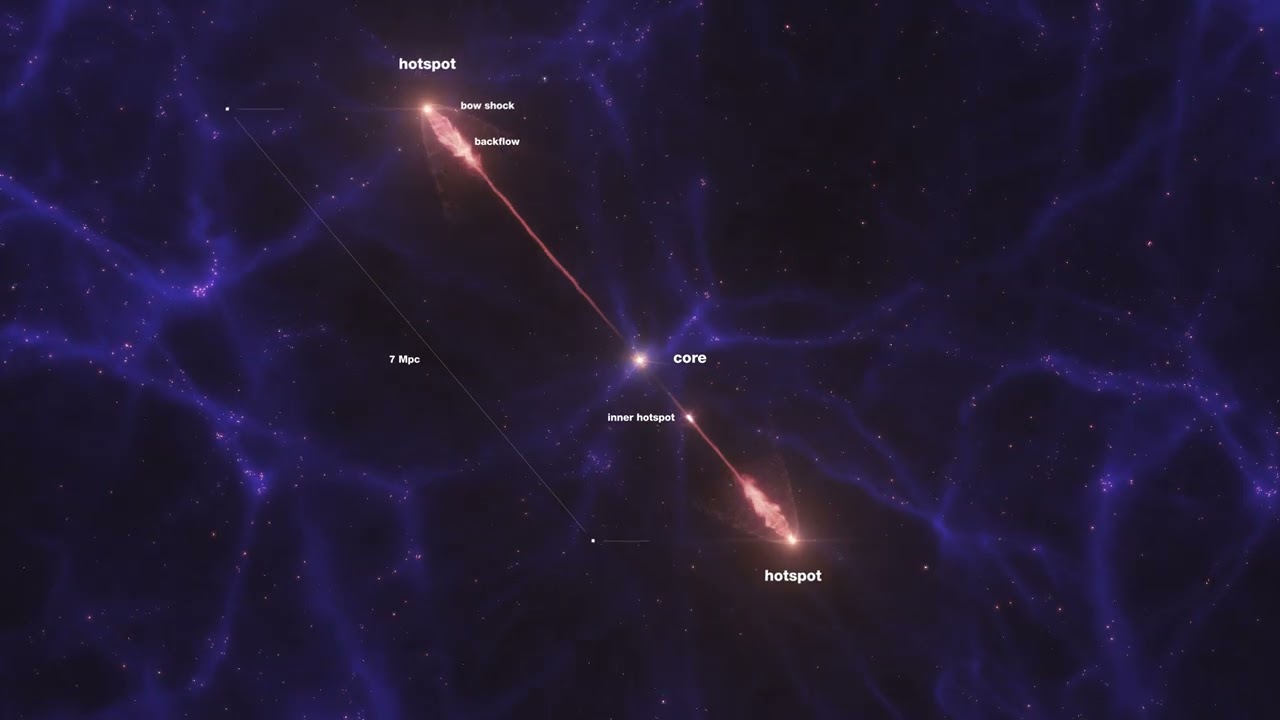
How far can black hole jets extend? A new record was found just recently with the discovery of a 23-million light-year long jet pair from a black hole active billions of years ago. Dubbed Porphyrion for a mythological Greek giant, the impressive jets were created by a type of black hole that does not usually create long jets — one that is busy creating radiation from infalling gas. The featured animated video depicts what it might look like to circle around this powerful black hole system. Porphyrion is shown as a fast stream of energetic particles, and the bright areas are where these particles are impacting surrounding gas. The discovery was made using data from the Keck and Mayall (DESI) optical observatories as well as LOFAR and the Giant Metrewave Radio Telescope. The existence of these jets demonstrates that black holes can affect not only their home galaxies but far out into the surrounding universe. [via NASA] https://ift.tt/BjVvdQx