The Variable Nebula NGC 2261

The interstellar cloud of dust and gas captured in this sharp telescopic snapshot is seen to change its appearance noticeably over periods as short as a few weeks. Discovered over 200 years ago and cataloged as NGC 2261, bright star R Monocerotis lies at the tip of the fan-shaped nebula. About one light-year across and 2500 light-years away, NGC 2261 was studied early last century by astronomer Edwin Hubble and the mysterious cosmic cloud is now more famous as Hubble’s Variable Nebula. So what makes Hubble’s nebula vary? NGC 2261 is composed of a dusty reflection nebula fanning out from the star R Monocerotis. The leading variability explanation holds that dense knots of obscuring dust pass close to R Mon and cast moving shadows across the dust clouds in the rest of Hubble’s Variable Nebula. [via NASA] https://ift.tt/AYZIv87

Hydrogen Clouds of M33

Gorgeous spiral galaxy Messier 33 seems to have more than its fair share of glowing hydrogen gas. A prominent member of the local group of galaxies, M33 is also known as the Triangulum Galaxy and lies a mere 3 million light-years away. The galaxy’s central 60,000 light-years or so are shown in this sharp galaxy portrait. The portrait features M33’s reddish ionized hydrogen clouds or HII regions. Sprawling along loose spiral arms that wind toward the core, M33’s giant HII regions are some of the largest known stellar nurseries, sites of the formation of short-lived but very massive stars. Intense ultraviolet radiation from the luminous, massive stars ionizes the surrounding hydrogen gas and ultimately produces the characteristic red glow. In this image, broadband data were combined with narrowband data recorded through a filter that transmits the light of the strongest visible hydrogen and oxygen emission lines. [via NASA] https://ift.tt/zBdcSrI

What are those strange rings? Rich in dust, the rings are likely 3D shells — but how they were created remains a topic of research. Where they were created is well known: in a binary star system that lies about 6,000 light years away toward the constellation of the Swan (Cygnus) — a system dominated by the Wolf-Rayet star WR 140. Wolf-Rayet stars are massive, bright, and known for their tumultuous winds. They are also known for creating and dispersing heavy elements such as carbon, which is a building block of interstellar dust. The other star in the binary is also bright and massive — but not as active. The two great starsjoust in an oblong orbit as they approach each other about every eight years. When at closest approach, the X-rayemission from the system increases, as, apparently, does the dust expelled into space — creating another shell. The featuredinfraredimage by the Webb Space Telescope resolves greater details and more dust shells than ever before. Images taken over consecutive years show the shells moving outward. [via NASA] https://ift.tt/7fE1emS

Comets can be huge. When far from the Sun, a comet’s size usually refers to its hard nucleus of ice and rock, which typically spans a few kilometers — smaller than even a small moon. When nearing the Sun, however, this nucleus can eject dust and gas and leave a thin tail that can spread to an enormous length — even greater than the distance between the Earth and the Sun. Pictured, C/2024 G3 (ATLAS) sports a tail of sunlight-reflecting dust and glowing gas that spans several times the apparent size of a full moon, appearing even larger on long duration camera images than to the unaided eye. The featured image shows impressive Comet ATLAS over trees and a grass field in Sierras de Mahoma, San Jose, Uruguay about a week ago. After being prominent in the sunset skies of Earth’s southern hemisphere, Comet G3 ATLAS is now fading as it moves away from the Sun, making its impressive tails increasingly hard to see. [via NASA] https://ift.tt/TwukLy7

Stars come in bunches. The most famous bunch of stars on the sky is the Pleiades, a bright cluster that can be easily seen with the unaided eye. The Pleiades lies only about 450 light years away, formed about 100 million years ago, and will likely last about another 250 million years. Our Sun was likely born in a star cluster, but now, being about 4.5 billion years old, its stellar birth companions have long since dispersed. The Pleiades star cluster is pictured over Half Dome, a famous rock structure in Yosemite National Park in California, USA. The featured image is a composite of 28 foreground exposures and 174 images of the stellar background, all taken from the same location and by the same camera on the same night in October 2019. After calculating the timing of a future juxtaposition of the Pleiades and Half Dome, the astrophotographer was unexpectedly rewarded by an electrical blackout, making the background sky unusually dark. [via NASA] https://ift.tt/h7BW4f6

Why does this comet have so many tails? C/2024 G3 (ATLAS) has developed several long and intricate tails visible from Earth’s southern hemisphere over the past two weeks. Many observers reported seeing the impressive comet without any optical aid above the western horizon just after sunset. At least six different tails appear in the featured image captured five days ago from the dark skies above Paranal Observatory in Chile. One possible cause for the multiple tails is dust and gas being expelled from the comet’s rotating nucleus. The outward push of the Sun’s complex solar wind may also play a role. The huge iceberg-like nucleus of CometATLAS appears to have broken up near its closest approach to the Sun two weeks ago. Unfortunately, Comet ATLAS and its tails are expected to fade significantly over the coming weeks. [via NASA] https://ift.tt/TJBqCox

Stardust in the Perseus Molecular Cloud

Clouds of stardust drift through this deep skyscape, across the Perseus molecular cloud some 850 light-years away. Dusty nebulae reflecting light from embedded young stars stand out in the nearly 4 degree wide field of view. With a characteristic bluish color reflection nebula NGC 1333 is prominent near center. Hints of contrasting red emission from Herbig-Haro objects, the jets and shocked glowing gas emanating from recently formed stars, are scattered across the dusty expanse. While many stars are forming in the molecular cloud, most are obscured at visible wavelengths by the pervasive dust. The chaotic environment surrounding NGC 1333 may be similar to one in which our own Sun formed over 4.5 billion years ago. At the estimated distance of the Perseus molecular cloud, this cosmic scene would span about 80 light-years. [via NASA] https://ift.tt/bcJl1kZ

Comet G3 ATLAS: a Tail and a Telescope

Comet C/2024 G3 ATLAS has made a dramatic appearance in planet Earth’s skies. A visitor from the distant Oort Cloud, the comet reached its perihelion on January 13. On January 19, the bright comet was captured here from ESO Paranal Observatory in the Atacama desert in Chile. Sporting spectacular sweeping dust tails, this comet ATLAS is setting in the southern hemisphere twilight and was clearly visible to the unaided eye. In the foreground is the closed shell of one of the observatory’s famous auxiliary telescopes. Still wowing southern hemisphere observers, the comet’s bright coma has become diffuse, its icy nucleus apparently disintegrating following its close approach to the Sun. [via NASA] https://ift.tt/NCeAJO1

NGC 7814: Little Sombrero

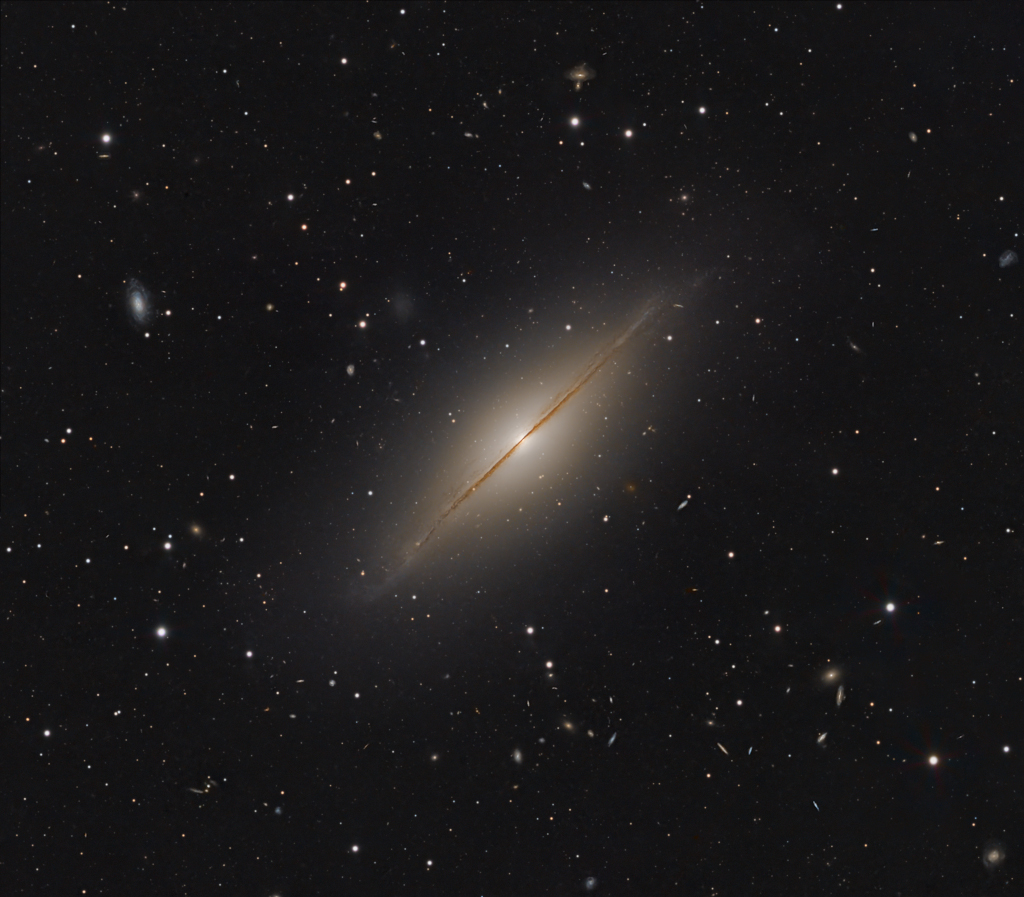
Point your telescope toward the high flying constellation Pegasus and you can find this cosmic expanse of Milky Way stars and distant galaxies. NGC 7814 is centered in the sharp field of view that would almost be covered by a full moon. NGC 7814 is sometimes called the Little Sombrero for its resemblance to the brighter more famous M104, the Sombrero Galaxy. Both Sombrero and Little Sombrero are spiral galaxies seen edge-on, and both have extensive halos and central bulges cut by a thin disk with thinner dust lanes in silhouette. In fact, NGC 7814 is some 40 million light-years away and an estimated 60,000 light-years across. That actually makes the Little Sombrero about the same physical size as its better known namesake, appearing smaller and fainter only because it is farther away. [via NASA] https://ift.tt/ho9qr0s

The North America nebula on the sky can do what the North America continent on Earth cannot — form stars. Specifically, in analogy to the Earth-confined continent, the bright part that appears as the east coast is actually a hot bed of gas, dust, and newly formed stars known as the Cygnus Wall. The featured image shows the star forming wall lit and eroded by bright young stars and partly hidden by the dark dust they have created. The part of the North America nebula (NGC 7000) shown spans about 50 light years and lies about 1,500 light years away toward the constellation of the Swan (Cygnus). [via NASA] https://ift.tt/8SbcjXm