An Evening Sky Full of Planets

Only Mercury is missing from a Solar System parade of planets in this early evening skyscape. Rising nearly opposite the Sun, bright Mars is at the far left. The other naked-eye planets Jupiter, Saturn, and Venus, can also be spotted, with the the position of too-faint Uranus and Neptune marked near the arcing trace of the ecliptic plane. On the far right and close to the western horizon after sunset is a young crescent Moon whose surface is partly illuminated by earthshine. In the foreground of the composite panorama captured on 2 January, planet Earth is represented by Mount Etna’s lower Silvestri Crater. Of course Earth’s early evening skies are full of planets for the entire month of January. On 13 January, a nearly Full Moon will appear to pass in front of Mars for skywatchers in the continental U.S. and Eastern Canada. [via NASA] https://ift.tt/wIM6Hvr

Young Stars, Dark Nebulae

An unassuming region in the constellation Taurus holds these dark and dusty nebulae. Scattered through the scene, stars in multiple star systems are forming within their natal Taurus molecular cloud complex some 450 light-years away. Millions of years young and still going through stellar adolescence, the stars are variable in brightness and in the late phases of their gravitational collapse. Known as T-Tauri class stars they tend to be faint and take on a yellowish hue in the image. One of the brightest T-Tauri stars in Taurus, V773 (aka HD283447) is near the center of the telescopic frame that spans over 1 degree. Toward the top is the dense, dark marking on the sky cataloged as Barnard 209. [via NASA] https://ift.tt/Usj21pi

Peculiar Galaxies of Arp 273

The colorful, spiky stars are in the foreground of this image taken with a small telescope on planet Earth. They lie well within our own Milky Way Galaxy. But the two eye-catching galaxies in the frame lie far beyond the Milky Way, at a distance of over 300 million light-years. The galaxies’ twisted and distorted appearance is due to mutual gravitational tides as the pair engage in close encounters. Cataloged as Arp 273 (also as UGC 1810), these galaxies do look peculiar, but interacting galaxies are now understood to be common in the universe. Closer to home, the large spiral Andromeda Galaxy is known to be some 2 million light-years away and inexorably approaching the Milky Way. In fact the far away peculiar galaxies of Arp 273 may offer an analog of the far future encounter of Andromeda and Milky Way. Repeated galaxy encounters on a cosmic timescale ultimately result in a merger into a single galaxy of stars. From our perspective, the bright cores of the Arp 273 galaxies are separated by only a little over 100,000 light-years. [via NASA] https://ift.tt/xNKEJY0

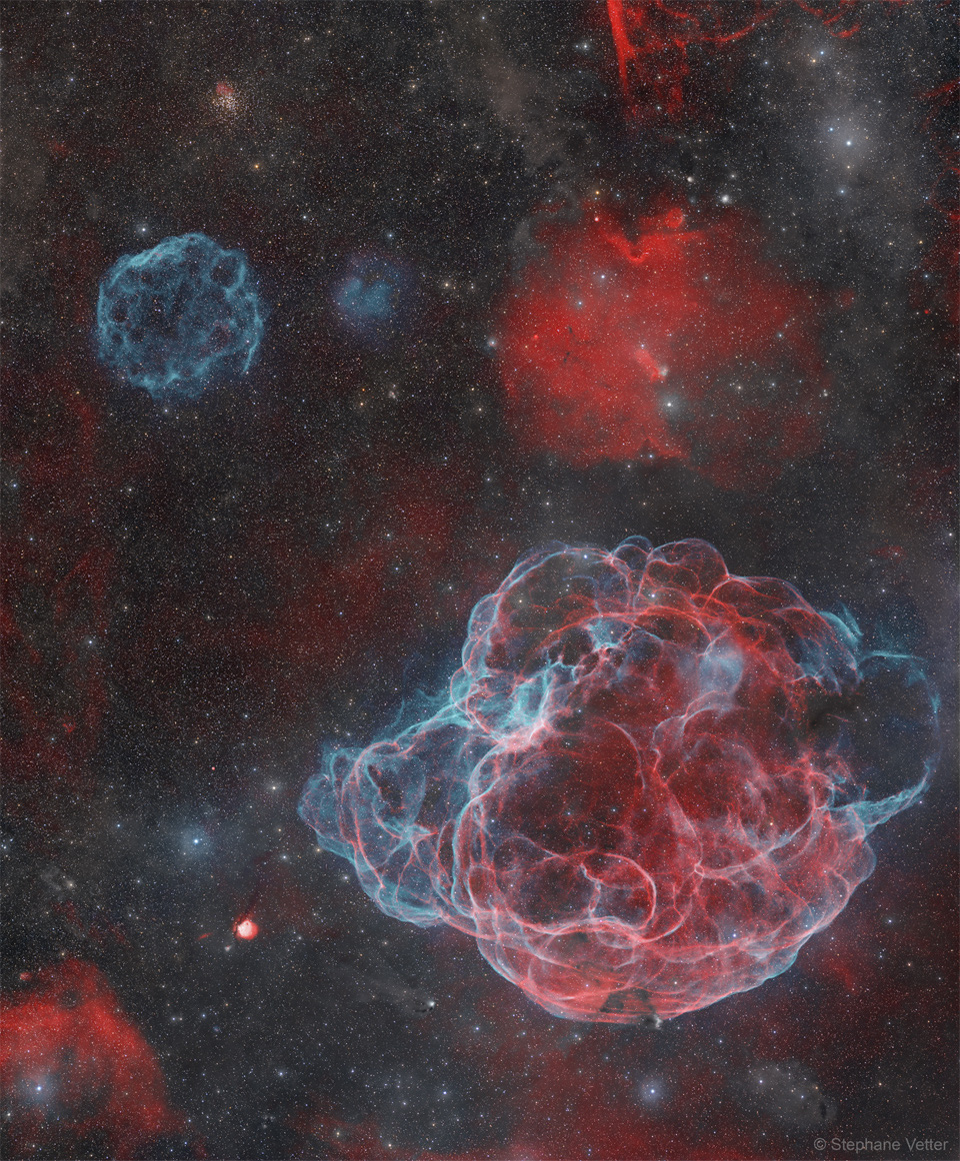
What happens after a star explodes? A huge fireball of hot gas shoots out in all directions. When this gas slams into the existing interstellar medium, it heats up so much it glows. Two different supernova remnants (SNRs) are visible in the featured image, taken at the OukaïmedenObservatory in Morocco. The blue soccer ball-looking nebula toward the upper left is SNR G179.0+02.6, which appears to be the smaller one. This supernova, about 11,000 light years distant, detonated about 50,000 years ago. Although composed mostly of hydrogen gas, the blue light is emitted by a trace amount of oxygen. The seemingly larger SNR, dominating the lower right of the frame, is the Spaghetti Nebula, cataloged as Simeis 147 and sh2-240. This supernova, only about 3,000 light years away, exploded about 40,000 years ago. Comparatively, even though they appear different sizes, both supernova remnants are not only roughly the same age, but about the same size, too. [via NASA] https://ift.tt/6g7Mpoy

It was a new year, and the sky was doubly red. The new year meant that the Earth had returned to its usual place in its orbit on January 1, a place a few days before its closest approach to the Sun. The first of the two red skyglows, on the left, was a red aurora, complete with vertical rays, caused by a blast from the Sun pushing charged particles into Earth’s atmosphere. The second red glow, most prominent on the far right, was possibly a SAR arc caused by a river of charged particles flowing across Earth’s atmosphere. Although both appear red, the slight color difference is likely due to the aurora being emitted by both oxygen and nitrogen, whereas the higher SAR arc was possibly emitted more purely by atmospheric oxygen. The featured image was taken on January 1 from near Pieve di Cadore in Italy. [via NASA] https://ift.tt/zHsL9Tl

Billions of years from now, only one of these two galaxies will remain. Until then, spiral galaxies NGC 2207 and IC 2163 will slowly pull each other apart, creating tides of matter, sheets of shocked gas, lanes of dark dust, bursts of star formation, and streams of cast-away stars. The featured image in scientifically assigned colors is a composite of Hubble exposures in visible light and Webb exposures in infrared light. Astronomers predict that NGC 2207, the larger galaxy on the right, will eventually incorporate IC 2163, the smaller galaxy on the left. In the most recent encounter that about peaked 40 million years ago, the smaller galaxy is swinging around counter-clockwise and is now slightly behind the larger galaxy. The space between stars is so vast that when galaxies collide, the stars in them usually do not collide. [via NASA] https://ift.tt/wmY4y6f

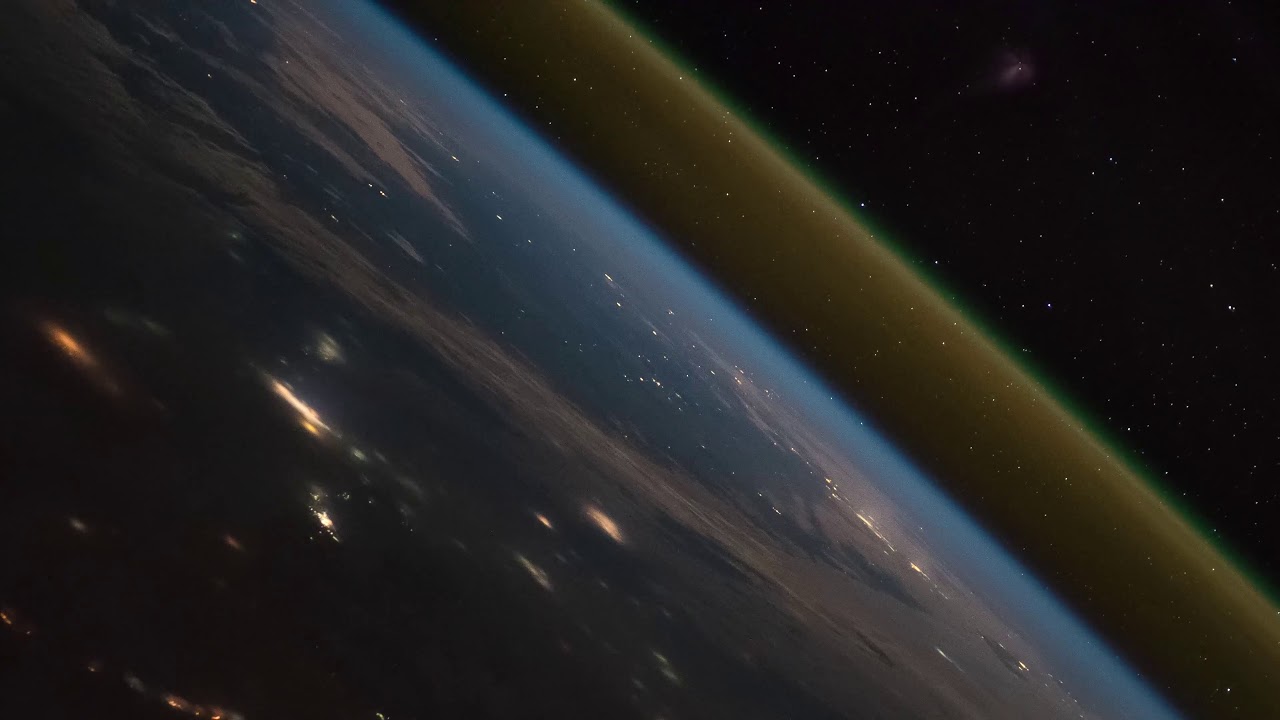
Have you ever seen a rocket launch — from space? A close inspection of the featured time-lapse video will reveal a rocket rising to Earth orbit as seen from the International Space Station (ISS). The Russian Soyuz-FG rocket was launched in November 2018 from the Baikonur Cosmodrome in Kazakhstan, carrying a Progress MS-10 (also 71P) module to bring needed supplies to the ISS. Highlights in the 90-second video (condensing about 15-minutes) include city lights and clouds visible on the Earth on the lower left, blue and gold bands of atmospheric airglow running diagonally across the center, and distant stars on the upper right that set behind the Earth. A lower stage can be seen falling back to Earth as the robotic supply ship fires its thrusters and begins to close on the ISS, a space laboratory that celebrated its 25th anniversary in 2023. Astronauts who live aboard the Earth-orbiting ISS conduct, among more practical duties, numerous science experiments that expand human knowledge and enable future commercial industry in low Earth orbit. [via NASA] https://ift.tt/7QCrfP1

Welcome to Perihelion

Earth’s orbit around the Sun is not a circle, it’s an ellipse. The point along its elliptical orbit where our fair planet is closest to the Sun is called perihelion. This year perihelion is today, January 4, at 13:28 UTC, with the Earth about 147 million kilometers from the Sun. For comparison, at aphelion on last July 3 Earth was at its farthest distance from the Sun, some 152 million kilometers away. But distance from the Sun doesn’t determine Earth’s seasons. It’s only by coincidence that the beginning of southern summer (northern winter) on the December solstice – when this H-alpha picture of the active Sun was taken – is within 14 days of Earth’s perihelion date. And it’s only by coincidence that Earth’s perihelion date is within 11 days of the historic perihelion of NASA’s Parker Solar Probe. Launched in 2018, the Parker Solar Probe flew within 6.2 million kilometers of the Sun’s surface on 2024 December 24, breaking its own record for closest perihelion for a spacecraft from planet Earth. [via NASA] https://ift.tt/SvoMZKy

Eclipse Pair

Eclipses tend to come in pairs. Twice a year, during an eclipse season that lasts about 34 days, Sun, Moon, and Earth can nearly align. Then the full and new phases of the Moon, separated by just over 14 days, create a lunar and a solar eclipse. But only rarely is the alignment at both new moon and full moon phases during a single eclipse season close enough to produce a pair with both total (or a total and an annular) lunar and solar eclipses. More often, partial eclipses are part of any eclipse season. In fact, the last eclipse season of 2024 produced this fortnight-separated eclipse pair: a partial lunar eclipse on 18 September and an annular solar eclipse on 2 October. The time-lapse composite images were captured from Somerset, UK (left) and Rapa Nui planet Earth. The 2025 eclipse seasons will see a total lunar eclipse on 14 March paired with a partial solar eclipse on 29 March, and a total lunar eclipse on 8 September followed by a partial solar eclipse on 21 September. [via NASA] https://ift.tt/1KAimGW

Solar Analemma 2024

Recorded during 2024, this year-spanning series of images reveals a pattern in the seasonal drift of the Sun’s daily motion through planet Earth’s sky. Known to some as an analemma, the figure-eight curve was captured in exposures taken only at 1pm local time on clear days from Kayseri, Turkiye. Of course the Sun’s position on the 2024 solstice dates was at the top and bottom of the curve. They correspond to the astronomical beginning of summer and winter in the north. The points along the curve half-way between the solstices, but not the figure-eight curve crossing point, mark the 2024 equinoxes and the start of spring and fall. Regional peaks and dormant volcano Mount Erciyes lie along the southern horizon in the 2024 timelapse skyscape. [via NASA] https://ift.tt/Q25YcFq