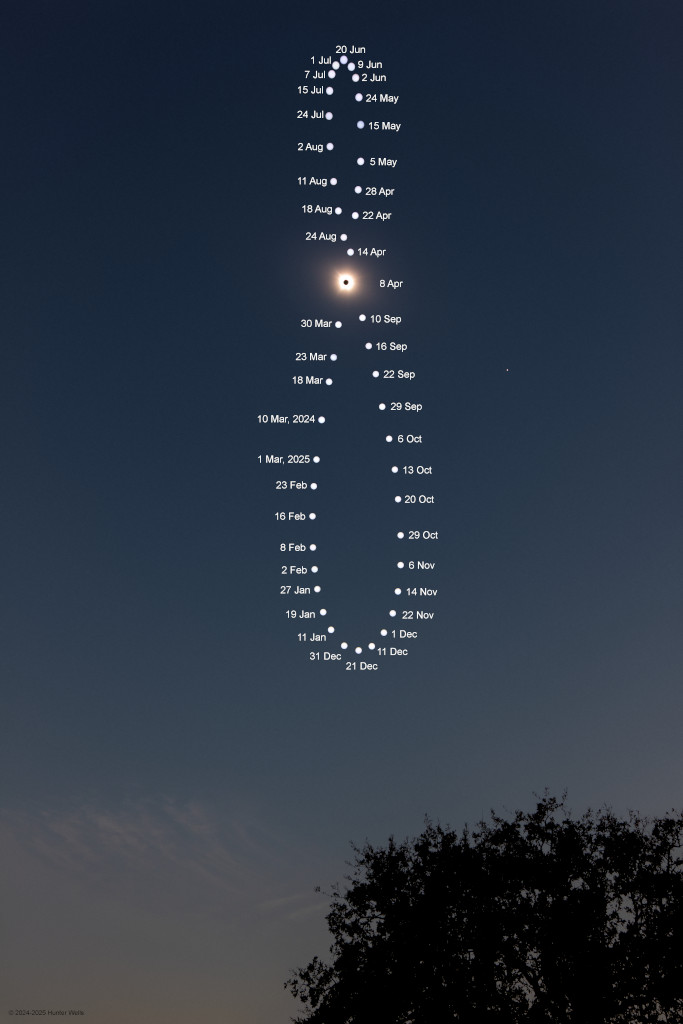
The Solar Eclipse Analemma Project

Recorded from 2024 March 10, to 2025 March 1, this composited series of images reveals a pattern in the seasonal drift of the Sun’s daily motion through planet Earth’s sky. Known to some as an analemma, the figure-eight curve was captured in exposures taken on the indicated dates only at 18:38 UTC from the exact same location south of Stephenville, Texas. The Sun’s position on the 2024 solstice dates of June 20 and December 21 would be at the top and bottom of the curve and correspond to the astronomical beginning of summer and winter in the north. Points that lie along the curve half-way between the solstices would mark the equinoxes. The 2024 equinox on September 22, and in 2025 the equinox on March 20 (today) are the start of northern fall and spring. And since one of the exposures was made on 2024 April 8 from the Stephenville location at 18:38:40 UTC, this analemma project also reveals the solar corona in planet Earth’s sky during a total solar eclipse. [via NASA] https://ift.tt/WXNQd7S
Blue Ghost s Diamond Ring

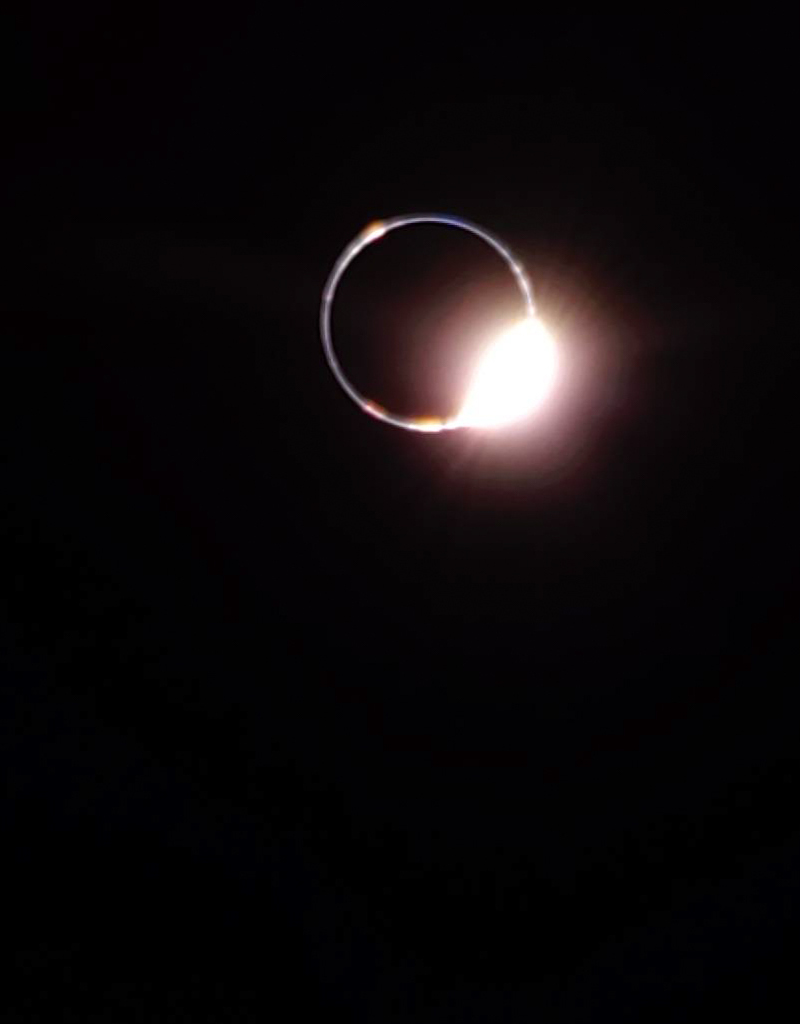
On March 14 the Full Moon slid through Earth’s dark umbral shadow and denizens of planet Earth were treated to a total lunar eclipse. Of course, from the Moon’s near side that same astronomical syzygy was seen as a solar eclipse. Operating in the Mare Crisium on the lunar surface, the Blue Ghost lander captured this video frame of Earth in silhouette around 3:30am CDT, just as the Sun was emerging from behind the terrestrial disk. From Blue Ghost’s lunar perspective the beautiful diamond ring effect, familiar to earthbound solar eclipse watchers, is striking. Since Earth appears about four times the apparent size of the Sun from the lunar surface the inner solar corona, the atmosphere of the Sun most easily seen from Earth during a total solar eclipse, is hidden from view. Still, scattering in Earth’s dense atmosphere creates the glowing band of sunlight embracing our fair planet. [via NASA] https://ift.tt/3nPr9SH

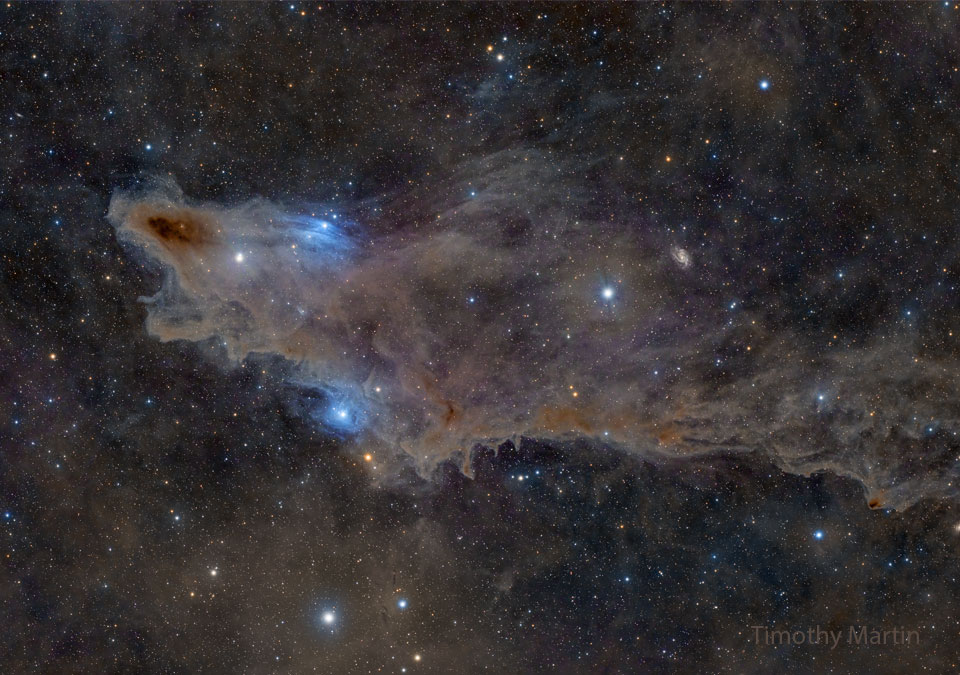
There is no sea on Earth large enough to contain the Shark nebula. This predator apparition poses us no danger as it is composed only of interstellar gas and dust. Dark dust like that featured here is somewhat like cigarette smoke and created in the cool atmospheres of giant stars. After expelling gas and gravitationally recondensing, massive stars may carve intricate structures into their birth cloud using their high energy light and fast stellar winds as sculpting tools. The heat they generate evaporates the murky molecular cloud as well as causing ambient hydrogen gas to disperse and glow red. During disintegration, we humans can enjoy imagining these great clouds as common icons, like we do for water clouds on Earth. Including smaller dust nebulae such as Van den Bergh 149 & 150, the Shark nebula, sometimes cataloged as LDN 1235, spans about 15 light years and lies about 650 light years away toward the constellation of the King of Aethiopia (Cepheus). [via NASA] https://ift.tt/k0CWJjf

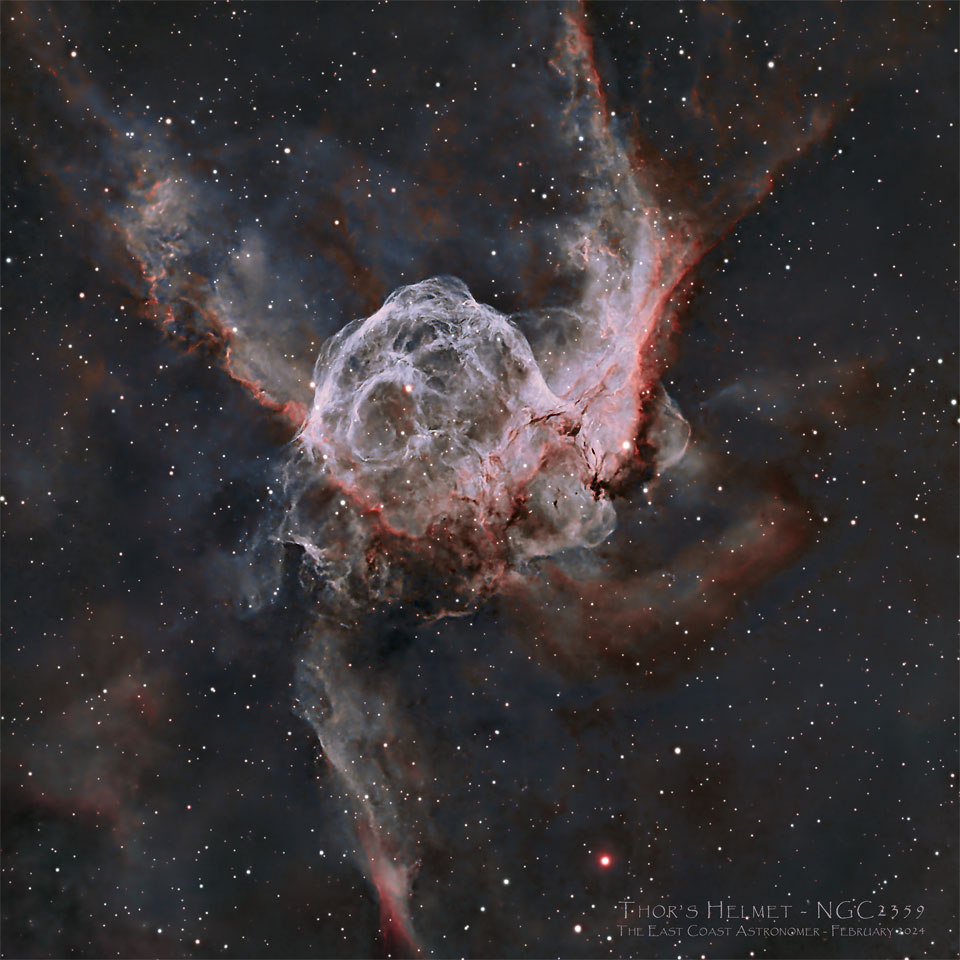
Thor not only has his own day (Thursday), but a helmet in the heavens. Popularly called Thor’s Helmet, NGC 2359 is a hat-shaped cosmic cloud with wing-like appendages. Heroically sized even for a Norse god, Thor’s Helmet is about 30 light-years across. In fact, the cosmic head-covering is more like an interstellar bubble, blown by a fast wind from the bright, massive star near the bubble’s center. Known as a Wolf-Rayet star, the central star is an extremely hot giant thought to be in a brief, pre-supernova stage of evolution. NGC 2359 is located about 15,000 light-years away toward the constellation of the Great Overdog. This sharp image is a mixed cocktail of data from narrowband filters, capturing not only natural looking stars but details of the nebula’s filamentary structures. The star in the center of Thor’s Helmet is expected to explode in a spectacular supernova sometime within the next few thousand years. [via NASA] https://ift.tt/2Ee5nVd

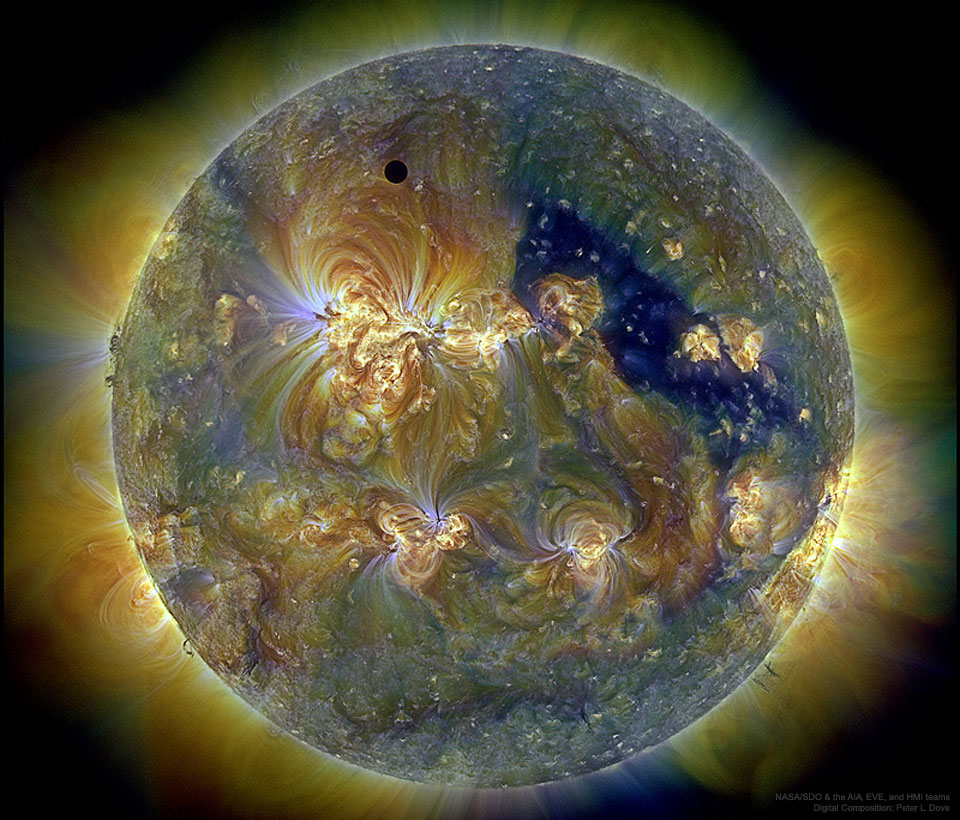
This was a very unusual type of solar eclipse. Typically, it is the Earth’s Moon that eclipses the Sun. In 2012, though, the planet Venus took a turn. Like a solar eclipse by the Moon, the phase of Venus became a continually thinner crescent as Venus became increasingly better aligned with the Sun. Eventually the alignment became perfect and the phase of Venus dropped to zero. The dark spot of Venus crossed our parent star. The situation could technically be labeled a Venusian annular eclipse with an extraordinarily large ring of fire. Pictured here during the occultation, the Sun was imaged in three colors of ultraviolet light by the Earth-orbiting Solar Dynamics Observatory, with the dark region toward the right corresponding to a coronal hole. Hours later, as Venus continued in its orbit, a slight crescent phase appeared again. The next Venusian transit across the Sun will occur in 2117. [via NASA] https://ift.tt/sKbfVpr

Tololo Totality

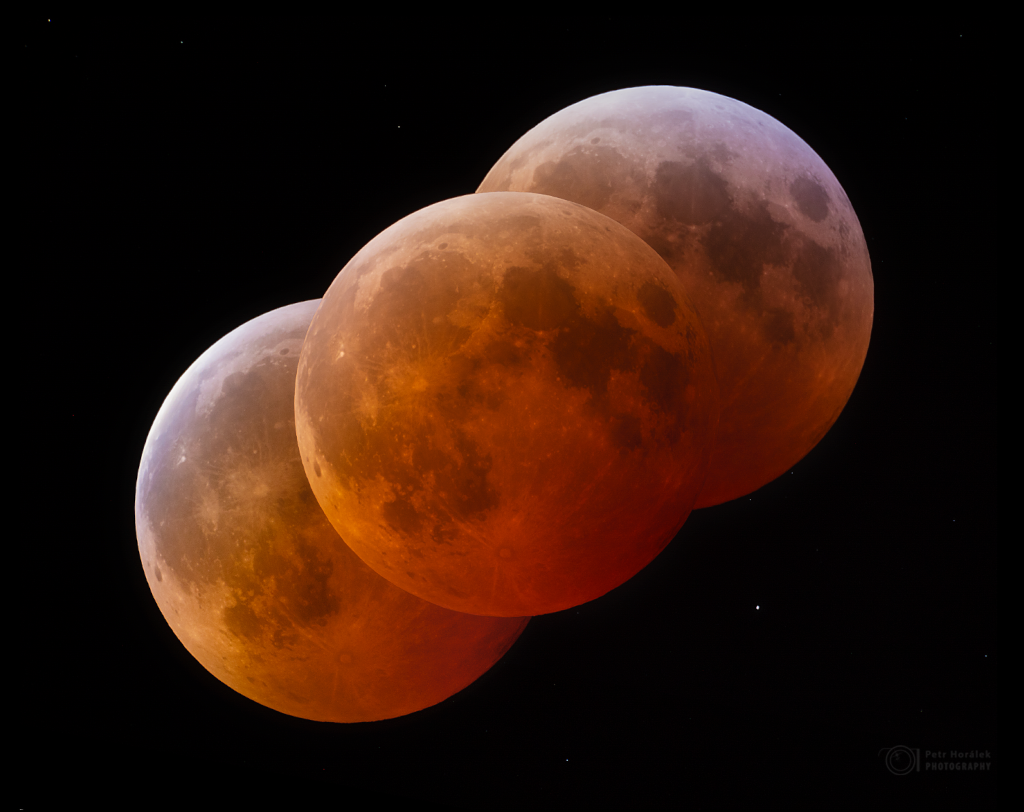
On March 14 the Moon was Full. In an appropriate celebration of Pi day, that put the Moon 3.14 radians (180 degrees) in ecliptic longitude from the Sun in planet Earth’s sky. As a bonus for fans of Pi and the night sky, on that date the Moon also passed directly through Earth’s umbral shadow in a total lunar eclipse. In clear skies, the colors of an eclipsed Moon can be vivid. Reflecting the deeply reddened sunlight scattered into Earth’s shadow, the darkened lunar disk was recorded in this time series composite image from Cerro Tololo Observatory, Chile. The lunar triptych captures the start, middle, and end of the total eclipse phase that lasted about an hour. A faint bluish tint seen just along the brighter lunar limb at the shadow’s edge is due to sunlight filtered through Earth’s stratospheric ozone layer. [via NASA] https://ift.tt/bnk3lN0

Moon Pi and Mountain Shadow

What phase of the Moon is 3.14 radians from the Sun? The Full Moon, of course. Even though the Moon might look full for several days, the Moon is truly at its full phase when it is Pi radians (aka 180 degrees) from the Sun in ecliptic longitude. That’s opposite the Sun in planet Earth’s sky. Rising as the Sun set on March 9, 2020, only an hour or so after the moment of its full phase, this orange tinted and slightly flattened Moon still looked full. It was photographed opposite the setting Sun from Teide National Park on the Canary Island of Tenerife. Also opposite the setting Sun, seen from near the Teide volcano peak about 3,500 meters above sea level, is the mountain’s rising triangular shadow extending into Earth’s dense atmosphere. Below the distant ridge line on the left are the white telescope domes of Teide Observatory. Today, March 14 2025, the moon is Pi radians from the Sun at exactly 06:55 UTC. That’s about three minutes before the midpoint of the March Full Moon’s total lunar eclipse. [via NASA] https://ift.tt/vGTdB0f

The Protostars within Lynds 483

Two protostars are hidden in a single pixel near the center of a striking hourglass-shaped nebula in this near-infrared image from the James Webb Space Telescope. The actively forming star system lies in a dusty molecular cloud cataloged as Lynds 483, some 650 light-years distant toward the constellation Serpens Cauda. Responsible for the stunning bipolar outflows, the collapsing protostars have been blasting out collimated energetic jets of material over tens of thousands of years. Webb’s high-resolution view shows the violence of star-formation in dramatic detail as twisting shock fronts expand and collide with slower, denser material. The premier close-up of the star-forming region spans less than 1/2 a light-year within dark nebula Lynds 483. [via NASA] https://ift.tt/41YGdDU

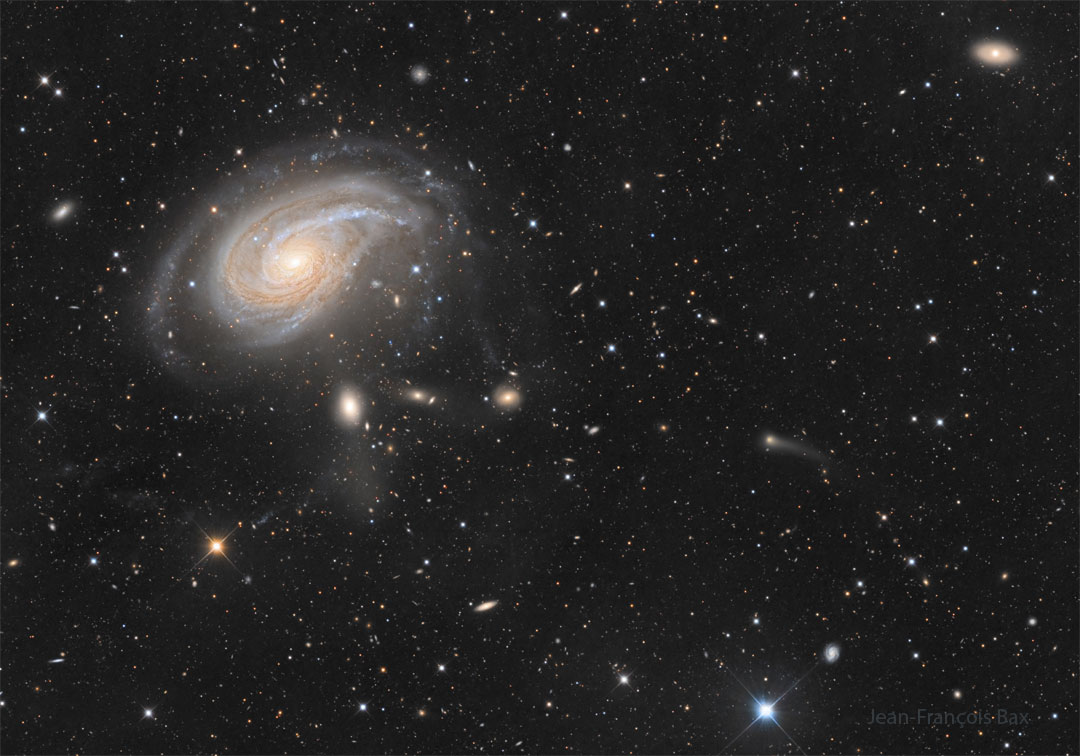
Why does this galaxy look like a curly vegetable? The Fiddlehead spiral galaxy likely gets its distorted spiral appearance from a gravitational interaction with its close-by elliptical companion NGC 770, seen just below. Cataloged as NGC 772 and Arp 78, the Fiddlehead spans over 200,000 light years, is a nearby 100 million light years beyond the stars of our Milky Way galaxy, and is visible toward the constellation of the Ram (Aries). But in the featured image, the Fiddlehead appears to have another companion — one with a long and fuzzy tail: Comet 43P/Wolf-Harrington. Though the comet appears to be aimed straight at the massive galaxy, it is actually much closer to us, residing only light minutes away — well within our Solar System. The comet will never reach the distant spiral galaxy, nor is it physically related to it. By a fortunate trick of perspective, though, these two cosmic wonders briefly share the same frame taken late last year from Calern, France. [via NASA] https://ift.tt/EmU93C1

Many spiral galaxies have bars across their centers. Even our own Milky Way Galaxy is thought to have a modest central bar. Prominently barred spiral galaxy NGC 1672, featured here, was captured in spectacular detail in an image taken by the orbiting Hubble Space Telescope. Visible are dark filamentary dust lanes, young clusters of bright blue stars, red emission nebulas of glowing hydrogen gas, a long bright bar of stars across the center, and a bright active nucleus that likely houses a supermassive black hole. Light takes about 60 million years to reach us from NGC 1672, which spans about 75,000 light years across. NGC 1672, which appears toward the constellation of the Dolphinfish (Dorado), has been studied to find out how a spiral bar contributes to star formation in a galaxy’s central regions. [via NASA] https://ift.tt/NCGpgxF