The Great Nebula in Orion is a colorful place. Visible to the unaided eye, it appears as a small fuzzy patch in the constellation of Orion. Long exposure, multi-wavelength images like this, however, show the Orion Nebula to be a busy neighborhood of young stars, hot gas, and dark dust. This digital composite features not only three colors of visible light but four colors of infrared light taken by NASA’s orbiting Spitzer Space Telescope as well. The power behind much of the Orion Nebula (M42) is the Trapezium – four of the brightest stars in the nebula. Many of the filamentary structures visible are actually shock waves – fronts where fast moving material encounters slow moving gas. The Orion Nebula spans about 40 light years and is located about 1500 light years away in the same spiral arm of our Galaxy as the Sun. [via NASA] https://ift.tt/uPbxZTk
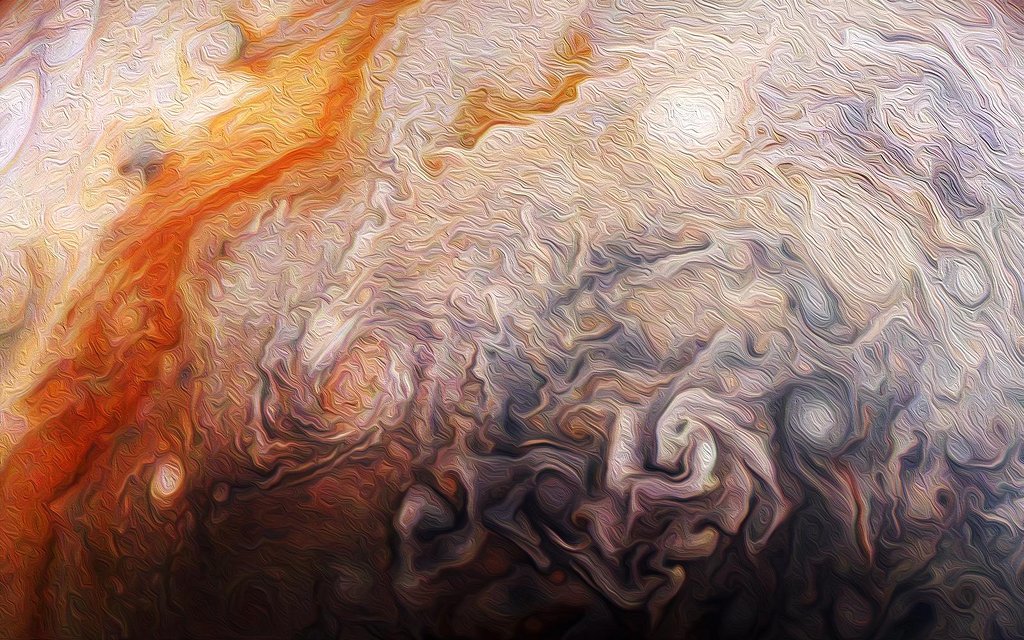
Painting with Jupiter

In digital brush strokes, Jupiter’s signature atmospheric bands and vortices were used to form this interplanetary post-impressionist work of art. The creative image from citizen scientist Rick Lundh uses data from the Juno spacecraft’s JunoCam. To paint on the digital canvas, a JunoCam image with contrasting light and dark tones was chosen for processing and an oil-painting software filter applied. The image data was captured during perijove 10. That was Juno’s December 16, 2017 close encounter with the solar system’s ruling gas giant. At the time the spacecraft was cruising about 13,000 kilometers above northern Jovian cloud tops. Now in an extended mission, Juno has explored Jupiter and its moons since entering orbit around Jupiter in July of 2016. [via NASA] https://ift.tt/CTGt4qB

Comet C/2025 F2 SWAN

In late March, the comet now designated C/2025 F2 SWAN was found independently by citizen scientists Vladimir Bezugly, Michael Mattiazzo, and Rob Matson while examining publicly available image data from the Solar Wind ANisotropies (SWAN) camera on the sun-staring SOHO spacecraft. Comet SWAN’s coma, its greenish color a signature of diatomic carbon molecules fluorescing in sunlight, is at lower left in this telescopic image. SWAN’s faint ion tail extends nearly two degrees toward the upper right across the field of view. The interplanetary scene was captured in clear but moonlit skies from June Lake, California on April 14. Seen against background of stars toward the constellation Andromeda, the comet was then some 10 light-minutes from our fair planet. Now a target for binoculars and small telescopes in northern hemisphere morning skies this comet SWAN is headed for a perihelion, its closest approach to the Sun, on May 1. That will bring this visitor from the distant Oort cloud almost as close to the Sun as the orbit of inner planet Mercury. [via NASA] https://ift.tt/uOUFglZ

Virgo Cluster Galaxies

Galaxies of the Virgo Cluster are scattered across this nearly 4 degree wide telescopic field of view. About 50 million light-years distant, the Virgo Cluster is the closest large galaxy cluster to our own local galaxy group. Prominent here are Virgo’s bright elliptical galaxies from the Messier catalog, M87 at bottom left, and M86 and M84 near center right. M86 and M84 are recognized as part of Markarian’s Chain, the visually striking line-up of galaxies on the that runs through the upper portion of this frame. Near the middle of the chain lies an intriguing interacting pair of galaxies, NGC 4438 and NGC 4435, known to some as Markarian’s Eyes. Still, giant elliptical galaxy M87 dominates the Virgo cluster. It’s the home of a super massive black hole, the first black hole ever imaged by planet Earth’s Event Horizon Telescope. [via NASA] https://ift.tt/RTLyOWV

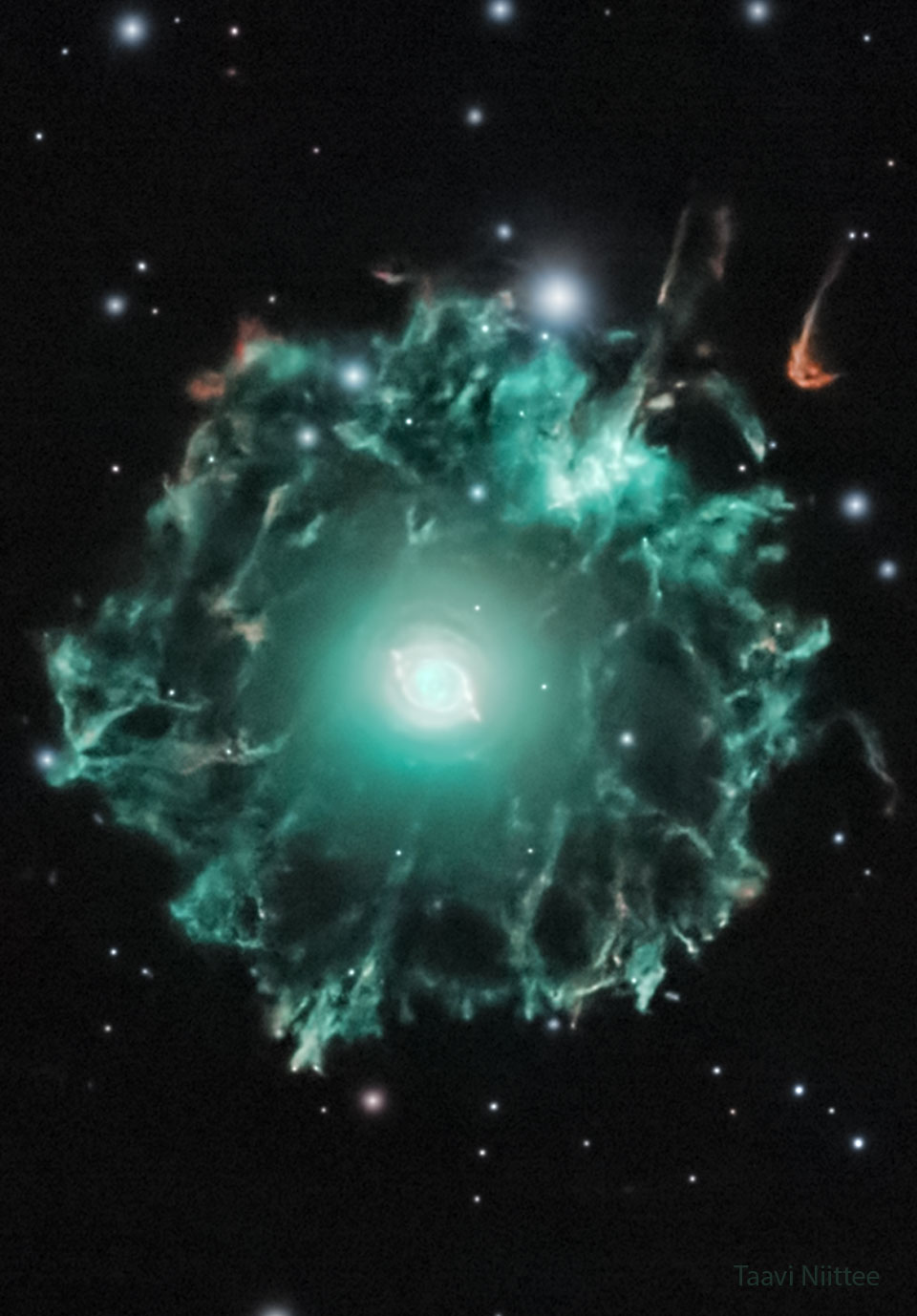
What created the unusual halo around the Cat’s Eye Nebula? No one is sure. What is sure is that the Cat’s Eye Nebula (NGC 6543) is one of the best known planetary nebulae on the sky. Although haunting symmetries are seen in the bright central region, this image was taken to feature its intricately structured outer halo, which spans over three light-years across. Planetary nebulae have long been appreciated as a final phase in the life of a Sun-like star. Only recently however, have some planetaries been found to have expansive halos, likely formed from material shrugged off during earlier puzzling episodes in the star’s evolution. While the planetary nebula phase is thought to last for around 10,000 years, astronomers estimate the age of the outer filamentary portions of the Cat’s Eye Nebula’s halo to be 50,000 to 90,000 years. [via NASA] https://ift.tt/h85oJZF

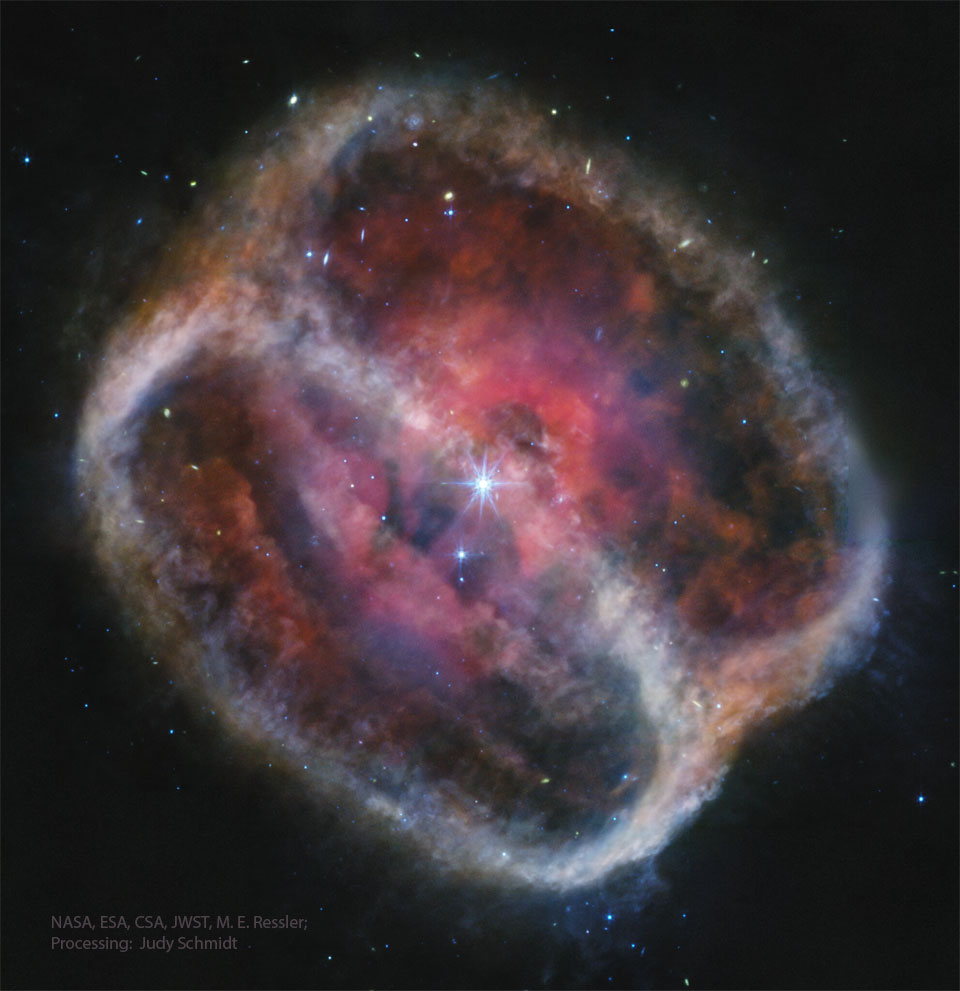
What happens when a star runs out of nuclear fuel? For stars like our Sun, the center condenses into a white dwarf while the outer atmosphere is expelled into space to appear as a planetary nebula. The expelled outer atmosphere of planetary nebula NGC 1514 appears to be a jumble of bubbles — when seen in visible light. But the view from the James Webb Space Telescope in infrared, as featured here, confirms a different story: in this light the nebula shows a distinct hourglass shape, which is interpreted as a cylinder seen along a diagonal. If you look closely at the center of the nebula, you can also see a bright central star that is part of a binary system. More observations might better reveal how this nebula is evolving and how the central stars are working together to produce the interesting cylinder and bubbles observed. [via NASA] https://ift.tt/UZ9GepK

What’s happening at the center of our galaxy? It’s hard to tell with optical telescopes since visible light is blocked by intervening interstellar dust. In other bands of light, though, such as radio, the galactic center can be imaged and shows itself to be quite an interesting and active place. The featured picture shows an image of our Milky Way’s center by the MeerKAT array of 64 radio dishes in South Africa. Spanning four times the angular size of the Moon (2 degrees), the image is impressively vast, deep, and detailed. Many known sources are shown in clear detail, including many with a prefix of Sgr, since the galactic center is in the direction of the constellation Sagittarius. In our galaxy’s center lies Sgr A, found here in the image center, which houses the Milky Way’s central supermassive black hole. Other sources in the image are not as well understood, including the Arc, just to the left of Sgr A, and numerous filamentary threads. The inset image shows a small patch recently imaged in infrared light with the James Webb Space Telescope to investigate the effects of magnetic fields on star formation. [via NASA] https://ift.tt/cCw1Bsj

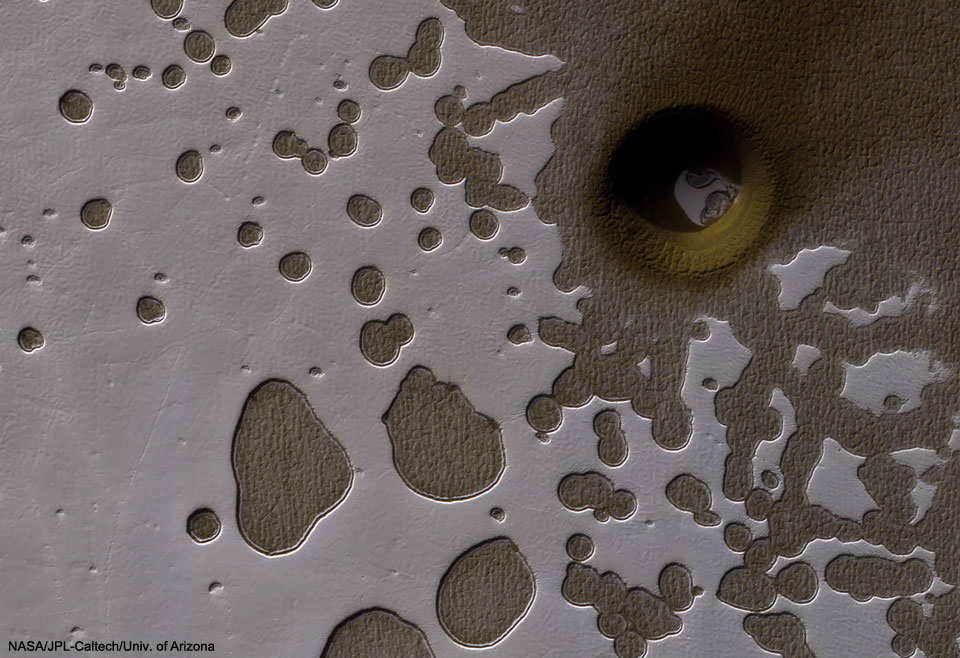
What created this unusual hole in Mars? Actually, there are numerous holes pictured in this Swiss cheese-like landscape, with all-but-one of them showing a dusty, dark, Martian terrain beneath evaporating, light, carbon dioxide ice. The most unusual hole is on the upper right, spans about 100 meters, and seems to punch through to a lower level. Why this hole exists and why it is surrounded by a circular crater remains a topic of speculation, although a leading hypothesis is that it was created by a meteor impact. Holes such as this are of particular interest because they might be portals to lower levels that extend into expansive underground caves. If so, these naturally occurring tunnels are relatively protected from the harsh surface of Mars, making them relatively good candidates to contain Martian life. These pits are therefore also prime targets for possible future spacecraft, robots, and even human interplanetary explorers. [via NASA] https://ift.tt/3cOGS8j

Moon Near the Edge

Most of us watch the Moon at night. But the Moon spends nearly as many daylight hours above our horizon, though in bright daytime skies the lunar disk looks pale and can be a little harder to see. Of course in daytime skies the Moon also appears to cycle through its phases, shining by reflected sunlight as it orbits our fair planet. For daytime moonwatchers, the Moon is probably easier to spot when the visible sunlit portion of the lunar disk is large and waxing following first quarter or waning approaching its third quarter phase. And though it might look unusual, a daytime moon is often seen even in urban skies. Captured here in a telephoto snapshot taken on March 12, a waxing daytime Moon is aligned near the edge of a popular observation deck that overlooks New York City’s borough of Manahattan. [via NASA] https://ift.tt/1Wg4i9U

The ISS Meets Venus

Made with a telescope shaded from bright sunlight by an umbrella, on April 5 a well-planned video captured a crescent Venus shining in clear daytime skies from Shoreline, Washington, USA at 11:57AM Pacific Time. It also caught the International Space Station in this single video frame. In close conjunction with the bright planet, the faint outline of the orbital outpost seen at a range of about 400 kilometers appears to be similar in size to the slender planetary crescent. Of course the ISS is much smaller than Venus. Now appearing as planet Earth’s brilliant morning star and climbing above the eastern horizon in predawn skies, inner planet Venus was nearly 45 million kilometers from Shoreline. [via NASA] https://ift.tt/Xtg48jL