38 Hours in the M81 Group

From a garden on planet Earth, 38 hours of exposure with a camera and small telescope produced this cosmic photo of the M81 galaxy group. In fact, the group’s dominant galaxy M81 is near the center of the frame sporting grand spiral arms and a bright yellow core. Also known as Bode’s galaxy, M81 itself spans some 100,000 light-years. Near the top is cigar-shaped irregular galaxy M82. The pair have been locked in gravitational combat for a billion years. Gravity from each galaxy has profoundly affected the other during a series of cosmic close encounters. Their last go-round lasted about 100 million years and likely raised density waves rippling around M81, resulting in massive star forming regions arrayed along M81’s spiral arms. M82 was left with violent star forming regions too, and colliding gas clouds so energetic that the galaxy glows in X-rays. In the next few billion years, their continuing gravitational encounters will result in a merger, and a single galaxy will remain. Another group member, NGC 3077 is below and left of the large spiral M81. Far far away, about 12 million light-years distant the M81 group galaxies are seen toward the northern constellation Ursa Major (the Great Bear). But in the closer foreground the wide-field image is filled with integrated flux nebulae whose faint, dusty interstellar clouds reflect starlight above the plane of our own Milky Way galaxy. [via NASA] https://ift.tt/yLG9xb5

What’s at the tip of this interstellar jet? First let’s consider the jet: it is being expelled by a star system just forming and is cataloged as Herbig-Haro 49 (HH 49). The star system expelling this jet is not visible — it is off to the lower right. The complex conical structure featured in this infrared image by the James Webb Space Telescope also includes another jet cataloged as HH 50. The fast jet particles impact the surrounding interstellar gas and form shock waves that glow prominently in infrared light — shown here as reddish-brown ridges. This JWST image also resolved the mystery of the unusual object at HH 49’s tip: it is a spiral galaxy far in the distance. The blue center is therefore not one star but many, and the surrounding circular rings are actually spiral arms. [via NASA] https://ift.tt/0g75RJu

Sometimes, the Moon visits the Pleiades. Technically, this means that the orbit of our Moon takes it directly in front of the famous Pleiades star cluster, which is far in the distance. The technical term for the event is an occultation, and the Moon is famous for its rare occultations ofallplanets and several well-known bright stars. The Moon’s tilted and precessing orbit makes its occultations of the Seven Sisters star cluster bunchy, with the current epoch starting in 2023 continuing monthly until 2029. After that, though, the next occultation won’t occur until 2042. Taken from Cantabria, Spain on April 1, the featured image is a composite where previous exposures of the Pleiades from the same camera and location were digitally added to the last image to bring up the star cluster’s iconic blue glow. [via NASA] https://ift.tt/C56RQpS

How much mass do flocculent spirals hide? The featured image of flocculent spiral galaxy NGC 4414 was taken with the Hubble Space Telescope to help answer this question. Flocculent spirals — galaxies without well-defined spiral arms — are a quite common form of galaxy, and NGC 4414 is one of the closest. Stars and gas near the visible edge of spiral galaxies orbit the center so fast that the gravity from a large amount of unseen dark matter must be present to hold them together. Understanding the matter and dark matter distribution of NGC 4414 helps humanity calibrate the rest of the galaxy and, by deduction, flocculent spirals in general. Further, calibrating the distance to NGC 4414 helps humanity calibrate the cosmological distance scale of the entire visible universe. [via NASA] https://ift.tt/IBe6Ksu

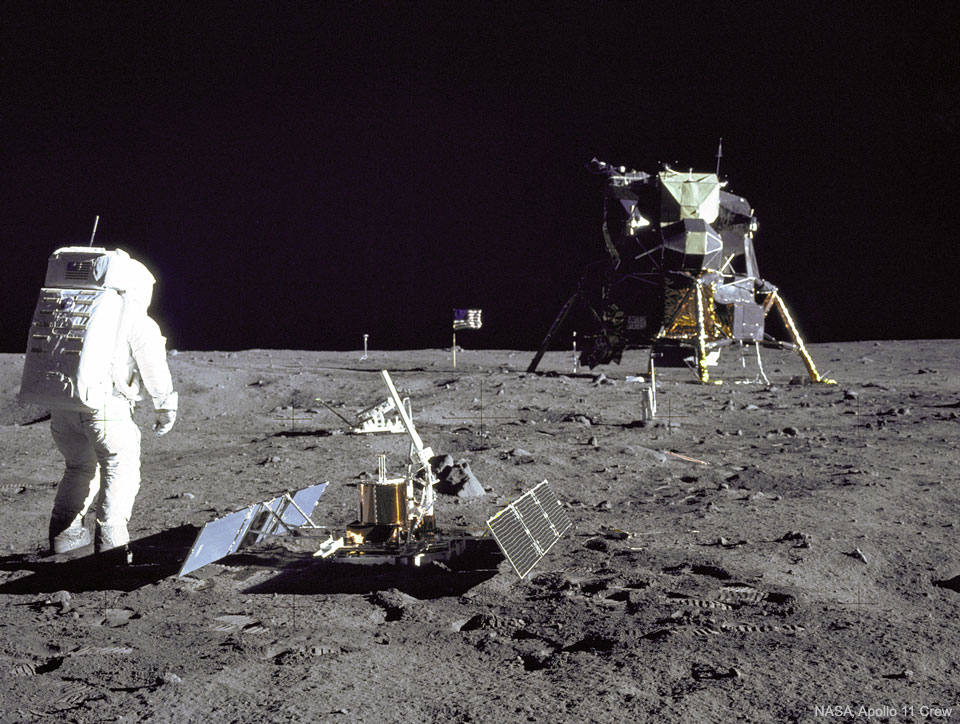
Why are there so many moonquakes? Analyses of seismometers left on the moon during the Apollo moon landings reveal a surprising number of moonquakes occurring within 100 kilometers of the surface. In fact, 62 moonquakes were detected in data recorded between 1972 and 1977. Many of these moonquakes are not only strong enough to move furniture in a lunar apartment, but the stiff rock of the moon continues to vibrate for many minutes, significantly longer than the softer rock earthquakes on Earth. The cause of the moonquakes remains unknown, but a leading hypothesis include tidal gravity from — and relative heating by — our Earth. Regardless of the source, future moon dwellings need to be built to withstand the frequent shakings. Pictured here, Apollo 11 astronaut Buzz Aldrin stands beside a recently deployed lunar seismometer, looking back toward the lunar landing module. [via NASA] https://ift.tt/QUuDfwO

A Gargoyles Eclipse

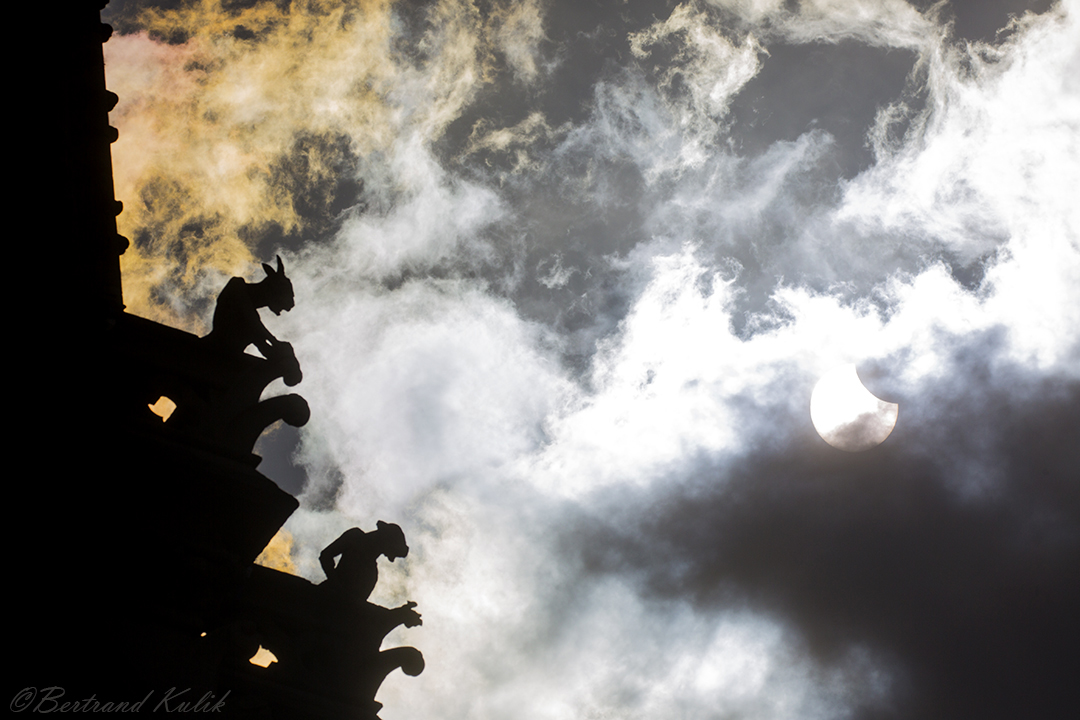
In dramatic silhouette against a cloudy daytime sky over Paris, France, gargoyles cast their monstrous gaze outward from the west facade of Notre Dame Cathedral. Taken on March 29, this telephoto snapshot also captures the dramatic silhouette of a New Moon against the bright solar disk in a partial solar eclipse. Happening high in Parisian skies, the partial eclipse was close to its maximum phase of about 23 percent. Occurring near the end of the first eclipse season of 2025, this partial solar eclipse followed the total eclipse of the Full Moon on March 13/14. The upcoming second eclipse season of 2025 will see a total lunar eclipse on September 7/8 and partial solar eclipse on September 21. The partial solar eclipse will be seen only from locations in planet Earth’s southern hemisphere. [via NASA] https://ift.tt/om2Pu0F

Hickson 44 in Leo

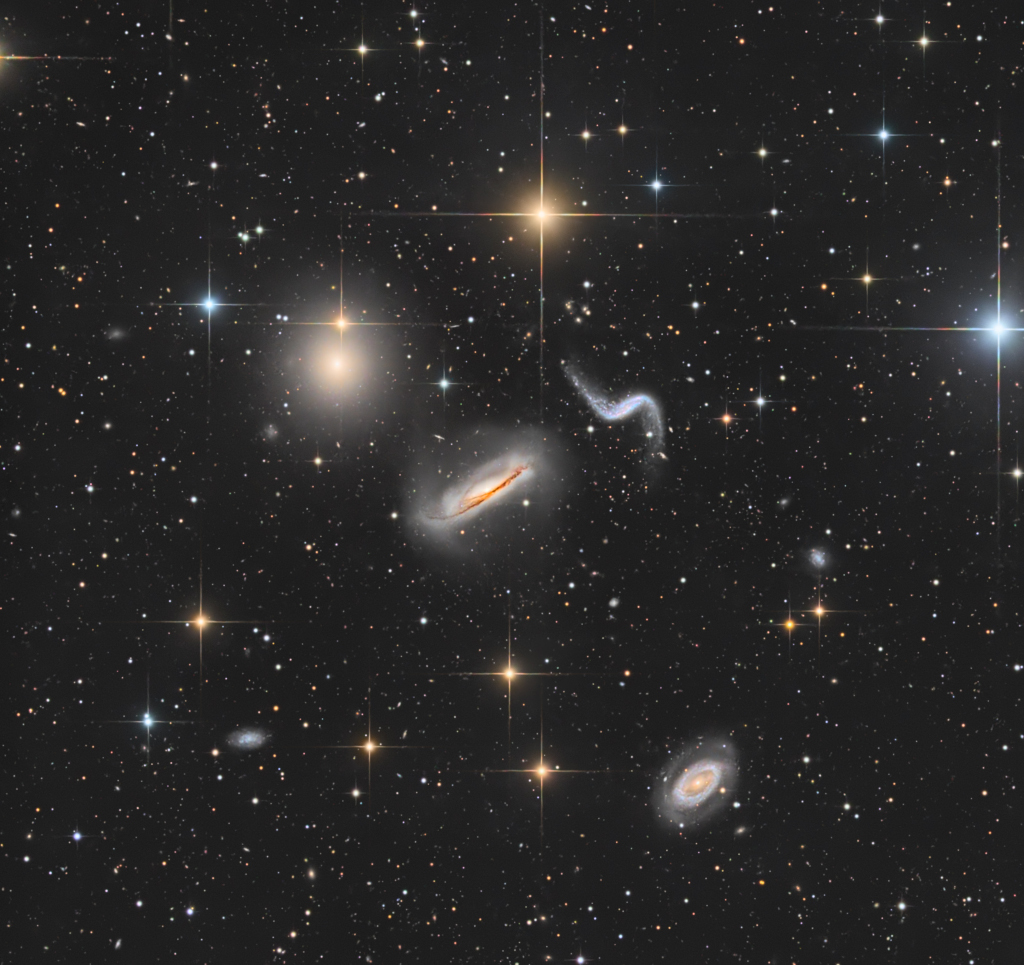
Scanning the skies for galaxies, Canadian astronomer Paul Hickson and colleagues identified some 100 compact groups of galaxies, now appropriately called Hickson Compact Groups. The four prominent galaxies seen in this intriguing telescopic skyscape are one such group, Hickson 44. The galaxy group is about 100 million light-years distant, far beyond the spiky foreground Milky Way stars, toward the constellation Leo. The two spiral galaxies in the center of the image are edge-on NGC 3190 with its distinctive, warped dust lanes, and S-shaped NGC 3187. Along with the bright elliptical, NGC 3193 (above and left) they are also known as Arp 316. The spiral toward the lower right corner is NGC 3185, the 4th member of the Hickson group. Like other galaxies in Hickson groups, these show signs of distortion and enhanced star formation, evidence of a gravitational tug of war that will eventually result in galaxy mergers on a cosmic timescale. The merger process is now understood to be a normal part of the evolution of galaxies, including our own Milky Way. For scale, NGC 3190 is about 75,000 light-years across at the estimated distance of Hickson 44. [via NASA] https://ift.tt/xni96Cq

The Da Vinci Glow

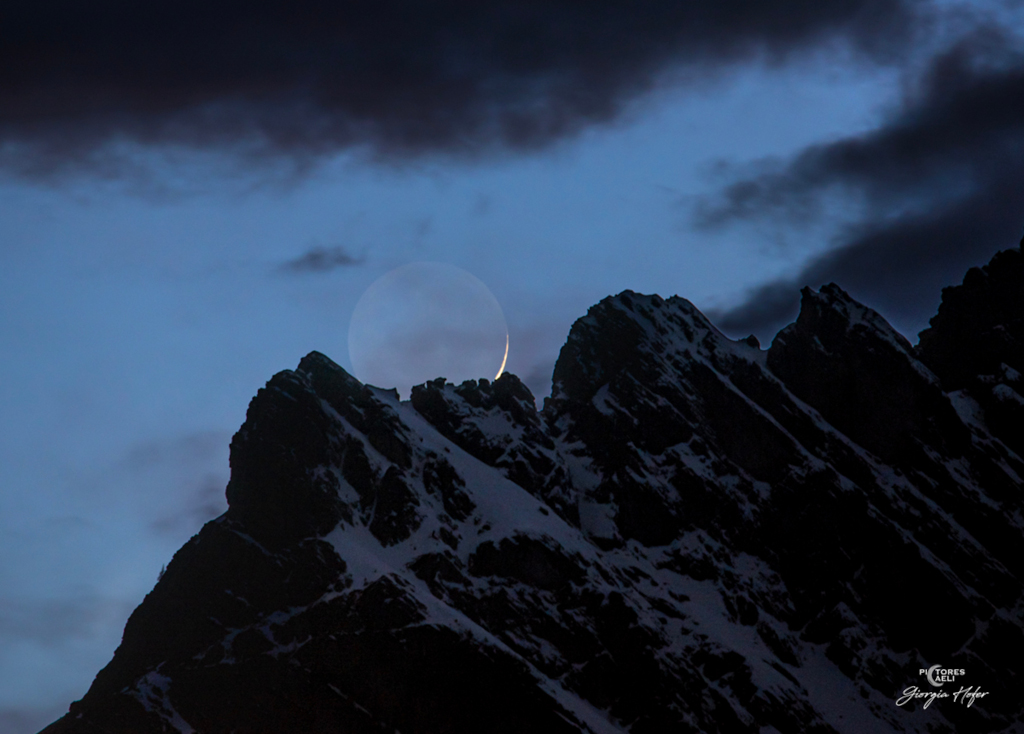
A 26 hour old Moon poses behind the craggy outline of the Italian Dolomites in this twilight mountain and skyscape. The one second long exposure was captured near moonset on March 30. And while only a a sliver of its sunlit surface is visible, most of the Moon’s disk can be seen by earthshine as light reflected from a bright planet Earth illuminates the lunar nearside. Also known as the Moon’s ashen glow, a description of earthshine in terms of sunlight reflected by Earth’s oceans illuminating the Moon’s dark surface was written over 500 years ago by Leonardo da Vinci. Of course earthshine is just the most familiar example of planetshine, the faint illumination of the dark portion of a moon by light reflected from its planet. [via NASA] https://ift.tt/Te6gzs8

Why does Jupiter have rings? Jupiter’s main ring was discovered in 1979 by NASA’s passing Voyager 1 spacecraft, but its origin was then a mystery. Data from NASA’s Galileo spacecraft that orbited Jupiter from 1995 to 2003, however, confirmed the hypothesis that this ring was created by meteoroid impacts on small nearby moons. As a small meteoroid strikes tiny Metis, for example, it will bore into the moon, vaporize, and explode dirt and dust off into a Jovian orbit. The featured image of Jupiter in infrared light by the James Webb Space Telescope shows not only Jupiter and its clouds, but this ring as well. Jupiter’s Great Red Spot (GRS) — in comparatively light color on the right, Jupiter’s large moon Europa — in the center of diffraction spikes on the left, and Europa’s shadow — next to the GRS — are also visible. Several features in the image are not yet well understood, including the seemingly separated cloud layer on Jupiter’s right limb. [via NASA] https://ift.tt/hsoEUkt

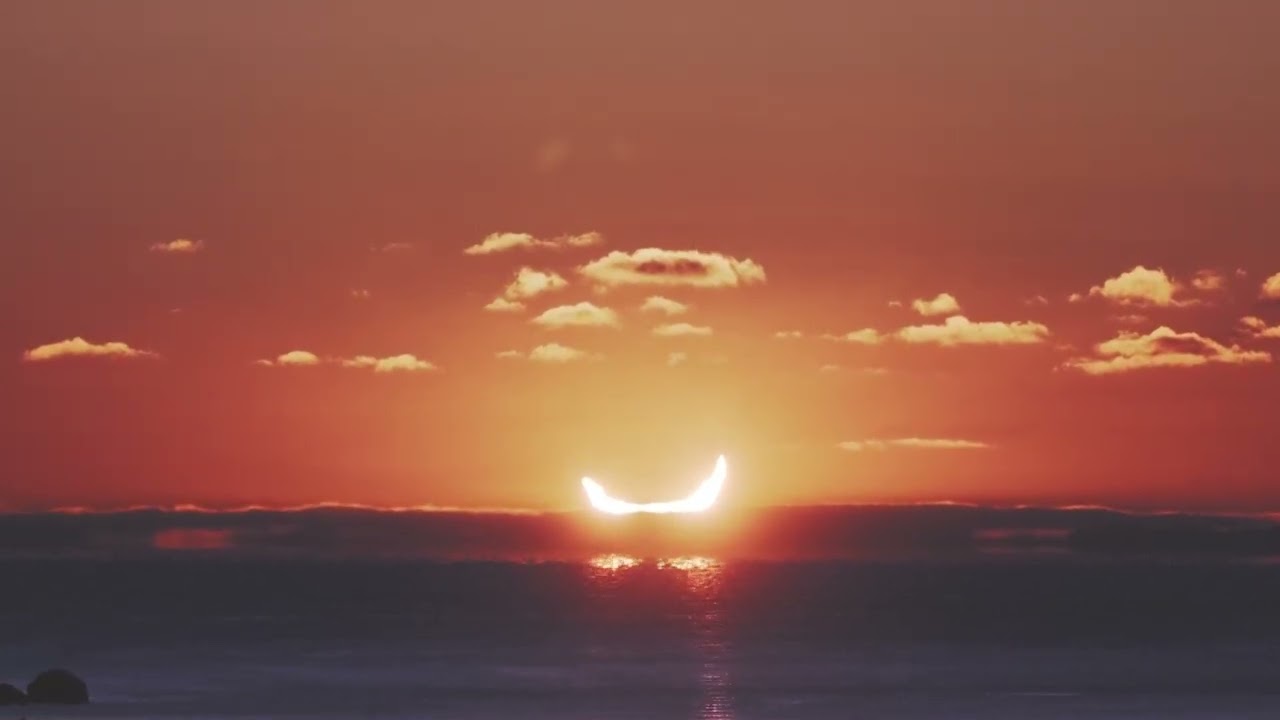
Can the Sun appear to rise twice at the same time? This was just the case a few days ago from Les Escoumins, Quebec, Canada as our Solar System’s bright central orb rose just as it was being partially eclipsed by the Moon. The featured video shows this unusual double-sunrise in real time and being reflected by the St. Lawrence River. Soon after the initial two spots of light appear over distant clouds, what appears to be bright horns become visible — which are really just parts of the Sun not being eclipsed. Soon, the entire eclipsed Sun is visible above the horizon. In all, this broken sunrise took less than two minutes during a partial eclipse that lasted many times longer. Although the Moon circles the Earth once a month (moon-th), it does not always eclipse the Sun because its tilted orbit usually takes it above or below. [via NASA] https://ift.tt/WSRZ9Lh