The Very Large Array at Moonset

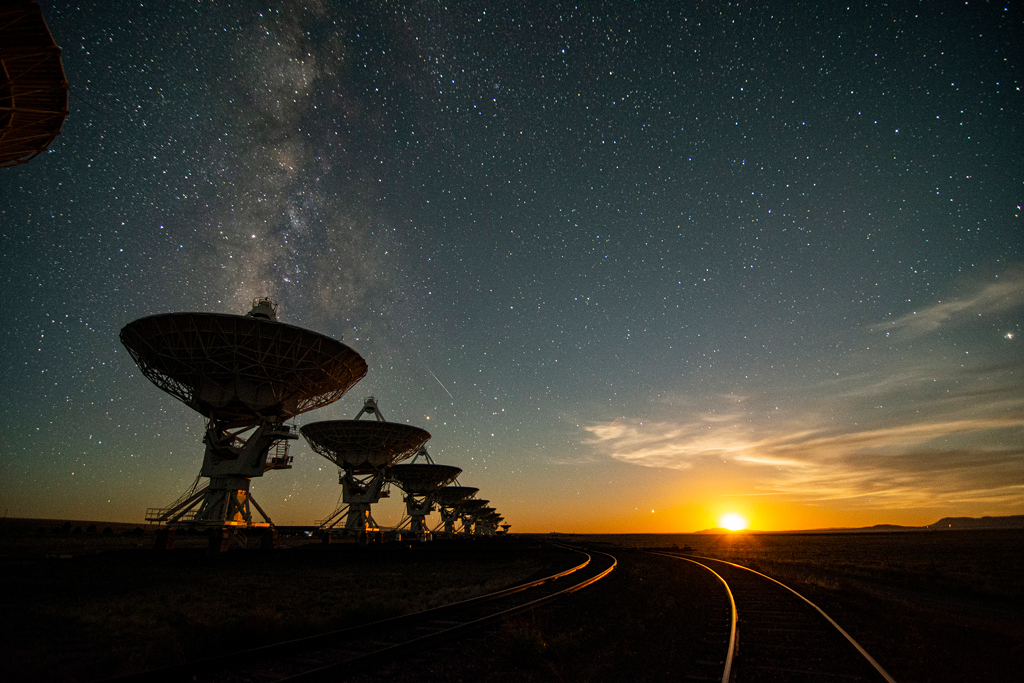
An inspirational sight, these giant dish antennas of the Karl G. Jansky Very Large Array (VLA) rise above the New Mexico desert at moonset. Mounted on piers but transportable on railroad tracks to change the VLA’s configuration, its 27 operating antennas are each house-sized (25 meters across) and can be organized into an array spanning the size of a city (35 kilometers). A prolific radio astronomy workhorse, the VLA has been used to discover water on planet Mercury, radio-bright coronae around stars, micro-quasars in our Galaxy, gravitationally-induced Einstein rings around distant galaxies, and radio counterparts to cosmologically distant gamma-ray bursts. Its vast size has allowed astronomers to study the details of radio galaxies, super-fast cosmic jets, and map the center of our own Milky Way. Now 40 years since its dedication the VLA has been used in more than 14,000 observing projects and contributed to more than 500 Ph.D. dissertations. On October 10, the National Radio Astronomy Observatory will host a day-long online celebration of the VLA at 40 featuring virtual tours and presentations on the history, operations, science, and future of the Very Large Array. [via NASA] https://ift.tt/33GEd8v
Mare Frigoris

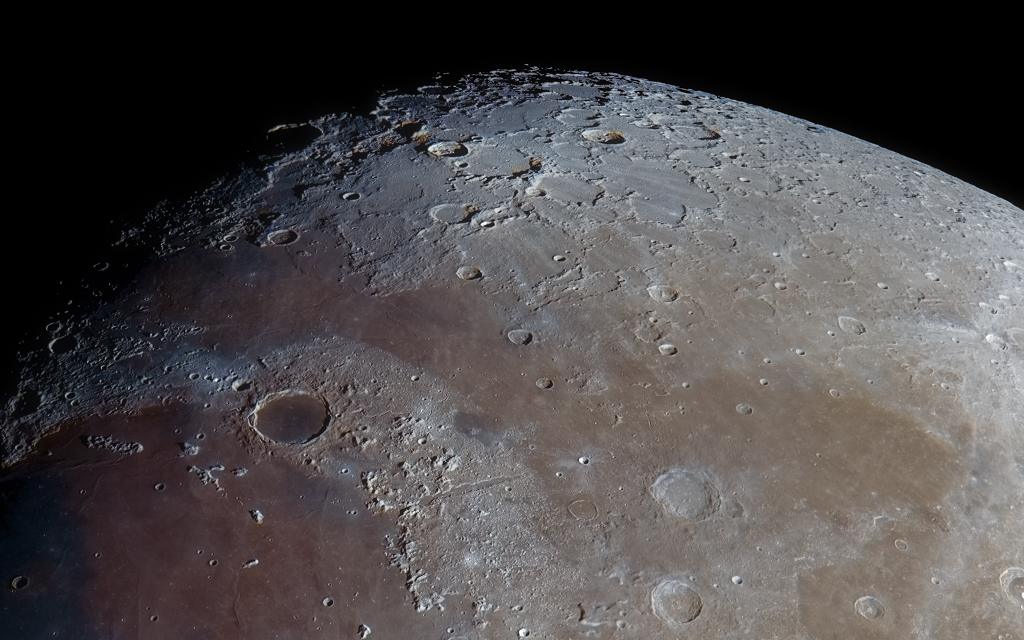
Lighter than typically dark, smooth, mare the Mare Frigoris lies in the far lunar north. Also known as the Sea of Cold, it stretches across the familiar lunar nearside in this close up of the waxing gibbous Moon’s north polar region. Dark-floored, 95 kilometer wide crater Plato is just left of the center. Sunlit peaks of the lunar Alps (Montes Alpes) are highlighted below and right of Plato, between the more southern Mare Imbrium (Sea of Rains) and Mare Frigoris. The prominent straight feature cutting through the mountains is the lunar Alpine Valley (Vallis Alpes). Joining the Mare Imbrium and Mare Frigoris, the lunar valley is about 160 kilometers long and up to 10 kilometers wide. [via NASA] https://ift.tt/3jSs9GQ

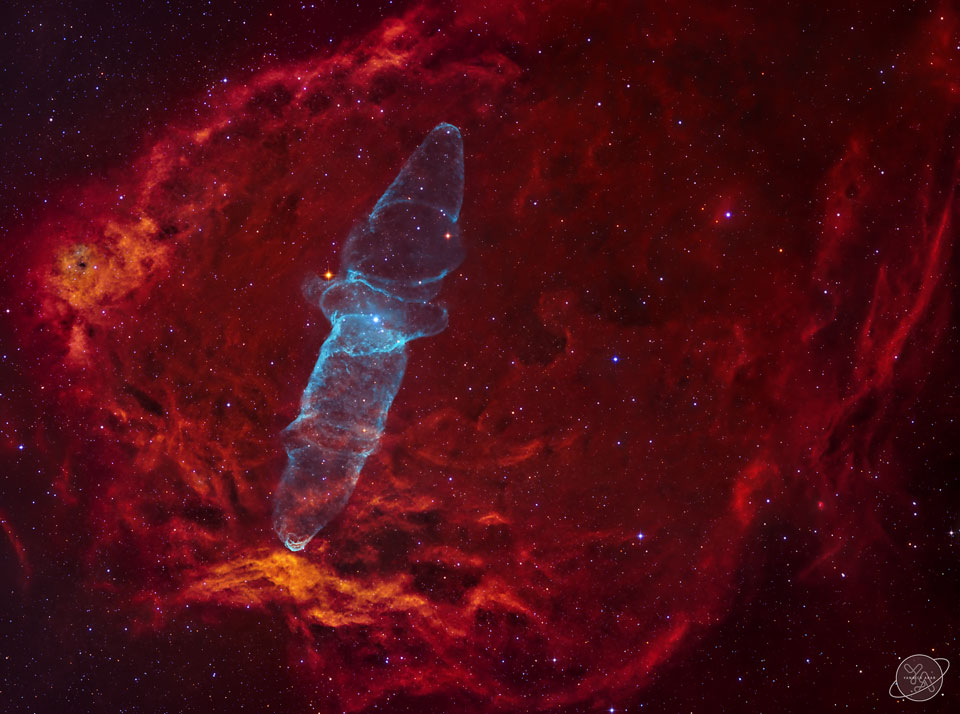
Ou4: A Giant Squid in a Flying Bat

A very faint but very large squid-like nebula is visible in planet Earth’s sky — but inside a still larger bat. The Giant Squid Nebula cataloged as Ou4, and Sh2-129 also known as the Flying Bat Nebula, are both caught in this cosmic scene toward the royal royal constellation Cepheus. Composed with 55 hours of narrowband image data, the telescopic field of view is 3 degrees or 6 Full Moons across. Discovered in 2011 by French astro-imager Nicolas Outters, the Squid Nebula’s alluring bipolar shape is distinguished here by the telltale blue-green emission from doubly ionized oxygen atoms. Though apparently completely surrounded by the reddish hydrogen emission region Sh2-129, the true distance and nature of the Squid Nebula have been difficult to determine. Still, a more recent investigation suggests Ou4 really does lie within Sh2-129 some 2,300 light-years away. Consistent with that scenario, Ou4 would represent a spectacular outflow driven by HR8119, a triple system of hot, massive stars seen near the center of the nebula. The truly giant Squid Nebula would physically be nearly 50 light-years across. [via NASA] https://ift.tt/2I4ZTmA

Mars Approach 2020

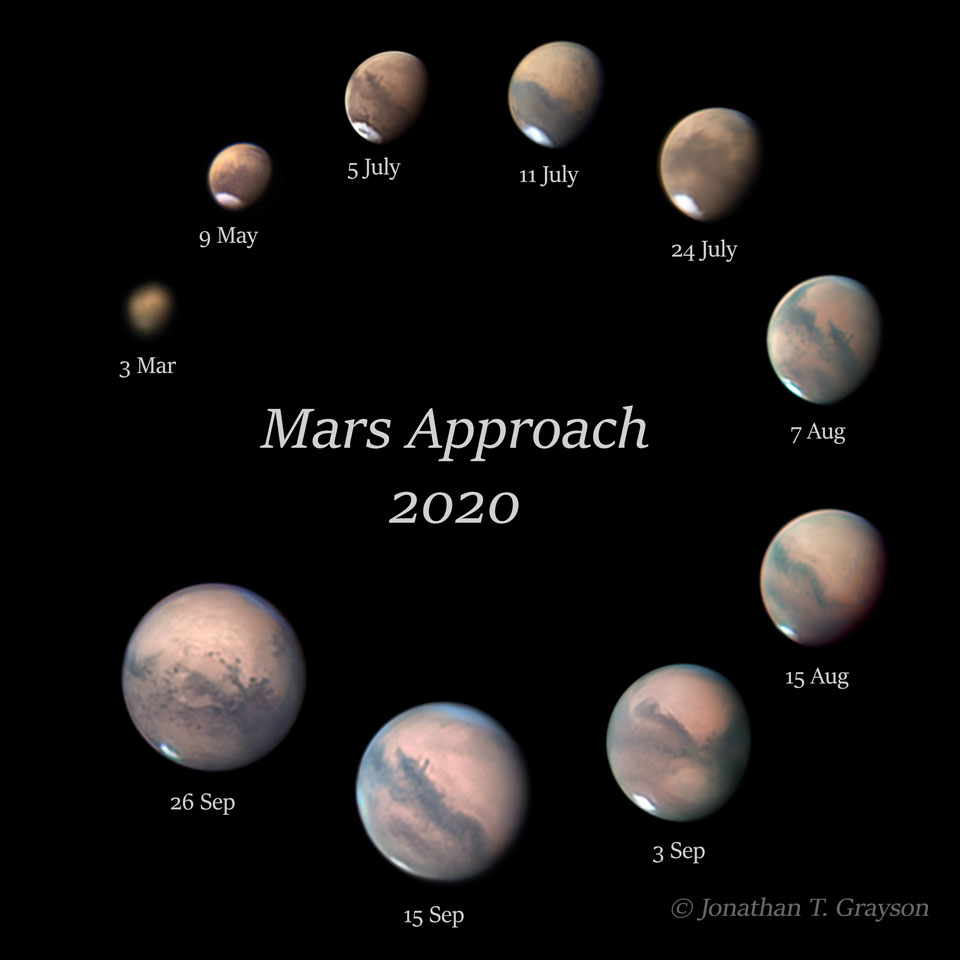
Look to the east just after sunset tonight and you’ll see a most impressive Mars. Tonight, Mars will appear its biggest and brightest of the year, as Earth passes closer to the red planet than it has in over two years — and will be again for another two years. In a week, Mars will be almost as bright — but at opposition, meaning that it will be directly opposite the Sun. Due to the slightly oval shape of the orbits of Mars and Earth, closest approach and opposition occur on slightly different days. The featured image sequence shows how the angular size of Mars has grown during its approach over the past few months. Noticeably orange, Mars is now visible nearly all night long, reflecting more sunlight toward Earth than either Saturn or Jupiter. Even at its closest and largest, though, Mars will still appear over 100 times smaller, in diameter, than a full moon. [via NASA] https://ift.tt/33yN8cn

NGC 5643: Nearby Spiral Galaxy from Hubble

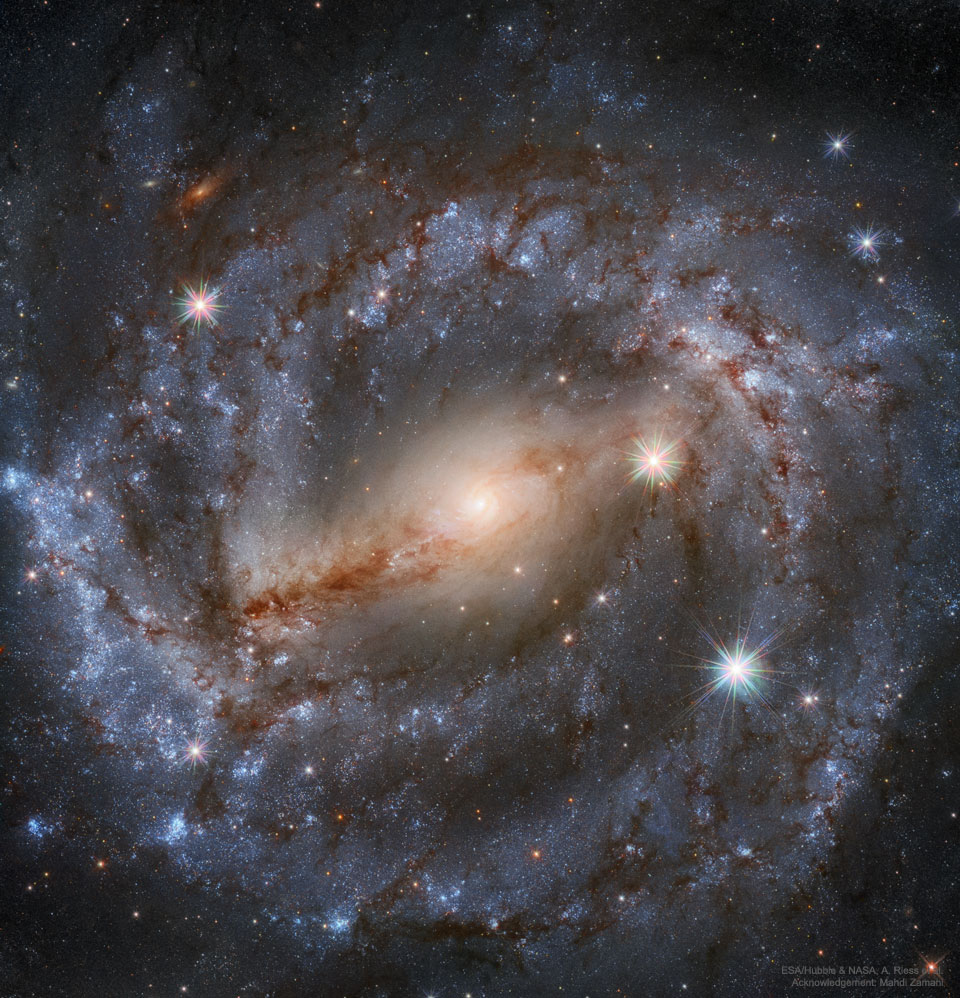
What’s happening at the center of spiral galaxy NGC 5643? A swirling disk of stars and gas, NGC 5643’s appearance is dominated by blue spiral arms and brown dust, as shown in the featured image taken by the Hubble Space Telescope. The core of this active galaxy glows brightly in radio waves and X-rays where twin jets have been found. An unusual central glow makes M106 one of the closest examples of the Seyfert class of galaxies, where vast amounts of glowing gas are thought to be falling into a central massive black hole. NGC 5643, is a relatively close 55 million light years away, spans about 100 thousand light years across, and can be seen with a small telescope towards the constellation of the Wolf (Lupus). [via NASA] https://ift.tt/34nlsWZ

Orion Nebula in Oxygen, Hydrogen, and Sulfur

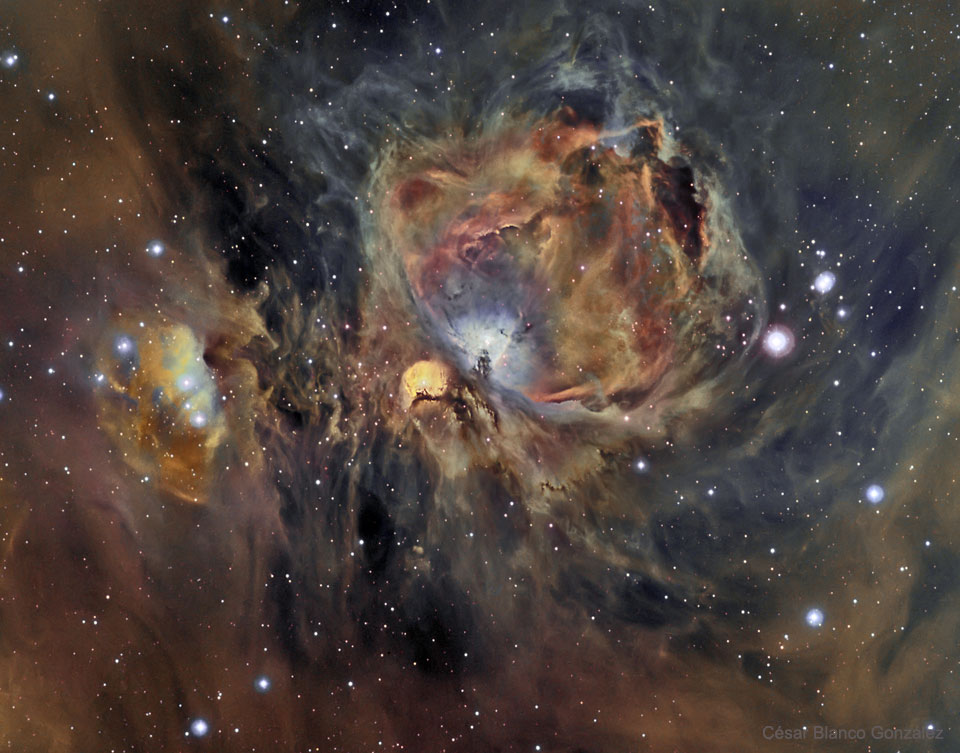
Few astronomical sights excite the imagination like the nearby stellar nursery known as the Orion Nebula. The Nebula’s glowing gas surrounds hot young stars at the edge of an immense interstellar molecular cloud. Many of the filamentary structures visible in the featured image are actually shock waves – fronts where fast moving material encounters slow moving gas. The Orion Nebula spans about 40 light years and is located about 1500 light years away in the same spiral arm of our Galaxy as the Sun. The Great Nebula in Orion can be found with the unaided eye just below and to the left of the easily identifiable belt of three stars in the popular constellation Orion. The image shows the nebula in three colors specifically emitted by hydrogen, oxygen, and sulfur gas. The whole Orion Nebula cloud complex, which includes the Horsehead Nebula, will slowly disperse over the next 100,000 years. [via NASA] https://ift.tt/2GB0bRc

Driving to the Sun

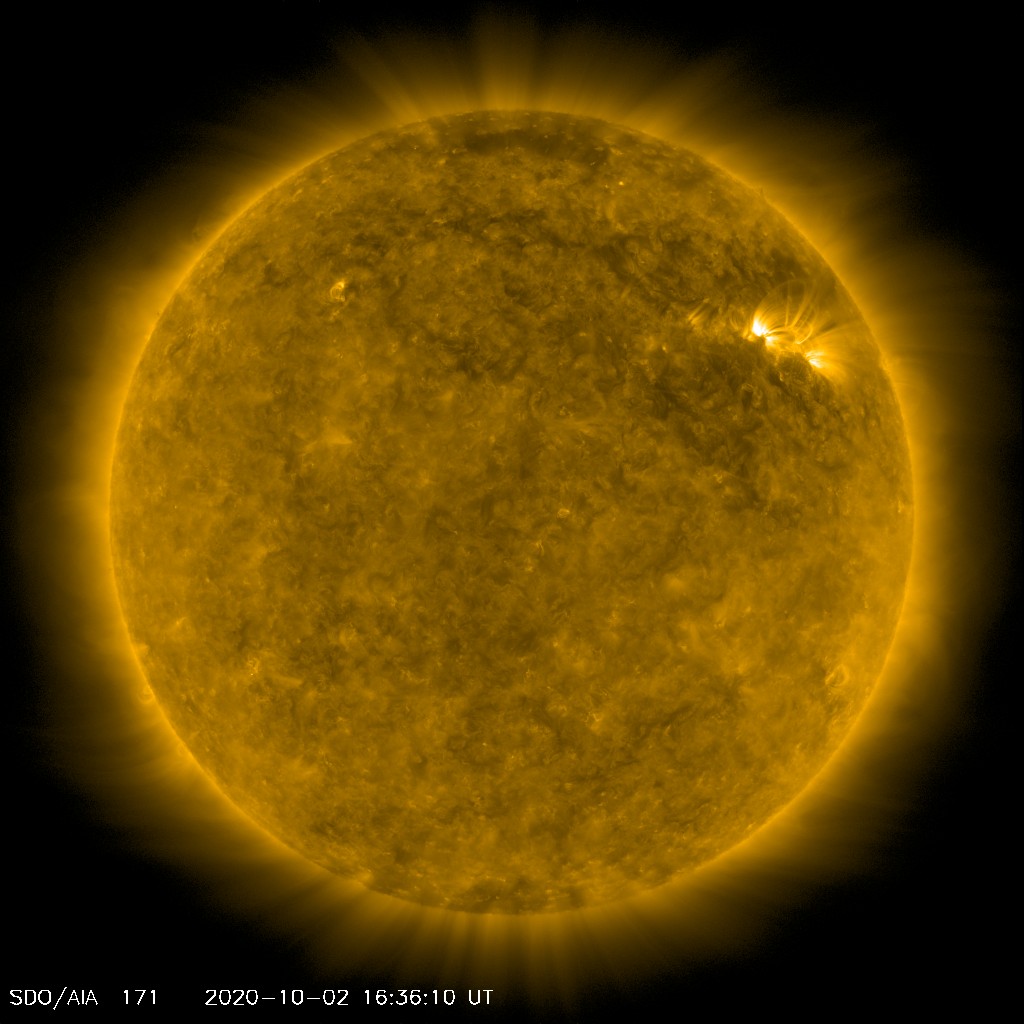
How long would it take to drive to the Sun? Brittany age 7, and D.J. age 12, ponder this question over dinner one evening. James also age 7, suggests taking a really fast racing car while Christopher age 4, eagerly agrees. Jerry, a really old guy who is used to estimating driving time on family trips based on distance divided by speed, offers to do the numbers. «Let’s see … the Sun is 93 million miles away. If we drove 93 miles per hour the trip would only take us 1 million hours.» How long is 1 million hours? One year is 365 days times 24 hours per day, or 8,760 hours. One hundred years would be 876,000 hours, but that’s still a little short of the 1 million hour drive time. So the Sun is really quite far away. Christopher is not impressed, but as he grows older he will be. You’ve got to be impressed by something that’s 93 million miles away and still hurts your eyes when you look at it! [via NASA] https://ift.tt/3jpozUI

Biking to the Moon

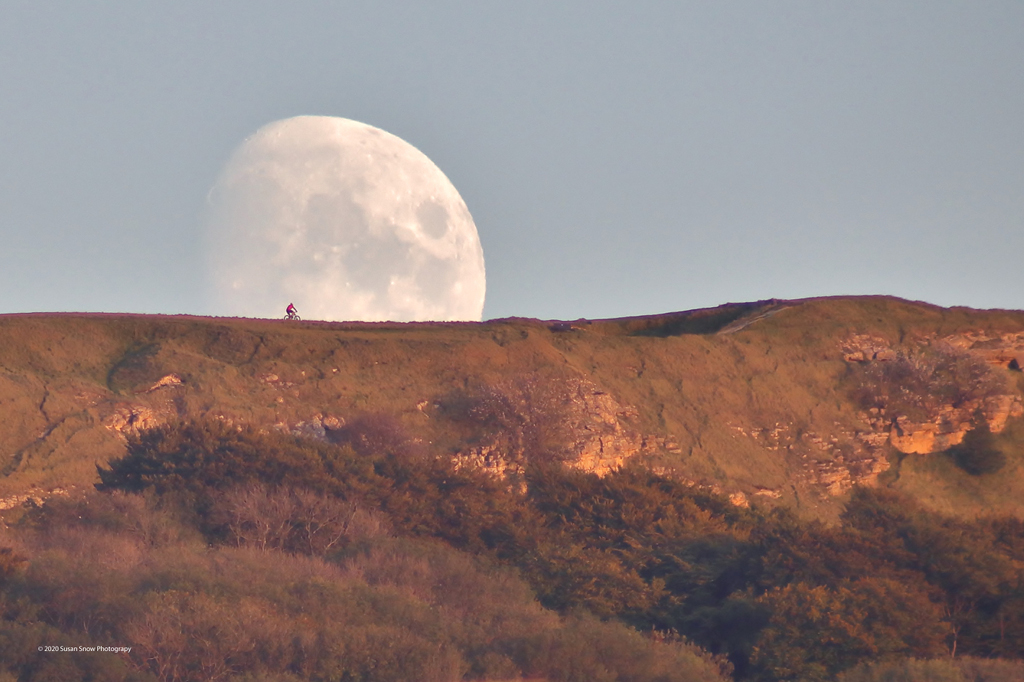
As you watched October’s first Full Moon rise last night, the Full Moon closest to the northern autumnal equinox, you were probably asking yourself, «How long would it take to bike to the Moon?» Sure, Apollo 11 astronauts made the trip in 1969, from launch to Moon landing, in about 103 hours or 4.3 days. But the Moon is 400,000 kilometers away. This year, the top bike riders in planet Earth’s well-known Tour de France race covered almost 3,500 kilometers in 21 stages after about 87 hours on the road. That gives an average speed of about 40 kilometers per hour and a lunar cycling travel time of 10,000 hours, a little over 416 days. While this bike rider’s destination isn’t clear, his journey did begin around moonrise on September 27 near Cleeve Hill, Bishops Cleeve, Cheltenham, UK. [via NASA] https://ift.tt/3kY6n4S

Solis Lacus: The Eye of Mars

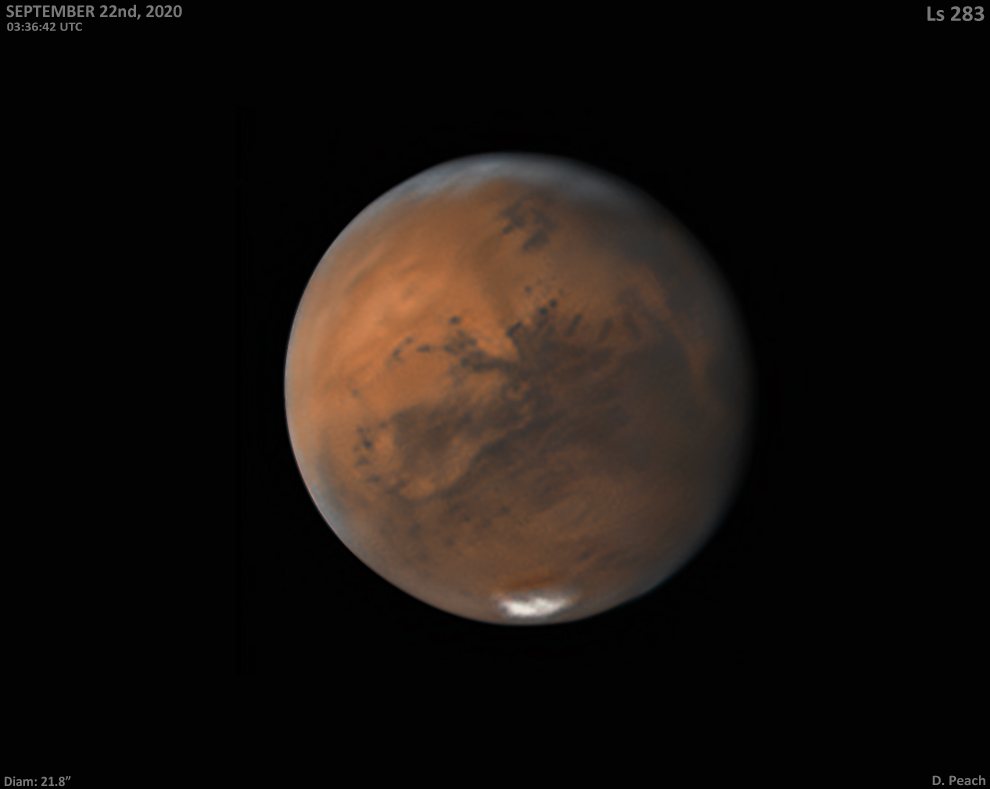
As telescopes around planet Earth watch, Mars is growing brighter in night skies, approaching its 2020 opposition on October 13. Mars looks like its watching too in this view of the Red Planet from September 22. Mars’ disk is already near its maximum apparent size for earthbound telescopes, less than 1/80th the apparent diameter of a Full Moon. The seasonally shrinking south polar cap is at the bottom and hazy northern clouds are at the top. A circular, dark albedo feature, Solis Lacus (Lake of the Sun), is just below and left of disk center. Surrounded by a light area south of Valles Marineris, Solis Lacus looks like a planet-sized pupil, famously known as The Eye of Mars . Near the turn of the 20th century, astronomer and avid Mars watcher Percival Lowell associated the Eye of Mars with a conjunction of canals he charted in his drawings of the Red Planet. Broad, visible changes in the size and shape of the Eye of Mars are now understood from high resolution surface images to be due to dust transported by winds in the thin Martian atmosphere. [via NASA] https://ift.tt/33jtLUp

Sonified: Eagle Nebula Pillars

Yes, but have you ever experienced the Eagle Nebula with your ears ? The famous nebula, M16, is best known for the feast it gives your eyes, highlighting bright young stars forming deep inside dark towering structures. These light-years long columns of cold gas and dust are some 6,500 light-years distant toward the constellation of the Serpent (Serpens). Sculpted and eroded by the energetic ultraviolet light and powerful winds from M16’s cluster of massive stars, the cosmic pillars themselves are destined for destruction. But the turbulent environment of star formation within M16, whose spectacular details are captured in this combined Hubble (visible) and Chandra (X-ray) image, is likely similar to the environment that formed our own Sun. In the featured video, listen for stars and dust sounding off as the line of sonification moves left to right, with vertical position determining pitch. [via NASA] https://ift.tt/2EOq2Vw