Magnetic Streamlines of the Milky Way

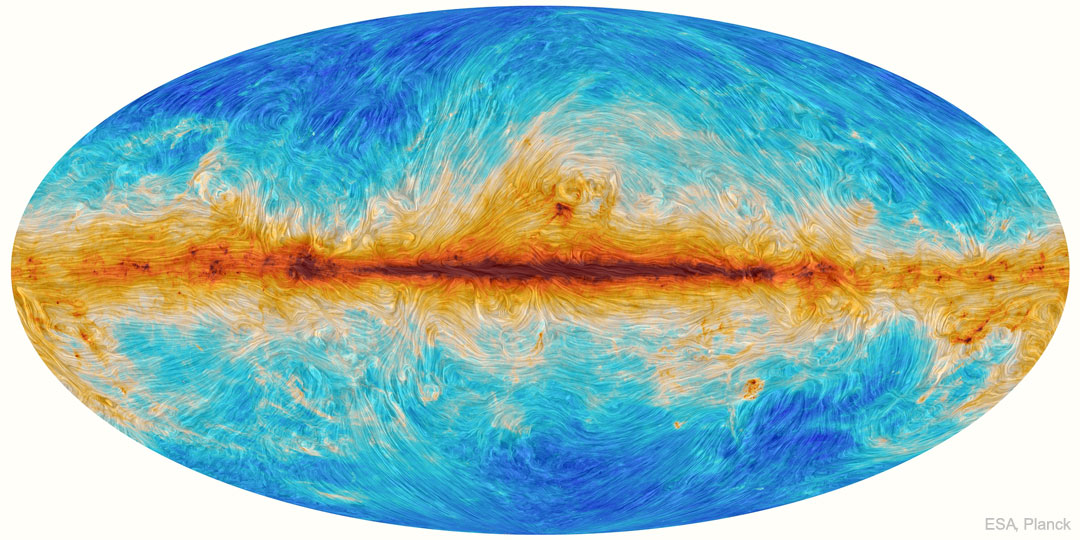
What role do magnetic fields play in interstellar physics? Analyses of observations by ESA’s Planck satellite of emission by small magnetically-aligned dust grains reveal previously unknown magnetic field structures in our Milky Way Galaxy — as shown by the curvy lines in the featured full-sky image. The dark red shows the plane of the Milky Way, where the concentration of dust is the highest. The huge arches above the plane are likely remnants of past explosive events from our Galaxy’s core, conceptually similar to magnetic loop-like structures seen in our Sun’s atmosphere. The curvy streamlines align with interstellar filaments of neutral hydrogen gas and provide tantalizing evidence that magnetic fields may supplement gravity in not only in shaping the interstellar medium, but in forming stars. How magnetism affected our Galaxy’s evolution will likely remain a topic of research for years to come. [via NASA] https://ift.tt/3hxyQ0l
APOD is 25 Years Old Today

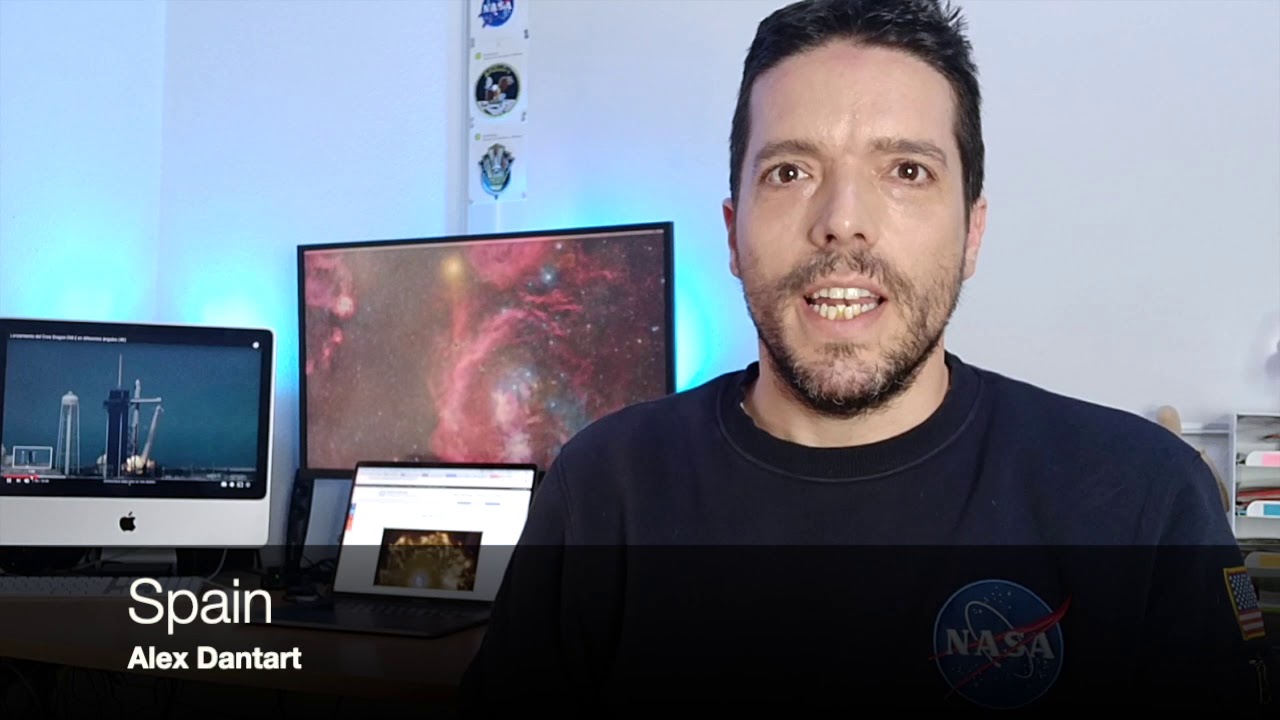
Welcome to the quadranscentennial year of the Astronomy Picture of the Day. Perhaps a source of consistency for some, APOD is still here. To help celebrate APOD’s Silver Anniversary, some of APOD’s TVAoTaSMD have recorded a birthday greeting and thanks to APOD’s readership in today’s featured video. Many have also highlighted a few of their favorite APOD images. In collaboration with NASA through APOD, these and other volunteers help to inform the world, in most major world languages and over most major media platforms, of NASA and humanity’s growing knowledge, active exploration, and inspiring visualizations of the amazing astronomical universe in which we live. APOD’s founders (still alive!) would also like to offer a sincere thank you — not only to our TVAoTaSMD — but to APOD’s readership for continued interest, support, and many gracious communications over the years. [via NASA] https://ift.tt/2YFMUwk

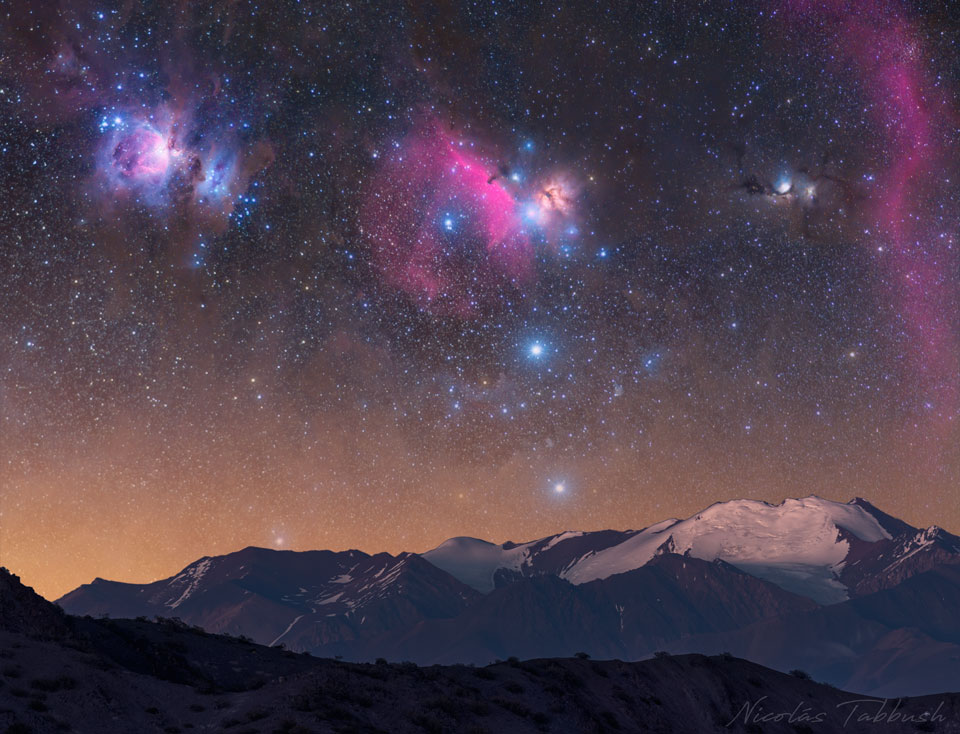
Orion over Argentine Mountains

Do you recognize the constellation of Orion? It may be harder than usual in today’s featured image because the camera has zoomed in on the center, and the exposure is long enough to enhance nebulas beyond what the unaided human eye can see. Still, once you become oriented, you can see Orion’s three belt stars lined up vertically near the image center, and even locate the familiar Orion Nebula on the upper left. Famous faint features that are also visible include the dark Horsehead Nebula indentation near the image center, and the dusty Flame Nebula just to its right. Part of the Orion-encircling Barnard’s Loop can also be found on the far right. The image combines multiple sky-tracking shots of the background in different colors with a single static foreground exposure taken at twilight — all captured with the same camera and from the same location. The picturesque scene was captured early last year from mountains in San Juan, Argentina. [via NASA] https://ift.tt/2MIQOPe

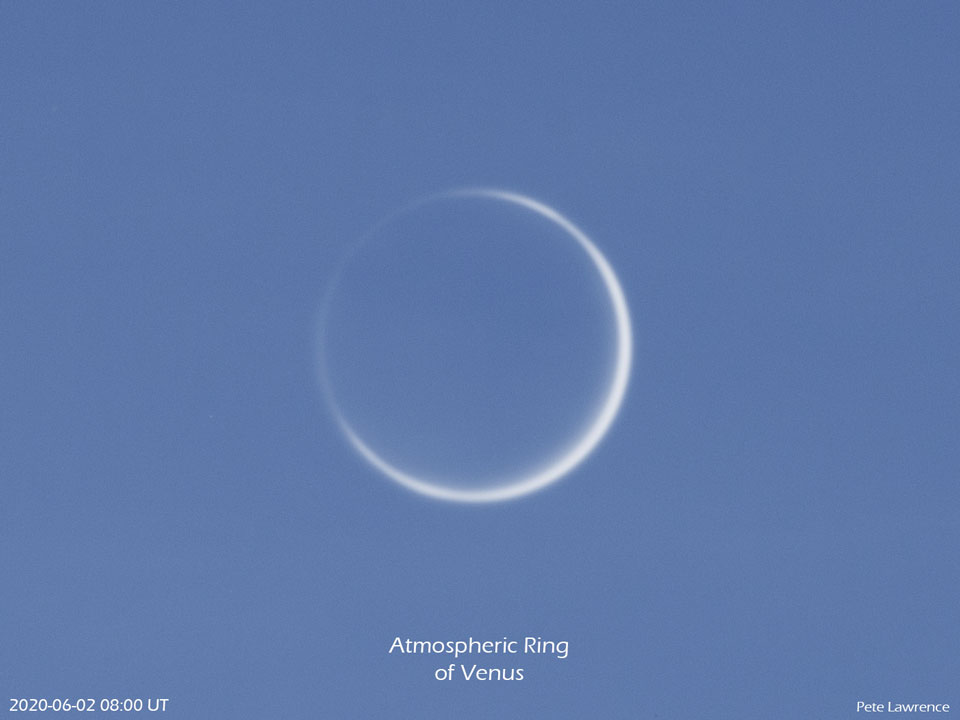
Atmospheric Ring of Venus

Why is Venus surrounded by a bright ring? Sometimes called a ring of fire, this rare ring is caused by the Sun’s light being visible all around an object. Usually seen around the Moon during an annular solar eclipse, the ring of fire is also visible when either Venus or Mercury cross the face of our Sun. In the featured pictured taken last week, though, Venus did not pass directly in front of the Sun — the complete atmospheric ring was caused by sunlight refracting through Venus’ thick atmosphere. Venus passed within one degree of the Sun during its inferior conjunction, as it moved from the evening to the morning sky.  The extreme brightness of the nearby Sun made capturing such an image very difficult — the featured image was only made possible by using a temporary filter to block direct sunlight. The image was captured from Thorton, Leicestershire, UK. The pervasive blue sky glow indicates that the image was actually captured during the day. [via NASA] https://ift.tt/3cFpGLO

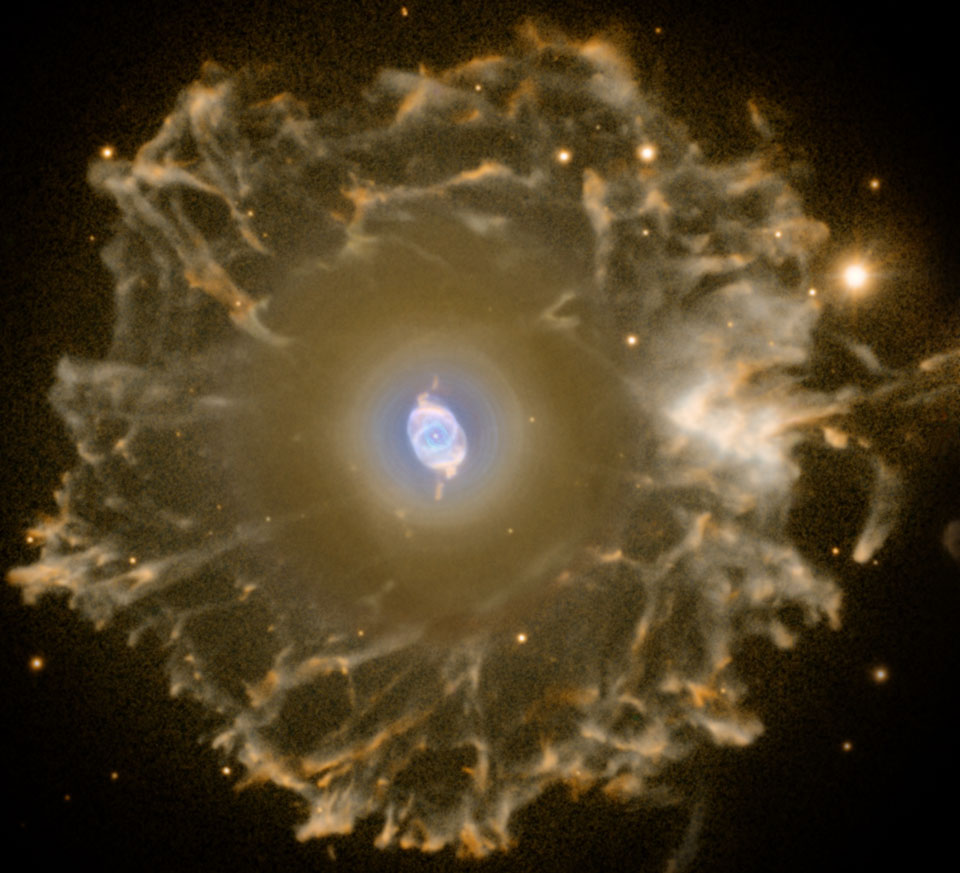
Halo of the Cats Eye

The Cat’s Eye Nebula (NGC 6543) is one of the best known planetary nebulae in the sky. Its haunting symmetries are seen in the very central region of this stunning false-color picture, processed to reveal the enormous but extremely faint halo of gaseous material, over three light-years across, which surrounds the brighter, familiar planetary nebula. Made with data from the Nordic Optical Telescope in the Canary Islands, the composite picture shows extended emission from the nebula. Planetary nebulae have long been appreciated as a final phase in the life of a Sun-like star. Only much more recently however, have some planetaries been found to have halos like this one, likely formed of material shrugged off during earlier active episodes in the star’s evolution. While the planetary nebula phase is thought to last for around 10,000 years, astronomers estimate the age of the outer filamentary portions of this halo to be 50,000 to 90,000 years. [via NASA] https://ift.tt/2A8S0Jb

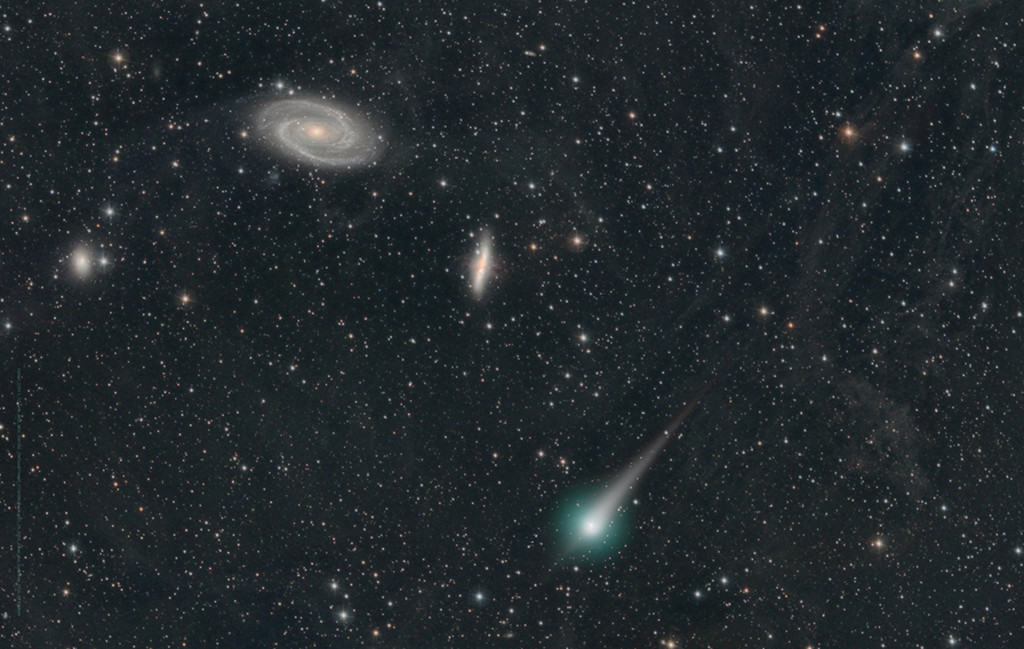
Comet PanSTARRs and the Galaxies

Comet PanSTARRs, C/2017 T2, shared this stunning telescopic field of view with galaxies M81 and M82 on May 22/23. Of course, the galaxies were some 12 million light-years distant and the comet about 14 light-minutes away, seen in planet Earth’s sky toward the Big Dipper. A new visitor from the Oort Cloud, this Comet PanSTARRs was discovered in 2017 by the PanSTARRs survey telescope when the comet was over 1 light-hour from the Sun, almost as distant as the orbit of Saturn. With a beautiful coma and dust tail, this comet has been a solid northern hemisphere performer for telescope wielding comet watchers this May, following its closest approach to the Sun on May 4. In this deep image from dark California skies the outbound comet even seems to develop a short anti-tail as it leaves the inner Solar System. [via NASA] https://ift.tt/2UfW3dy

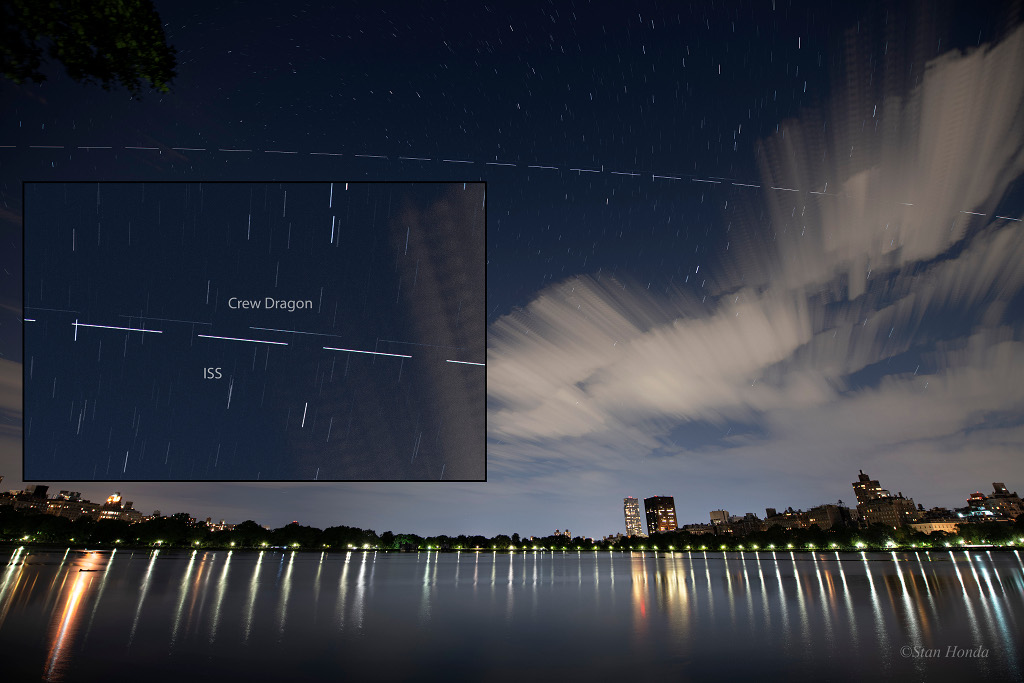
Dragon over Central Park

Still bathed in sunlight the International Space Station (ISS) arced through this Manhattan evening sky on May 30. Moving left to right, its bright trail was captured in this composite image with a series of 5 second long exposures. Stars left short trails and lights were reflected in still waters looking toward the north across the Central Park reservoir. Chasing the ISS in low Earth orbit the Crew Dragon spacecraft dubbed Endeavour also left a trail through that urban night. Seen about 6 hours after its launch the spacecraft’s faint trail appears above the ISS, shown in the inset just as the two approached the bank of clouds at the right. Dragon Endeavour docked successfully with the ISS about nineteen hours after reaching orbit. [via NASA] https://ift.tt/2BxBbrD

Portrait of NGC 3628

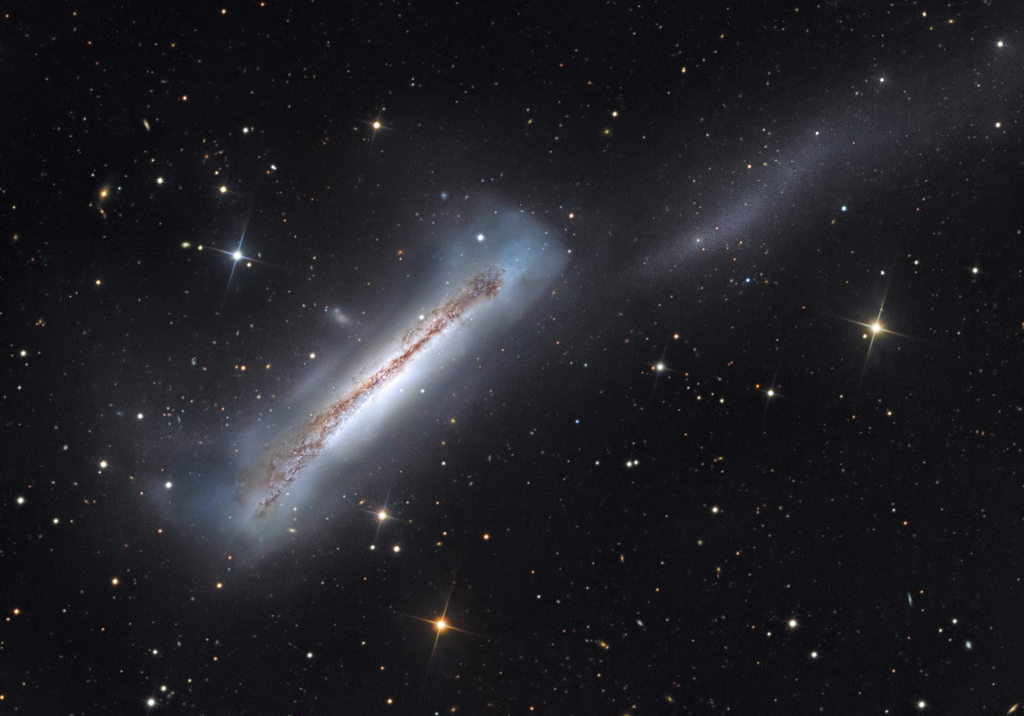
Sharp telescopic views of NGC 3628 show a puffy galactic disk divided by dark dust lanes. Of course, this deep portrait of the magnificent, edge-on spiral galaxy puts some astronomers in mind of its popular moniker, the Hamburger Galaxy. It also reveals a small galaxy nearby, likely a satellite of NGC 3628, and a faint but extensive tidal tail. The drawn out tail stretches for about 300,000 light-years, even beyond the right edge of the wide frame. NGC 3628 shares its neighborhood in the local universe with two other large spirals M65 and M66 in a grouping otherwise known as the Leo Triplet. Gravitational interactions with its cosmic neighbors are likely responsible for creating the tidal tail, as well as the extended flare and warp of this spiral’s disk. The tantalizing island universe itself is about 100,000 light-years across and 35 million light-years away in the northern springtime constellation Leo. [via NASA] https://ift.tt/2XtqsXR

The Dance of Venus and Earth

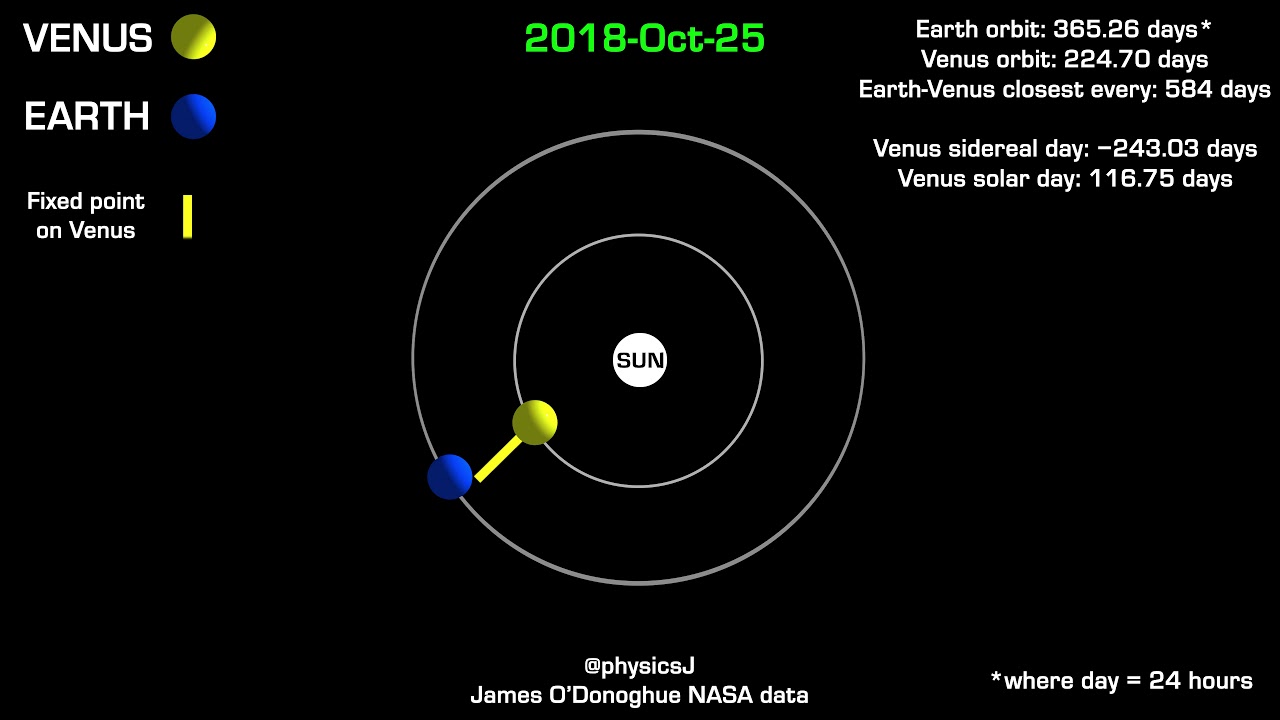
Every time Venus passes the Earth, it shows the same face. This remarkable fact has been known for only about 50 years, ever since radio telescopes have been able to peer beneath Venus’ thick clouds and track its slowly rotating surface. This inferior conjunction — when Venus and Earth are the closest — occurs today. The featured animation shows the positions of the Sun, Venus and Earth between 2010-2023 based on NASA-downloaded data, while a mock yellow ‘arm’ has been fixed to the ground on Venus to indicate rotation. The reason for this unusual 1.6-year resonance is the gravitational influence that Earth has on Venus, which surprisingly dominates the Sun’s tidal effect. If Venus could be seen through the Sun’s glare today, it would show just a very slight sliver of a crescent. Although previously visible in the evening sky, starting tomorrow, Venus will appear in the morning sky — on the other side of the Sun as viewed from Earth. [via NASA] https://ift.tt/2z2bWwS

Novel Coronavirus Attacks Humanity

Humanity is under attack. The attack is not from large tentacle-flailing aliens, but from invaders so small they can barely be seen, and so strange they are not even clearly alive. All over planet Earth, the human home world, DNA-based humans are being invaded by the RNA-based SARS-CoV2. The virus, which creates a disease known as COVID-19, specializes in reprogramming human cells into zombies that manufacture and release copies of itself. Pictured here is a high magnification image of a human cell covered by attacking novel coronavirus SARS-CoV2 (orange). Epic battles where two species square off in a fight to the death are not unusual on Earth, with several just involving humans typically ongoing at any time. Even so, most humans are predicted to survive. After several years, humanity expects to win this war — but only after millions of humans have died and trillions of coronaviruses have been destroyed. [via NASA] https://ift.tt/2zVaAo3