Sky Full of SARs

On August 11 a Rocket Lab Electron rocket launched from a rotating planet. With a small satellite on board its mission was dubbed A Sky Full of SARs (Synthetic Aperture Radar satellites), departing for low Earth orbit from Mahia Peninsula on New Zealand’s north island. The fiery trace of the Electron’s graceful launch arc is toward the east in this southern sea and skyscape, a composite of 50 consecutive frames taken over 2.5 hours. Fixed to a tripod, the camera was pointing directly at the South Celestial Pole, the extension of planet Earth’s axis of rotation in to space. But no bright star marks that location in the southern hemisphere’s night sky. Still, the South Celestial Pole is easy to spot. It lies at the center of the concentric star trail arcs that fill the skyward field of view. [via NASA] https://ift.tt/w5kRSFm

Meteor Borealis

A single exposure made with a camera pointed almost due north on August 12 recorded this bright Perseid meteor in the night sky west of Halifax, Nova Scotia, Canada. The meteor’s incandescent trace is fleeting. It appears to cross the stars of the Big Dipper, famous northern asterism and celestial kitchen utensil, while shimmering curtains of aurora borealis, also known as the northern lights, dance in the night. Doubling the wow factor for night skywatchers near the peak of this year’s Perseid meteor shower auroral activity on planet Earth was enhanced by geomagnetic storms. The intense space weather was triggered by flares from an active Sun. [via NASA] https://ift.tt/fdYPMGL

Late Night Vallentuna

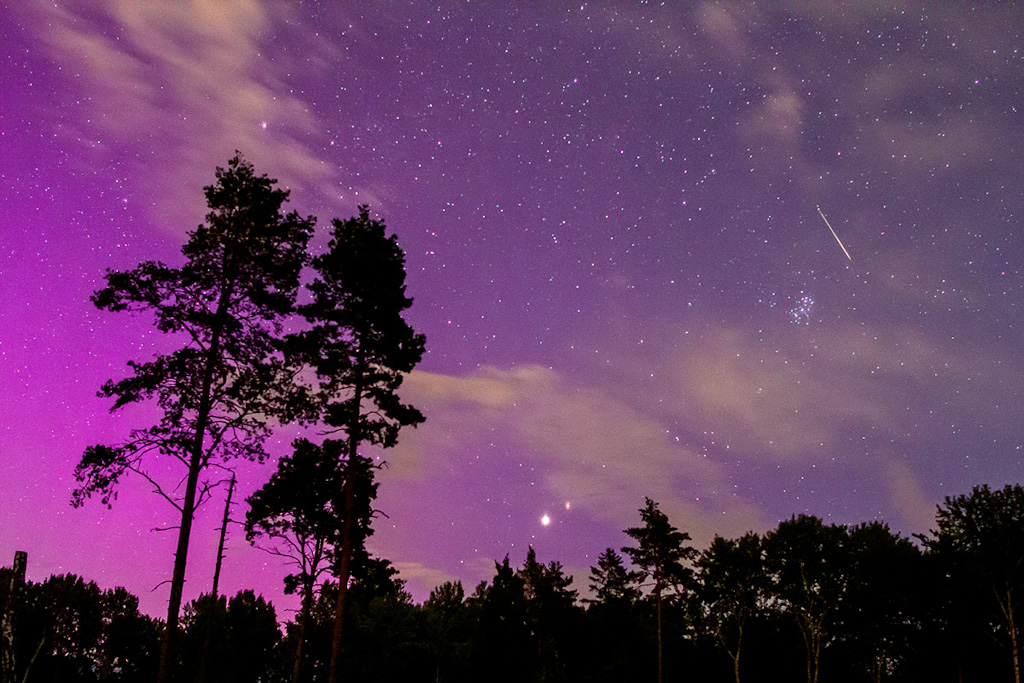
Bright Mars and even brighter Jupiter are in close conjunction just above the pine trees in this post-midnight skyscape from Vallentuna, Sweden. Taken on August 12 during a geomagnetic storm, the snapshot records the glow of aurora borealis or northern lights, beaming from the left side of the frame. Of course on that date Perseid meteors rained through planet Earth’s skies, grains of dust from the shower’s parent, periodic comet Swift-Tuttle. The meteor streak at the upper right is a Perseid plowing through the atmosphere at about 60 kilometers per second. Also well-known in in Earth’s night sky, the bright Pleides star cluster shines below the Perseid meteor streak. In Greek myth, the Pleiades were seven daughters of the astronomical titan Atlas and sea-nymph Pleione. The Pleiades and their parents’ names are given to the cluster’s nine brightest stars. [via NASA] https://ift.tt/ZtJyQSv

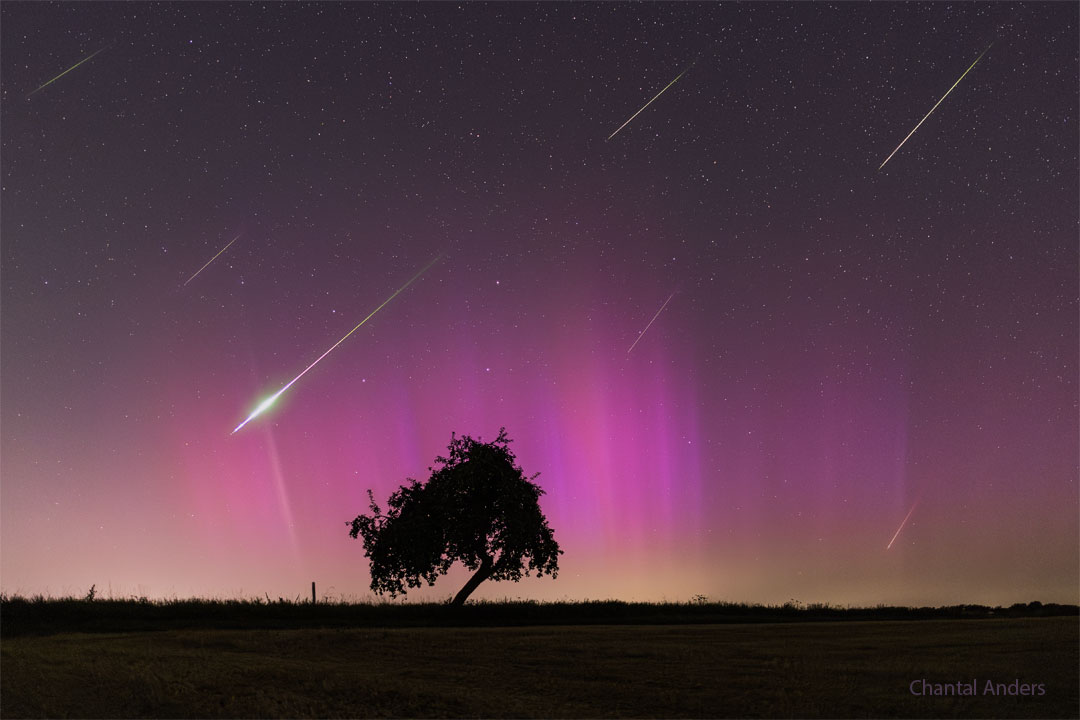
This was an unusual night. For one thing, the night sky of August 11 and 12, earlier this week, occurred near the peak of the annual Perseid Meteor Shower. Therefore, meteors streaked across the dark night as small bits cast off from Comet Swift-Tuttle came crashing into the Earth’s atmosphere. Even more unusually, for central Germany at least, the night sky glowed purple. The red-blue hue was due to aurora caused by an explosion of particles from the Sun a few days before. This auroral storm was so intense that it was seen as far south as Texas and Italy, in Earth’s northern hemisphere. The featured image composite was built from 7 exposures taken over 26 minutes from Ense, Germany. The Perseids occur predictably every August, but auroras visible this far south are more unusual and less predictable. [via NASA] https://ift.tt/0m8MSj2

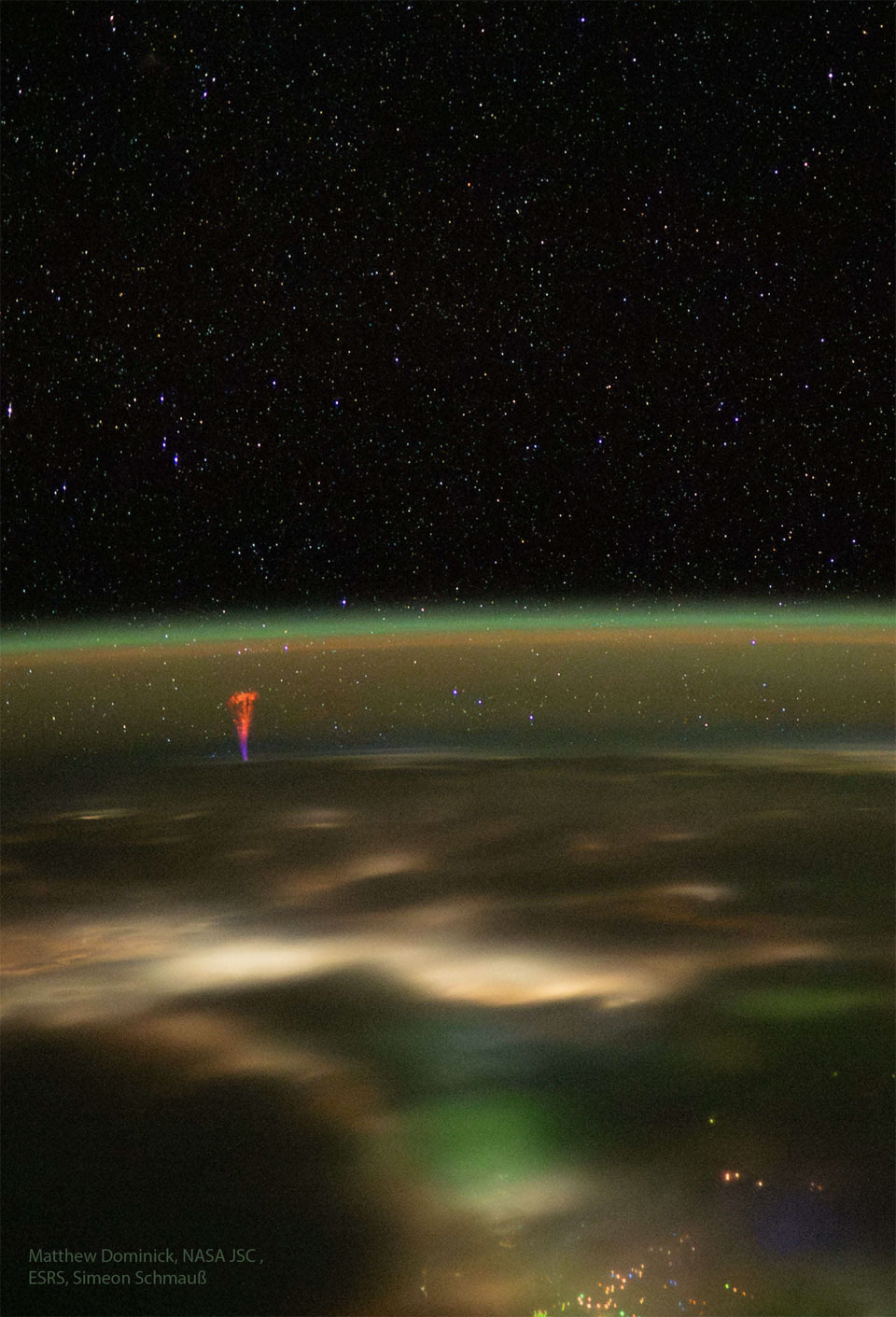
What’s that on the horizon? When circling the Earth on the International Space Station early last month, astronaut Matthew Dominick saw an unusual type of lightning just beyond the Earth’s edge: a gigantic jet. The powerful jet appears on the left of the featured image in red and blue. Giant jet lightning has only been known about for the past 23 years. The atmospheric jets are associated with thunderstorms and extend upwards towards Earth’s ionosphere. The lower part of the frame shows the Earth at night, with Earth’s thin atmosphere tinted green from airglow. City lights are visible, sometimes resolved, but usually creating diffuse white glows in intervening clouds. The top of the frame reveals distant stars in the dark night sky. The nature of gigantic jets and their possible association with other types of Transient Luminous Events (TLEs) such as blue jets and red sprites remains an active topic of research. [via NASA] https://ift.tt/E6oPfjc

What’s happening in the sky above Stonehenge? A meteor shower: specifically, the Perseid meteor shower. A few nights ago, after the sky darkened, many images of meteors from this year’s Perseids were captured separately and merged into a single frame. Although the meteors all traveled on straight paths, these paths appear slightly curved by the wide-angle lens of the capturing camera. The meteor streaks can all be traced back to a single point on the sky called the radiant, here just off the top of the frame in the constellation of Perseus. The same camera took a deep image of the background sky that brought up the central band of our Milky Way galaxy running nearly vertical through the image center. The featured image was taken from Wiltshire, England, being careful to include, at the bottom, the famous astronomical monument of Stonehenge. Although the Perseids peaked last night, some Perseid meteors should still be visible for a few more nights. [via NASA] https://ift.tt/Ie8MBX2

The Light, Dark, and Dusty Trifid

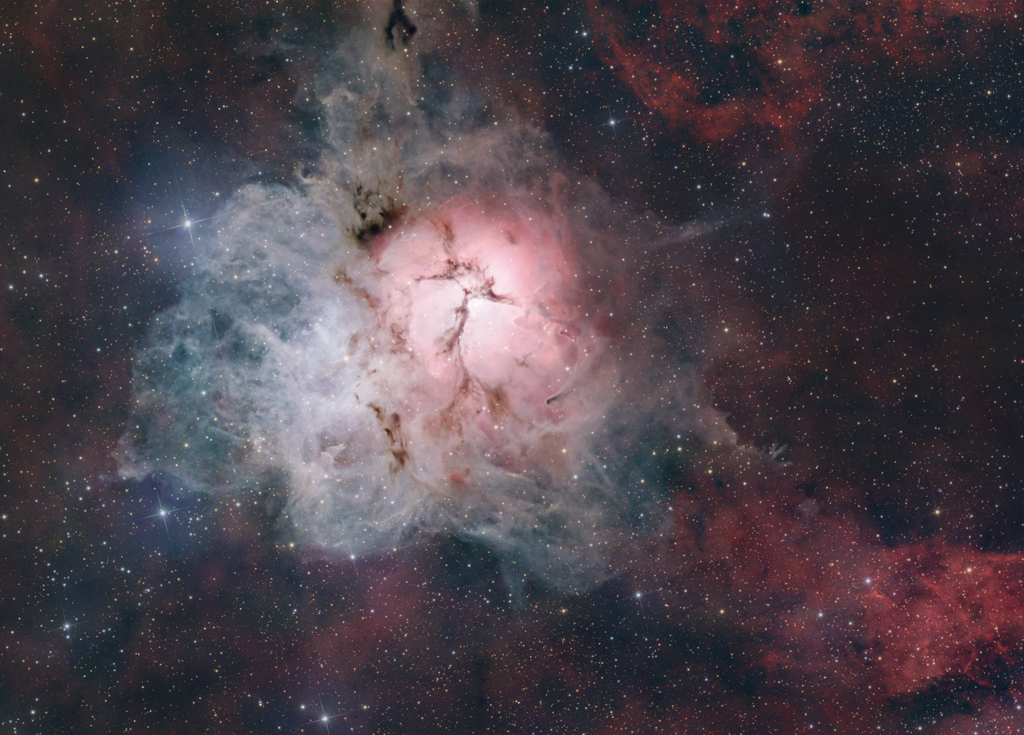
Messier 20, popularly known as the Trifid Nebula, lies about 5,000 light-years away toward the nebula rich constellation Sagittarius. A star forming region in the plane of our galaxy, the Trifid does illustrate three different types of astronomical nebulae; red emission nebulae dominated by light from hydrogen atoms, blue reflection nebulae produced by dust reflecting starlight, and dark nebulae where dense dust clouds appear in silhouette. The reddish emission region, roughly separated into three parts by obscuring dust lanes, is what lends the Trifid its popular name. The cosmic cloud complex is over 40 light-years across and would cover the area of a full moon on planet Earth’s sky. But the Trifid Nebula is too faint to be seen by the unaided eye. Over 75 hours of image data captured under dark night skies was used to create this stunning telescopic view. [via NASA] https://ift.tt/yV3iw5Q

A Perseid Below

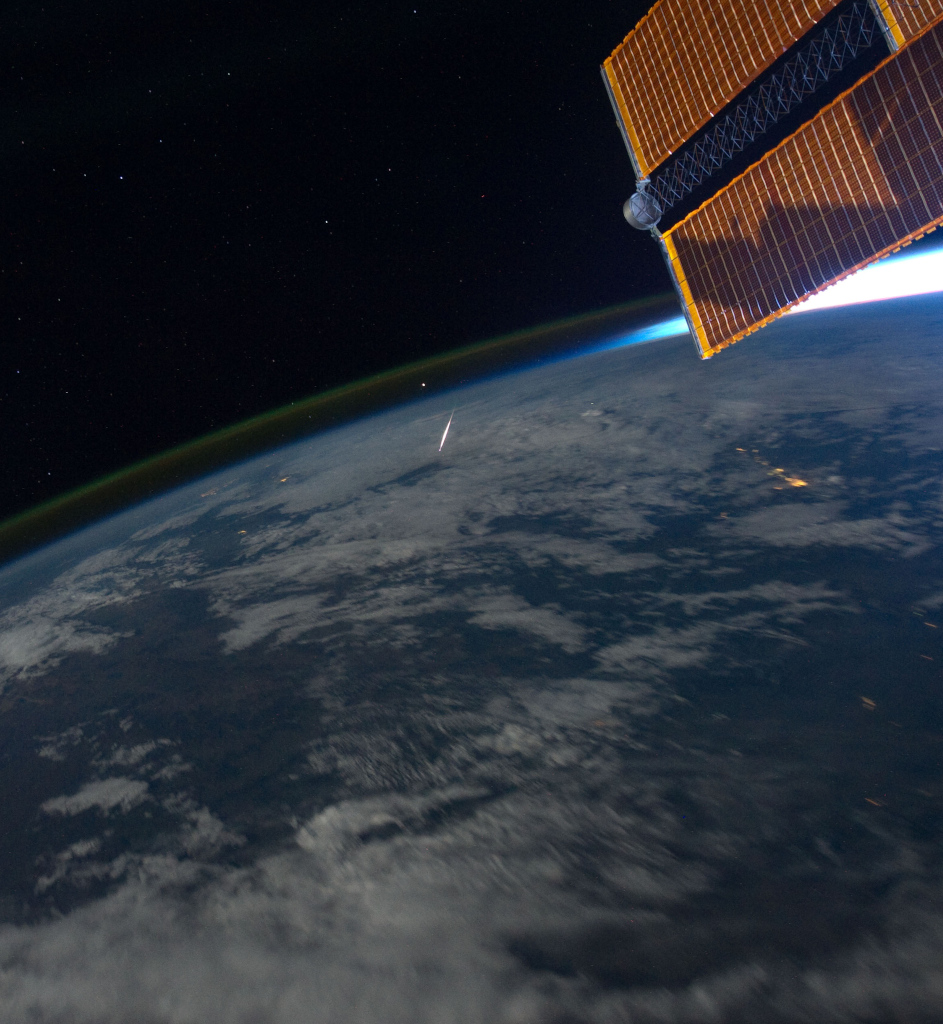
Denizens of planet Earth typically watch meteor showers by looking up. But this remarkable view, captured on August 13, 2011 by astronaut Ron Garan, caught a Perseid meteor by looking down. From Garan’s perspective on board the International Space Station orbiting at an altitude of about 380 kilometers, the Perseid meteors streak below, swept up dust from comet Swift-Tuttle. The vaporizing comet dust grains are traveling at about 60 kilometers per second through the denser atmosphere around 100 kilometers above Earth’s surface. In this case, the foreshortened meteor flash is near frame center, below the curving limb of the Earth and a layer of greenish airglow, just below bright star Arcturus. Want to look up at a meteor shower? You’re in luck, as the 2024 Perseid meteor shower is active now and predicted to peak near August 12. With interfering bright moonlight absent, this year you’ll likely see many Perseid meteors under clear, dark skies after midnight. [via NASA] https://ift.tt/zTuOmQM

Periodic Comet Swift Tuttle

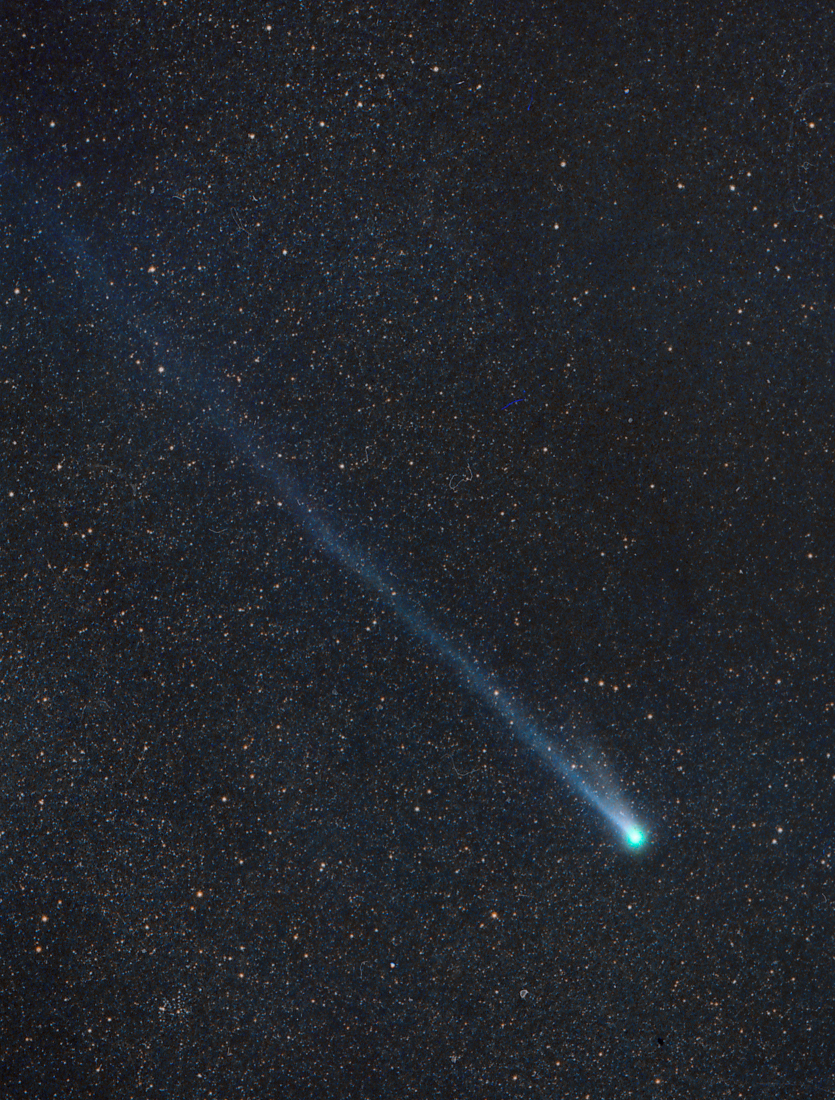
A Halley-type comet with an orbital period of about 133 years, Comet 109P/Swift-Tuttle is recognized as the parent of the annual Perseid Meteor Shower. The comet’s last visit to the inner Solar System was in 1992. Then, it did not become easily visible to the naked eye, but it did become bright enough to see from most locations with binoculars and small telescopes. This stunning color image of Swift-Tuttle’s greenish coma, long ion tail and dust tail was recorded using film on November 24, 1992. That was about 16 days after the large periodic comet’s closest approach to Earth. Comet Swift-Tuttle is expected to next make an impressive appearance in night skies in 2126. Meanwhile, dusty cometary debris left along the orbit of Swift-Tuttle will continue to be swept up creating planet Earth’s best-known July and August meteor shower. [via NASA] https://ift.tt/9Nq6Oiu

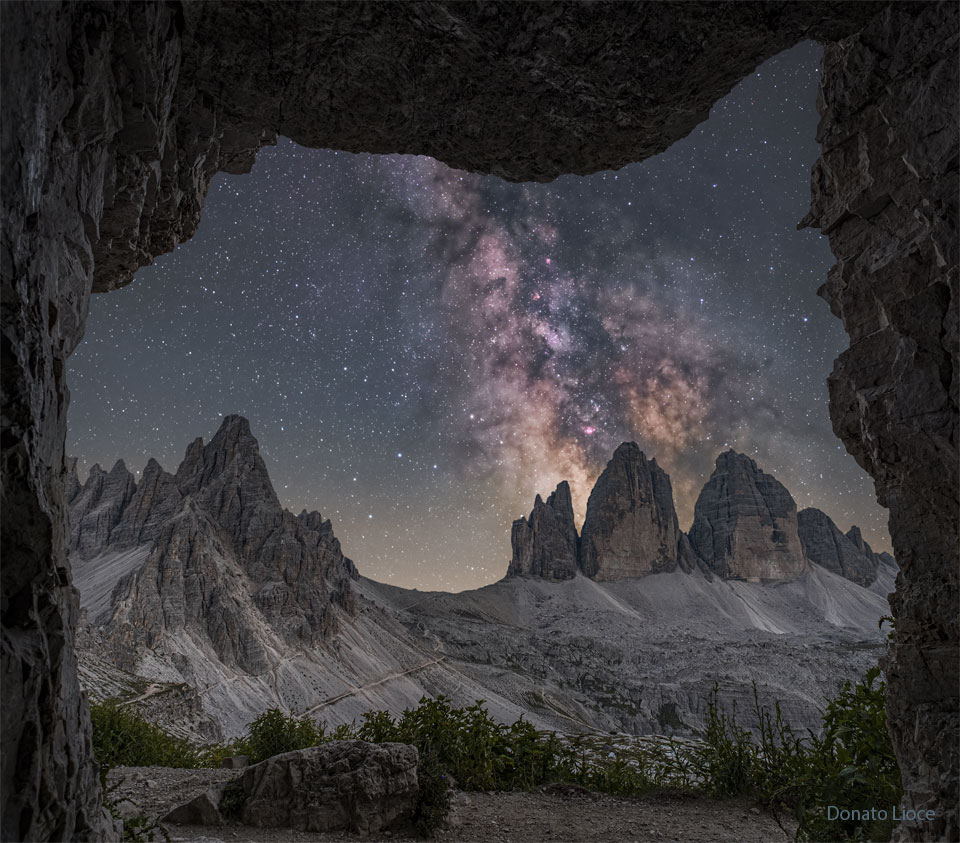
To some, they look like battlements, here protecting us against the center of the Milky Way. The Three Merlons, also called the Three Peaks of Lavaredo, stand tall today because they are made of dense dolomite rock which has better resisted erosion than surrounding softer rock. They formed about 250 million years ago and so are comparable in age with one of the great extinctions of life on Earth. A leading hypothesis is that this great extinction was triggered by an asteroid about 10-km across, larger in size than Mount Everest, impacting the Earth. Humans have gazed up at the stars in the Milky Way and beyond for centuries, making these battlefield-like formations, based in the Sexten Dolomites, a popular place for current and ancient astronomers. [via NASA] https://ift.tt/TOHzvCK