Milky Way, Launch, and Landing

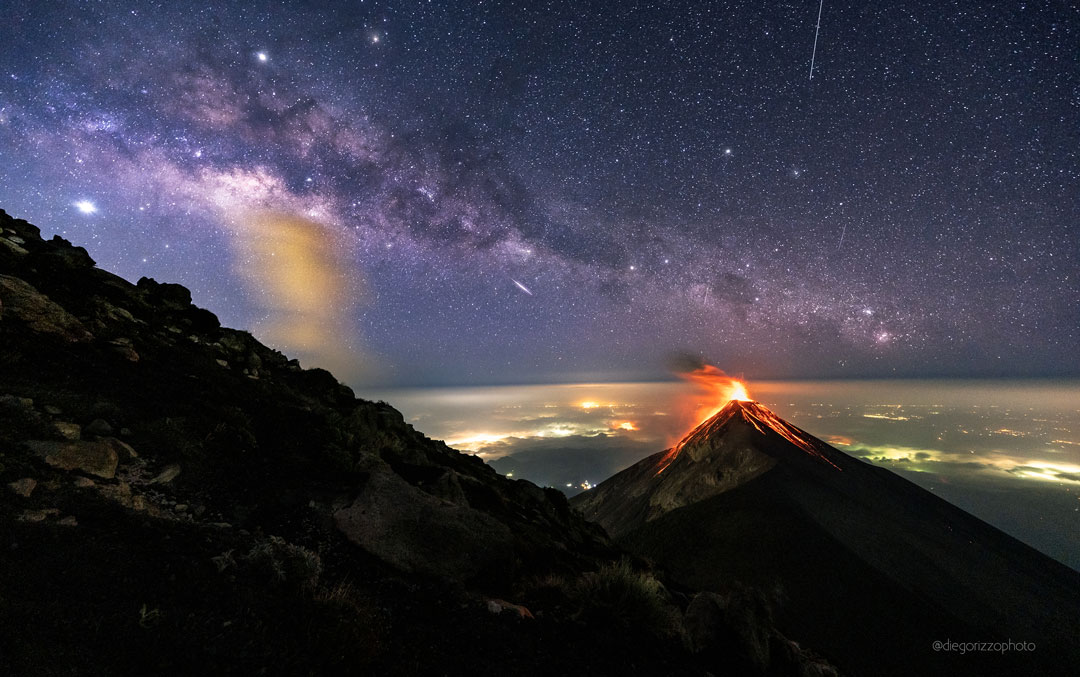
The Milky Way doesn’t look quite this colorful and bright to the eye, but a rocket launch does. So a separate deep exposure with a sensitive digital camera was used in this composite skyscape to bring out our galaxy’s central crowded starfields and cosmic dust clouds. In the scene from Merritt Island National Wildlife Refuge, a nine minute long exposure begun about 20 minutes after the Miky Way image recorded a rocket launch and landing. The Falcon 9 rocket, named for the Millennium Falcon of Star Wars fame, appropriately launched a Dragon resupply ship to the International Space Station in the early morning hours of May the 4th. The plume and flare at the peak of the launch arc mark the rocket’s first stage boost back burn. Two shorter diagonal streaks are the rocket engines bringing the Falcon 9 stage back to an offshore landing on autonomous drone ship Of course I Still Love You. [via NASA] https://go.nasa.gov/2vQMwgz

Halley Dust and Milky Way

Grains of cosmic dust streaked through the mostly moonless night skies of May 7. Swept up as planet Earth plowed through the debris streams left behind by periodic Comet Halley, the annual meteor shower is known as the Eta Aquarids. Though it was made about a day after the shower’s predicted maximum, this composite image still captures 20 meteors in exposures taken over a 2 hour period, registered on a background exposure of the sky. The meteor trails point back to the shower radiant near eponymous faint star Eta Aquarii close to the horizon, seen from 100 kilometers south of Sydney Australia. Known for speed, Eta Aquarid meteors move fast, entering the atmosphere at about 66 kilometers per second. Brilliant Jupiter shines near the central bulge of the Milky Way high above the horizon. The Southern Cross is just tucked in to the upper right corner of the frame. [via NASA] https://go.nasa.gov/2YoPe9f

The Great Nebula in Carina

What’s happening in the center of the Carina Nebula? Stars are forming, dying, and leaving an impressive tapestry of dark dusty filaments. The entire Carina Nebula, cataloged as NGC 3372, spans over 300 light years and lies about 8,500 light-years away in the constellation of Carina. The nebula is composed predominantly of hydrogen gas, which emits the pervasive red glow seen in this highly detailed featured image. The blue glow in the center is created by a trace amount of glowing oxygen. Young and massive stars located in the nebula’s center expel dust when they explode in supernovae. Eta Carinae, the most energetic star in the nebula’s center, was one of the brightest stars in the sky in the 1830s, but then faded dramatically. [via NASA] https://go.nasa.gov/2vFXMfD

Virtual Flyby of the Whirlpool Galaxy

What would it look like to fly over a spiral galaxy? To help visualize this, astronomers and animators at the Space Telescope Science Institute computed a virtual flyby of the Whirlpool Galaxy (M51) using data and images from the Hubble Space Telescope. At only 25 million light years distant and fully 50 thousand light years across, the Whirlpool is one of the brightest and most picturesque galaxies on the sky. Visible during the virtual flyby are spiral arms dominated by young blue stars, older lighter-colored stars, dark lanes of dust, and bright red emission nebulae. Many galaxies far in the distance can be seen right through M51. The visualization should be considered a time-lapse, because otherwise the speed of the virtual camera would need to be very near the speed of light. [via NASA] https://go.nasa.gov/2vBhyZE

Saturn, Titan, Rings, and Haze

This is not a solar eclipse. Pictured here is a busy vista of moons and rings taken at Saturn. The large circular object in the center of the image is Titan, the largest moon of Saturn and one of the most intriguing objects in the entire Solar System. The dark spot in the center is the main solid part of the moon. The bright surrounding ring is atmospheric haze above Titan, gas that is scattering sunlight to a camera operating onboard the robotic Cassini spacecraft. Cutting horizontally across the image are the rings of Saturn, seen nearly edge on. At the lower right of Titan is Enceladus, a small moon of Saturn. Since the image was taken pointing nearly at the Sun, the surfaces of Titan and Enceladus appear in silhouette, and the rings of Saturn appear similar to a photographic negative. Now if you look really really closely at Enceladus, you can see a hint of icy jets shooting out toward the bottom of the image. It is these jets that inspired future proposals to land on Enceladus, burrow into the ice, and search for signs of extraterrestrial life. [via NASA] https://go.nasa.gov/2LlskxP

Saturn and the Da Vinci Glow

On February 2nd early morning risers saw Saturn near an old Moon low on the eastern horizon. On that date bright planet, sunlit crescent, and faint lunar night side were captured in this predawn skyscape from Bursa, Turkey. Of course the Moon’s ashen glow is earthshine, earthlight reflected from the Moon’s night side. A description of earthshine, in terms of sunlight reflected by Earth’s oceans illuminating the Moon’s dark surface, was written over 500 years ago by Leonardo da Vinci. On May 2nd an old Moon also rose in the predawn twilight. On that date its ashen glow shared the sky with Venus, the brilliant morning star. May 2nd also marked the 500th anniversary of Leonardo’s death in 1519. [via NASA] https://go.nasa.gov/2VjwJWN

Manicouagan Impact Crater from Space

Orbiting 400 kilometers above Quebec, Canada, planet Earth, the International Space Station Expedition 59 crew captured this snapshot of the broad St. Lawrence River and curiously circular Lake Manicouagan on April 11. Right of center, the ring-shaped lake is a modern reservoir within the eroded remnant of an ancient 100 kilometer diameter impact crater. The ancient crater is very conspicuous from orbit, a visible reminder that Earth is vulnerable to rocks from space. Over 200 million years old, the Manicouagan crater was likely caused by the impact of a rocky body about 5 kilometers in diameter. Currently, there is no known asteroid with a significant probability of impacting Earth in the next century. But a fictional scenario to help practice for an asteroid impact is on going at the 2019 IAA Planetary Defense Conference. [via NASA] https://go.nasa.gov/2DIsj0O

The Cats Eye Nebula in Optical and Xray

To some it looks like a cat’s eye. To others, perhaps like a giant cosmic conch shell. It is actually one of brightest and most highly detailed planetary nebula known, composed of gas expelled in the brief yet glorious phase near the end of life of a Sun-like star. This nebula’s dying central star may have produced the outer circular concentric shells by shrugging off outer layers in a series of regular convulsions. The formation of the beautiful, complex-yet-symmetric inner structures, however, is not well understood. The featured image is a composite of a digitally sharpened Hubble Space Telescope image with X-ray light captured by the orbiting Chandra Observatory. The exquisite floating space statue spans over half a light-year across. Of course, gazing into this Cat’s Eye, humanity may well be seeing the fate of our sun, destined to enter its own planetary nebula phase of evolution … in about 5 billion years. [via NASA] https://go.nasa.gov/2URMn6i

N11: Star Clouds of the LMC

Massive stars, abrasive winds, mountains of dust, and energetic light sculpt one of the largest and most picturesque regions of star formation in the Local Group of Galaxies. Known as N11, the region is visible on the upper right of many images of its home galaxy, the Milky Way neighbor known as the Large Magellanic Clouds (LMC). The featured image was taken for scientific purposes by the Hubble Space Telescope and reprocessed for artistry by an amateur to win a Hubble’s Hidden Treasures competition. Although the section imaged above is known as NGC 1763, the entire N11 emission nebula is second in LMC size only to the Tarantula Nebula. Compact globules of dark dust housing emerging young stars are also visible around the image. A new study of variable stars in the LMC with Hubble has helped to recalibrate the distance scale of the observable universe, but resulted in a slightly different scale than found using the pervasive cosmic microwave background. [via NASA] https://go.nasa.gov/2PBumZ8

The Galaxy, the Jet and the Black Hole

Bright elliptical galaxy Messier 87 (M87) is home to the supermassive black hole captured by planet Earth’s Event Horizon Telescope in the first ever image of a black hole. Giant of the Virgo galaxy cluster about 55 million light-years away, M87 is the large galaxy rendered in blue hues in this infrared image from the Spitzer Space telescope. Though M87 appears mostly featureless and cloud-like, the Spitzer image does record details of relativistic jets blasting from the galaxy’s central region. Shown in the inset at top right, the jets themselves span thousands of light-years. The brighter jet seen on the right is approaching and close to our line of sight. Opposite, the shock created by the otherwise unseen receding jet lights up a fainter arc of material. Inset at bottom right, the historic black hole image is shown in context, at the center of giant galaxy and relativistic jets. Completely unresolved in the Spitzer image, the supermassive black hole surrounded by infalling material is the source of the enormous energy driving the relativistic jets from the center of active galaxy M87. [via NASA] https://go.nasa.gov/2GGntln