NGC 1333: Stellar Nursery in Perseus

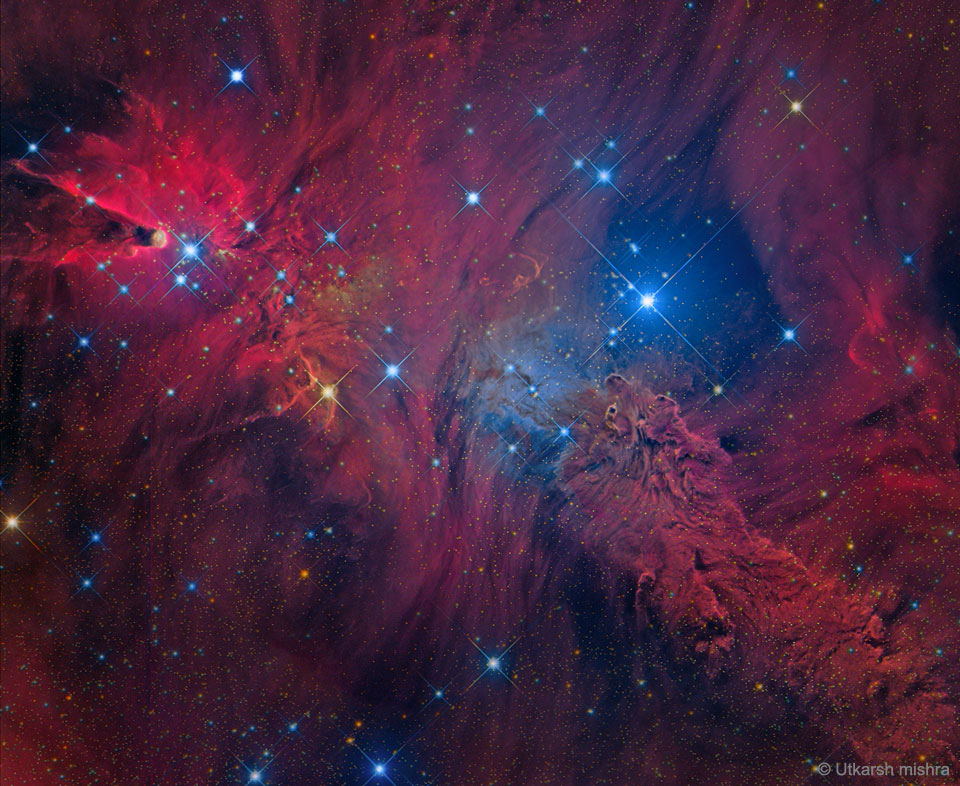
NGC 1333 is seen in visible light as a reflection nebula, dominated by bluish hues characteristic of starlight reflected by interstellar dust. A mere 1,000 light-years distant toward the heroic constellation Perseus, it lies at the edge of a large, star-forming molecular cloud. This striking close-up spans about two full moons on the sky or just over 15 light-years at the estimated distance of NGC 1333. It shows details of the dusty region along with telltale hints of contrasty red emission from Herbig-Haro objects, jets and shocked glowing gas emanating from recently formed stars. In fact, NGC 1333 contains hundreds of stars less than a million years old, most still hidden from optical telescopes by the pervasive stardust. The chaotic environment may be similar to one in which our own Sun formed over 4.5 billion years ago. [via NASA] https://ift.tt/2HJK03l

Arp 194: Merging Galaxy Group

Why are stars forming in the bridge between these colliding galaxies? Usually when galaxies crash, star formation is confined to galaxy disks or tidal tails. In Arp 194, though, there are bright knots of young stars right in a connecting bridge. Analyses of images and data including the featured image of Arp 194 from Hubble, as well as computer simulations of the interaction, indicate that the bottom galaxy passed right through the top galaxy within the past 100 million years. The result has left a stream of gas that is now falling toward the bottom galaxy. Astronomers hypothesize that stars form in this bridge because of the recent fading of turbulence after the rapid collision. In about a billion years, the galaxies — including a smaller galaxy superposed on the upper galaxy (see it?) — will all merge into one larger galaxy. [via NASA] https://ift.tt/2CDpNZ1

Zooming in on Star Cluster Terzan 5

Globular clusters once ruled the Milky Way. Back in the old days, back when our Galaxy first formed, perhaps thousands of globular clusters roamed our Galaxy. Today, there are less than 200 left. Over the eons, many globular clusters were destroyed by repeated fateful encounters with each other or the Galactic center. Surviving relics are older than any Earth fossil, older than any other structures in our Galaxy, and limit the universe itself in raw age. There are few, if any, young globular clusters in our Milky Way Galaxy because conditions are not ripe for more to form. The featured video shows what it might look like to go from the Earth to the globular cluster Terzan 5, ending with a picture of the cluster taken with the Hubble Space Telescope. This star cluster has been found to contain not only stars formed in the early days of our Milky Way Galaxy, but also, quite surprisingly, others that formed in a separate burst of star formation about 7 billion years later. [via NASA] https://ift.tt/2TRMxPD

Four Towers and the Equinox Moon

The first Full Moon of northern spring rises behind four distant towers in this telescopic view. In an image captured from some 40 kilometers west of the city of Madrid, this moonrise also represents a near coincidence of the full lunar phase with lunar perigee and the March equinox. Close to the horizon, the Full Moon’s strangely rippled and distorted shape has more to do with the long sight-line through a layered atmosphere, though. Tantalizing visible effects of the substantial atmospheric refraction include the appearance of a thin floating sliver just above the lunar disk. The remarkable optical mirage is related to the more commonly witnessed green flash of the setting Sun. [via NASA] https://ift.tt/2U943Ow

A Symphony in Northern Winter Skies

Despite the cold, a chance to view the shimmering northern lights coaxed this skygazer onto the frozen surface of Lake Superior on the west coast of the Keweenaw Peninusla and offered this nocturnal crescendo as a reward. A northern late winter night sky also plays across the panoramic composition of images made between 10pm and 1am on the night of February 28/March 1. At left, a faint band of Zodiacal light rises sharply from the horizon crossing Mars and the Pleides star cluster. Both the distant galaxy M31 and our own Milky Way shine above the greenish auroral arc. Navigational north pole star Polaris is centered above and accompanied on the right by the northern night’s most recognizable asterism, the Big Dipper. Terrestrial lights include markers for two breakwaters on the the horizon near the center of the scene. [via NASA] https://ift.tt/2FrNgOu

Star Trails and the Equinox Sunrise

Stars trail and the Sun rises in this night and day composite panorama made on March 19. The view looks toward the eastern horizon from La Nava de Santiago, Spain. To create it, a continuous series of digital frames was recorded for about two hours and combined to trace the concentric motion of the stars through the night sky. A reflection of the Earth’s rotation, star trails curve around the north celestial pole toward upper left and the south celestial pole toward the lower right. Of course on that day the Sun was near the celestial equator, a diagonal straight line in the wide-angle projection. A dense dimming filter was used to capture the Sun’s image every two minutes. Superimposed on the star trails it rose due east in the morning sky. In the scene, foreground landscape and a local prehistoric monument were illuminated by full moonlight, though. The monument’s corridor faces nearly to the east and the equinox sunrise. [via NASA] https://ift.tt/2WaUxrz

Equinox on Planet Earth

Welcome to an equinox on planet Earth. Today is the first day of spring in our fair planet’s northern hemisphere, fall in the southern hemisphere, with day and night nearly equal around the globe. At an equinox Earth’s terminator, the dividing line between day and night, connects the planet’s north and south poles as seen at the start of this remarkable time-lapse video compressing an entire year into twelve seconds. To make it, the Meteosat satellite recorded these infrared images every day at the same local time from a geosynchronous orbit. The video actually starts at the September 2010 equinox with the terminator aligned vertically. As the Earth revolves around the Sun, the terminator tilts to provide less daily sunlight to the northern hemisphere, reaching the solstice and northern hemisphere winter at the maximum tilt. As the year continues, the terminator tilts back again and March 2011 equinox arrives halfway through the video. Then the terminator swings past vertical the other way, reaching the the June 2011 solstice and the beginning of northern summer. The video ends as the September equinox returns. [via NASA] https://ift.tt/2Joytbm

Abell 370: Galaxy Cluster Gravitational Lens

What are those strange arcs? While imaging the cluster of galaxies Abell 370, astronomers noticed an unusual arc. The arc wasn’t understood right away — not until better images showed that the arc was a previously unseen type of astrophysical artifact of a gravitational lens, where the lens was the center of an entire cluster of galaxies. Today, we know that this arc, the brightest arc in the cluster, actually consists of two distorted images of a fairly normal galaxy that happens to lie far in the distance. Abell 370’s gravity caused the background galaxies’ light — and others — to spread out and come to the observer along multiple paths, not unlike a distant light appears through the stem of a wine glass. Almost all of the yellow images featured here are galaxies in the Abell 370 cluster. An astute eye can pick up many strange arcs and distorted arclets, however, that are actually gravitationally lensed images of distant normal galaxies. Studying Abell 370 and its images gives astronomers a unique window into the distribution of normal and dark matter in galaxy clusters and the universe. [via NASA] https://ift.tt/2Tcf90R

Horsehead and Orion Nebulas

The dark Horsehead Nebula and the glowing Orion Nebula are contrasting cosmic vistas. Adrift 1,500 light-years away in one of the night sky’s most recognizable constellations, they appear in opposite corners of the above stunning two-panel mosaic. The familiar Horsehead nebula appears as a dark cloud on the lower left, a small silhouette notched against the glow of hydrogen (alpha) gas, here tinted orange. Alnitak is the easternmost star in Orion’s belt and can be found to the left of the Horsehead. Below Alnitak is the Flame Nebula, with clouds of bright emission and dramatic dark dust lanes. The magnificent emission region, the Orion Nebula (aka M42), lies at the upper right, surrounded by the blue glow of reflecting dust. Immediately to its left is a prominent reflection nebula sometimes called the Running Man. Pervasive tendrils of glowing hydrogen gas are easily traced throughout the region. [via NASA] https://ift.tt/2Y4gWIX

NGC 3324 in Carina

This bright cosmic cloud was sculpted by stellar winds and radiation from the hot young stars of open cluster NGC 3324. With dust clouds in silhouette against its glowing atomic gas, the pocket-shaped star-forming region actually spans about 35 light-years. It lies some 7,500 light-years away toward the nebula rich southern constellation Carina. A composite of narrowband image data, the telescopic view captures the characteristic emission from ionized sulfur, hydrogen, and oxygen atoms mapped to red, green, and blue hues in the popular Hubble Palette. For some, the celestial landscape of bright ridges of emission bordered by cool, obscuring dust along the right side create a recognizable face in profile. The region’s popular name is the Gabriela Mistral Nebula for the Nobel Prize winning Chilean poet. [via NASA] https://ift.tt/2ULHY5C