Moon Pi and Mountain Shadow

What phase of the Moon is 3.14 radians from the Sun? The Full Moon, of course. Even though the Moon might look full for several days, the Moon is truly at its full phase when it is Pi radians (aka 180 degrees) from the Sun in ecliptic longitude. That’s opposite the Sun in planet Earth’s sky. Rising as the Sun set on March 9, 2020, only an hour or so after the moment of its full phase, this orange tinted and slightly flattened Moon still looked full. It was photographed opposite the setting Sun from Teide National Park on the Canary Island of Tenerife. Also opposite the setting Sun, seen from near the Teide volcano peak about 3,500 meters above sea level, is the mountain’s rising triangular shadow extending into Earth’s dense atmosphere. Below the distant ridge line on the left are the white telescope domes of Teide Observatory. Today, March 14 2025, the moon is Pi radians from the Sun at exactly 06:55 UTC. That’s about three minutes before the midpoint of the March Full Moon’s total lunar eclipse. [via NASA] https://ift.tt/vGTdB0f

The Protostars within Lynds 483

Two protostars are hidden in a single pixel near the center of a striking hourglass-shaped nebula in this near-infrared image from the James Webb Space Telescope. The actively forming star system lies in a dusty molecular cloud cataloged as Lynds 483, some 650 light-years distant toward the constellation Serpens Cauda. Responsible for the stunning bipolar outflows, the collapsing protostars have been blasting out collimated energetic jets of material over tens of thousands of years. Webb’s high-resolution view shows the violence of star-formation in dramatic detail as twisting shock fronts expand and collide with slower, denser material. The premier close-up of the star-forming region spans less than 1/2 a light-year within dark nebula Lynds 483. [via NASA] https://ift.tt/41YGdDU

Why does this galaxy look like a curly vegetable? The Fiddlehead spiral galaxy likely gets its distorted spiral appearance from a gravitational interaction with its close-by elliptical companion NGC 770, seen just below. Cataloged as NGC 772 and Arp 78, the Fiddlehead spans over 200,000 light years, is a nearby 100 million light years beyond the stars of our Milky Way galaxy, and is visible toward the constellation of the Ram (Aries). But in the featured image, the Fiddlehead appears to have another companion — one with a long and fuzzy tail: Comet 43P/Wolf-Harrington. Though the comet appears to be aimed straight at the massive galaxy, it is actually much closer to us, residing only light minutes away — well within our Solar System. The comet will never reach the distant spiral galaxy, nor is it physically related to it. By a fortunate trick of perspective, though, these two cosmic wonders briefly share the same frame taken late last year from Calern, France. [via NASA] https://ift.tt/EmU93C1

Many spiral galaxies have bars across their centers. Even our own Milky Way Galaxy is thought to have a modest central bar. Prominently barred spiral galaxy NGC 1672, featured here, was captured in spectacular detail in an image taken by the orbiting Hubble Space Telescope. Visible are dark filamentary dust lanes, young clusters of bright blue stars, red emission nebulas of glowing hydrogen gas, a long bright bar of stars across the center, and a bright active nucleus that likely houses a supermassive black hole. Light takes about 60 million years to reach us from NGC 1672, which spans about 75,000 light years across. NGC 1672, which appears toward the constellation of the Dolphinfish (Dorado), has been studied to find out how a spiral bar contributes to star formation in a galaxy’s central regions. [via NASA] https://ift.tt/NCGpgxF

Could Queen Calafia’s mythical island exist in space? Perhaps not, but by chance the outline of this molecular space cloud echoes the outline of the state of California, USA. Our Sun has its home within the Milky Way’s Orion Arm, only about 1,000 light-years from the California Nebula. Also known as NGC 1499, the classic emission nebula is around 100 light-years long. On the featured image, the most prominent glow of the California Nebula is the red light characteristic of hydrogen atoms recombining with long lost electrons, stripped away (ionized) by energetic starlight. The star most likely providing the energetic starlight that ionizes much of the nebular gas is the bright, hot, bluish Xi Persei just to the right of the nebula. A regular target for astrophotographers, the California Nebula can be spotted with a wide-field telescope under a dark sky toward the constellation of Perseus, not far from the Pleiades. [via NASA] https://ift.tt/GtIDJh3

Why are there so many cyclones around the north pole of Jupiter? The topic is still being researched. NASA’s robotic Juno mission orbiting Jupiter took data in 2018 that was used to construct this stunning view of the curious cyclones at Jupiter’s north pole. Measuring the thermal emission from Jovian cloud tops, the infrared observations are not restricted to the hemisphere illuminated by sunlight. They reveal eight cyclonic features that surround a cyclone about 4,000 kilometers in diameter, just offset from the giant planet’s geographic north pole. Similar data show a cyclone at the Jovian south pole with five circumpolar cyclones. The south pole cyclones are slightly larger than their northern cousins. Oddly, data from the once Saturn-orbiting Cassini mission has shown that Saturn’s north and south poles each have only a single cyclonic storm system. [via NASA] https://ift.tt/skJ0w4a

Galaxies in Space

The plane of our Milky Way galaxy extends beyond the limb of planet Earth in this space age exposure captured by astronaut Don Pettit. His camera, with low light and long duration settings, was pointed out the window of a Dragon crew spacecraft docked with the International Space Station on January 29. The orbital outpost was at an altitude of about 400 kilometers above the Pacific Ocean at the time. Motion blurs the Earth below, while the gorgeous view from low Earth orbit includes the Milky Way’s prominent satellite galaxies, known as the Large and Small Magellanic Clouds, near the upper left in the frame. Fans of southern skies can also spot the Southern Cross. The four brightest stars of the famous southern constellation Crux are near picture center, just beyond the edge of the bright horizon and shining through Earth’s orange tinted atmospheric glow. [via NASA] https://ift.tt/o4wrgha

Planetary Nebula Abell 7

Very faint planetary nebula Abell 7 is about 1,800 light-years distant. It lies just south of Orion in planet Earth’s skies toward the constellation Lepus, The Hare. Surrounded by Milky Way stars and near the line-of-sight to distant background galaxies its generally simple spherical shape, about 8 light-years in diameter, is revealed in this deep telescopic image. Within the cosmic cloud are beautiful and complex structures though, enhanced by the use of long exposures and narrowband filters that capture emission from hydrogen, sulfur, and oxygen atoms. Otherwise Abell 7 would be much too faint to be appreciated by eye. A planetary nebula represents a very brief final phase in stellar evolution that our own Sun will experience 5 billion years hence, as the nebula’s central, once sun-like star shrugs off its outer layers. Abell 7 itself is estimated to be 20,000 years old. But its central star, seen here as a fading white dwarf, is some 10 billion years old. [via NASA] https://ift.tt/1FpoGI5

Starburst Galaxy Messier 94

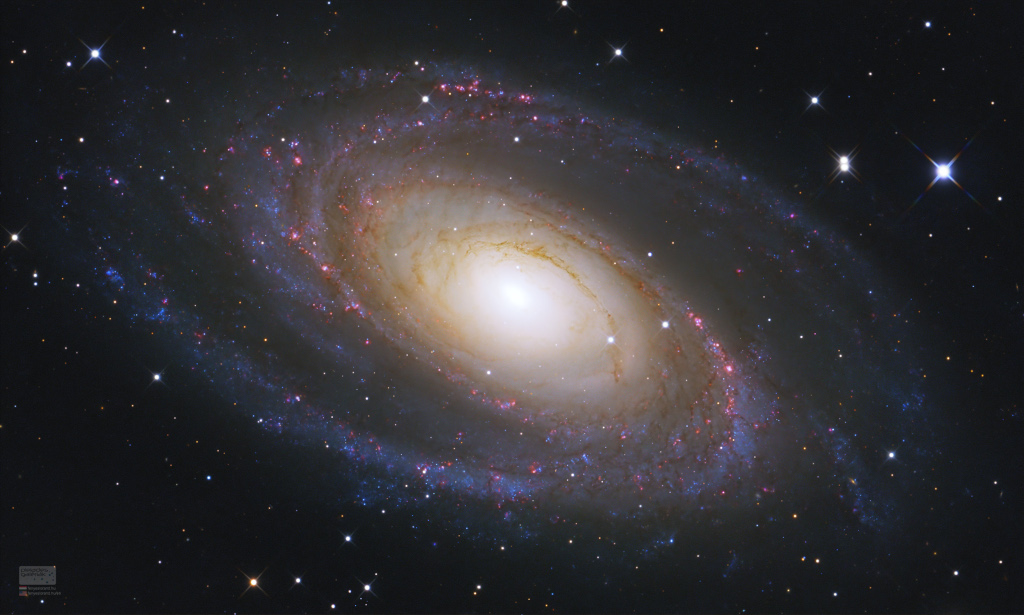
Beautiful island universe Messier 94 lies a mere 15 million light-years distant in the northern constellation of the hunting dogs, Canes Venatici. A popular target for earth-based astronomers, the face-on spiral galaxy is about 30,000 light-years across, with spiral arms sweeping through the outskirts of its broad disk. But this Hubble Space Telescope field of view spans about 7,000 light-years or so across M94’s central region. The sharp close-up examines the galaxy’s compact, bright nucleus and prominent inner dust lanes, surrounded by a remarkable bluish ring of young, massive stars. The massive stars in the ring appear to be less than about 10 million years old, indicating the galaxy experienced a corresponding well-defined era of rapid star formation. As a result, while the small, bright nucleus is typical of the Seyfert class of active galaxies, M94 is also known as a starburst galaxy. Because M94 is relatively nearby, astronomers can explore in detail reasons for the galaxy’s burst of star formation. [via NASA] https://ift.tt/YRmDOjt

On the right, dressed in blue, is the Pleiades. Also known as the Seven Sisters and M45, the Pleiades is one of the brightest and most easily visibleopen clusters on the sky. The Pleiades contains over 3,000 stars, is about 400 light years away, and only 13 light years across. Surrounding the stars is a spectacular blue reflection nebula made of fine dust. A common legend is that one of the brighter stars faded since the cluster was named. On the left, shining in red, is the California Nebula. Named for its shape, the California Nebula is much dimmer and hence harder to see than the Pleiades. Also known as NGC 1499, this mass of red glowing hydrogen gas is about 1,500 light years away. Although about 25 full moons could fit between them, the featured wide angle, deep field image composite has captured themboth. A careful inspection of the deep image will also reveal the star forming region IC 348 and the molecular cloudLBN 777 (the Baby Eagle Nebula). [via NASA] https://ift.tt/LR1dnCk