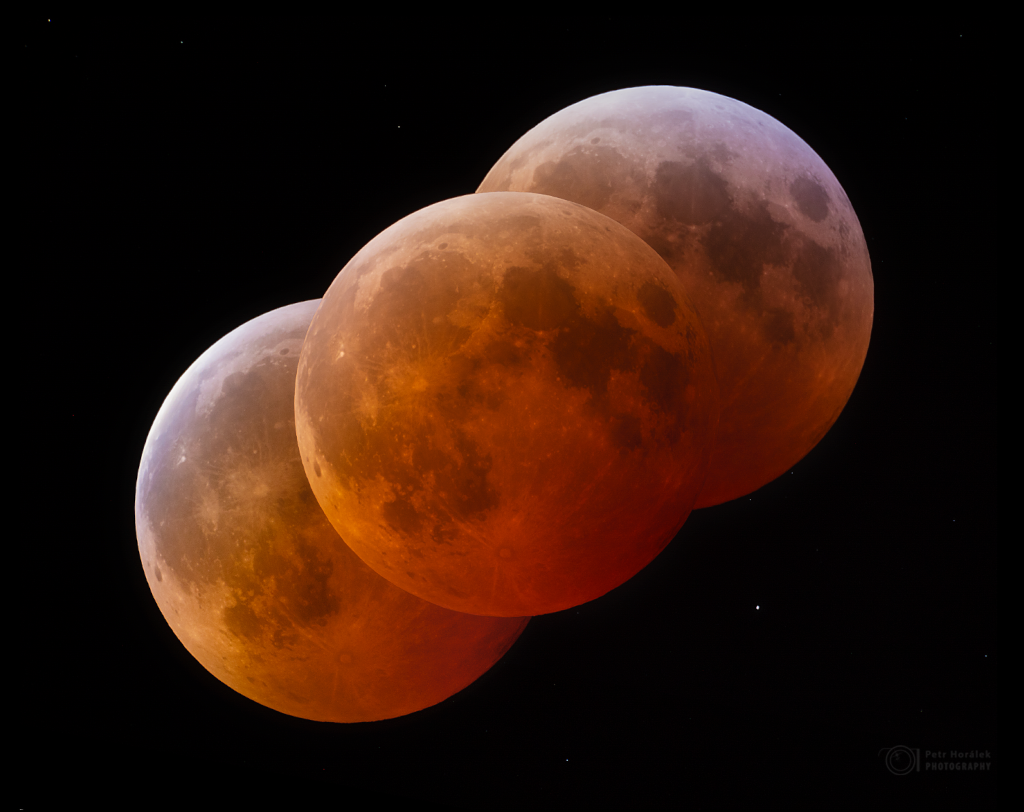
Why does this Moon look so unusual? A key reason is its vivid red color. The color is caused by the deflection of blue light by Earth’s atmosphere — the same reason that the daytime sky appears blue. The Moon also appears unusually distorted. Its strange structuring is an optical effect arising from layers in the Earth’s atmosphere that refract light differently due to sudden differences in temperature or pressure. A third reason the Moon looks so unusual is that there is, by chance, an airplane flying in front. The featured picturesque gibbousMoon was captured about two weeks ago above Turin, Italy. Our familiar hovering sky orb was part of an unusual quadruple alignment that included two historic ground structures: the Sacra di San Michele on the near hill and Basilica of Superga just beyond. [via NASA] https://ift.tt/4IC2j0W

There’s a new lander on the Moon. Yesterday Firefly Aerospace’s Blue Ghost executed the first-ever successful commercial lunar landing. During its planned 60-day mission, Blue Ghost will deploy several NASA-commissioned scientific instruments, including PlanetVac which captures lunar dust after creating a small whirlwind of gas. Blue Ghost will also host the telescope LEXI that captures X-ray images of the Earth’s magnetosphere. LEXI data should enable a better understanding of how Earth’s magnetic field protects the Earth from the Sun’s wind and flares. Pictured, the shadow of the Blue Ghost lander is visible on the cratered lunar surface, while the glowing orb of the planet Earth hovers just over the horizon. Goals for future robotic Blue Ghost landers include supporting lunar astronauts in NASA’s Artemis program, with Artemis III currently scheduled to land humans back on the Moon in 2027. [via NASA] https://ift.tt/9mTUG1a

Blue Ghost to the Moon

With spacecraft thrusters at top center, the rugged surface of the Moon lies below the Blue Ghost lander in this space age video frame. The view of the lunar far side was captured by the Firefly Aerospace lunar lander on February 24, following a maneuver to circularize its orbit about 100 kilometers above the lunar surface. The robotic lunar lander is scheduled to touch down tomorrow, Sunday, March 2, at 3:34am Eastern Time in the Mare Crisium impact basin on the lunar near side. In support of the Artemis campaign, Blue Ghost is set to deliver science and technology experiments to the Moon, part of NASA’s Commercial Lunar Payload Services program. Blue Ghost’s mission on the surface is planned to operate during the lunar daylight hours at the landing site, about 14 Earth days. [via NASA] https://ift.tt/c7DLfp1

Athena to the Moon

Planet Earth hangs in the background of this space age selfie. The snapshot was captured by the IM-2 Nova-C lander Athena, just after stage separation following its February 26 launch to the Moon. A tall robotic lander, Athena is scheduled to touch down on Thursday, March 6, in Mons Mouton, a plateau near the Moon’s South Pole. The intended landing site is in the central portion of one of the Artemis 3 potential landing regions. Athena carries rovers and experiments as part of NASA’s Commercial Lunar Payload Services program, including a drill intended to explore beneath the lunar surface in a search for evidence of frozen water. It also carries a propulsive drone dubbed the Micro Nova Hopper. After release to the lunar surface, the autonomous drone is intended to hop into a nearby crater and send science data back to the lander. [via NASA] https://ift.tt/YVNoApQ

Open Star Clusters M35 and NGC 2158

Framed in this single, starry, telescopic field of view are two open star clusters, M35 and NGC 2158. Located within the boundaries of the constellation Gemini, they do appear to be side by side. Its stars concentrated toward the upper right, M35 is relatively nearby, though. M35 (also cataloged as NGC 2168) is a mere 2800 light-years distant, with 400 or so stars spread out over a volume about 30 light-years across. Bright blue stars frequently distinguish younger open clusters like M35, whose age is estimated at 150 million years. At lower left, NGC 2158 is about four times more distant than M35 and much more compact, shining with the more yellowish light of a population of stars over 10 times older. In general, open star clusters are found along the plane of our Milky Way Galaxy. Loosely gravitationally bound, their member stars tend to be dispersed over billions of years as the open star clusters orbit the galactic center. [via NASA] https://ift.tt/QMckzvJ

Do you see the ring? If you look very closely at the center of the featured galaxy NGC 6505, a ring becomes evident. It is the gravity of NGC 6505, the nearby (z = 0.042) elliptical galaxy that you can easily see, that is magnifying and distorting the image of a distant galaxy into a complete circle. To create a complete Einstein ring there must be perfect alignment of the nearby galaxy’s center and part of the background galaxy. Analysis of this ring and the multiple images of the background galaxy help to determine the mass and fraction of dark matter in NGC 6505’s center, as well as uncover previously unseen details in the distorted galaxy. The featured image was captured by ESA’s Earth-orbiting Euclid telescope in 2023 and released earlier this month. [via NASA] https://ift.tt/cRrVvGn

Why are there so many bright blue stars? Stars are usually born in clusters, and the brightest and most massive of these stars typically glow blue. Less-bright, non-blue stars like our Sun surely also exist in this M41 star cluster but are harder to see. A few bright orange-appearing red giant stars are visible. The red-light filaments are emitted by diffuse hydrogen gas, a color that was specifically filtered and enhanced in this image. In a hundred million years or so, the bright blue stars will have exploded in supernovas and disappeared, while the slightly different trajectories of the fainter stars will cause this picturesque open cluster to disperse. Similarly, billions of years ago, our own Sun was likely born into a star cluster like M41, but it has long since drifted apart from its sister stars. The featured image was captured over four hours with Chilescope T2 in Chile. [via NASA] https://ift.tt/dUoaQL6

Can a lava flow extend into the sky? No, but light from the lava flow can. One effect is something quite unusual — a volcanic light pillar. More typically, light pillars are caused by sunlight and so appear as a bright column that extends upward above a rising or setting Sun. Alternatively, other light pillars — somequitecolorful — have been recorded above street and house lights. This light pillar, though, was illuminated by the red light emitted by the glowing magma of an erupting volcano. The volcano is Italy’s Mount Etna, and the featured image was captured with a single shot during an early morning in mid-February. Freezing temperatures above the volcano’s lava flow created ice-crystals either in the air above the volcano or in condensed water vapor expelled by Mount Etna. These ice crystals — mostly flat toward the ground but fluttering — then reflected away light from the volcano’s caldera. [via NASA] https://ift.tt/nXrH6AS

Saturn looks slightly different in infrared light. Bands of clouds show great structure, including long stretching storms. Also quite striking in infrared is the unusual hexagonal cloud pattern surrounding Saturn’s North Pole. Each side of the dark hexagon spans roughly the width of our Earth. The hexagon’s existence was not predicted, and its origin and likely stability remain a topics of research. Saturn’s famous rings circle the planet and cast shadows below the equator. The featured image was taken by the robotic Cassini spacecraft in 2014 in several infrared colors. In 2017 September, the Cassini mission was brought to a dramatic conclusion when the spacecraft was directed to dive into the ringed giant. [via NASA] https://ift.tt/kYeTNHr

Rima Hyginus

Rima Hyginus is a spectacular fissure, some 220 kilometers long, found near the center of the lunar near side. Easy to spot in telescopic views of the Moon, it stretches top left to bottom right across this lunar closeup. The image was made with exaggerated colors that reflect the mineral composition of the lunar soil. Hyginus crater lies near the center of the narrow lunar surface groove. About 10 kilometers in diameter, the low-walled crater is a volcanic caldera, one of the larger non-impact craters on the lunar surface. Dotted with small pits formed by surface collapse, Hyginus rima itself was likely created by stresses due to internal magma upwelling and collapse along a long surface fault. The intriguing region was a candidate landing site for the canceled Apollo 19 mission. [via NASA] https://ift.tt/uzKHQnF