The Great Globular Cluster in Hercules

In 1716, English astronomer Edmond Halley noted, «This is but a little Patch, but it shows itself to the naked Eye, when the Sky is serene and the Moon absent.» Of course, M13 is now less modestly recognized as the Great Globular Cluster in Hercules, one of the brightest globular star clusters in the northern sky. Sharp telescopic views like this one reveal the spectacular cluster’s hundreds of thousands of stars. At a distance of 25,000 light-years, the cluster stars crowd into a region 150 light-years in diameter. Approaching the cluster core, upwards of 100 stars could be contained in a cube just 3 light-years on a side. For comparison, the closest star to the Sun is over 4 light-years away. The deep, wide-field image also reveals distant background galaxies including NGC 6207 at the upper left, and faint, foreground Milky Way dust clouds known to some as integrated flux nebulae. [via NASA] https://ift.tt/u3UCm8K

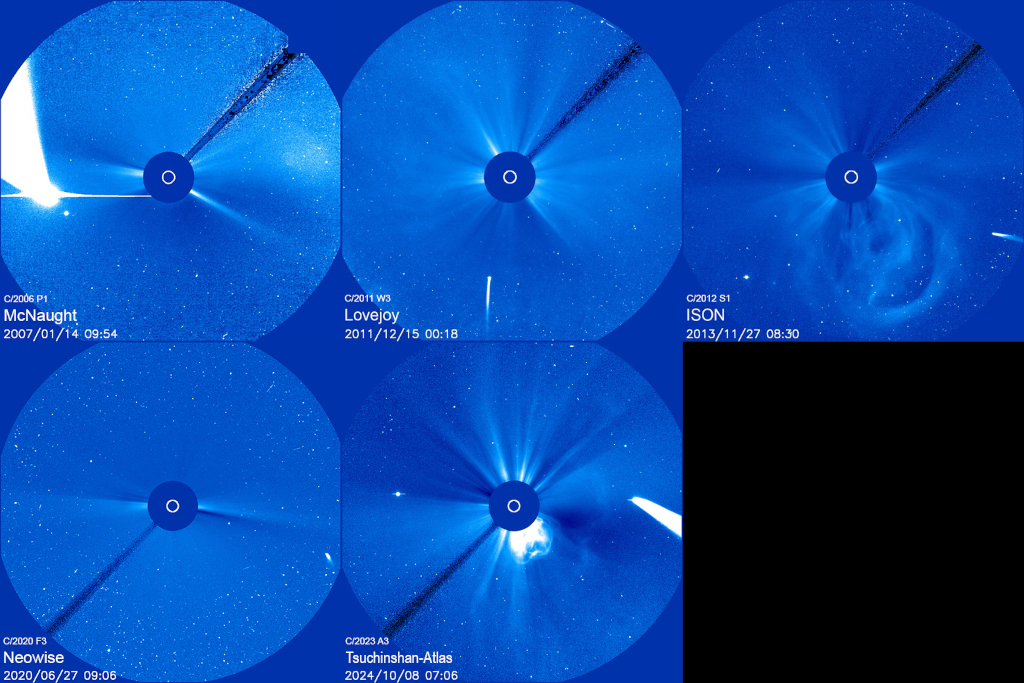
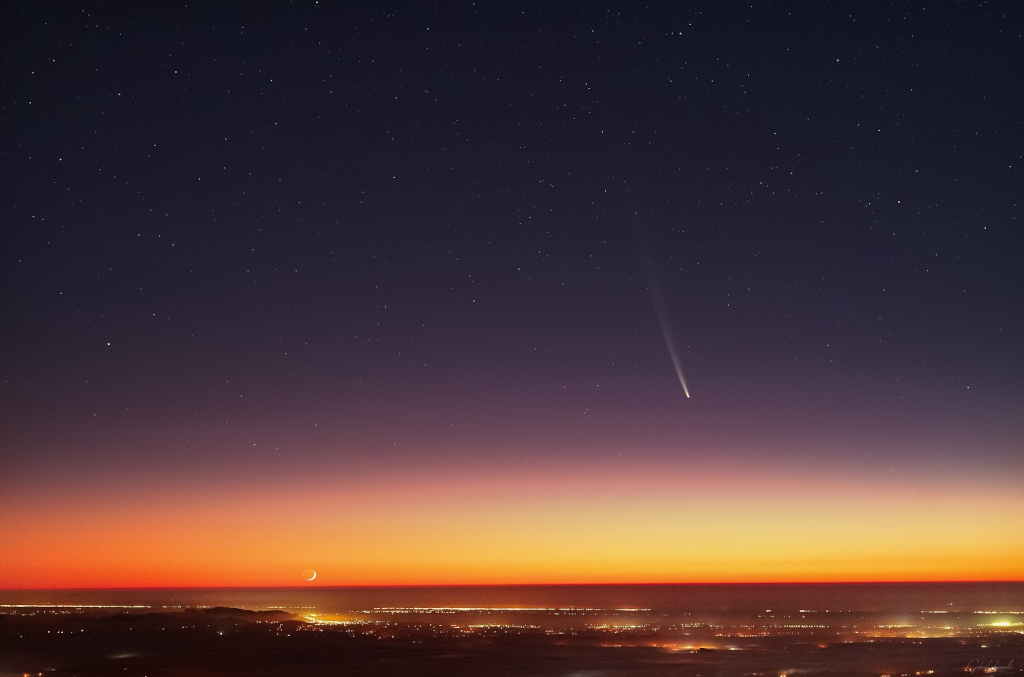
Comet Tsuchinshan-ATLAS is now visible in the early morning sky. Diving into the inner Solar System at an odd angle, this large dirty iceberg will pass its closest to the Sun — between the orbits of Mercury and Venus — in just two days. Long camera exposures are now capturing C/2023 A3 (Tsuchinshan–ATLAS), sometimes abbreviated as just A3, and its dust tail before and during sunrise. The featured image composite was taken four days ago and captured the comet as it rose above Lake George, NSW, Australia. Vertical bands further left are images of the comet as the rising Sun made the predawn sky increasingly bright and colorful. Just how bright the comet will become over the next month is currently unknown as it involves how much gas and dust the comet’s nucleus will expel. Optimistic skywatchers are hoping for a great show where Tsuchinshan–ATLAS creates dust and ion tails visible across Earth’s sky and becomes known as the GreatComet of 2024. [via NASA] https://ift.tt/U1oMfJc

This dusty region is forming stars. Part of a sprawling molecular cloud complex that resembles, to some, a rampaging baboon, the region is a relatively close by 500 light-years away toward the constellation Corona Australis. That’s about one third the distance of the more famous stellar nursery known as the Orion Nebula. Mixed with bright nebulosities, the brown dust clouds effectively block light from more distant background stars in the Milky Way and obscure from view embedded stars still in the process of formation. The eyes of the dust creature in the featured image are actually blue reflection nebulas cataloged as NGC 6726, 6727, 6729, and IC 4812, while the red mouth glows with light emitted by hydrogen gas. Just to the upper left of the baboon’s head is NGC 6723, a whole globular cluster of stars nearly 30,000 light years in the distance. [via NASA] https://ift.tt/niVsrw5

What will happen as this already bright comet approaches? Optimistic predictions have Comet C/2023 A3 (Tsuchinshan–ATLAS) briefly becoming easily visible to the unaided eye — although the future brightness of comets are notoriously hard to predict, and this comet may even break up in warming sunlight. What is certain is that the comet is now unexpectedly bright and is on track to pass its closest to the Sun (0.39 AU) later this week and closest to the Earth (0.47 AU) early next month. The featured image was taken in late May as Comet Tsuchinshan–ATLAS, discovered only last year, passed nearly in front of two distant galaxies. The comet can now be found with binoculars in the early morning sky rising just before the Sun, while over the next few weeks it will brighten as it moves to the early evening sky. [via NASA] https://ift.tt/wv9R0Bh

Chicago, in a way, is like a modern Stonehenge. The way is east to west, and the time is today. Today, and every equinox, the Sun will set exactly to the west, everywhere on Earth. Therefore, today in Chicago, the Sun will set directly down the long equatorially-aligned grid of streets and buildings, an event dubbed #chicagohenge. Featured here is a Chicago Henge picture taken during the equinox in mid-September of 2017 looking along part of Upper Wacker Drive. Many cities, though, have streets or other features that are well-aligned to Earth’s spin axis. Therefore, quite possibly, your favorite street may also run east – west. Tonight at sunset, with a quick glance, you can actually find out. [via NASA] https://ift.tt/WzMxdIG

Sunrise Shadows in the Sky

The defining astronomical moment of this September’s equinox is at 12:44 UTC on September 22, when the Sun crosses the celestial equator moving south in its yearly journey through planet Earth’s sky. That marks the beginning of fall for our fair planet in the northern hemisphere and spring in the southern hemisphere, when day and night are nearly equal around the globe. Of course, if you celebrate the astronomical change of seasons by watching a sunrise you can also look for crepuscular rays. Outlined by shadows cast by clouds, crepuscular rays can have a dramatic appearance in the twilight sky during any sunrise (or sunset). Due to perspective, the parallel cloud shadows will seem to point back to the rising Sun and a place due east on your horizon on the equinox date. But in this spectacular sunrise skyscape captured in early June, the parallel shadows and crepuscular rays appear to converge toward an eastern horizon’s more northerly sunrise. The well-composed photo places the rising Sun just behind the bell tower of a church in the town of Vic, province of Barcelona, Catalonia, Spain. [via NASA] https://ift.tt/k4XxpQM

A Hazy Harvest Moon

For northern hemisphere dwellers, September’s Full Moon was the Harvest Moon. On September 17/18 the sunlit lunar nearside passed into shadow, just grazing Earth’s umbra, the planet’s dark, central shadow cone, in a partial lunar eclipse. Over the two and half hours before dawn a camera fixed to a tripod was used to record this series of exposures as the eclipsed Harvest Moon set behind Spiš Castle in the hazy morning sky over eastern Slovakia. Famed in festival, story, and song, Harvest Moon is just the traditional name of the full moon nearest the autumnal equinox. According to lore the name is a fitting one. Despite the diminishing daylight hours as the growing season drew to a close, farmers could harvest crops by the light of a full moon shining on from dusk to dawn. This September’s Harvest Moon was also known to some as a supermoon, a term becoming a traditional name for a full moon near perigee. [via NASA] https://ift.tt/EqOhxfc

The Dark Seahorse of Cepheus

Spanning light-years, this suggestive shape known as the Seahorse Nebula floats in silhouette against a rich, luminous background of stars. Seen toward the royal northern constellation of Cepheus, the dusty, dark nebula is part of a Milky Way molecular cloud some 1,200 light-years distant. It is also listed as Barnard 150 (B150), one of 182 dark markings of the sky cataloged in the early 20th century by astronomer E. E. Barnard. Packs of low mass stars are forming within, but their collapsing cores are only visible at long infrared wavelengths. Still, the colorful Milky Way stars of Cepheus add to this stunning galactic skyscape. [via NASA] https://ift.tt/uvwPMJj

New stars are born from the remnants of deadstars. The gaseous remnant of the gravitational collapse and subsequent death of a very massive star in our Milky Way created the G296.5+10.0supernova remnant, of which the featured Mermaid Nebula is part. Also known as the Betta Fish Nebula, the Mermaid Nebula makes up part of an unusual subclass of supernova remnants that are two-sided and nearly circular. Originally discovered in X-rays, the filamentary nebula is a frequently studied source also in radio and gamma-ray light. The blue color visible here originates from doubly ionized oxygen (OIII), while the deep red is emitted by hydrogen gas. The nebula’s mermaid-like shape has proven to be useful for measurements of the interstellar magnetic field. [via NASA] https://ift.tt/S4H03zE

Cosmic clouds form fantastic shapes in the central regions of emission nebula IC 1805. The clouds are sculpted by stellar winds and radiation from massive hot stars in the nebula’s newborn star cluster, Melotte 15. About 1.5 million years young, the cluster stars are scattered in this colorful skyscape, along with dark dust clouds in silhouette against glowing atomic gas. A composite of narrowband and broadband telescopic images, the view spans about 15 light-years and includes emission from ionized hydrogen, sulfur, and oxygen atoms mapped to green, red, and blue hues in the popular Hubble Palette. Wider field images reveal that IC 1805’s simpler, overall outline suggests its popular name – the Heart Nebula. IC 1805 is located about 7,500 light years away toward the boastful constellation Cassiopeia. [via NASA] https://ift.tt/cZXvF7D