Why does this galaxy have such a long tail? In this stunning vista, based on image data from the Hubble Legacy Archive, distant galaxies form a dramatic backdrop for disrupted spiral galaxy Arp 188, the Tadpole Galaxy. The cosmic tadpole is a mere 420 million light-years distant toward the northern constellation of the Dragon (Draco). Its eye-catching tail is about 280 thousand light-years long and features massive, bright blue star clusters. One story goes that a more compact intruder galaxy crossed in front of Arp 188 – from right to left in this view – and was slung around behind the Tadpole by their gravitational attraction. During the close encounter, tidal forces drew out the spiral galaxy’s stars, gas, and dust forming the spectacular tail. The intruder galaxy itself, estimated to lie about 300 thousand light-years behind the Tadpole, can be seen through foreground spiral arms at the upper right. Following its terrestrial namesake, the Tadpole Galaxy will likely lose its tail as it grows older, the tail’s star clusters forming smaller satellites of the large spiral galaxy. [via NASA] https://ift.tt/prjY15v

The galaxy was never in danger. For one thing, the Triangulum galaxy (M33), pictured, is much bigger than the tiny grain of rock at the head of the meteor. For another, the galaxy is much farther away — in this instance 3 million light years as opposed to only about 0.0003 light seconds. Even so, the meteor’s path took it angularly below the galaxy. Also the wind high in Earth’s atmosphere blew the meteor’s glowing evaporative molecule train away from the galaxy, in angular projection. Still, the astrophotographer was quite lucky to capture both a meteor and a galaxy in a single exposure — which was subsequently added to two other images of M33 to bring up the spiral galaxy’s colors. At the end, the meteor was gone in a second, but the galaxy will last billions of years. [via NASA] https://ift.tt/XDUBgJq

Solar System Family Portrait

In 1990, cruising four billion miles from the Sun, the Voyager 1 spacecraft looked back to make this first ever Solar System family portrait. The complete portrait is a 60 frame mosaic made from a vantage point 32 degrees above the ecliptic plane. In it, Voyager’s wide-angle camera frames sweep through the inner Solar System at the left, linking up with ice giant Neptune, the Solar System’s outermost planet, at the far right. Positions for Venus, Earth, Jupiter, Saturn, Uranus, and Neptune are indicated by letters, while the Sun is the bright spot near the center of the circle of frames. The inset frames for each of the planets are from Voyager’s narrow-field camera. Unseen in the portrait are Mercury, too close to the Sun to be detected, and Mars, unfortunately hidden by sunlight scattered in the camera’s optical system. Closer to the Sun than Neptune at the time, small, faint Pluto’s position was not covered. In 2024 Voyager 1, NASA’s longest-running and most-distant spacecraft, is some 15 billion miles away, operating in interstellar space. [via NASA] https://ift.tt/x7engk0

Jones Emberson 1

Planetary nebula Jones-Emberson 1 is the death shroud of a dying Sun-like star. It lies some 1,600 light-years from Earth toward the sharp-eyed constellation Lynx. About 4 light-years across, the expanding remnant of the dying star’s atmosphere was shrugged off into interstellar space, as the star’s central supply of hydrogen and then helium for fusion was depleted after billions of years. Visible near the center of the planetary nebula is what remains of the stellar core, a blue-hot white dwarf star. Also known as PK 164 +31.1, the nebula is faint and very difficult to glimpse at a telescope’s eyepiece. But this deep image combining over 12 hours of exposure time does show it off in exceptional detail. Stars within our own Milky Way galaxy as well as background galaxies across the universe are scattered through the clear field of view. Ephemeral on the cosmic stage, Jones-Emberson 1 will fade away over the next few thousand years. Its hot, central white dwarf star will take billions of years to cool. [via NASA] https://ift.tt/WFyxDJ6

Globular Cluster Omega Centauri

Globular star cluster Omega Centauri packs about 10 million stars much older than the Sun into a volume some 150 light-years in diameter. Also known as NGC 5139, at a distance of 15,000 light-years it’s the largest and brightest of 200 or so known globular clusters that roam the halo of our Milky Way galaxy. Though most star clusters consist of stars with the same age and composition, the enigmatic Omega Cen exhibits the presence of different stellar populations with a spread of ages and chemical abundances. In fact, Omega Cen may be the remnant core of a small galaxy merging with the Milky Way. With a yellowish hue, Omega Centauri’s red giant stars are easy to pick out in this sharp telescopic view. A two-decade-long exploration of the dense star cluster with the Hubble Space Telescope has revealed evidence for a massive black hole near the center of Omega Centauri. [via NASA] https://ift.tt/PB7smwi

A Sagittarius Triplet

These three bright nebulae are often featured on telescopic tours of the constellation Sagittarius and the crowded starfields of the central Milky Way. In fact, 18th century cosmic tourist Charles Messier cataloged two of them; M8, the large nebula above center, and colorful M20 below and left in the frame. The third emission region includes NGC 6559, right of M8 and separated from the larger nebula by a dark dust lane. All three are stellar nurseries about five thousand light-years or so distant. Over a hundred light-years across the expansive M8 is also known as the Lagoon Nebula. M20’s popular moniker is the Trifid. Glowing hydrogen gas creates the dominant red color of the emission nebulae. But for striking contrast, blue hues in the Trifid are due to dust reflected starlight. The broad interstellar skyscape spans almost 4 degrees or 8 full moons on the sky. [via NASA] https://ift.tt/uAbgR7E

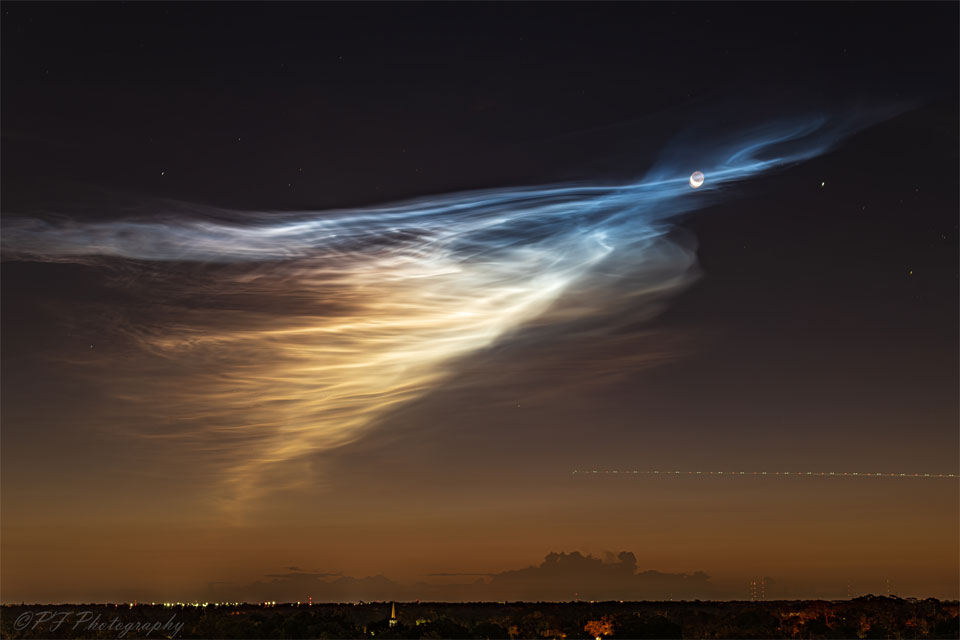
These clouds are doubly unusual. First, they are rare noctilucent clouds, meaning that they are visible at night — but only just before sunrise or just after sunset. Second, the source of these noctilucent clouds is actually known. In this rare case, the source of the sunlight-reflecting ice-crystals in the upper atmosphere can be traced back to the launch of a nearby SpaceX rocket about 30 minutes earlier. Known more formally as polar mesospheric clouds, the vertex of these icy wisps happens to converge just in front of a rising crescent Moon. The featured image — and accompanying video — were captured over Orlando, Florida, USA about a week ago. The bright spot to the right of the Moon is the planet Jupiter, while the dotted lights above the horizon on the right are from an airplane. [via NASA] https://ift.tt/M8edpCL

Do other stars have planets like our Sun? Surely they do, and evidence includes slight star wobbles created by the gravity of orbiting exoplanets and slight star dimmings caused by orbiting planets moving in front. In all, there have now been over 5,500 exoplanets discovered, including thousands by NASA’s space-based Kepler and TESS missions, and over 100 by ESO’s ground-based HARPS instrument. Featured here is an illustrated guess as to what some of these exoplanets might look like. Neptune-type planets occupy the middle and are colored blue because of blue-scattering atmospheric methane they might contain. On the sides of the illustration, Jupiter-type planets are shown, colored tan and red from the scatterings of atmospheric gases that likely include small amounts of carbon. Interspersed are many Earth-type rocky planets of many colors. As more exoplanets are discovered and investigated, humanity is developing a better understanding of how common Earth-like planets are, and how common life might be in the universe. [via NASA] https://ift.tt/j4kvf1W

Why are these clouds multi-colored? A relatively rare phenomenon in clouds known as iridescence can bring up unusual colors vividly — or even a whole spectrum of colors simultaneously. These polar stratospheric clouds also, known as nacreous and mother-of-pearl clouds, are formed of small water droplets of nearly uniform size. When the Sun is in the right position and, typically, hidden from direct view, these thin clouds can be seen significantly diffracting sunlight in a nearly coherent manner, with different colors being deflected by different amounts. Therefore, different colors will come to the observer from slightly different directions. Many clouds start with uniform regions that could show iridescence but quickly become too thick, too mixed, or too angularly far from the Sun to exhibit striking colors. The featured image and an accompanying video were taken late in 2019 over Ostersund, Sweden. [via NASA] https://ift.tt/u4twpR8

NGC 7789: Caroline s Rose

Found among the rich starfields of the Milky Way, star cluster NGC 7789 lies about 8,000 light-years away toward the constellation Cassiopeia. A late 18th century deep sky discovery of astronomer Caroline Lucretia Herschel, the cluster is also known as Caroline’s Rose. Its visual appearance in small telescopes, created by the cluster’s complex of stars and voids, is suggestive of nested rose petals. Now estimated to be 1.6 billion years young, the galactic or open cluster of stars also shows its age. All the stars in the cluster were likely born at the same time, but the brighter and more massive ones have more rapidly exhausted the hydrogen fuel in their cores. These have evolved from main sequence stars like the Sun into the many red giant stars shown with a yellowish cast in this color composite. Using measured color and brightness, astronomers can model the mass and hence the age of the cluster stars just starting to «turn off» the main sequence and become red giants. Over 50 light-years across, Caroline’s Rose spans about half a degree (the angular size of the Moon) near the center of the sharp telescopic image. [via NASA] https://ift.tt/14phX5a