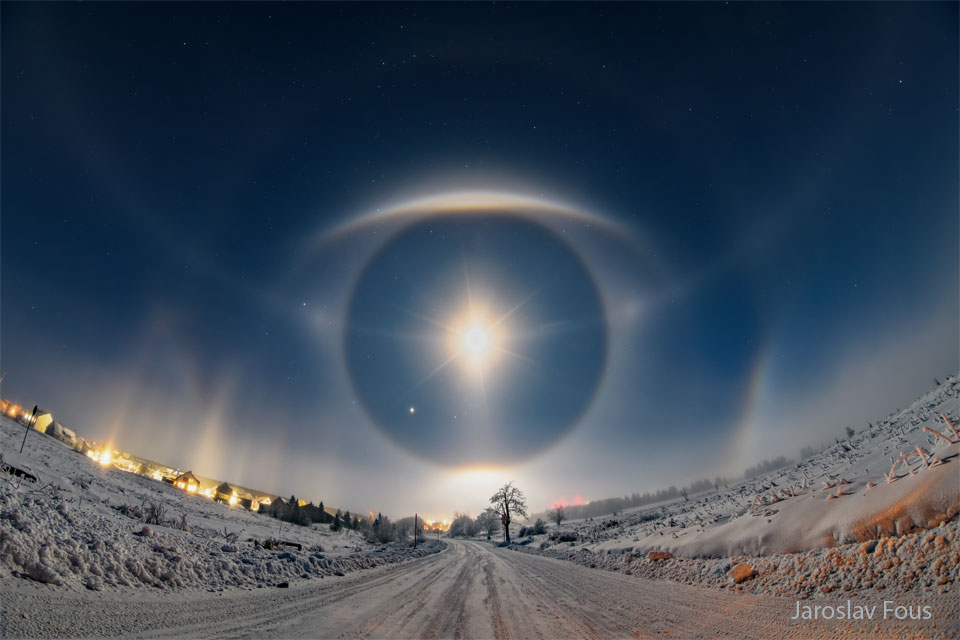
Why is there a huge eye in the sky? Diamond dust. That is an informal term for small ice crystals that form in the air and flitter to the ground. Because these crystals are geometrically shaped, they can together reflect light from the Sun or Moon to your eyes in a systematic way, causing huge halos and unusual arcs to appear. And sometimes, together the result can seem like a giant eye looking right back at you. In the featured image taken in the Ore Mountains of the Czech Republic last week, a bright Moon rising through ice fog-filled air resulted in many of these magnificent sky illusions to be visible simultaneously. Besides Moon dogs, tangent arcs, halos, and a parhelic circle, light pillars above distant lights are visible on the far left, while Jupiter and Mars can be found just inside the bottom of the 22-degree halo. [via NASA] https://ift.tt/KgbmLPJ

What do the following things have in common: a cone, the fur of a fox, and a Christmas tree? Answer: they all occur in the constellation of the Unicorn (Monoceros). Considered as a star forming region and cataloged as NGC 2264, the complex jumble of cosmic gas and dust is about 2,700 light-years distant and mixes reddish emission nebulae excited by energetic light from newborn stars with dark interstellar dust clouds. The featured image spans an angle larger than a full moon, covering over 50 light-years at the distance of NGC 2264. Its cast of cosmic characters includes the Fox Fur Nebula, whose convoluted pelt lies just to the left of the image center, bright variable starS Mon visible just to the right of the Fox Fur, and the Cone Nebula near the image top. With the Cone Nebula at the peak, the shape of the general glow of the region give it the nickname of the Christmas Tree Cluster, where stars are tree ornaments. [via NASA] https://ift.tt/1K6B2f5

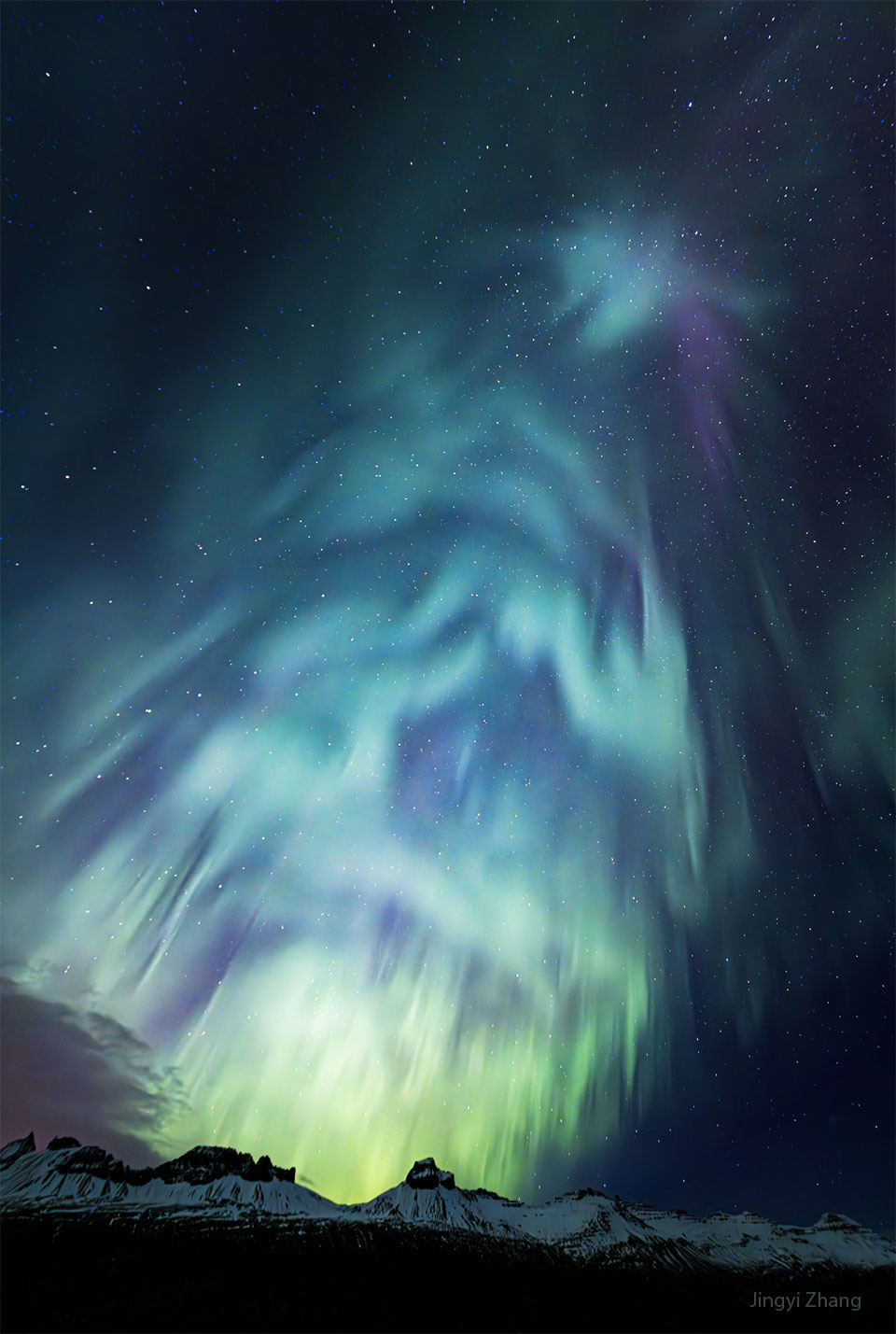
It was December and the sky lit up like a Christmas tree. Shimmering, the vivid green, blue, and purple auroral colors that formed the tree-like apparition were caused by high atmospheric oxygen and nitrogen reacting to a burst of incoming electrons. Collisions caused the orbital electrons of atoms and molecules to jump into excited energy states and emit visible light when returning to their normal state. The featured image was captured in Djúpivogur, Iceland during the last month of 2023. Our Sun is currently in its most energetic phase of its 11-year cycle, with its high number of active regions and sunspots likely to last into next year. Of course, the Sun has been near solar maximum during this entire year, with its outbursts sometimes resulting in spectacular Earthly auroras. [via NASA] https://ift.tt/i4zP7n3

The stars are not alone. In the disk of our Milky Way Galaxy, about 10 percent of visible matter is in the form of gas called the interstellar medium (ISM). The ISM is not uniform and shows patchiness even near our Sun. It can be quite difficult to detect the local ISM because it is so tenuous and emits so little light. This mostly hydrogen gas, however, absorbs some very specific colors that can be detected in the light of the nearest stars. A working map of the local ISM within 20 light-years, based on ongoing observations and particle detections from the Earth-orbiting Interstellar Boundary Exporer satellite (IBEX), is shown here. These observations indicate that our Sun is moving through a Local Interstellar Cloud as this cloud flows outwards from the Scorpius-Centaurus Association star forming region. Our Sun may exit the Local Cloud, also called the Local Fluff, during the next 10,000 years. Much remains unknown about the local ISM, including details of its distribution, its origin, and how it affects the Sun and the Earth. Unexpectedly, IBEX spacecraft measurements indicate that the direction from which neutral interstellar particles flow through our Solar System is changing. [via NASA] https://ift.tt/t4OvdQU

A Year in Sunsets

A year in sunsets, from April 2023 to March 2024, track along the western horizon in these stacked panoramic views. The well-planed sequence is constructed of images recorded near the 21st day of the indicated month from the same location overlooking Cairo, Egypt. But for any location on planet Earth the yearly extreme northern (picture right) and southern limits of the setting Sun mark the solstice days. The word solstice is from Latin for «Sun» and «stand still». On the solstice date the seasonal drift of the Sun’s daily path through the sky appears to pause and reverse direction in its annual celestial journey. Of course the Sun reaches a stand still on today’s date. The 21 December 2024 solstice at 09:21 UTC is the moment of the Sun’s southernmost declination, the start of astronomical winter in the north and summer in the south. [via NASA] https://ift.tt/xFUYHaM

The Long Night Moon

On the night of December 15, the Full Moon was bright. Known to some as the Cold Moon or the Long Night Moon, it was the closest Full Moon to the northern winter solstice and the last Full Moon of 2024. This Full Moon was also at a major lunar standstill. A major lunar standstill is an extreme in the monthly north-south range of moonrise and moonset caused by the precession of the Moon’s orbit over an 18.6 year cycle. As a result, the full lunar phase was near the Moon’s northernmost moonrise (and moonset) along the horizon. December’s Full Moon is rising in this stacked image, a composite of exposures recording the range of brightness visible to the eye on the northern winter night. Along with a colorful lunar corona and aircraft contrail this Long Night Moon shines in a cold sky above the rugged, snowy peaks of the Italian Dolomites. [via NASA] https://ift.tt/TZ7DoPU

Messier 2

After the Crab Nebula, this giant star cluster is the second entry in 18th century astronomer Charles Messier’s famous list of things that are not comets. M2 is one of the largest globular star clusters now known to roam the halo of our Milky Way galaxy. Though Messier originally described it as a nebula without stars, this stunning Hubble image resolves stars across the cluster’s central 40 light-years. Its population of stars numbers close to 150,000, concentrated within a total diameter of around 175 light-years. About 55,000 light-years distant toward the constellation Aquarius, this ancient denizen of the Milky Way, also known as NGC 7089, is 13 billion years old. An extended stellar debris stream, a signature of past gravitational tidal disruption, was recently found to be associated with Messier 2. [via NASA] https://ift.tt/ViFfbLz

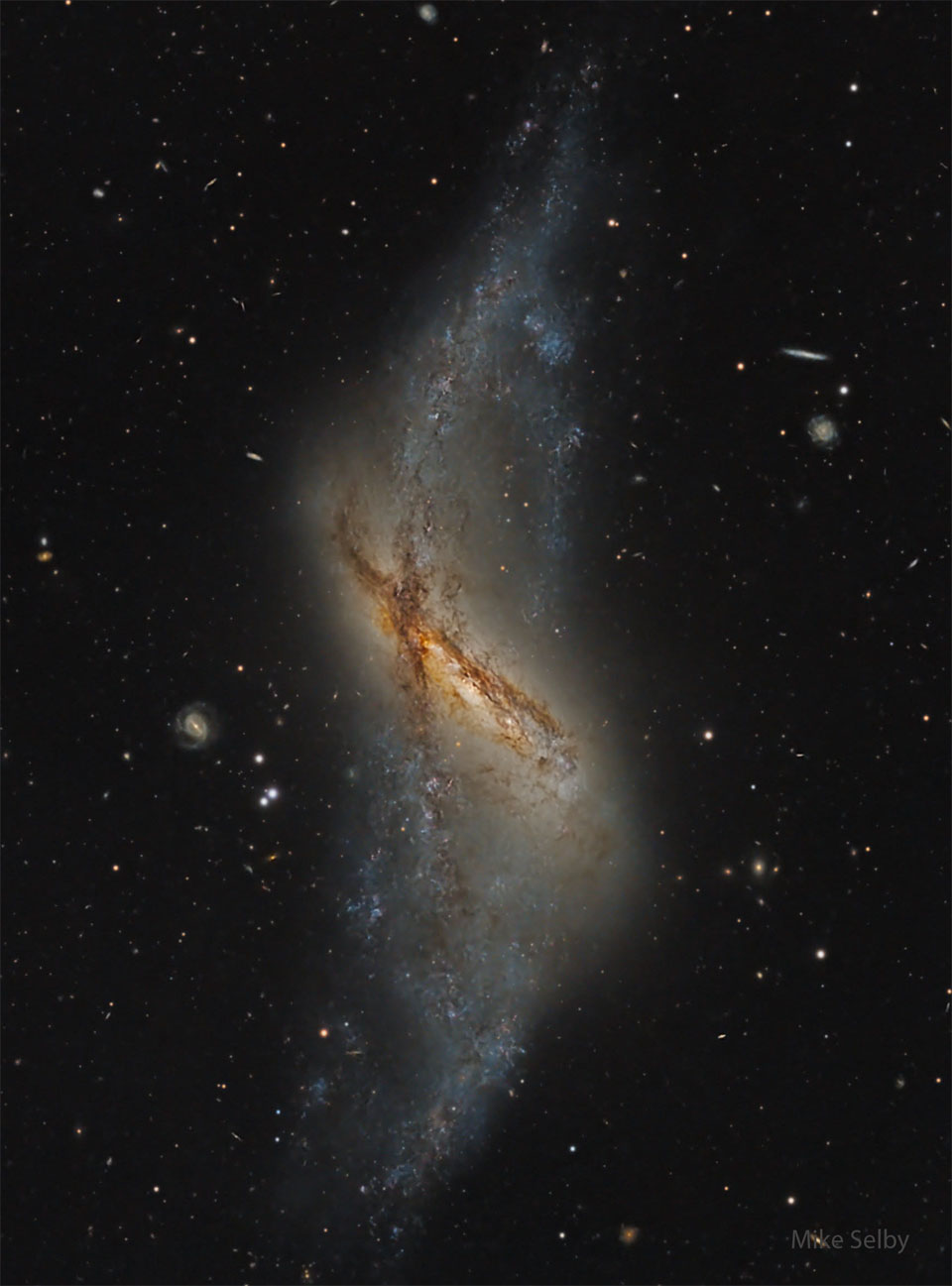
What kind of strange galaxy is this? This rare structure is known as a polar ring galaxy, and it seems to have two different rings of stars. In this galaxy, NGC 660, one ring of bright stars, gas, and dark dust appears nearly vertical, while another similar but shorter ring runs diagonally from the upper left. How polar ring galaxies obtain their striking appearance remains a topic of research, but a leading theory holds that it is usually the result of two galaxies with different central ring planes colliding. NGC 660 spans about 50,000 light years and is located about 40 million light years away toward the constellation of the Fish (Pisces). The featured image was captured recently from Observatorio El Sauce in Chile. [via NASA] https://ift.tt/tdG1jqA

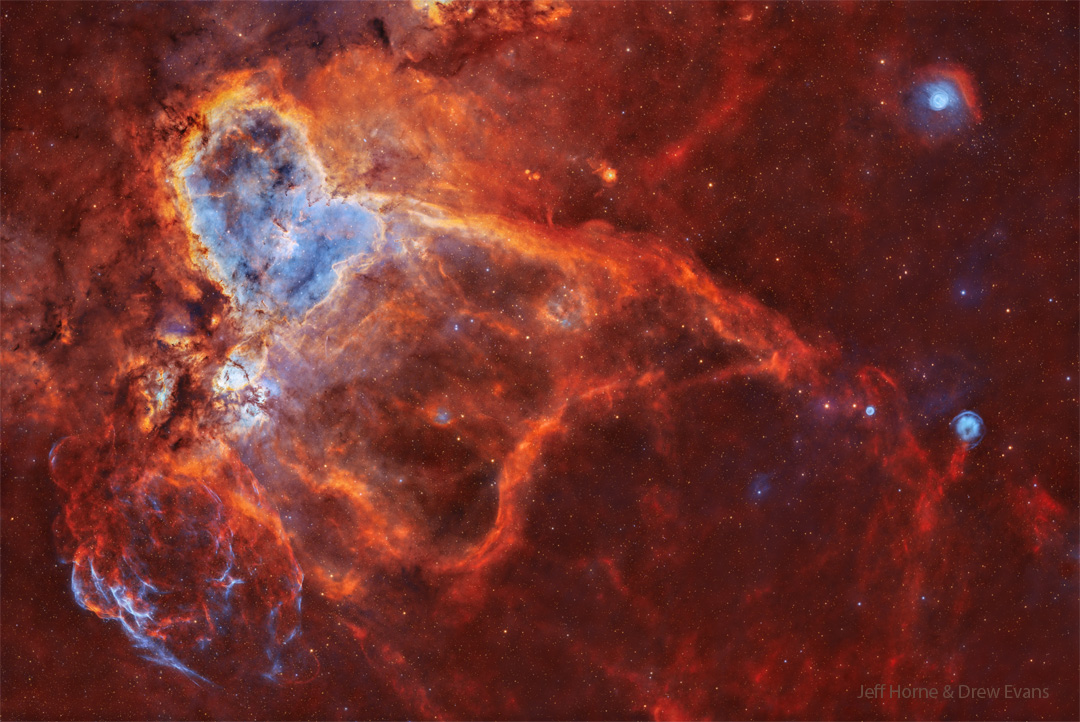
What excites the Heart Nebula? First, the large emission nebula on the upper left, catalogued as IC 1805, looks somewhat like a human heart. The nebula glows brightly in red light emitted by its most prominent element, hydrogen, but this long-exposure image was also blended with light emitted by sulfur (yellow) and oxygen (blue). In the center of the Heart Nebula are young stars from the open star cluster Melotte 15 that are eroding away several picturesque dust pillars with their atom-exciting energetic light and winds. The Heart Nebula is located about 7,500 light years away toward the constellation of Cassiopeia. This wide field image shows much more, though, including the Fishhead Nebula just below the Heart, a supernova remnant on the lower left, and three planetary nebulas on the image right. Taken over 57 nights, this image is so deep, though, that it clearly shows fainter long and complex filaments. [via NASA] https://ift.tt/I2rjWAV

This kilometer high cliff occurs on the surface of a comet. It was discovered on the dark nucleus of Comet Churyumov – Gerasimenko (CG) by Rosetta, a robotic spacecraft launched by ESA, which orbited the comet from 2014 to 2016. The ragged cliff, as featuredhere, was imaged by Rosetta early in its mission. Although towering about one kilometer high, the low surface gravity of Comet CG would likely make a jump from the cliffs by a human survivable. At the foot of the cliffs is relatively smooth terrain dotted with boulders as large as 20 meters across. Data from Rosetta indicates that the ice in Comet CG has a significantly different deuterium fraction — and hence likely a different origin — than the water in Earth’s oceans. The probe was named after the Rosetta Stone, a rock slab featuring the same text written in three different languages that helped humanity decipher ancient Egyptian writing. [via NASA] https://ift.tt/qpgHetx