Stereo Jupiter near Opposition

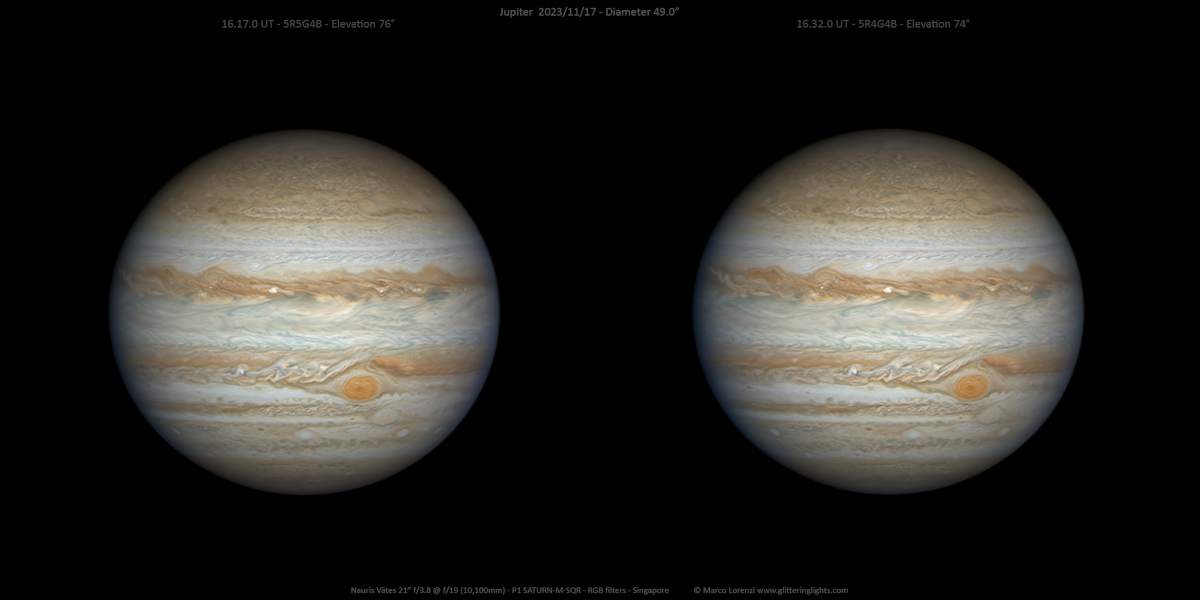
Jupiter looks sharp in these two rooftop telescope images. Both were captured on November 17 from Singapore, planet Earth, about two weeks after Jupiter’s 2023 opposition. Climbing high in midnight skies the giant planet was a mere 33.4 light-minutes from Singapore. That’s about 4 astronomical units away. Jupiter’s planet girdling dark belts and light zones are visible in remarkable detail, along with the giant world’s whitish oval vortices. Its signature Great Red Spot is still prominent in the south. Jupiter rotates rapidly on its axis once every 10 hours. So, based on video frames taken only 15 minutes apart, these images form a stereo pair. Look at the center of the pair and cross your eyes until the separate images come together to see the Solar System’s ruling gas giant in 3D. [via NASA] https://ift.tt/D5hxNgP
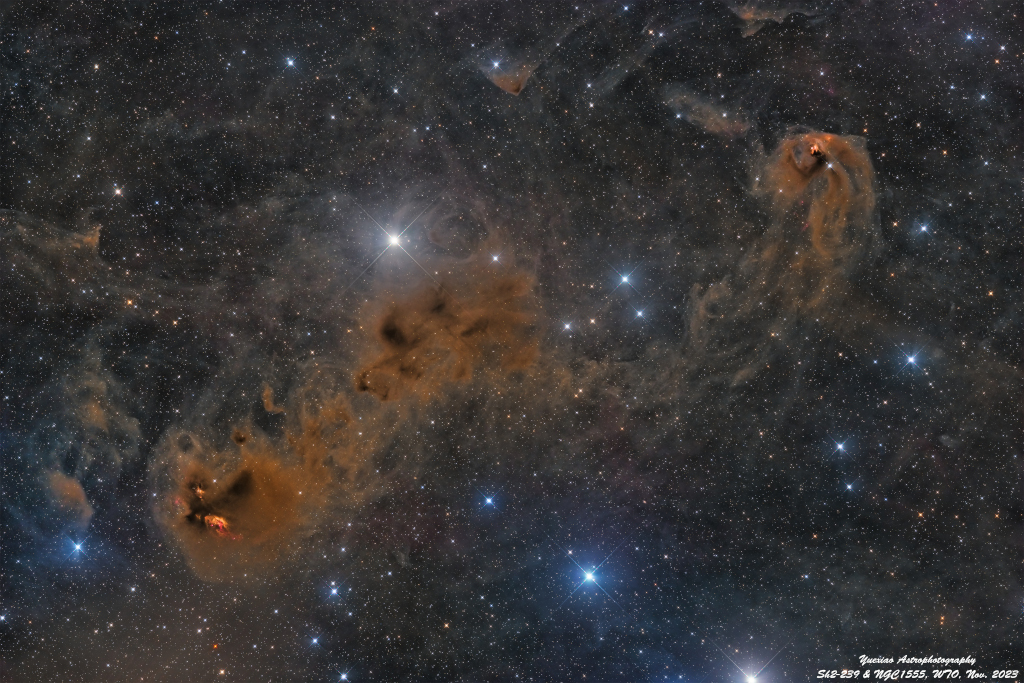
Along the Taurus Molecular Cloud

The cosmic brush of star formation composed this interstellar canvas of emission, dust, and dark nebulae. A 5 degree wide telescopic mosaic, it frames a region found north of bright star Aldebaran on the sky, at an inner wall of the local bubble along the Taurus molecular cloud. At lower left, emission cataloged as Sh2-239 shows signs of embedded young stellar objects. The region’s Herbig-Haro objects, nebulosities associated with newly born stars, are marked by tell-tale reddish jets of shocked hydrogen gas. Above and right T Tauri, the prototype of the class of T Tauri variable stars, is next to a yellowish nebula historically known as Hind’s Variable Nebula (NGC 1555). T Tauri stars are now generally recognized as young, less than a few million years old, sun-like stars still in the early stages of formation. [via NASA] https://ift.tt/Z39uPbr

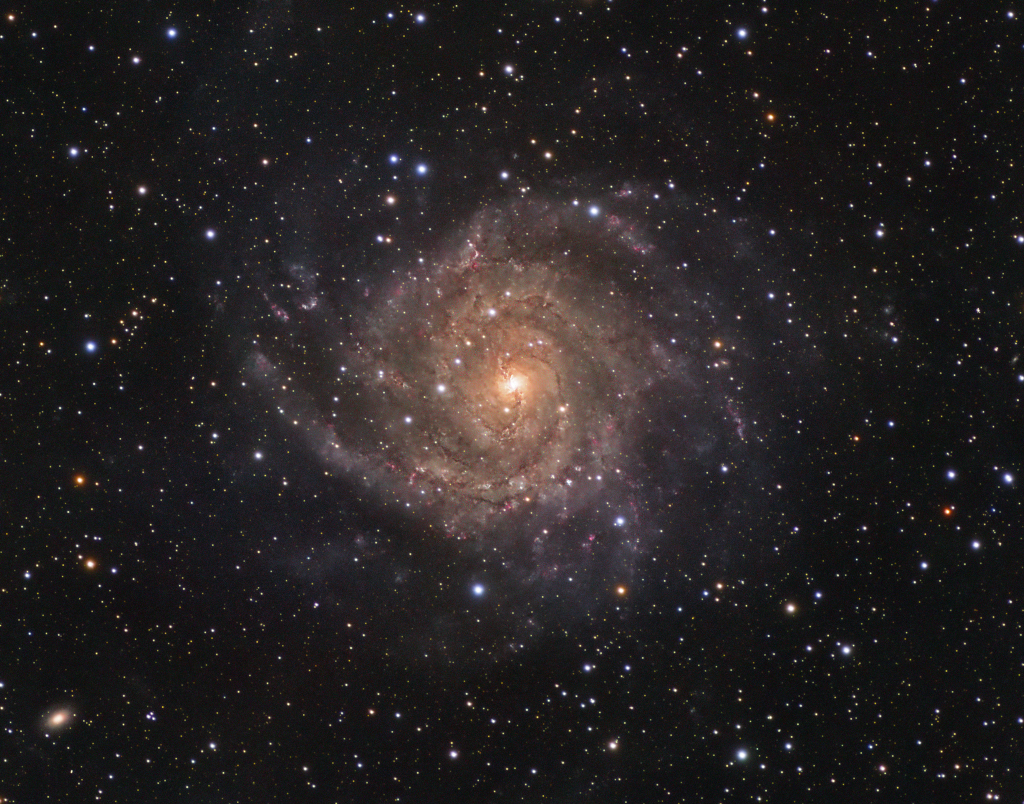
IC 342: Hidden Galaxy in Camelopardalis

Similar in size to large, bright spiral galaxies in our neighborhood, IC 342 is a mere 10 million light-years distant in the long-necked, northern constellation Camelopardalis. A sprawling island universe, IC 342 would otherwise be a prominent galaxy in our night sky, but it is hidden from clear view and only glimpsed through the veil of stars, gas and dust clouds along the plane of our own Milky Way galaxy. Even though IC 342’s light is dimmed and reddened by intervening cosmic clouds, this sharp telescopic image traces the galaxy’s own obscuring dust, young star clusters, and glowing star forming regions along spiral arms that wind far from the galaxy’s core. IC 342 has undergone a recent burst of star formation activity and is close enough to have gravitationally influenced the evolution of the local group of galaxies and the Milky Way. [via NASA] https://ift.tt/kOruxjc

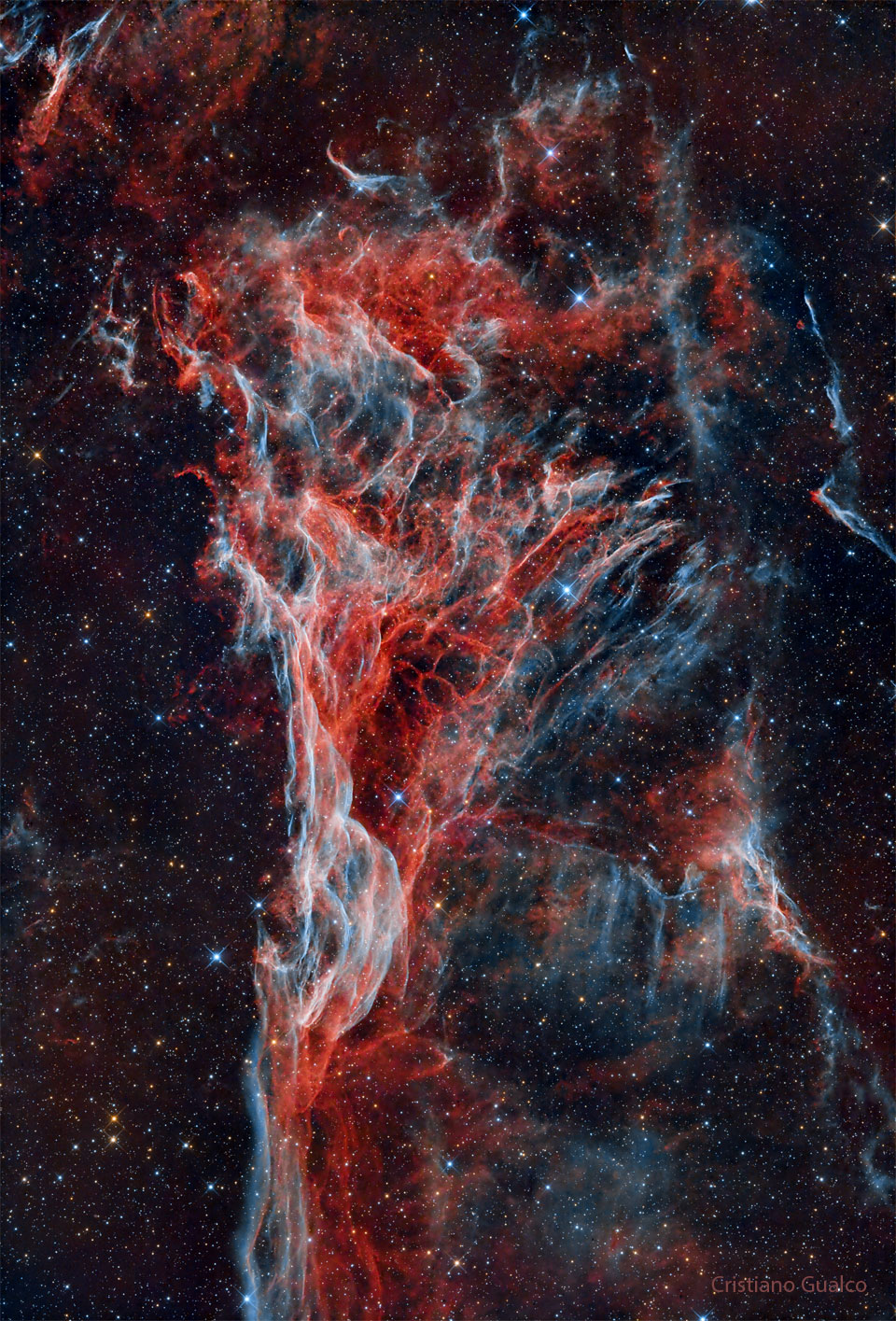
These chaotic and tangled filaments of shocked, glowing gas are spread across planet Earth’s sky toward the constellation of Cygnus as part of the Veil Nebula. The Veil Nebula itself is a large supernova remnant, an expanding cloud born of the death explosion of a massive star. Light from the original supernova explosion likely reached Earth over 5,000 years ago. The glowing filaments are really more like long ripples in a sheet seen almost edge on, remarkably well separated into the glow of ionized hydrogen atoms shown in red and oxygen in blue hues. Also known as the Cygnus Loop and cataloged as NGC 6979, the Veil Nebula now spans about 6 times the diameter of the full Moon. The length of the wisp corresponds to about 30 light years, given its estimated distance of 2,400 light years. Often identified as Pickering’s Triangle for a director of Harvard College Observatory, it is perhaps better named for its discoverer, astronomer Williamina Fleming, as Fleming’s Triangular Wisp. [via NASA] https://ift.tt/kzgLKwG

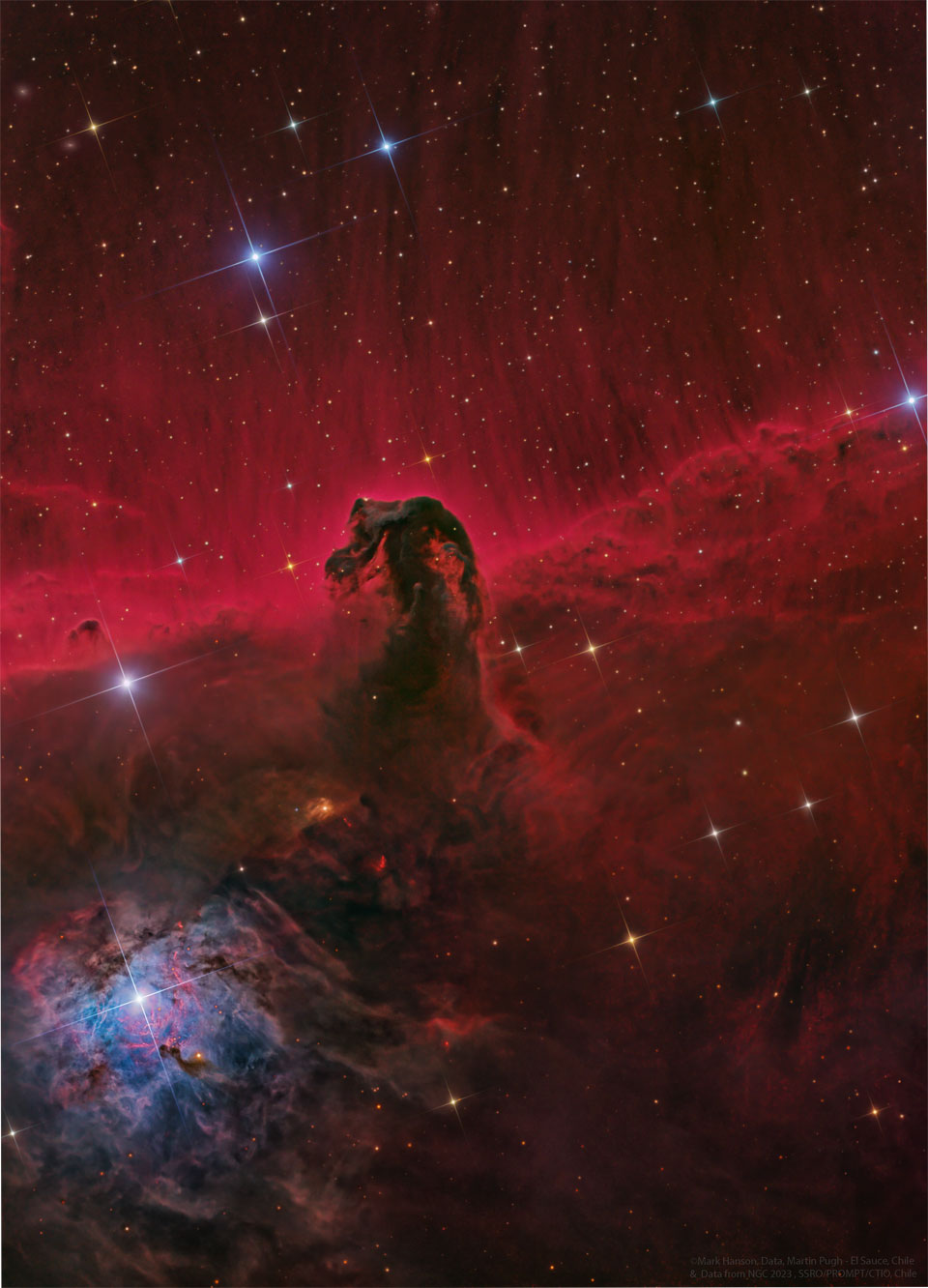
Sculpted by stellar winds and radiation, a magnificent interstellar dust cloud by chance has assumed this recognizable shape. Fittingly named the Horsehead Nebula, it is some 1,500 light-years distant, embedded in the vast Orion cloud complex. About five light-years «tall,» the dark cloud is cataloged as Barnard 33 and is visible only because its obscuring dust is silhouetted against the glowing red emission nebula IC 434. Stars are forming within the dark cloud. Contrasting blue reflection nebula NGC 2023, surrounding a hot, young star, is at the lower left of the full image. The featured gorgeous color image combines both narrowband and broadband images recorded using several different telescopes. [via NASA] https://ift.tt/2hQslAg

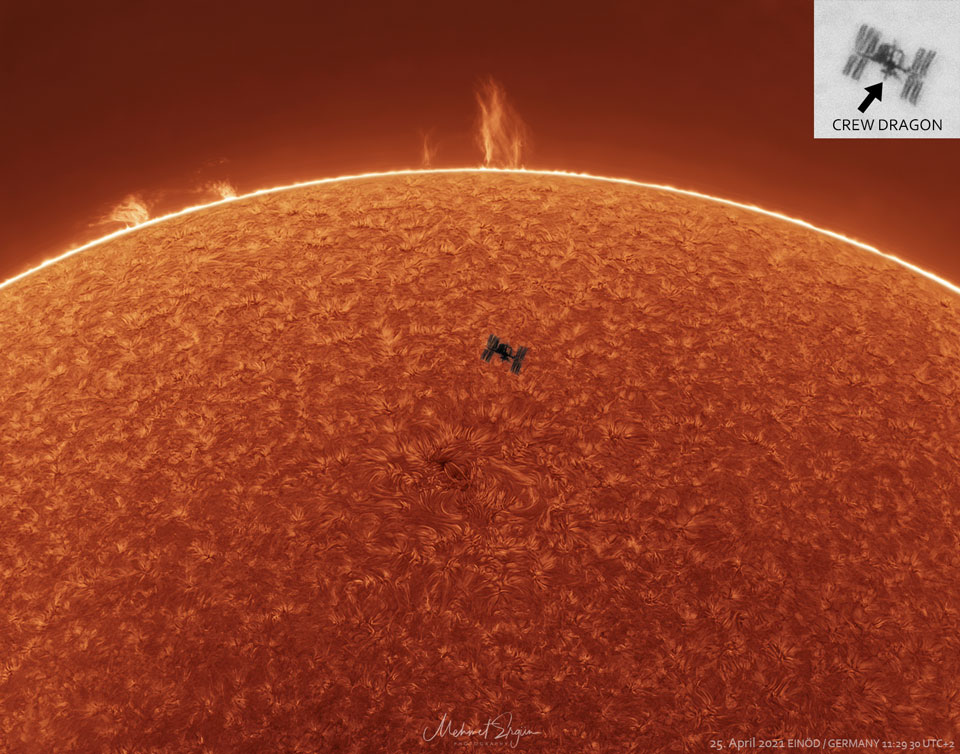
That’s no sunspot. It’s the International Space Station (ISS) caught passing in front of the Sun. Sunspots, individually, have a dark central umbra, a lighter surrounding penumbra, and no Dragon capsules attached. By contrast, the ISS is a complex and multi-spired mechanism, one of the largest and most complicated spacecraft ever created by humanity. Also, sunspots circle the Sun, whereas the ISS orbits the Earth. Transiting the Sun is not very unusual for the ISS, which orbits the Earth about every 90 minutes, but getting one’s location, timing and equipment just right for a great image is rare. The featured picture combined three images all taken in 2021 from the same location and at nearly the same time. One image — overexposed — captured the faint prominences seen across the top of the Sun, a second image — underexposed — captured the complex texture of the Sun’s chromosphere, while the third image — the hardest to get — captured the space station as it shot across the Sun in a fraction of a second. Close inspection of the space station’s silhouette even reveals a docked Dragon Crew capsule. [via NASA] https://ift.tt/yCtgBVx

Planet Earth from Orion

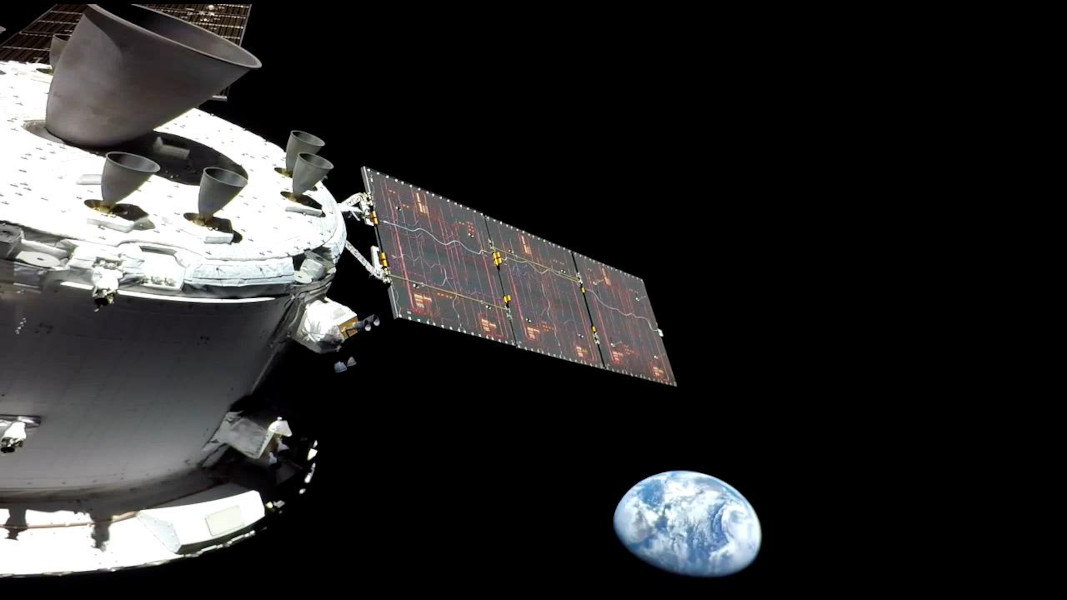
One year ago a Space Launch System rocket left planet Earth on November 16, 2022 at 1:47am EST carrying the Orion spacecraft on the Artemis I mission, the first integrated test of NASA’s deep space exploration systems. Over an hour after liftoff from Kennedy Space Center’s historic Launch Complex 39B, one of Orion’s external video cameras captured this view of its new perspective from space. In the foreground are Orion’s Orbital Maneuvering System engine and auxillary engines, at the bottom of the European Service Module. Beyond one of the module’s 7-meter long extended solar array wings lies the spacecraft’s beautiful home world. Making close flybys of the lunar surface and reaching a retrograde orbit 70,000 kilometers beyond the Moon, the uncrewed Artemis I mission lasted over 25 days, testing capabilities to enable human exploration of the Moon and Mars. Building on the success of Artemis I, no earlier than November 2024 the Artemis II mission with a crew of 4 will venture around the Moon and back again. [via NASA] https://ift.tt/MOFbuez

Nightlights in Qeqertaq

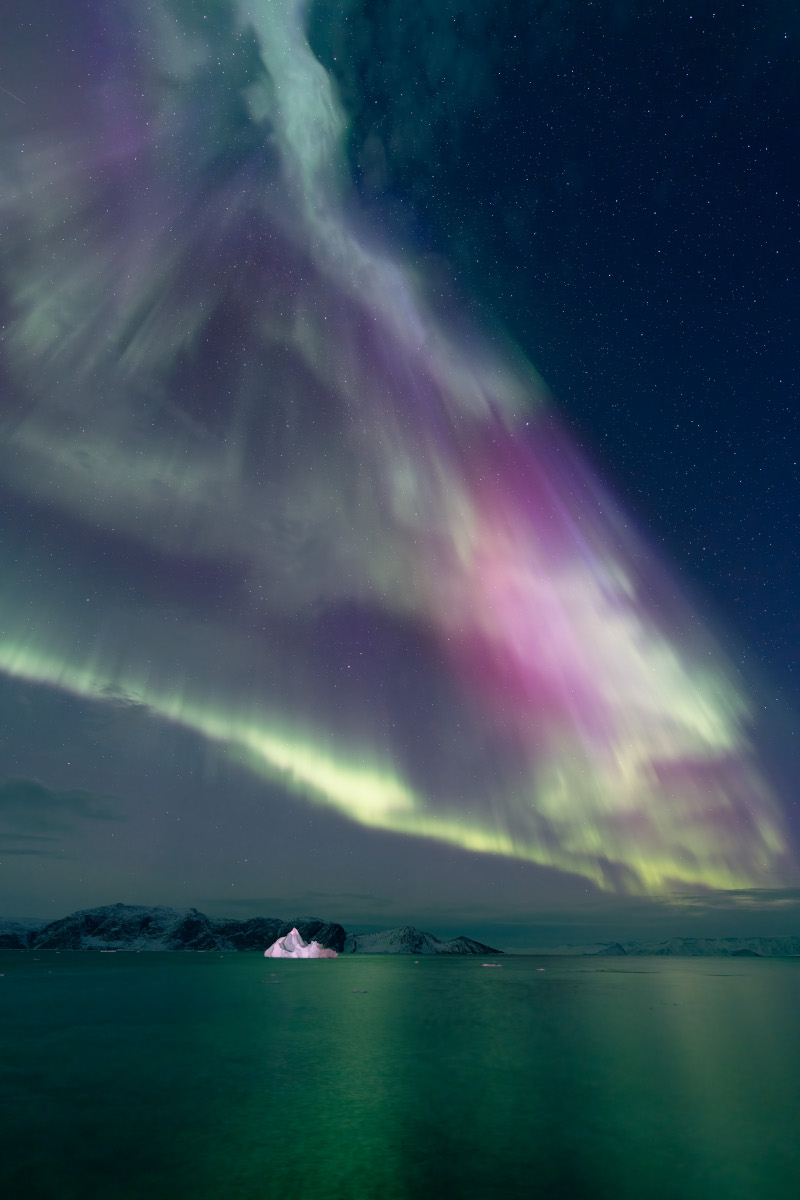
Light pollution is usually not a problem in Qeqertaq. In western Greenland the remote coastal village boasted a population of 114 in 2020. Lights still shine in its dark skies though. During planet Earth’s recent intense geomagnetic storm, on November 6 these beautiful curtains of aurora borealis fell over the arctic realm. On the eve of the coming weeks of polar night at 70 degrees north latitude, the inspiring display of northern lights is reflected in the waters of Disko Bay. In this view from the isolated settlement a lone iceberg is illuminated by shore lights as it drifts across the icy sea. [via NASA] https://ift.tt/6K7vx9f

Daytime Moon Meets Morning Star

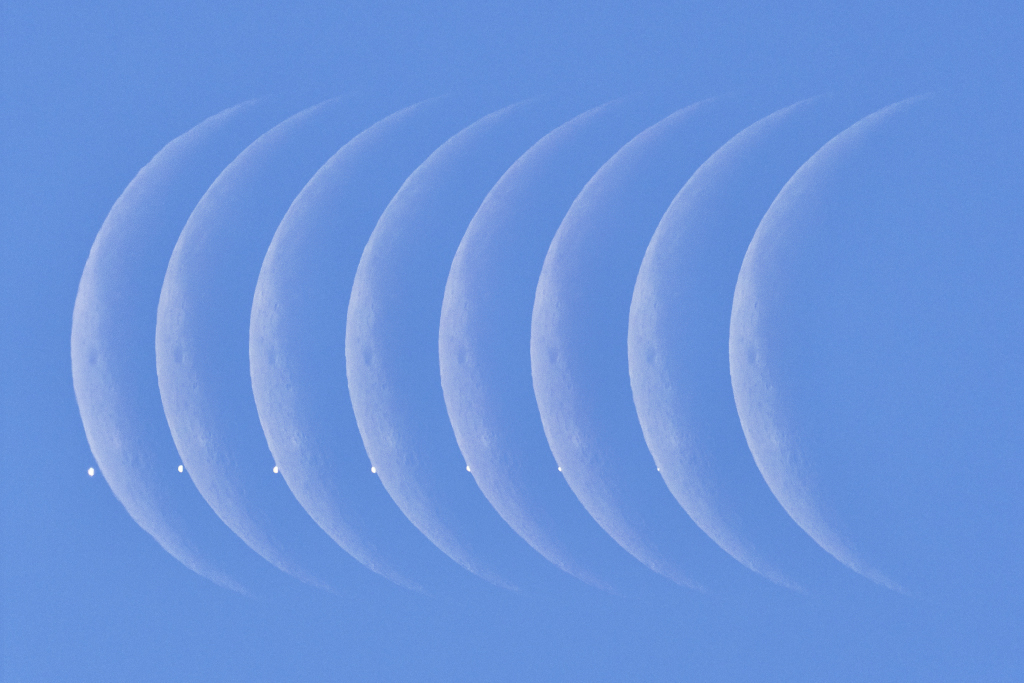
Venus now appears as Earth’s brilliant morning star, shining above the southeastern horizon before dawn. For early morning risers, the silvery celestial beacon rose predawn in a close pairing with a waning crescent Moon on Thursday, November 9. But from some northern locations, the Moon was seen to occult or pass in front of Venus. From much of Europe, the lunar occultation could be viewed in daylight skies. This time series composite follows the daytime approach of Moon and morning star in blue skies from Warsaw, Poland. The progression of eight sharp telescopic snapshots, made between 10:56am and 10:58am local time, runs from left to right, when Venus winked out behind the bright lunar limb. [via NASA] https://ift.tt/CaxhNjI

M1: The Incredible Expanding Crab

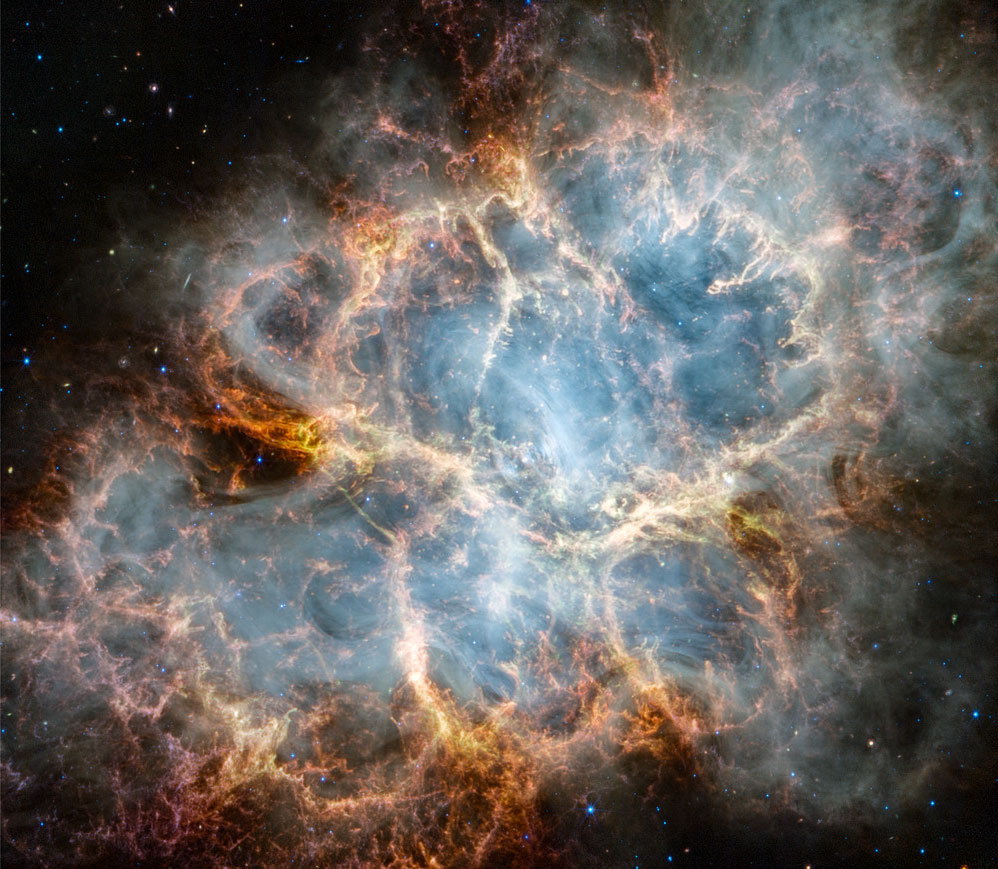
Cataloged as M1, the Crab Nebula is the first on Charles Messier’s famous list of things which are not comets. In fact, the Crab Nebula is now known to be a supernova remnant, an expanding cloud of debris from the death explosion of a massive star. The violent birth of the Crab was witnessed by astronomers in the year 1054. Roughly 10 light-years across, the nebula is still expanding at a rate of about 1,500 kilometers per second. You can see the expansion by comparing these sharp images from the Hubble Space Telescope and James Webb Space Telescope. The Crab’s dynamic, fragmented filaments were captured in visible light by Hubble in 2005 and Webb in infrared light in 2023. This cosmic crustacean lies about 6,500 light-years away in the constellation Taurus. [via NASA] https://ift.tt/j7xO6ud