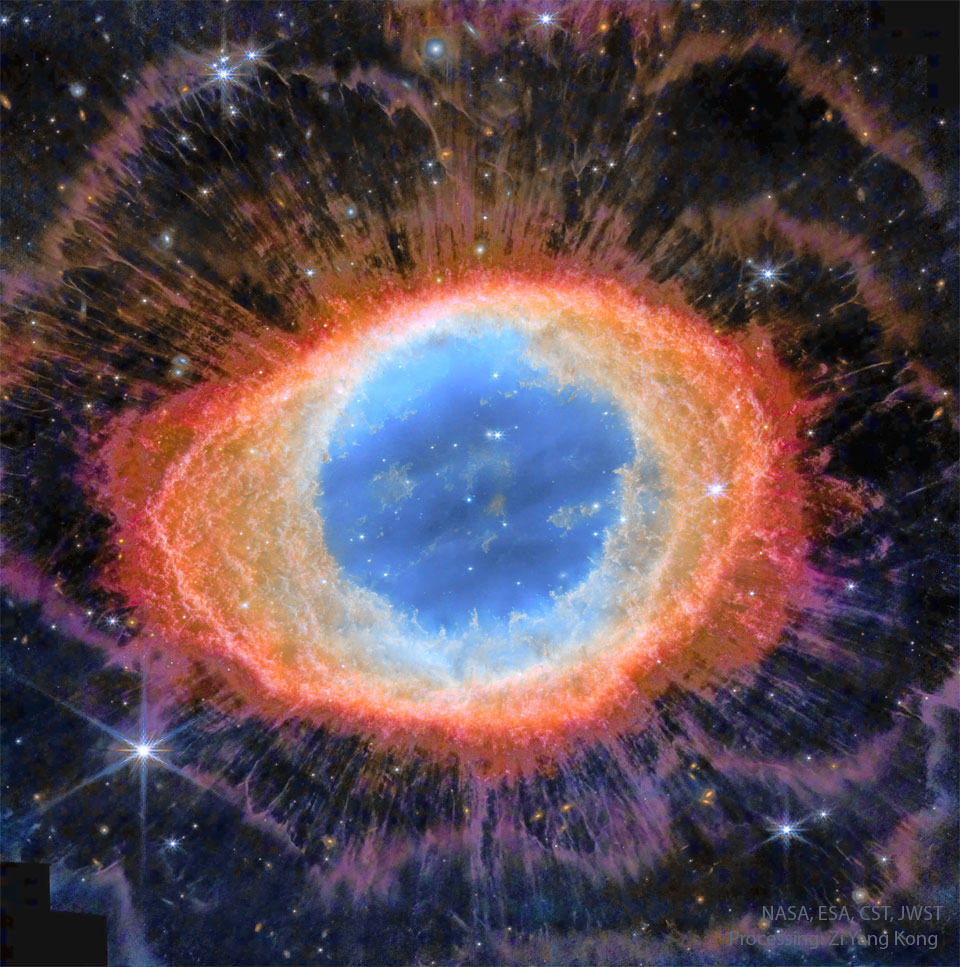
The Ring Nebula (M57), is more complicated than it appears through a small telescope. The easily visible central ring is about one light-year across, but this remarkable exposure by the James Webb Space Telescope explores this popular nebula with a deep exposure in infrared light. Strings of gas, like eyelashes around a cosmic eye, become evident around the Ring in this digitally enhanced featured image in assigned colors. These long filaments may be caused by shadowing of knots of dense gas in the ring from energetic light emitted within. The Ring Nebula is an elongated planetary nebula, a type of gas cloud created when a Sun-like star evolves to throw off its outer atmosphere to become a white dwarf star. The central oval in the Ring Nebula lies about 2,500 light-years away toward the musical constellation Lyra. [via NASA] https://ift.tt/kdv4VcZ
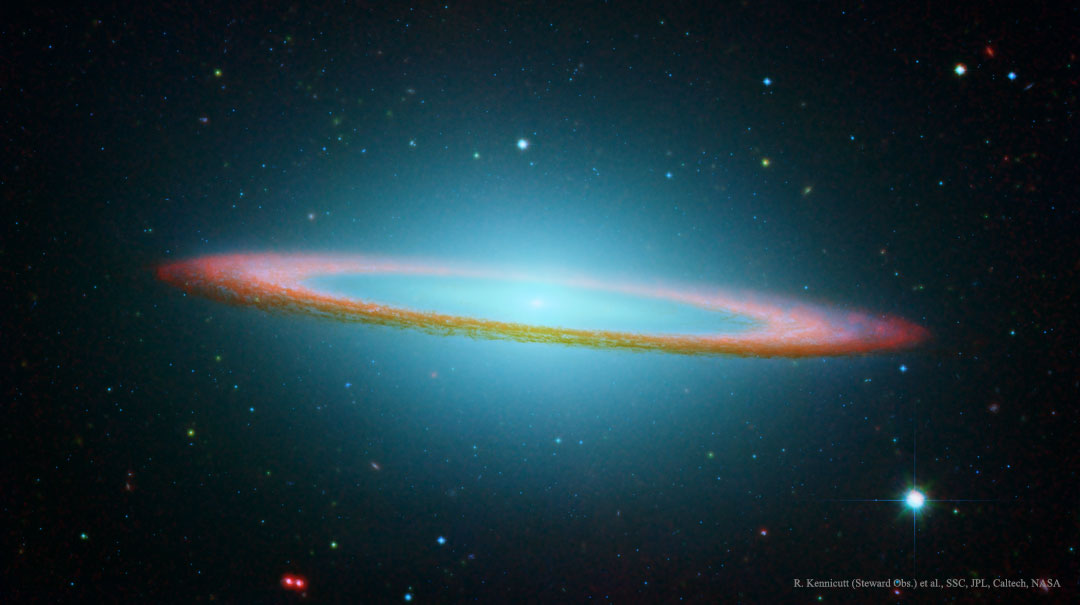
This floating ring is the size of a galaxy. In fact, it is a galaxy — or at least part of one: the photogenic Sombrero Galaxy, one of the largest galaxies in the nearby Virgo Cluster of Galaxies. The dark band of dust that obscures the mid-section of the Sombrero Galaxy in optical light actually glows brightly in infrared light. The featured image, digitally sharpened, shows the infrared glow, recently recorded by the orbiting Spitzer Space Telescope, superposed in false-color on an existing image taken by NASA’s Hubble Space Telescope in visible light. The Sombrero Galaxy, also known as M104, spans about 50,000 light years across and lies 28 million light years away. M104 can be seen with a small telescope in the direction of the constellation Virgo. [via NASA] https://ift.tt/iMnD1TH

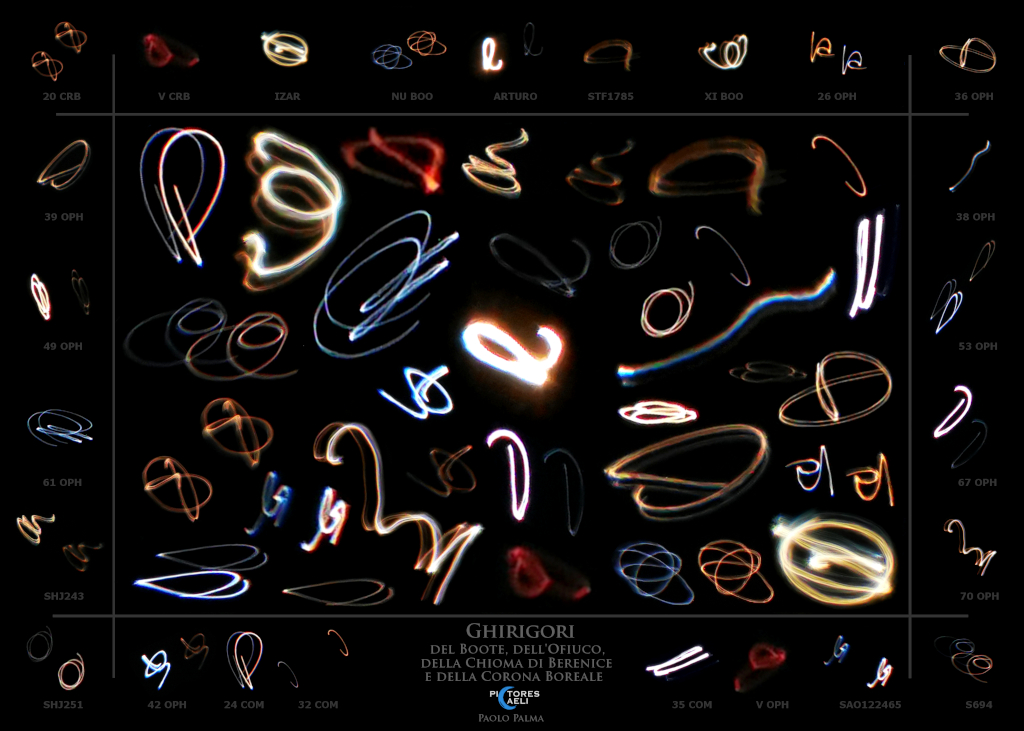
Ghirigori Star Scribbles

It’s fun to scribble on the canvas of the sky. You can use a creative photographic technique to cause the light of point-like stars to dance across a digital image by tapping lightly on the telescope while making an exposure. The result will be a squiggly line traced by the star (or two squiggles traced by binary stars) that can reveal the star’s color. Colorful lines, dubbed Ghirigori, made from stars found in the northern sky constellations Bootes, Corona Borealis, Ophiucus, and Coma Berenices, are captured in this artistic mosaic. The 25 stars creating the varied and colorful squiggles are identified around the border. Of course, temperature determines the color of a star. While whitish stars tend to be close to the Sun’s temperature, stars with bluer hues are hotter, and yellow and red colors are cooler than the Sun. [via NASA] https://ift.tt/lRHxDAQ

M51 in 255 Hours

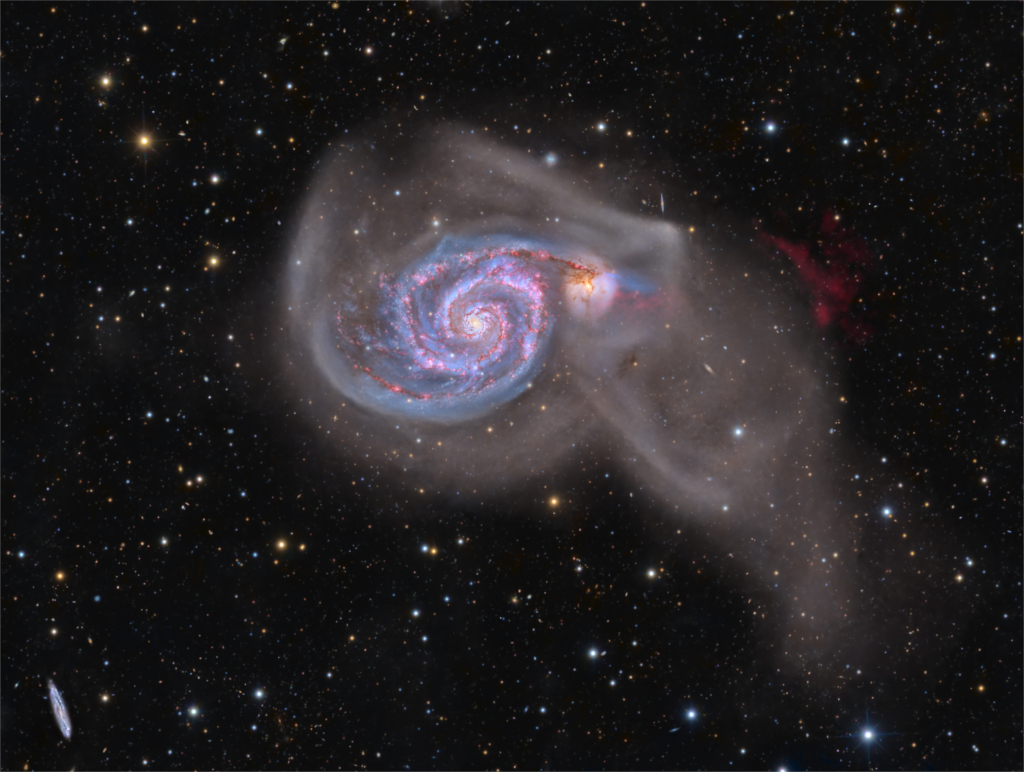
An intriguing pair of interacting galaxies, M51 is the 51st entry in Charles Messier’s famous catalog. Perhaps the original spiral nebula, the large galaxy with whirlpool-like spiral structure seen nearly face-on is also cataloged as NGC 5194. Its spiral arms and dust lanes sweep in front of a companion galaxy (right), NGC 5195. Some 31 million light-years distant, within the boundaries of the well-trained constellation Canes Venatici, M51 looks faint and fuzzy to the eye in direct telescopic views. But this remarkably deep image shows off stunning details of the galaxy pair’s striking colors and extensive tidal debris. A collaboration of astro-imagers using telescopes on planet Earth combined over 10 days of exposure time to create this definitive galaxy portrait of M51. The image includes 118 hours of narrowband data that also reveals a vast glowing cloud of reddish ionized hydrogen gas discovered in the M51 system. [via NASA] https://ift.tt/c3nugAD

Five Meters over Mars

On mission sol 872 (Earth date August 3) Ingenuity snapped this sharp image on its 54th flight above the surface of the Red Planet. During the flight the Mars Helicopter hovered about 5 meters, or just over 16 feet, above the Jezero crater floor. Tips of Ingenuity’s landing legs peek over the left and right edges in the camera’s field of view. Tracks visible near the upper right corner lead to the Perseverance Mars Rover, seen looking on from a distance at the top right edge of the frame. Planned as a brief «pop-up» flight, Ingenuity’s 54th flight lasted less than 25 seconds. It followed Ingenuity’s 53rd flight made on July 22 that resulted in an unscheduled landing. [via NASA] https://ift.tt/CH3LT5v

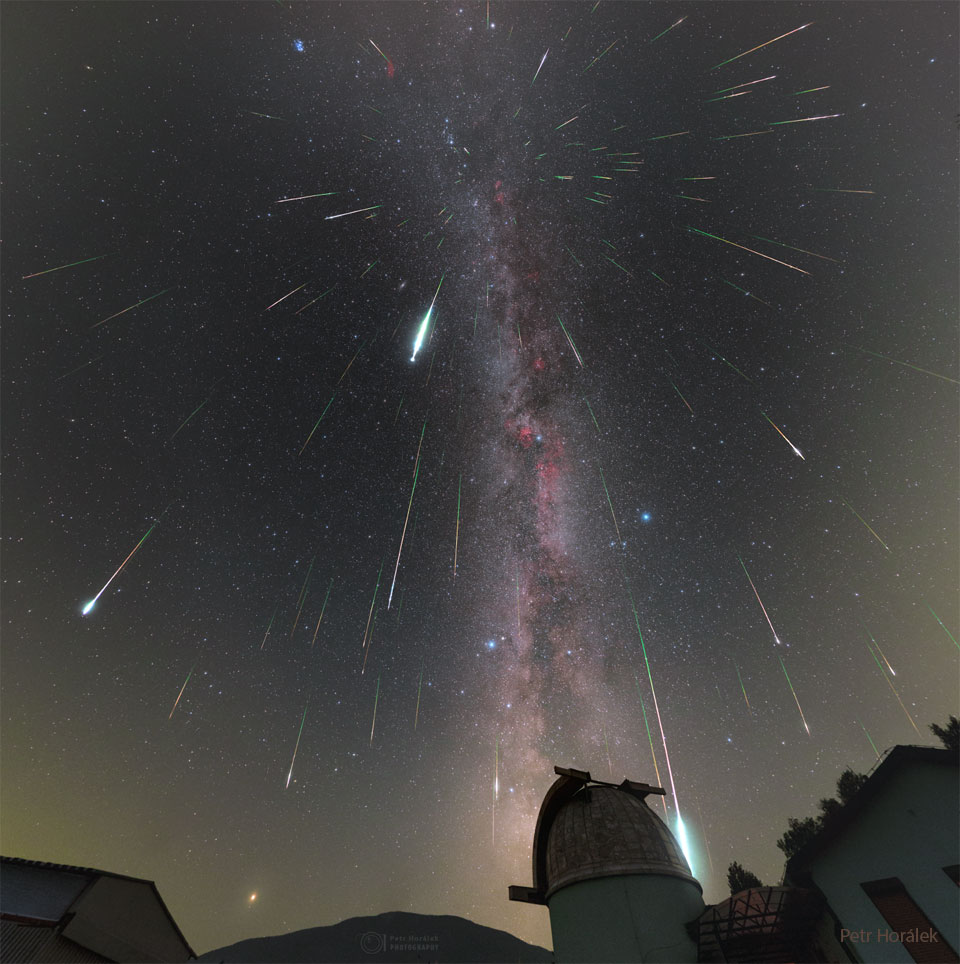
This is a good week to see meteors. Comet dust will rain down on planet Earth, streaking through dark skies during peak nights of the annual Perseid Meteor Shower. The featured composite image was taken during the 2018 Perseids from the Poloniny Dark Sky Park in Slovakia. The dome of the observatory in the foreground is on the grounds of Kolonica Observatory. Although the comet dust particles travel parallel to each other, the resulting shower meteors clearly seem to radiate from a single point on the sky in the eponymous constellation Perseus. The radiant effect is due to perspective, as the parallel tracks appear to converge at a distance, like train tracks. The Perseid Meteor Shower is expected to reach its highest peak on Saturday after midnight. Since a crescent Moon will rise only very late that night, cloudless skies will be darker than usual, making a high number of faint meteors potentially visible this year. [via NASA] https://ift.tt/DIHsVO6

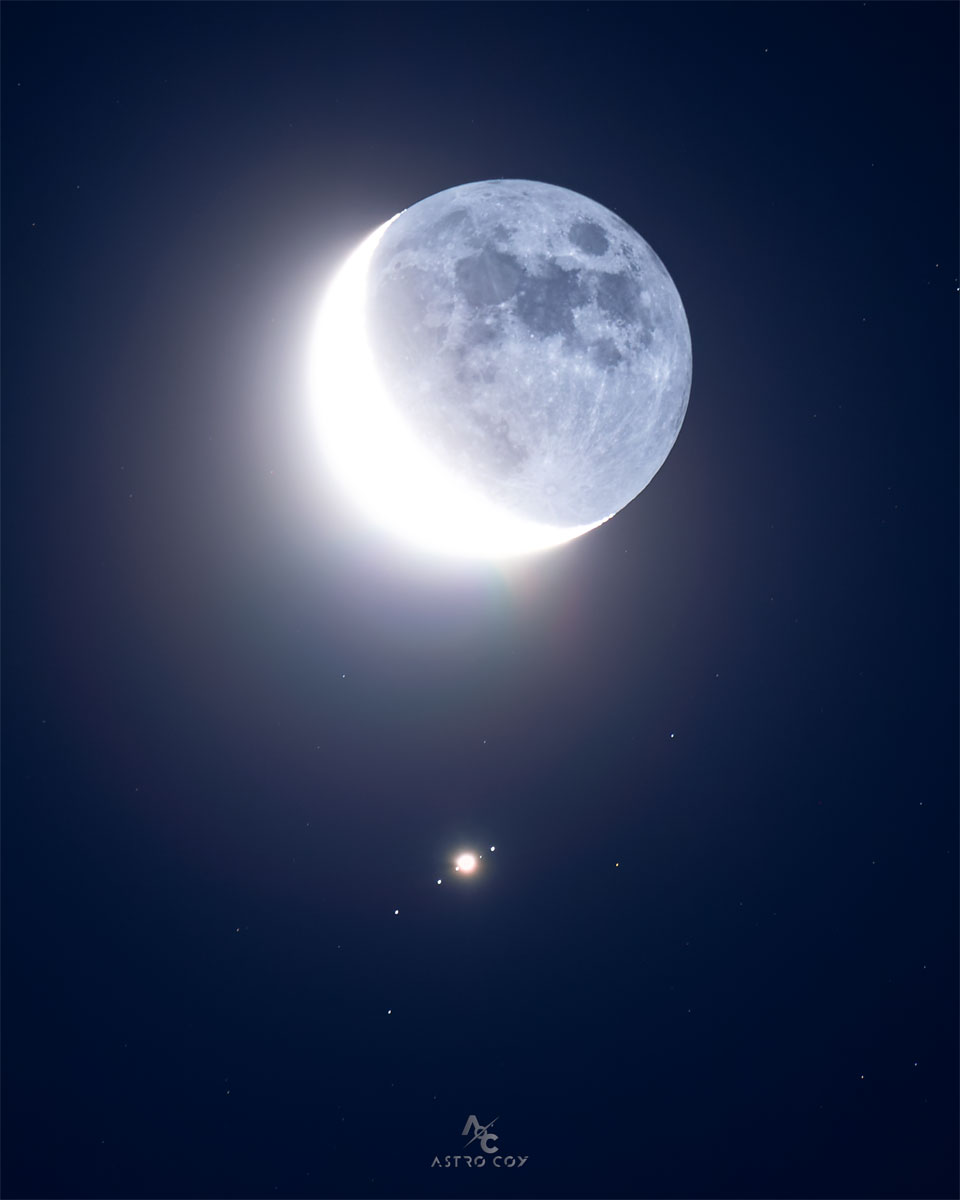
What’s that below the Moon? Jupiter — and its largest moons. Many skygazers across planet Earth enjoyed the close conjunction of Earth’s Moon passing nearly in front of Jupiter in mid-June. The featured image is a single exposure of the event taken from Morón de la Frontera, Spain. The sunlit lunar crescent on the left is overexposed, while the Moon’s night side, on the right, is only faintly illuminated by Earthshine. Lined up diagonally below the Moon, left to right, are Jupiter’s bright Galilean satellites: Callisto, Ganymede, Io (hard to see as it is very near to Jupiter), and Europa. In fact, Callisto, Ganymede, and Io are larger than Earth’s Moon, while Europa is only slightly smaller. NASA’s robotic spacecraft Juno is currently orbiting Jupiter and made a close pass near Io only a week ago. If you look up in the night sky tonight, you will again see two of the brightest objects angularly close together — because tonight is another Moon-Jupiter conjunction. [via NASA] https://ift.tt/arQP3dE

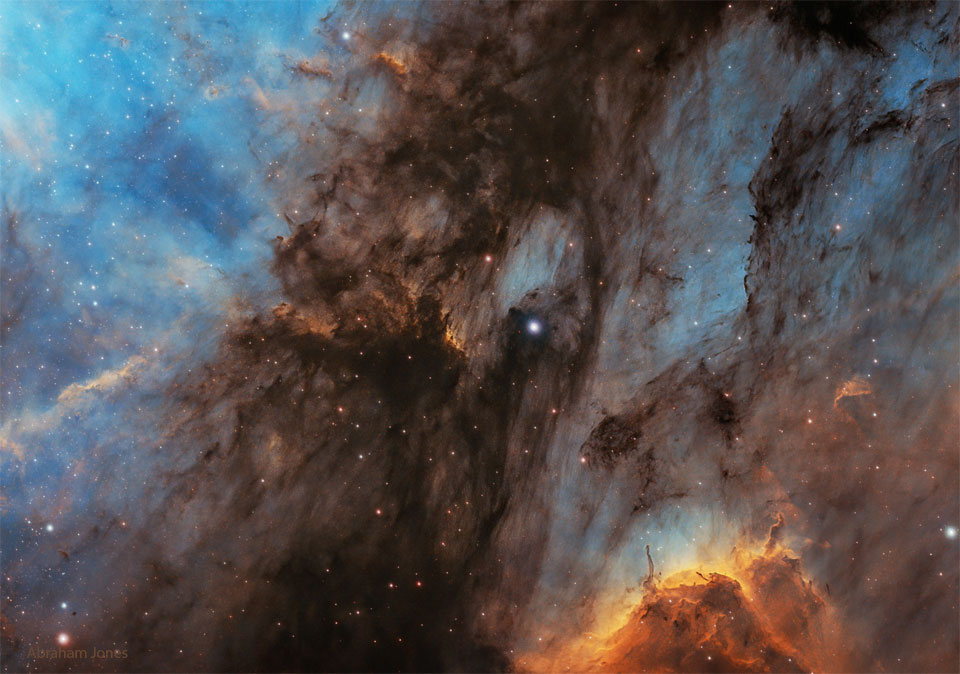
The Pelican Nebula is slowly being transformed. IC 5070 (the official designation) is divided from the larger North America Nebula by a molecular cloud filled with dark dust. The Pelican, however, receives much study because it is a particularly active mix of star formation and evolving gas clouds. The featured picture was produced in three specific colors — light emitted by sulfur, hydrogen, and oxygen — that can help us to better understand these interactions. The light from young energetic stars is slowly transforming the cold gas to hot gas, with the advancing boundary between the two, known as an ionization front, visible in bright orange on the right. Particularly dense tentacles of cold gas remain. Millions of years from now, the Pelican nebula, bounded by dark nebula LDN 935, might no longer be known as the Pelican, as the balance and placement of stars and gas will surely leave something that appears completely different. [via NASA] https://ift.tt/YAc2uNm

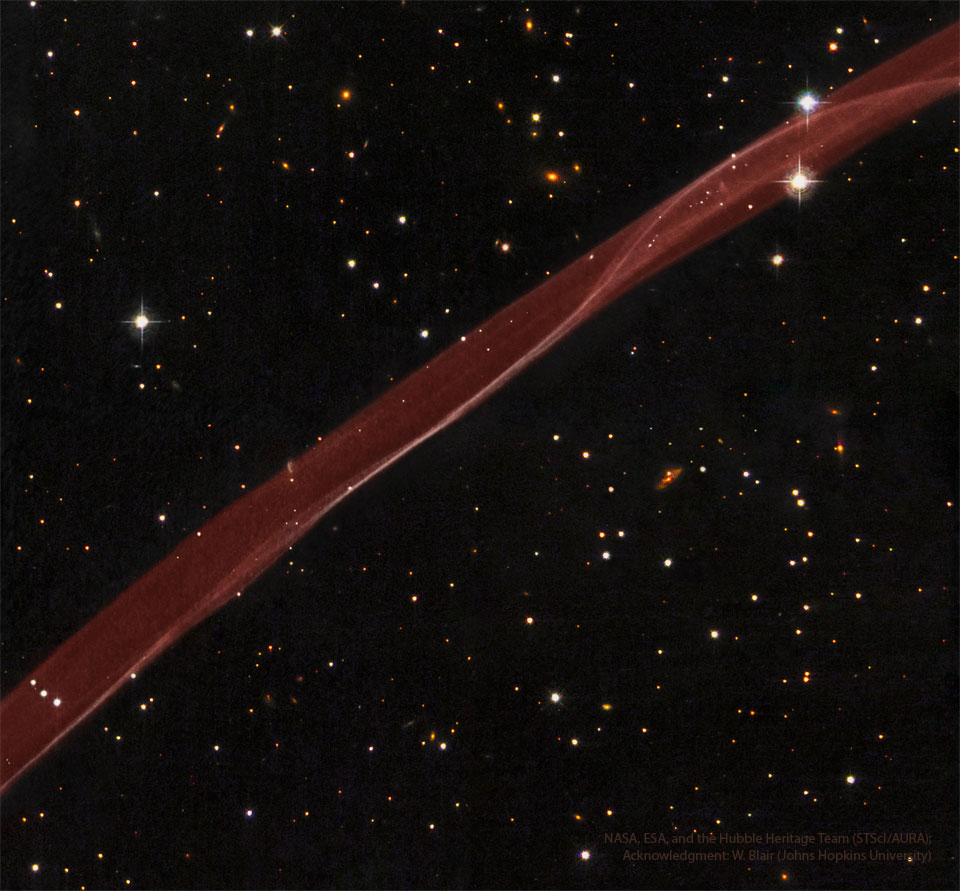
What created this unusual space ribbon? The answer: one of the most violent explosions ever witnessed by ancient humans. Back in the year 1006 AD, light reached Earth from a stellar explosion in the constellation of the Wolf (Lupus), creating a «guest star» in the sky that appeared brighter than Venus and lasted for over two years. The supernova, now cataloged at SN 1006, occurred about 7,000 light years away and has left a large remnant that continues to expand and fade today. Pictured here is a small part of that expanding supernova remnant dominated by a thin and outwardly moving shock front that heats and ionizes surrounding ambient gas. The supernova remnant SN 1006 now has a diameter of nearly 60 light years. [via NASA] https://ift.tt/4ykiwJq

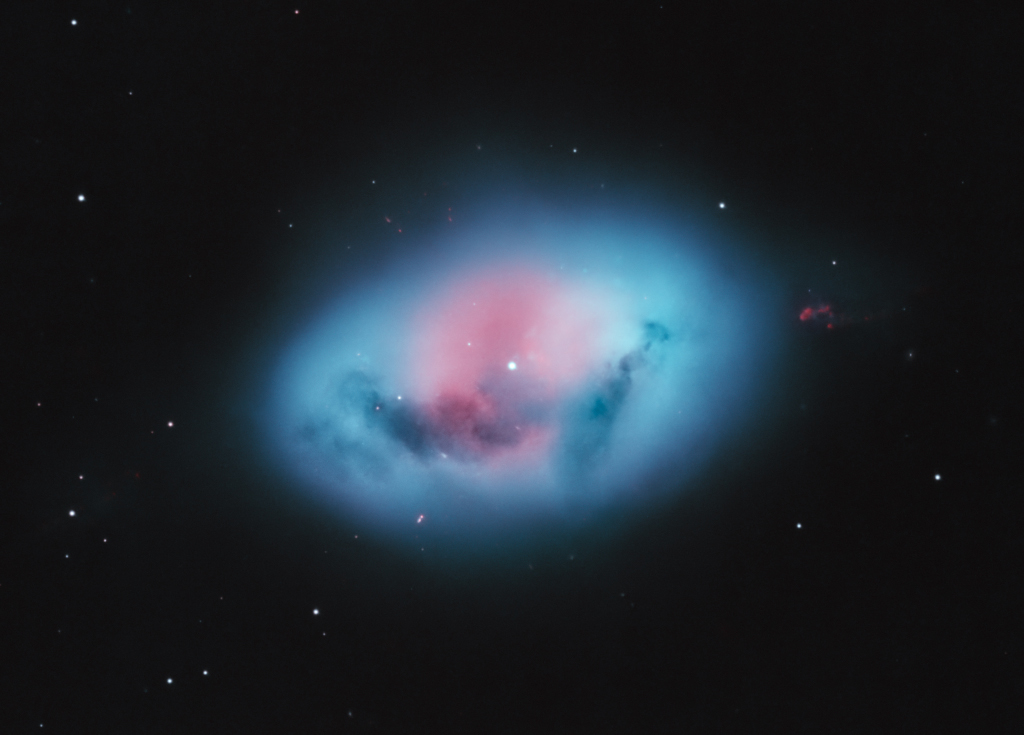
NGC 1360: The Robin’s Egg Nebula

This pretty nebula lies some 1,500 light-years away, its shape and color in this telescopic view reminiscent of a robin’s egg. The cosmic cloud spans about 3 light-years, nestled securely within the boundaries of the southern constellation Fornax. Recognized as a planetary nebula, egg-shaped NGC 1360 doesn’t represent a beginning though. Instead it corresponds to a brief and final phase in the evolution of an aging star. In fact, visible at the center of the nebula, the central star of NGC 1360 is known to be a binary star system likely consisting of two evolved white dwarf stars, less massive but much hotter than the Sun. Their intense and otherwise invisible ultraviolet radiation has stripped away electrons from the atoms in their mutually surrounding gaseous shroud. The predominant blue-green hue of NGC 1360 seen here is the strong emission produced as electrons recombine with doubly ionized oxygen atoms. [via NASA] https://ift.tt/uDqUA8R