Three Clusters in Puppis

Galactic or open star clusters are young. The swarms of stars are born together near the plane of the Milky Way, but their numbers steadily dwindle as cluster members are ejected by galactic tides and gravitational interactions. Caught in this telescopic frame over three degrees across are three good examples of galactic star clusters, seen toward the southern sky’s nautical constellation Puppis. Below and left, M46 is some 5,500 light-years in the distance. Right of center M47 is only 1,600 light-years away and NGC 2423 (top) is about 2500 light-years distant. Around 300 million years young M46 contains a few hundred stars in a region about 30 light-years across. Sharp eyes can spot a planetary nebula, NGC 2438, at about 11 o’clock against the M46 cluster stars. But that nebula’s central star is billions of years old, and NGC 2438 is likely a foreground object only by chance along the line of sight to youthful M46. Even younger, aged around 80 million years, M47 is a smaller and looser star cluster spanning about 10 light-years. Star cluster NGC 2423 is pushing about 750 million years in age though. NGC 2423 is known to harbor an extrasolar planet, detected orbiting one of its red giant stars. [via NASA] https://ift.tt/gQtBVkc

Chamaeleon I Molecular Cloud

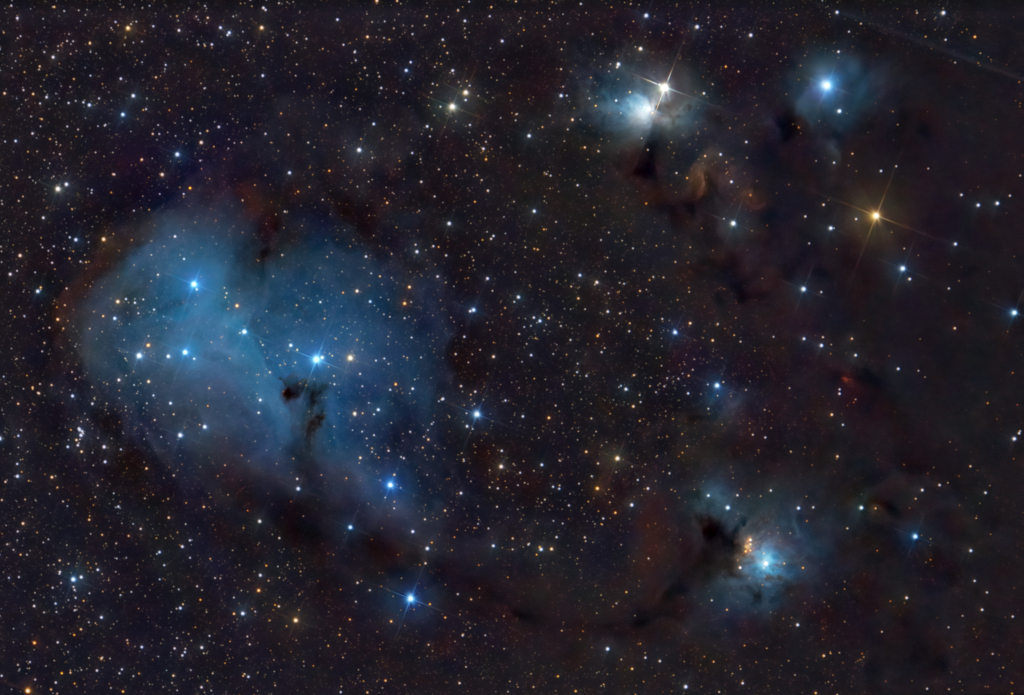
Dark markings and bright nebulae in this telescopic southern sky view are telltale signs of young stars and active star formation. They lie a mere 650 light-years away, at the boundary of the local bubble and the Chamaeleon molecular cloud complex. Regions with young stars identified as dusty reflection nebulae from the 1946 Cederblad catalog include the C-shaped Ced 110 just above and left of center, and bluish Ced 111 below it. Also a standout in the frame, the orange tinted V-shape of the Chamaeleon Infrared Nebula (Cha IRN) was carved by material streaming from a newly formed low-mass star. The well-composed image spans 1.5 degrees. That’s about 17 light-years at the estimated distance of the nearby Chamaeleon I molecular cloud. [via NASA] https://ift.tt/jo8yfiG

Eiffel Tower Prominence on the Sun

What’s that on the Sun? Although it may look like a flowing version of the Eiffel Tower, it is a solar prominence that is actually much bigger — about the height of Jupiter. The huge prominence emerged about ten days ago, hovered over the Sun’s surface for about two days, and then erupted — throwing a coronal mass ejection (CME) into the Solar System. The featured video, captured from the astrophotographer’s backyard in Hendersonville, Tennessee, USA, shows an hour time-lapse played both forwards and backwards. That CME did not impact the Earth, but our Sun had unleashed other recent CMEs that not only triggered Earthly auroras, but puffed out the Earth’s atmosphere enough to cause just-launched Starlink satellites to fall back. Activity on the Sun, including sunspots, prominences, CMEs and flares, continues to increase as the Sun evolves away from a deep minimum in its 11-year magnetic cycle. [via NASA] https://ift.tt/dEHlyIa

Terminator Moon

What’s different about this Moon? It’s the terminators. In the featured image, you can’t directly see any terminator — the line that divides the light of day from the dark of night. That’s because the image is a digital composite of 29 near-terminator lunar strips. Terminator regions show the longest and most prominent shadows — shadows which, by their contrast and length, allow a flat photograph to appear three-dimensional. The original images and data were taken near the Moon by NASA’s Lunar Reconnaissance Orbiter. Many of the Moon’s craters stand out because of the shadows they all cast to the right. The image shows in graphic detail that the darker regions known as maria are not just darker than the rest of the Moon — they are flatter. [via NASA] https://ift.tt/4YoDwhJ

In the Heart of the Heart Nebula

What excites the Heart Nebula? First, the large emission nebula dubbed IC 1805 looks, in whole, like a human heart. Its shape perhaps fitting of the Valentine’s Day, this heart glows brightly in red light emitted by its most prominent element: excited hydrogen. The red glow and the larger shape are all created by a small group of stars near the nebula’s center. In the heart of the Heart Nebula are young stars from the open star cluster Melotte 15 that are eroding away several picturesque dust pillars with their energetic light and winds. The open cluster of stars contains a few bright stars nearly 50 times the mass of our Sun, many dim stars only a fraction of the mass of our Sun, and an absent microquasar that was expelled millions of years ago. The Heart Nebula is located about 7,500 light years away toward the constellation of the mythological Queen of Aethiopia (Cassiopeia). [via NASA] https://ift.tt/HPMhxl8

Earth at Night

This is what the Earth looks like at night. Can you find your favorite country or city? Surprisingly, city lights make this task quite possible. Human-made lights highlight particularly developed or populated areas of the Earth’s surface, including the seaboards of Europe, the eastern United States, and Japan. Many large cities are located near rivers or oceans so that they can exchange goods cheaply by boat. Particularly dark areas include the central parts of South America, Africa, Asia, and Australia. The featured image, nicknamed Black Marble, is actually a composite of hundreds of pictures remade in 2016 from data taken by the orbiting Suomi NPP satellite. [via NASA] https://ift.tt/FVPoNig

Aurora by Moonlight

The ice was singing as light from a bright gibbous Moon cast shadows across this frozen lake, about 20 kilometers north of Stockholm, Sweden, planet Earth. In the alluring night skyscape captured on February 10, shimmering auroral curtains of light dance in the evening sky. On that northern night nature’s performance included the auroral displays fostered by a minor geomagnetic storm. Stormy space weather was the result of a coronal mass ejection, erupting from a solar prominence days earlier and brushing our fair planet’s magnetosphere. [via NASA] https://ift.tt/dum2ZBD

IC 342: The Hidden Galaxy in Camelopardalis

Similar in size to large, bright spiral galaxies in our neighborhood, IC 342 is a mere 10 million light-years distant in the long-necked, northern constellation Camelopardalis. A sprawling island universe, IC 342 would otherwise be a prominent galaxy in our night sky, but it is hidden from clear view and only glimpsed through the veil of stars, gas and dust clouds along the plane of our own Milky Way galaxy. Even though IC 342’s light is dimmed and reddened by intervening cosmic clouds, this sharp telescopic image traces the galaxy’s own obscuring dust, young star clusters, and glowing pink star forming regions along spiral arms that wind far from the galaxy’s core. IC 342 may have undergone a recent burst of star formation activity and is close enough to have gravitationally influenced the evolution of the local group of galaxies and the Milky Way. [via NASA] https://ift.tt/McDIvy5

T Tauri and Hind s Variable Nebula

The star with an orange tint near top center in this dusty telescopic frame is T Tauri, prototype of the class of T Tauri variable stars. Next to it (right) is a yellow cosmic cloud historically known as Hind’s Variable Nebula (NGC 1555). About 650 light-years away, at the boundary of the local bubble and the Taurus molecular cloud, both star and nebula are seen to vary significantly in brightness but not necessarily at the same time, adding to the mystery of the intriguing region. T Tauri stars are now generally recognized as young (less than a few million years old), sun-like stars still in the early stages of formation. To further complicate the picture, infrared observations indicate that T Tauri itself is part of a multiple system and suggest that the associated Hind’s Nebula may also contain a very young stellar object. The well-composed image spans about 8 light-years at the estimated distance of T Tauri. [via NASA] https://ift.tt/ecigBGJ

Eta Car: 3D Model of the Most Dangerous Star Known

What’s the most dangerous star near earth? Many believe it’s Eta Carinae, a binary star system about 100 times the mass of the Sun, just 10,000 light years from earth. Eta Carinae is a ticking time bomb, set to explode as a supernova in only a few million years, when it may bathe the earth in dangerous gamma rays. The star suffered a notorious outburst in the 1840s when it became the brightest star in the southern sky, only to fade to obscurity within decades. The star was not destroyed, but lies hidden behind a thick, expanding, double-lobed structure called the Homunculus which now surrounds the binary. Studies of this ejecta provide forensic clues about the explosion. Using observations from NASA satellites we can now visualize the 3D distribution of the shrapnel, all the way from the infrared, through optical and UV, to the outermost shell of million-degree material, visible only in X-rays. [via NASA] https://ift.tt/jild5xR