Mars over Duddo Stone Circle

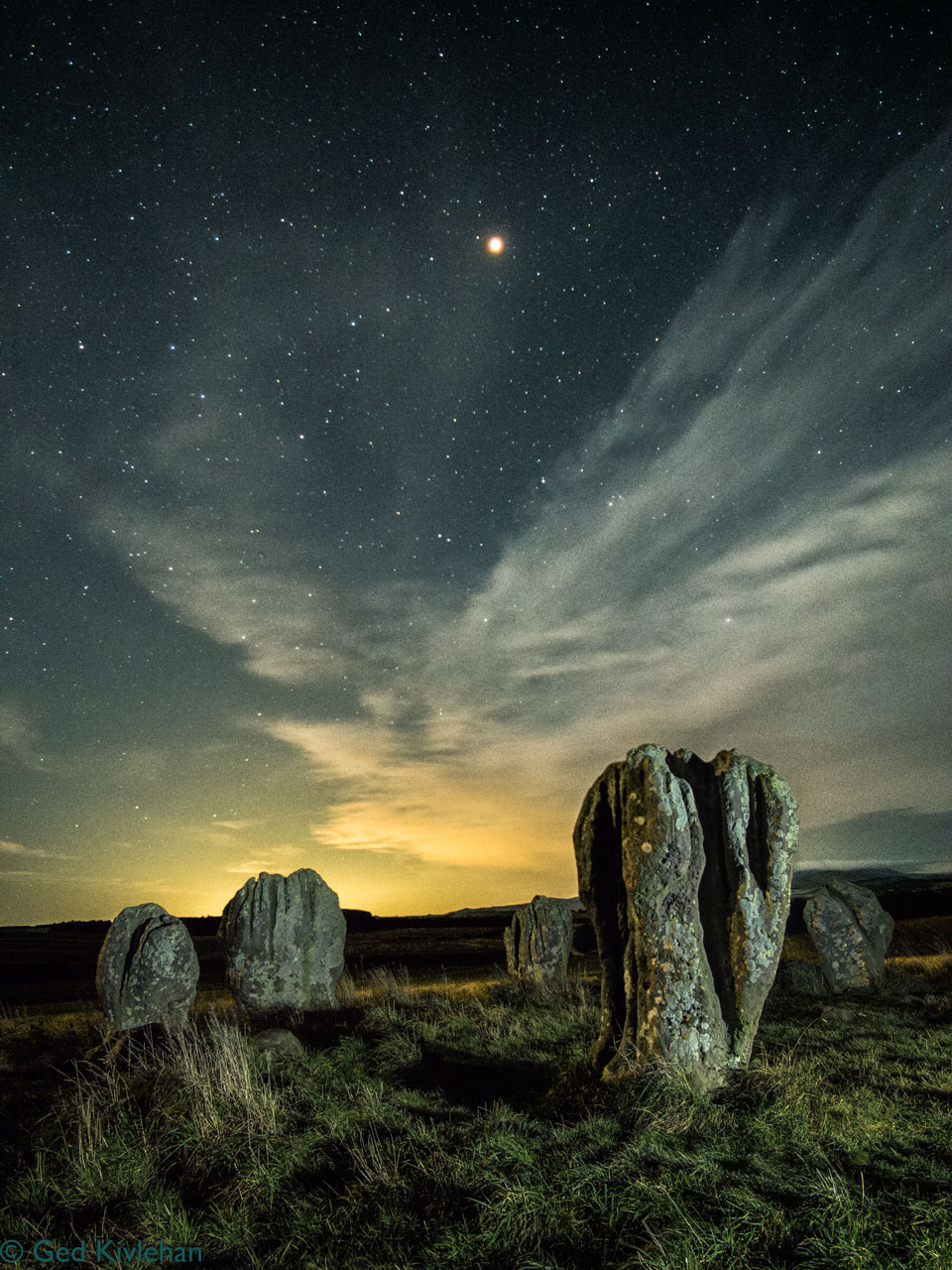
Why are these large stones here? One the more famous stone circles is the Duddo Five Stones of Northumberland, England. Set in the open near the top of a modest incline, a short hike across empty fields will bring you to unusual human -sized stones that are unlike anything surrounding them. The grooved, pitted, and deeply weathered surfaces of the soft sandstones are consistent with being placed about 4000 years ago — but placed for reasons now unknown. The featured image — a composite of two consecutive images taken from the same location — was captured last October under a starry sky when the Earth was passing near Mars, making the red planet unusually large and bright. Mars remains visible at sunset, although increasingly close to the horizon over the next few months. [via NASA] https://ift.tt/3lIymH7
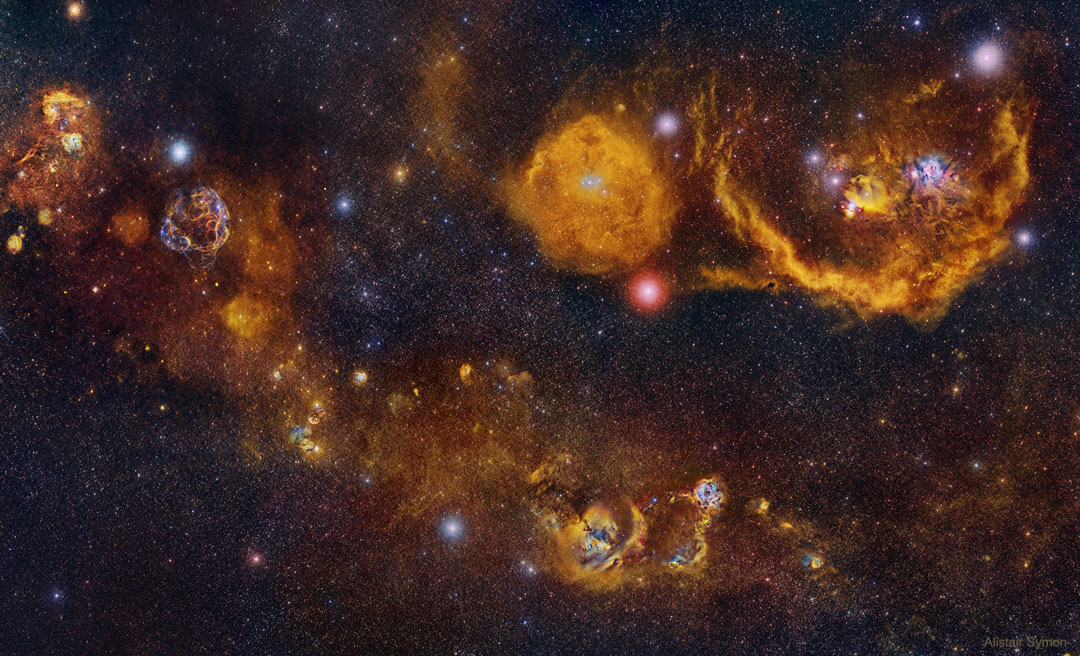

From Auriga to Orion

What’s up in the sky from Auriga to Orion? Many of the famous stars and nebulas in this region were captured on 34 separate images, taking over 430 hours of exposure, and digitally combined to reveal the featured image. Starting on the far upper left, toward the constellation of Auriga (the Chariot driver), is the picturesque Flaming Star Nebula (IC 405). Continuing down along the bright arc of our Milky Way Galaxy, from left to right crossing the constellations of the Twins and the Bull, notable appearing nebulas include the Tadpole, Simeis 147, Monkey Head, Jellyfish, Cone and Rosette nebulas. In the upper right quadrant of the image, toward the constellation of Orion (the hunter), you can see Sh2-264, the half-circle of Barnard’s Loop, and the Horsehead and Orion nebulas. Famous stars in and around Orion include, from left to right, orange Betelgeuse (just right of the image center), blue Bellatrix (just above it), the Orion belt stars of Mintaka, Alnilam, and Alnitak, while bright Rigel appears on the far upper right. This stretch of sky won’t be remaining up in the night very long — it will be setting continually earlier in the evening as mid-year approaches. [via NASA] https://ift.tt/3s9ZhOJ

The Antikythera Mechanism

No one knew that 2,000 years ago, the technology existed to build such a device. The Antikythera mechanism, pictured, is now widely regarded as the first computer. Found at the bottom of the sea aboard a decaying Greek ship, its complexity prompted decades of study, and even today some of its functions likely remain unknown. X-ray images of the device, however, have confirmed that a main function of its numerous clock-like wheels and gears is to create a portable, hand-cranked, Earth-centered, orrery of the sky, predicting future star and planet locations as well as lunar and solar eclipses. The corroded core of the Antikythera mechanism’s largest gear is featured, spanning about 13 centimeters, while the entire mechanism was 33 centimeters high, making it similar in size to a large book. Recently, modern computer modeling of missing components is allowing for the creation of a more complete replica of this surprising ancient machine. [via NASA] https://ift.tt/3lzJdTI

The Leo Trio

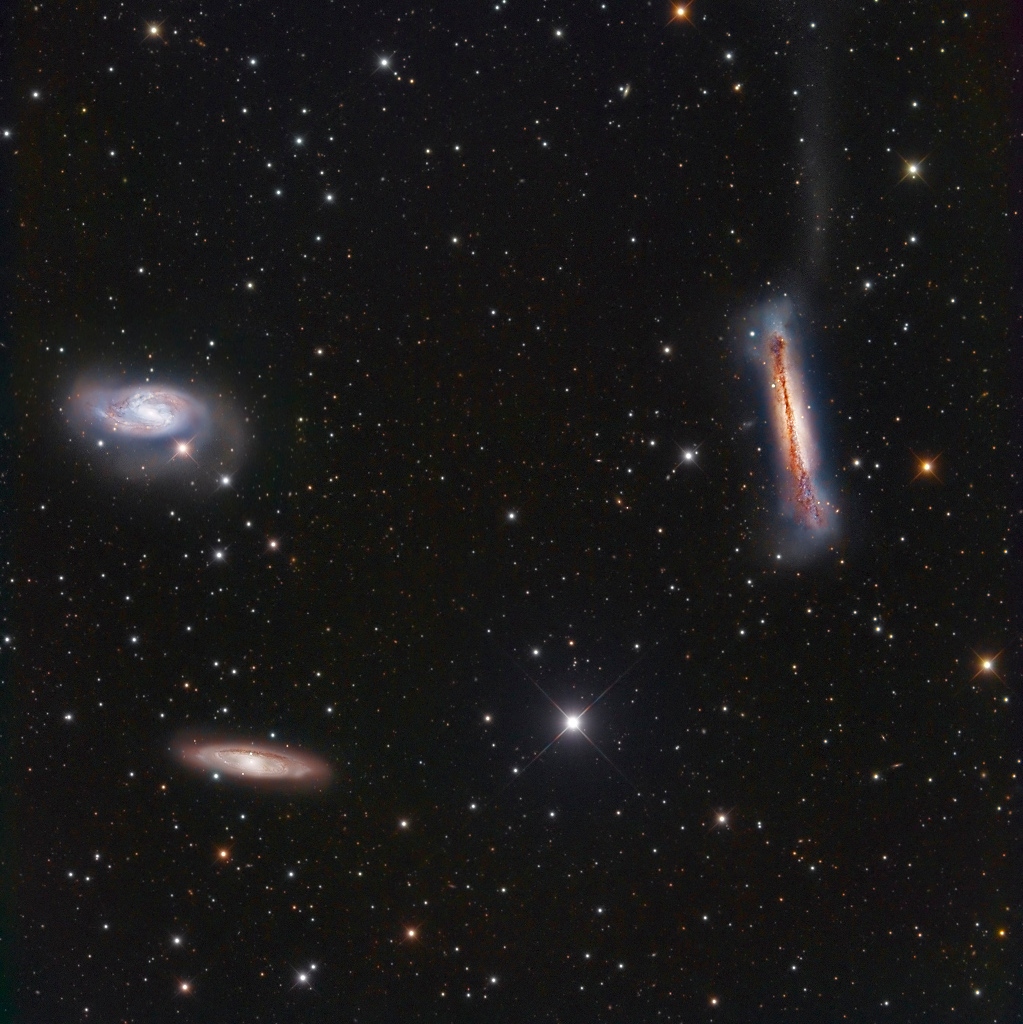
This popular group leaps into the early evening sky around the March equinox and the northern hemisphere spring. Famous as the Leo Triplet, the three magnificent galaxies found in the prominent constellation Leo gather here in one astronomical field of view. Crowd pleasers when imaged with even modest telescopes, they can be introduced individually as NGC 3628 (right), M66 (upper left), and M65 (bottom). All three are large spiral galaxies but tend to look dissimilar, because their galactic disks are tilted at different angles to our line of sight. NGC 3628, also known as the Hamburger Galaxy, is temptingly seen edge-on, with obscuring dust lanes cutting across its puffy galactic plane. The disks of M66 and M65 are both inclined enough to show off their spiral structure. Gravitational interactions between galaxies in the group have left telltale signs, including the tidal tails and warped, inflated disk of NGC 3628 and the drawn out spiral arms of M66. This gorgeous view of the region spans over 1 degree (two full moons) on the sky in a frame that covers over half a million light-years at the trio’s estimated distance of 30 million light-years. Of course the spiky foreground stars lie well within our own Milky Way. [via NASA] https://ift.tt/3c3yQ7N

Central Lagoon in Infrared

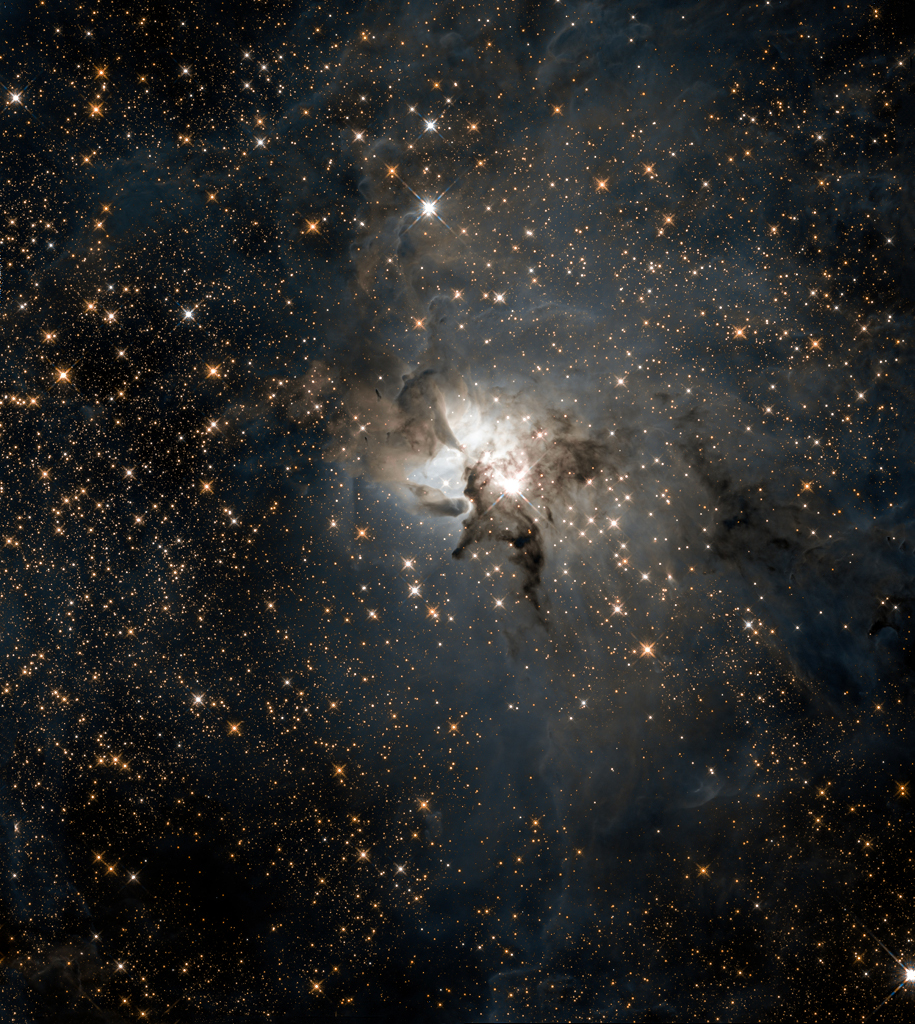
Stars fill this infrared view, spanning 4 light-years across the center of the Lagoon Nebula. Visible light images show the glowing gas and obscuring dust clouds that dominate the scene. But this infrared image, constructed from Hubble Space Telescope data, peers closer to the heart of the active star-forming region revealing newborn stars scattered within, against a crowded field of background stars toward the center of our Milky Way galaxy. This tumultuous stellar nursery’s central regions are sculpted and energized by the massive, young Herschel 36, seen as the bright star near center in the field of view. Herschel 36 is actually a multiple system of massive stars. At over 30 times the mass of the Sun and less than 1 million years old, the most massive star in the system should live to a stellar old age of 5 million years. Compare that to the almost 5 billion year old Sun which will evolve into a red giant in only another 5 billion years or so. The Lagoon Nebula, also known as M8, lies about 4,000 light-years away within the boundaries of the constellation Sagittarius. [via NASA] https://ift.tt/3tFHBuJ

Stardust in the Perseus Molecular Cloud

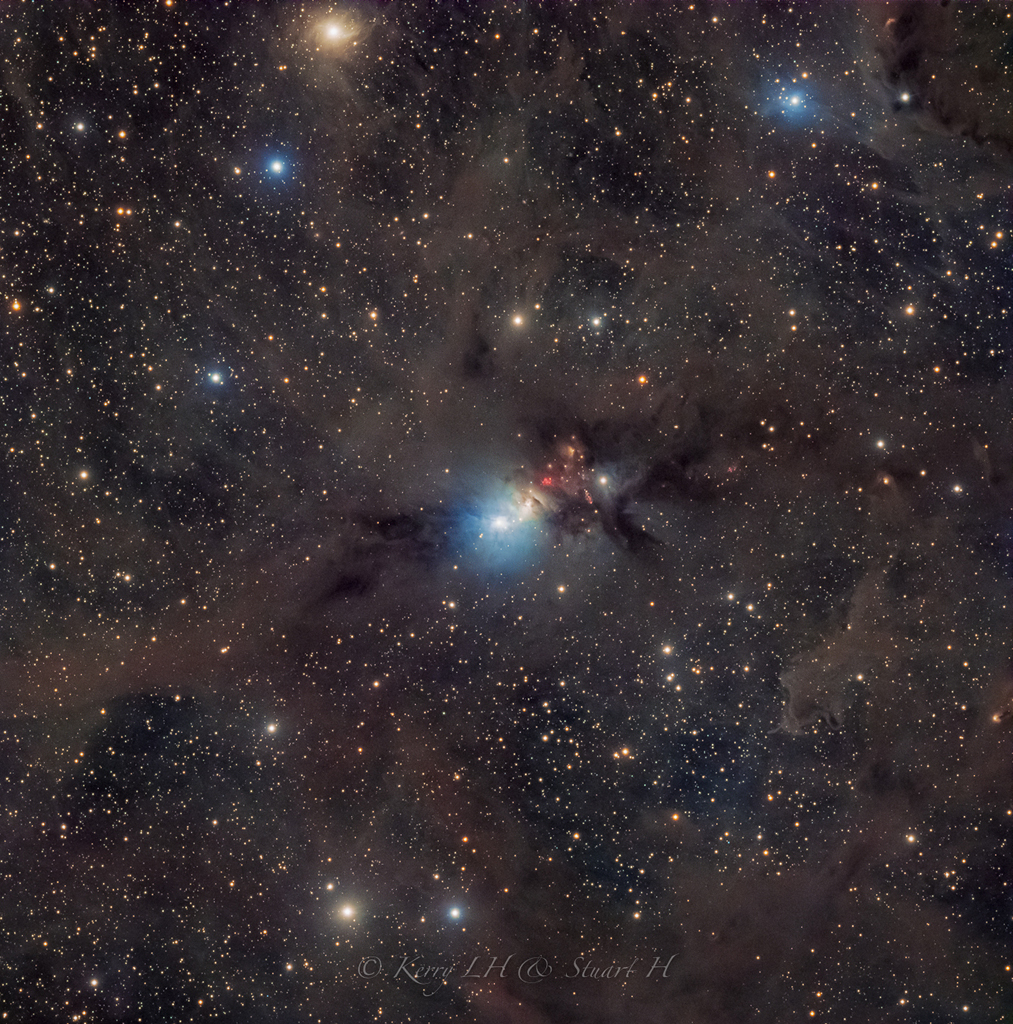
Clouds of stardust drift through this deep skyscape, across the Perseus molecular cloud some 850 light-years away. Dusty nebulae reflecting light from embedded young stars stand out in the nearly 2 degree wide telescopic field of view. With a characteristic bluish color reflection nebula NGC 1333 is at center, vdB 13 at top right, with rare yellowish reflection nebula vdB 12 near the top of the frame. Stars are forming in the molecular cloud, though most are obscured at visible wavelengths by the pervasive dust. Still, hints of contrasting red emission from Herbig-Haro objects, the jets and shocked glowing gas emanating from recently formed stars, are evident in NGC 1333. The chaotic environment may be similar to one in which our own Sun formed over 4.5 billion years ago. At the estimated distance of the Perseus molecular cloud, this cosmic scene would span about 40 light-years. [via NASA] https://ift.tt/3rSXTjj

The Surface of Venus from Venera 13

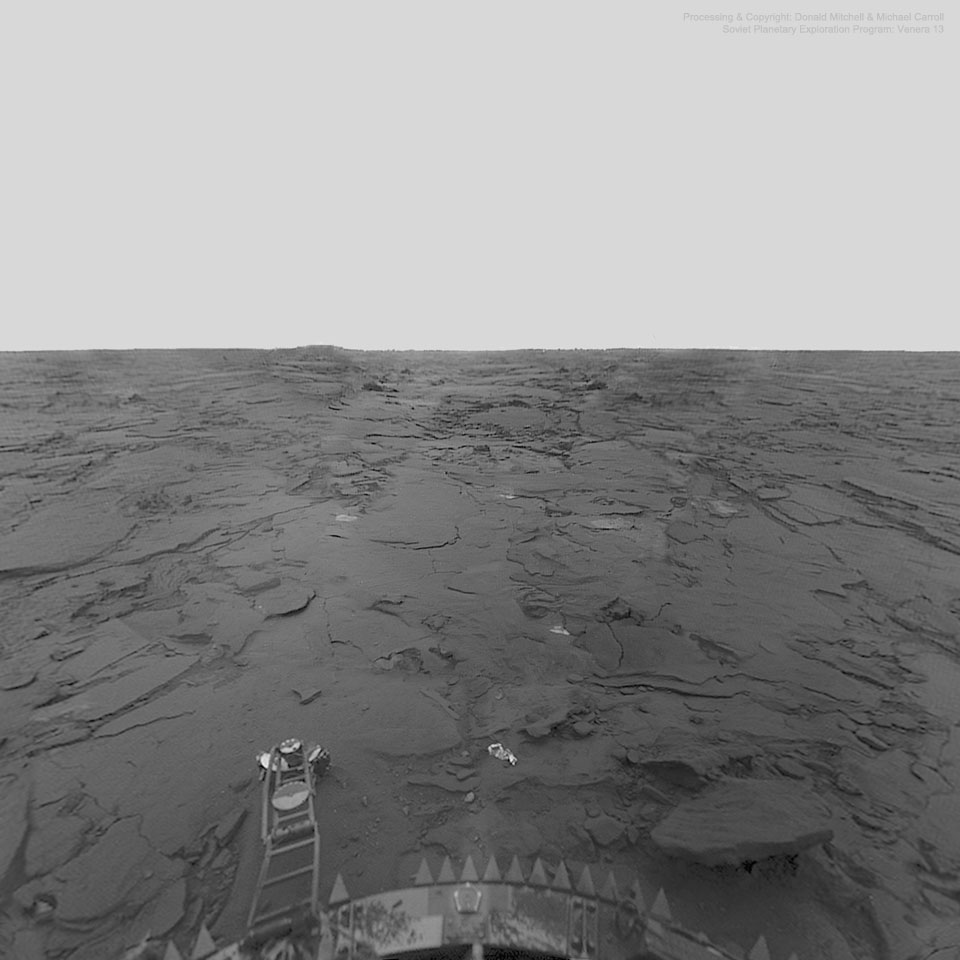
If you could stand on Venus — what would you see? Pictured is the view from Venera 13, a robotic Soviet lander which parachuted and air-braked down through the thick Venusian atmosphere in March of 1982. The desolate landscape it saw included flat rocks, vast empty terrain, and a featureless sky above Phoebe Regio near Venus’ equator. On the lower left is the spacecraft’s penetrometer used to make scientific measurements, while the light piece on the right is part of an ejected lens-cap. Enduring temperatures near 450 degrees Celsius and pressures 75 times that on Earth, the hardened Venera spacecraft lasted only about two hours. Although data from Venera 13 was beamed across the inner Solar System almost 40 years ago, digital processing and merging of Venera’s unusual images continues even today. Recent analyses of infrared measurements taken by ESA’s orbiting Venus Express spacecraft indicate that active volcanoes may currently exist on Venus. [via NASA] https://ift.tt/2Oyoi7O

IC 1318: The Butterfly Nebula in Gas and Dust

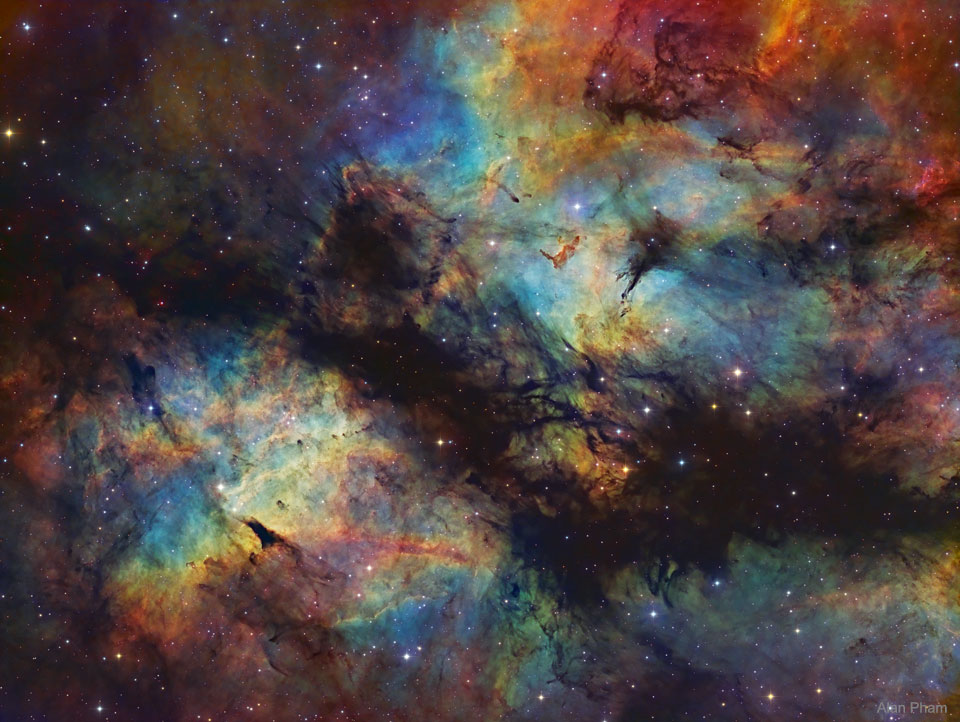
In the constellation of the swan near the nebula of the pelican lies the gas cloud of the butterfly next to a star known as the hen. That star, given the proper name Sadr, is just to the right of the featured frame, but the central Butterfly Nebula, designated IC 1318, is shown in high resolution. The intricate patterns in the bright gas and dark dust are caused by complex interactions between interstellar winds, radiation pressures, magnetic fields, and gravity. The featured telescopic view captures IC 1318’s characteristic emission from ionized sulfur, hydrogen, and oxygen atoms mapped to the red, green, and blue hues of the popular Hubble Palette. The portion of the Butterfly Nebula pictured spans about 100 light years and lies about 4000 light years away. [via NASA] https://ift.tt/3czzRmZ

Meteor Fireballs in Light and Sound

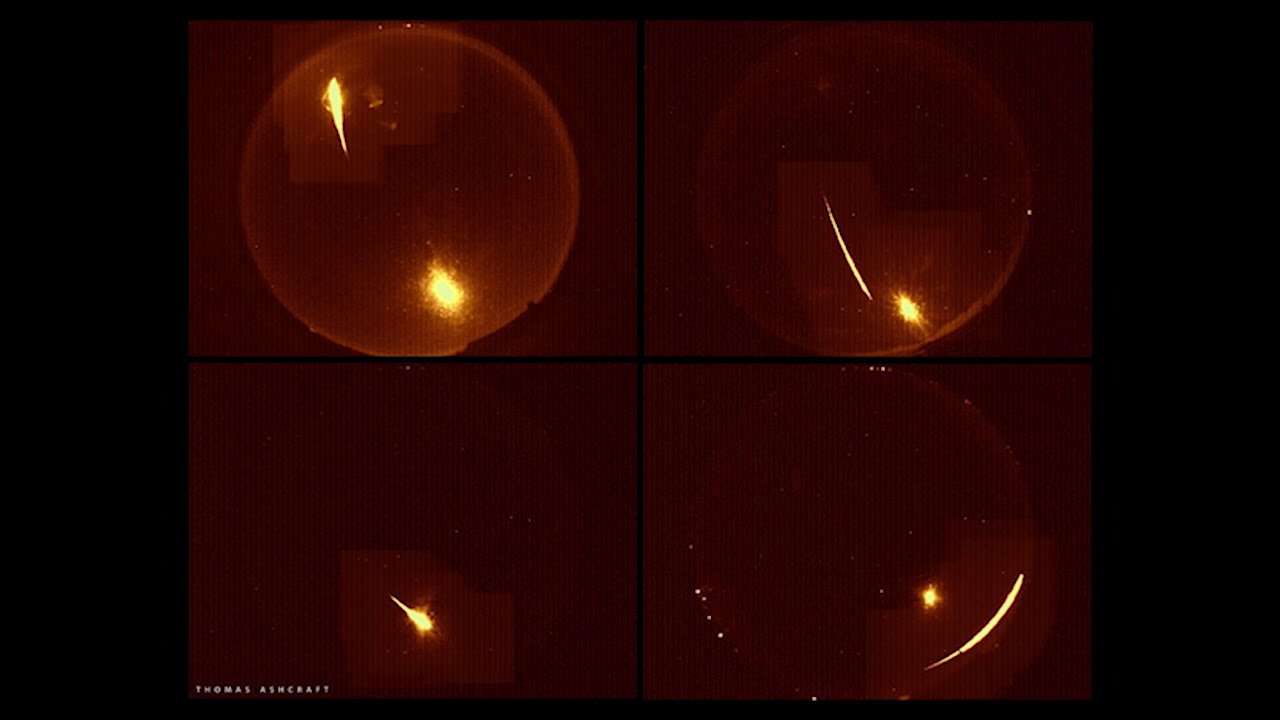
Yes, but have you ever heard a meteor? Usually, meteors are too far away to make any audible sound. However, a meteor will briefly create an ionization trail that can reflect a distant radio signal. If the geometry is right, you may momentarily hear — through your radio — a distant radio station even over static. In the featured video, the sounds of distant radio transmitters were caught reflecting from large meteor trails by a sensitive radio receiver — at the same time the bright streaks were captured by an all-sky video camera. In the video, the bright paths taken by four fireballs across the sky near Lamy, New Mexico, USA, are shown first. Next, after each static frame, a real-time video captures each meteor streaking across the sky, now paired with the sound recorded from its radio reflection. Projecting a meteor trail down to the Earth may lead to finding its impact site (if any), while projecting its trail back into the sky may lead to identifying its parent comet or asteroid. [via NASA] https://ift.tt/3eCPxZi

A Flag Shaped Aurora over Sweden

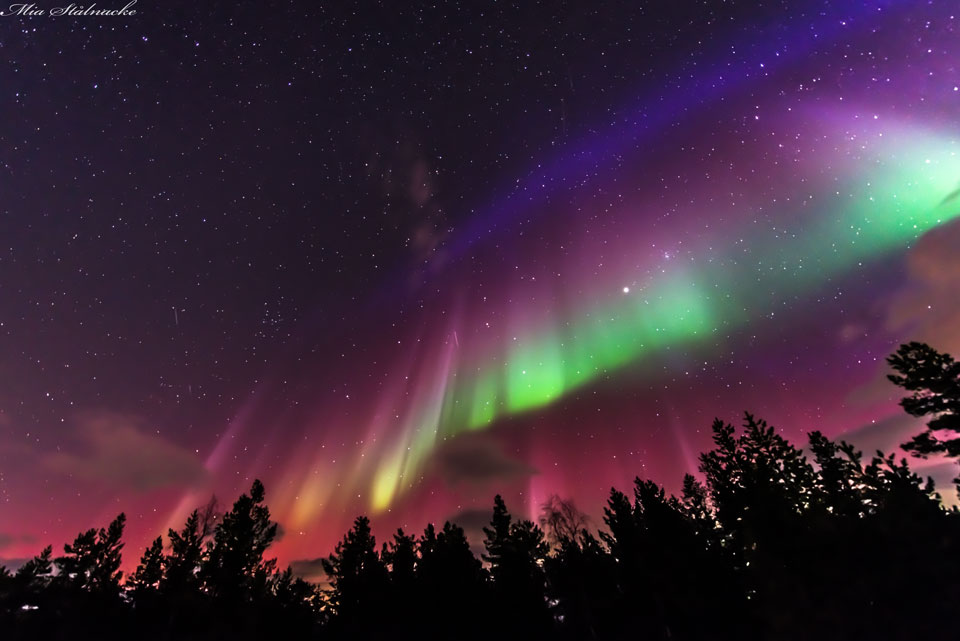
It appeared, momentarily, like a 50-km tall banded flag. In mid-March of 2015, an energetic Coronal Mass Ejection directed toward a clear magnetic channel to Earth led to one of the more intense geomagnetic storms of recent years. A visual result was wide spread auroras being seen over many countries near Earth’s magnetic poles. Captured over Kiruna, Sweden, the image features an unusually straight auroral curtain with the green color emitted low in the Earth’s atmosphere, and red many kilometers higher up. It is unclear where the rare purple aurora originates, but it might involve an unusual blue aurora at an even lower altitude than the green, seen superposed with a much higher red. Now past Solar Minimum, colorful nights of auroras over Earth are likely to increase. [via NASA] https://ift.tt/3vk0QLP