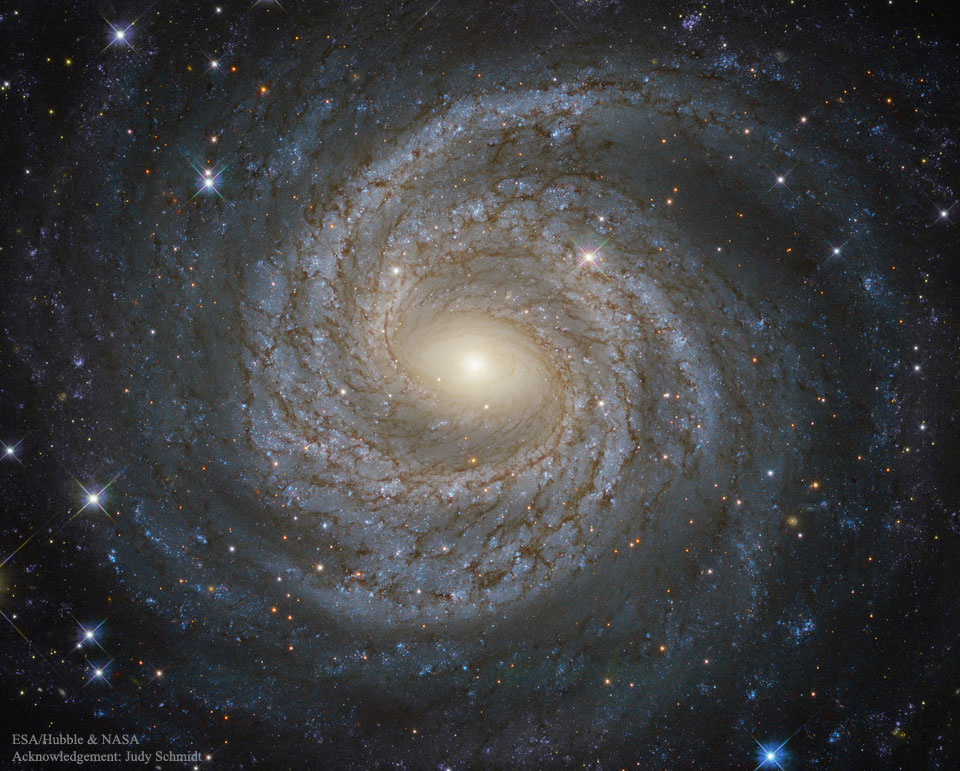
In the center of this serene stellar swirl is likely a harrowing black-hole beast. The surrounding swirl sweeps around billions of stars which are highlighted by the brightest and bluest. The breadth and beauty of the display give the swirl the designation of a grand design spiral galaxy. The central beast shows evidence that it is a supermassive black hole about 10 million times the mass of our Sun. This ferocious creature devours stars and gas and is surrounded by a spinning moat of hot plasma that emits blasts of X-rays. The central violent activity gives it the designation of a Seyfert galaxy. Together, this beauty and beast are cataloged as NGC 6814 and have been appearing together toward the constellation of the Eagle (Aquila) for roughly the past billion years. [via NASA] https://ift.tt/2Q2Sk0d
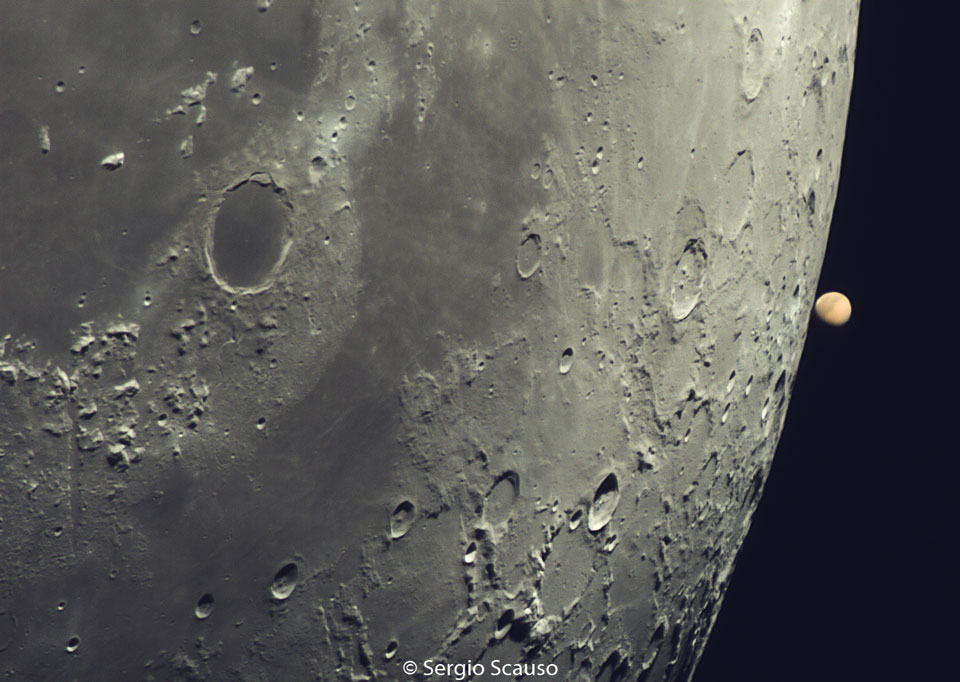
Does the Moon ever block out Mars? Yes, the Moon occasionally moves in front of all of the Solar System’s planets. Just this past Sunday, as visible from some locations in South America, a waning gibbous Moon eclipsed Mars. The featured image from Córdoba, Argentina captured this occultation well, showing a familiar cratered Moon in the foreground with the bright planet Mars unusually adjacent. Within a few seconds, Mars then disappeared behind the Moon, only to reappear a few minutes later across the Moon. Today the Moon moves close to, but not in front of, Venus. Because alignments will not have changed by much, the next two times the Moon passes through this part of the sky – in early September and early October – it will also occult Mars, as seen from parts of South America. [via NASA] https://ift.tt/3apukOx

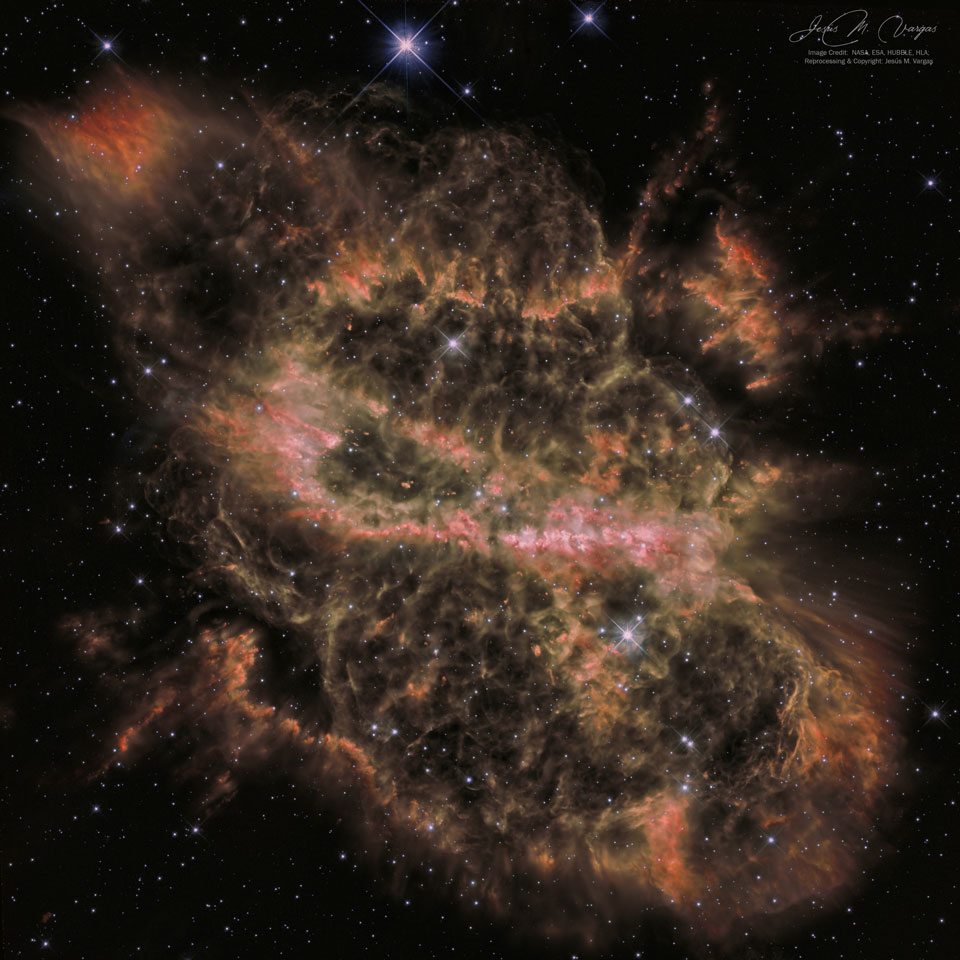
Why is this nebula so complex? When a star like our Sun is dying, it will cast off its outer layers, usually into a simple overall shape. Sometimes this shape is a sphere, sometimes a double lobe, and sometimes a ring or a helix. In the case of planetary nebula NGC 5189, however, besides an overall «Z» shape (the featured image is flipped horizontally and so appears as an «S»), no such simple structure has emerged. To help find out why, the Earth-orbiting Hubble Space Telescope has observed NGC 5189 in great detail. Previous findings indicated the existence of multiple epochs of material outflow, including a recent one that created a bright but distorted torus running horizontally across image center. Hubble results appear consistent with a hypothesis that the dying star is part of a binary star system with a precessing symmetry axis. NGC 5189 spans about three light years and lies about 3,000 light years away toward the southern constellation of the Fly (Musca). [via NASA] https://ift.tt/324JHrZ

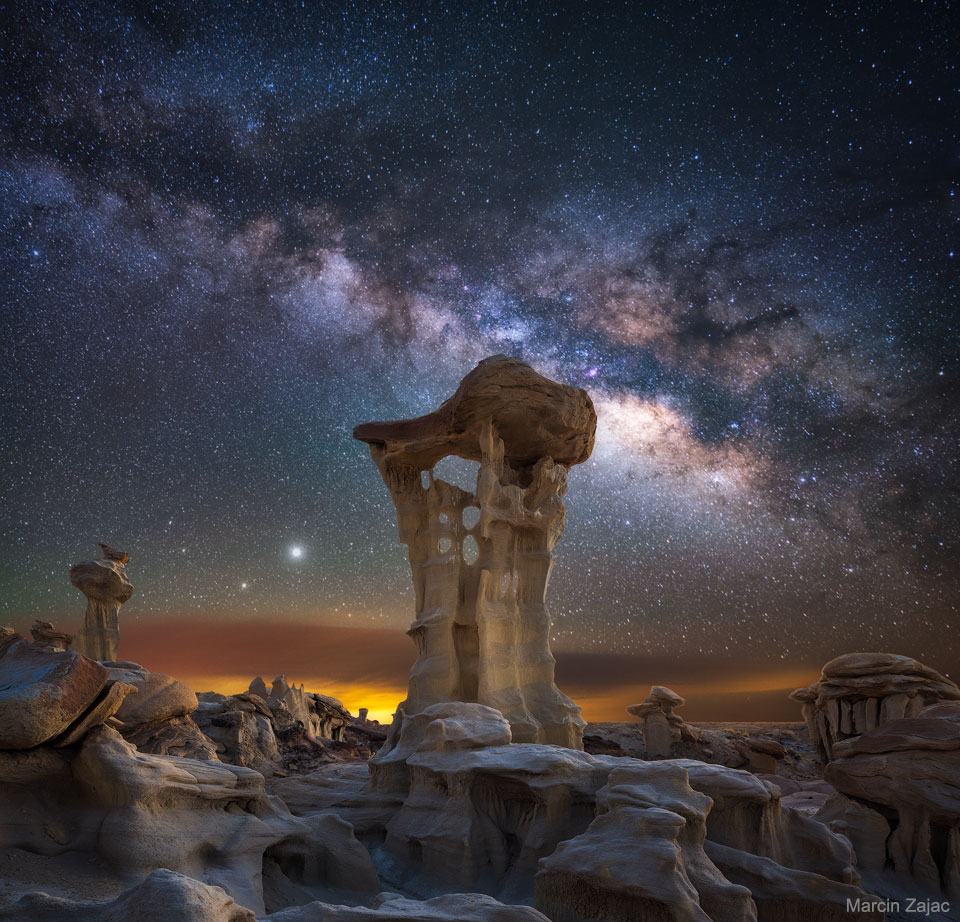
What planets are those behind that unusual rock spire? Saturn (lower left) and Jupiter.  This month, after sunset, the bright planetary duo are quite prominent toward the southeast.  Now your view of our Solar System’s largest planets might not include a picturesque hoodoo in the foreground, nor the spectacular central band of our Milky Way Galaxy across the background, but should be quite eye-catching anyway.  The featured image is a composite of consecutive foreground and background exposures all taken in late May with the same camera and from the same location — the badlands of the  Ah-Shi-Sle-Pah Wilderness in the San Juan Basin in New Mexico, USA.  The rock spire, informally dubbed ‘Alien Throne’, stands about 3 meters tall. Saturn and Jupiter will remain visible together after sunset for several months. [via NASA] https://ift.tt/31PNdGr

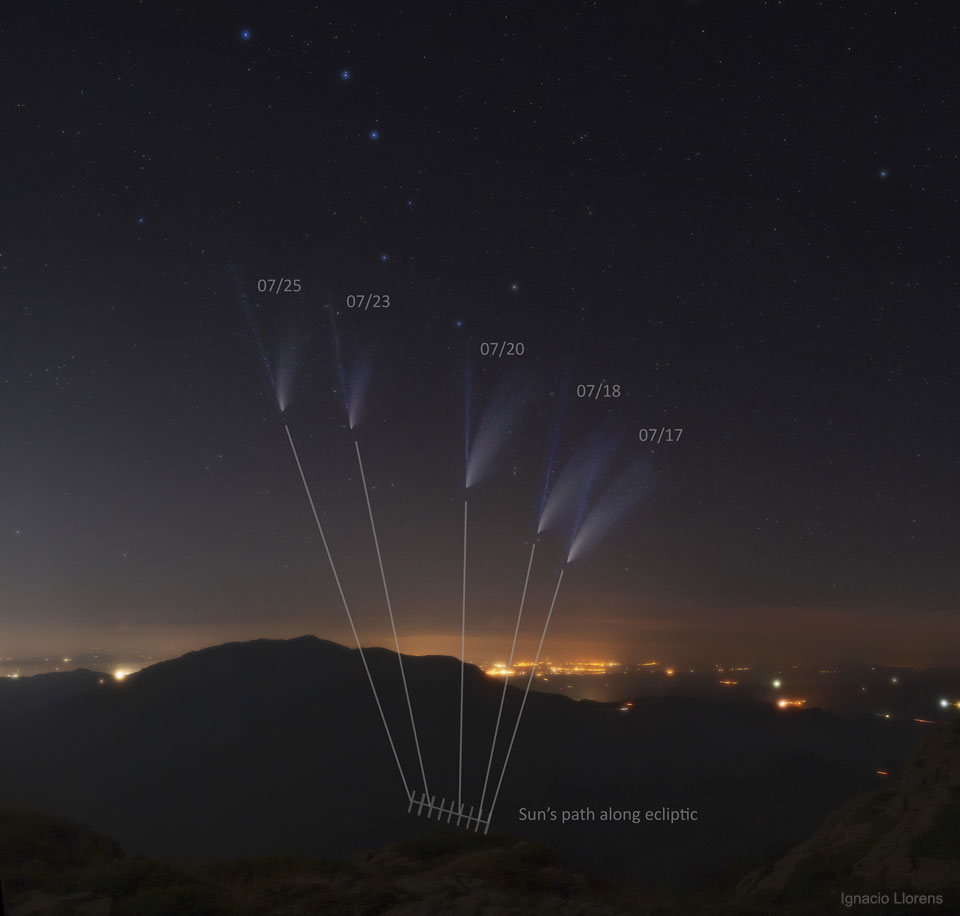
The Shifting Tails of Comet NEOWISE

Keep your eye on the ion tail of Comet NEOWISE. A tale of this tail is the trail of the Earth. As with all comets, the blue ion tail always points away from the Sun. But as Comet C/2020 F3 (NEOWISE) rounded our Sun, its ion tail pointed in slightly different directions. This is because between 2020 July 17 and July 25 when the featured images were taken, the Earth moved noticeably in its orbit around the Sun. But the Earth’s motion made the Sun appear to shift in the sky. So even though you can’t see the Sun directly in the featured image(s), the directions of the ion tails reveal this apparent solar shift. The Sun’s apparent motion is in the ecliptic, the common plane where all planets orbit. The featured five image composite was meticulously composed to accurately place each comet image — and the five extrapolated solar positions — on a single foreground image of Turó de l’Home Mountain, north of Barcelona, Spain Comet NEOWISE is no longer the impressive naked-eye object it was last month, but it can still be found with a small telescope as it heads back to the outer Solar System. [via NASA] https://ift.tt/3gOmhND

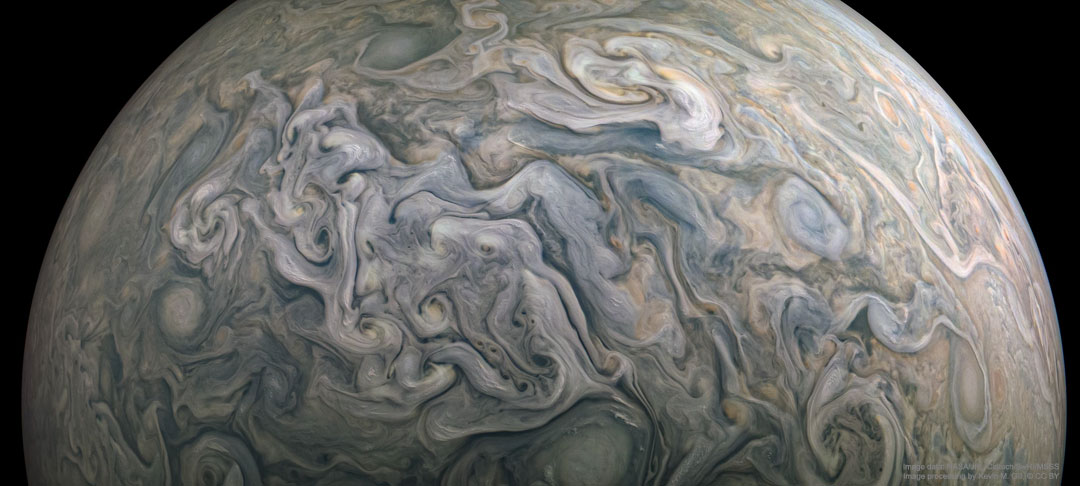
Churning Clouds on Jupiter

Where is Jupiter’s ammonia? Gaseous ammonia was expected to be seen in Jupiter’s upper atmosphere by the orbiting Juno spacecraft — but in many clouds is almost absent. Recent Juno data, however, gives some clues: some high-level clouds appear to be home to an unexpected type of electrical discharge dubbed shallow lightning. Great charge separations are needed for lightning, which might be created by colliding mushballs lifted by rising updrafts of gas. Ammonia and water stick to these mushballs which rise until they get too heavy — after which they fall deep into Jupiter’s atmosphere and melt. By this process, ammonia found missing from Jupiter’s upper atmosphere reappears below. Pictured by Juno, churning clouds on Jupiter show not only mesmerizing complexity but some high-level, light-colored pop-up clouds. Understanding atmospheric dynamics on Jupiter gives valuable perspective to similar atmospheric and lightning phenomena that occur on our home Earth. [via NASA] https://ift.tt/3gM6grb

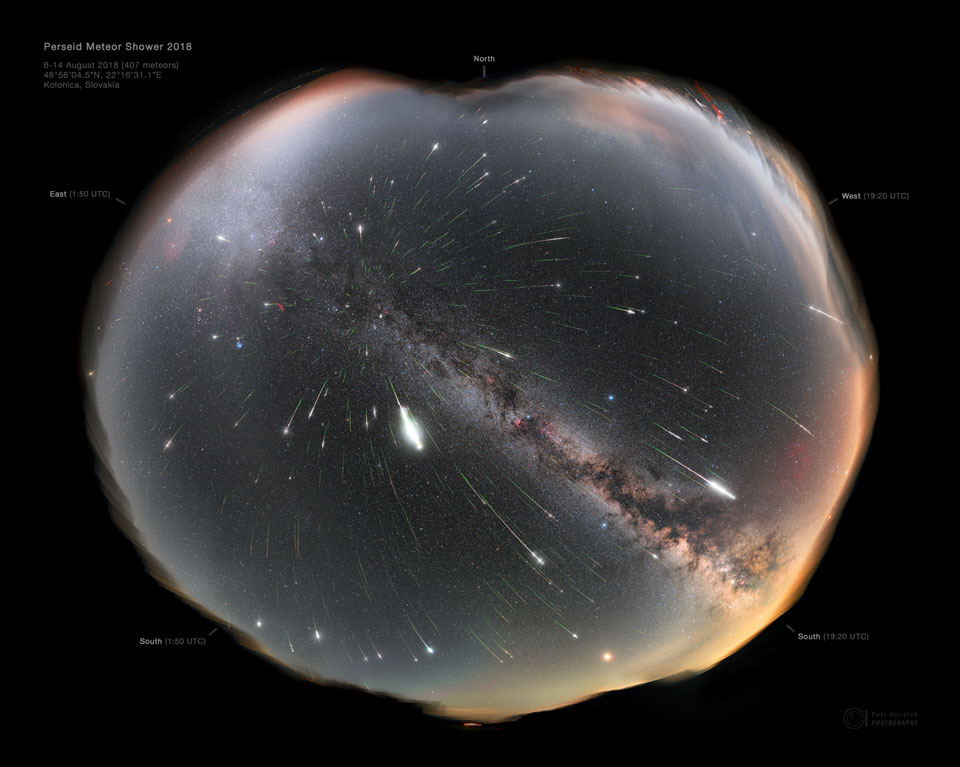
Perseids from Perseus

Where are all these meteors coming from? In terms of direction on the sky, the pointed answer is the constellation of Perseus. That is why the meteor shower that peaks tomorrow night is known as the Perseids — the meteors all appear to came from a radiant toward Perseus. In terms of parent body, though, the sand-sized debris that makes up the Perseids meteors come from Comet Swift-Tuttle. The comet follows a well-defined orbit around our Sun, and the part of the orbit that approaches Earth is superposed in front of the Perseus. Therefore, when Earth crosses this orbit, the radiant point of falling debris appears in Perseus. Featured here, a composite image taken over eight nights and containing over 400 meteors from last August’s Perseids meteor shower shows many bright meteors that streaked over Kolonica Observatory in Slovakia. This year’s Perseids holds promise to be one of the best meteor showers of the year. [via NASA] https://ift.tt/3fJkt78

The Origin of Elements

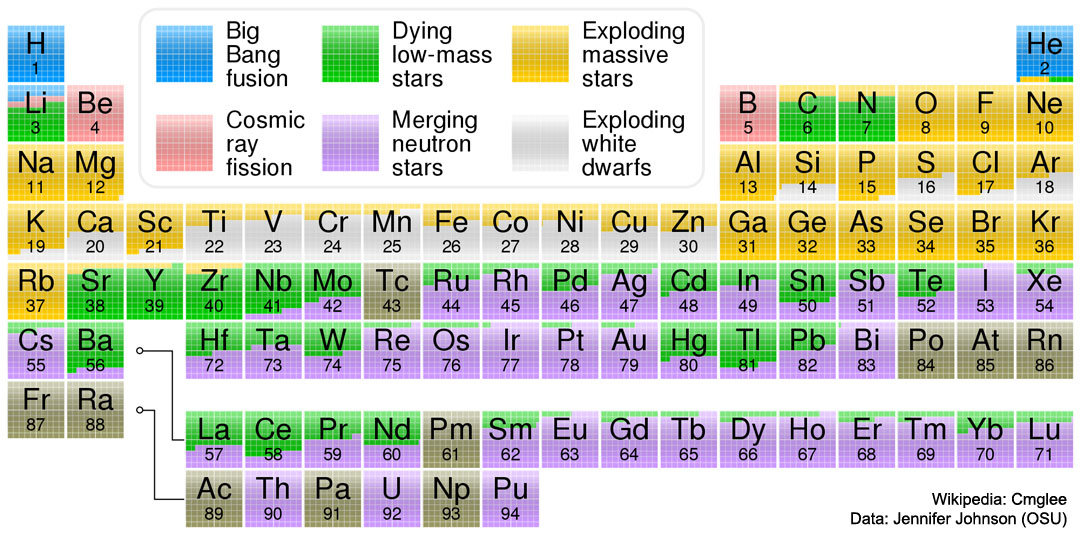
The hydrogen in your body, present in every molecule of water, came from the Big Bang. There are no other appreciable sources of hydrogen in the universe. The carbon in your body was made by nuclear fusion in the interior of stars, as was the oxygen. Much of the iron in your body was made during supernovas of stars that occurred long ago and far away. The gold in your jewelry was likely made from neutron stars during collisions that may have been visible as short-duration gamma-ray bursts or gravitational wave events. Elements like phosphorus and copper are present in our bodies in only small amounts but are essential to the functioning of all known life. The featured periodic table is color coded to indicate humanity’s best guess as to the nuclear origin of all known elements. The sites of nuclear creation of some elements, such as copper, are not really well known and are continuing topics of observational and computational research. [via NASA] https://ift.tt/2DCCwin

Crescent Saturn

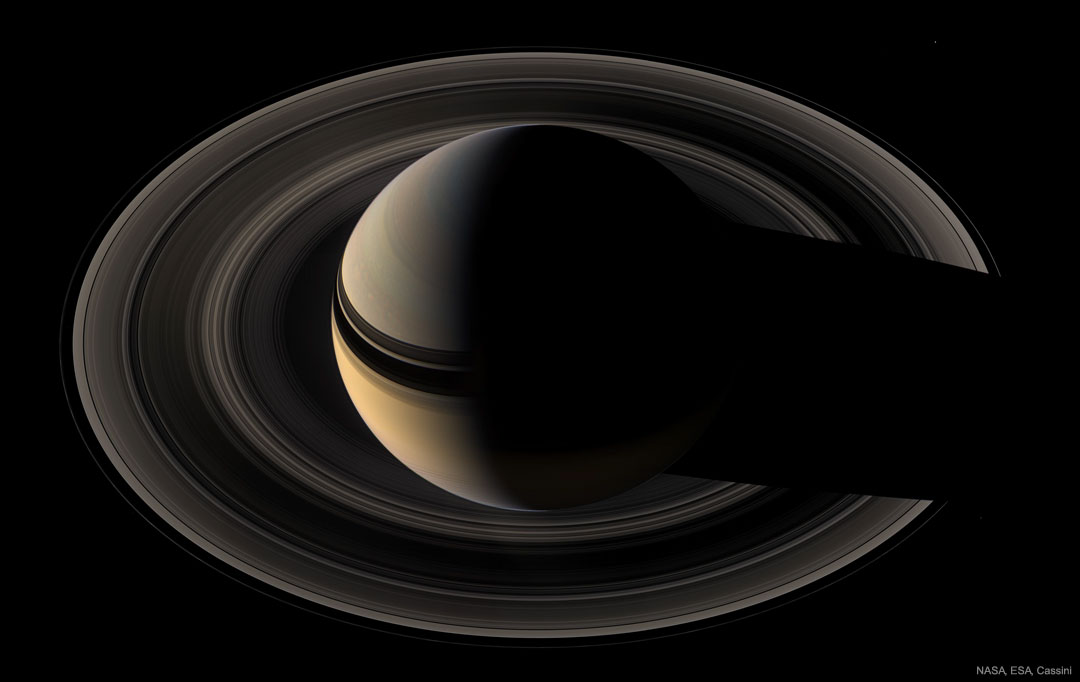
From Earth, Saturn never shows a crescent phase. But when viewed from a spacecraft the majestic giant planet can show just a sunlit slice. This image of crescent Saturn in natural color was taken by the robotic Cassini spacecraft in 2007. It captures Saturn’s rings from the side of the ring plane opposite the Sun — the unilluminated side — another vista not visible from Earth. Visible are subtle colors of cloud bands, the complex shadows of the rings on the planet, and the shadow of the planet on the rings. The moons Mimas, at 2 o’clock, and Janus 4 o’clock, can be seen as specks of light, but the real challenge is to find Pandora (8 o’clock). From Earth, Saturn’s disk is nearly full now and opposite the Sun. Along with bright fellow giant planet Jupiter it rises in the early evening. [via NASA] https://ift.tt/3iko795

The Pipe Nebula

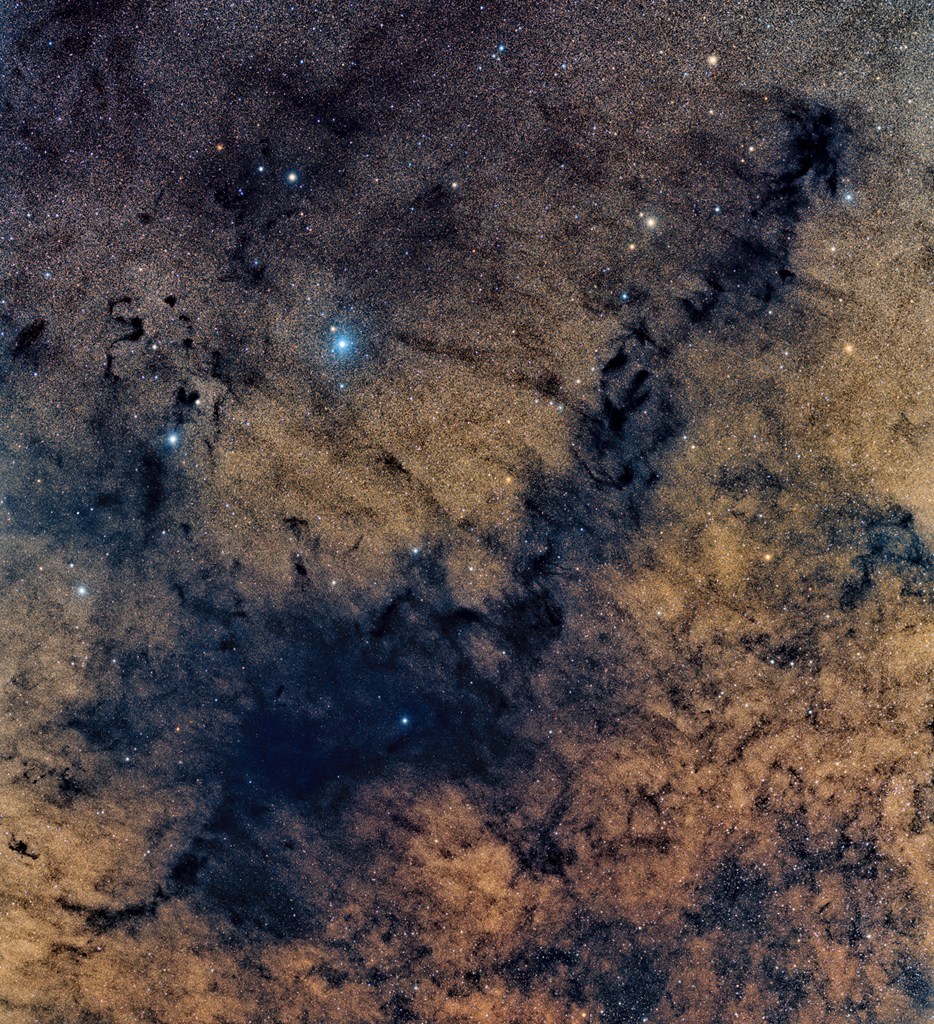
East of Antares, dark markings sprawl through crowded star fields toward the center of our Milky Way Galaxy. Cataloged in the early 20th century by astronomer E. E. Barnard, the obscuring interstellar dust clouds include B59, B72, B77 and B78, seen in against the starry background. Here, their combined shape suggests a pipe stem and bowl, and so the dark nebula’s popular name is the Pipe Nebula. The deep and expansive view covers a full 10 by 10 degree field in the pronounceable constellation Ophiuchus. The Pipe Nebula is part of the Ophiuchus dark cloud complex located at a distance of about 450 light-years. Dense cores of gas and dust within the Pipe Nebula are collapsing to form stars. [via NASA] https://ift.tt/2XCwSUb