The Porpoise Galaxy from Hubble

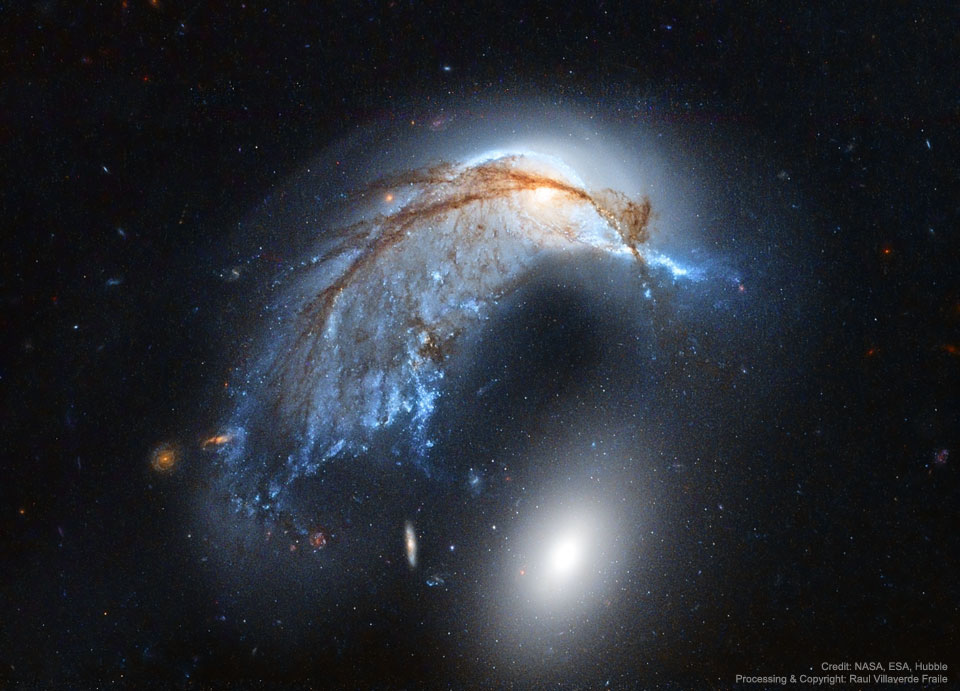
What’s happening to this spiral galaxy? Just a few hundred million years ago, NGC 2936, the upper of the two large galaxies shown, was likely a normal spiral galaxy — spinning, creating stars — and minding its own business. But then it got too close to the massive elliptical galaxy NGC 2937 below and took a dive. Dubbed the Porpoise Galaxy for its iconic shape, NGC 2936 is not only being deflected but also being distorted by the close gravitational interaction. A burst of young blue stars forms the nose of the porpoise toward the right of the upper galaxy, while the center of the spiral appears as an eye. Alternatively, the galaxy pair, together known as Arp 142, look to some like a penguin protecting an egg. Either way, intricate dark dust lanes and bright blue star streams trail the troubled galaxy to the lower right. The featured re-processed image showing Arp 142 in unprecedented detail was taken by the Hubble Space Telescope last year. Arp 142 lies about 300 million light years away toward the constellation, coincidently, of the Water Snake (Hydra). In a billion years or so the two galaxies will likely merge into one larger galaxy. [via NASA] https://ift.tt/35KezPT

Full Flower Moonrise

Rising as the Sun set, the Moon was bright and full in planet Earth skies on May 7 and known to some as a Flower Moon. Near the horizon it does seem to take on rose pink hues of reddened sunlight in this reflective twilight scene. In fact one of the brighter Full Moons of the year, this month’s full lunar phase occurred within about 32 hours of perigee. That’s the closest point in the Moon’s elliptical orbit. Flooded field and ruined church tower are near the municipality of Casaleggio Novara, Piedmont Region of northern Italy.
[via NASA] https://ift.tt/3cfRiru

Long Tailed Comet SWAN

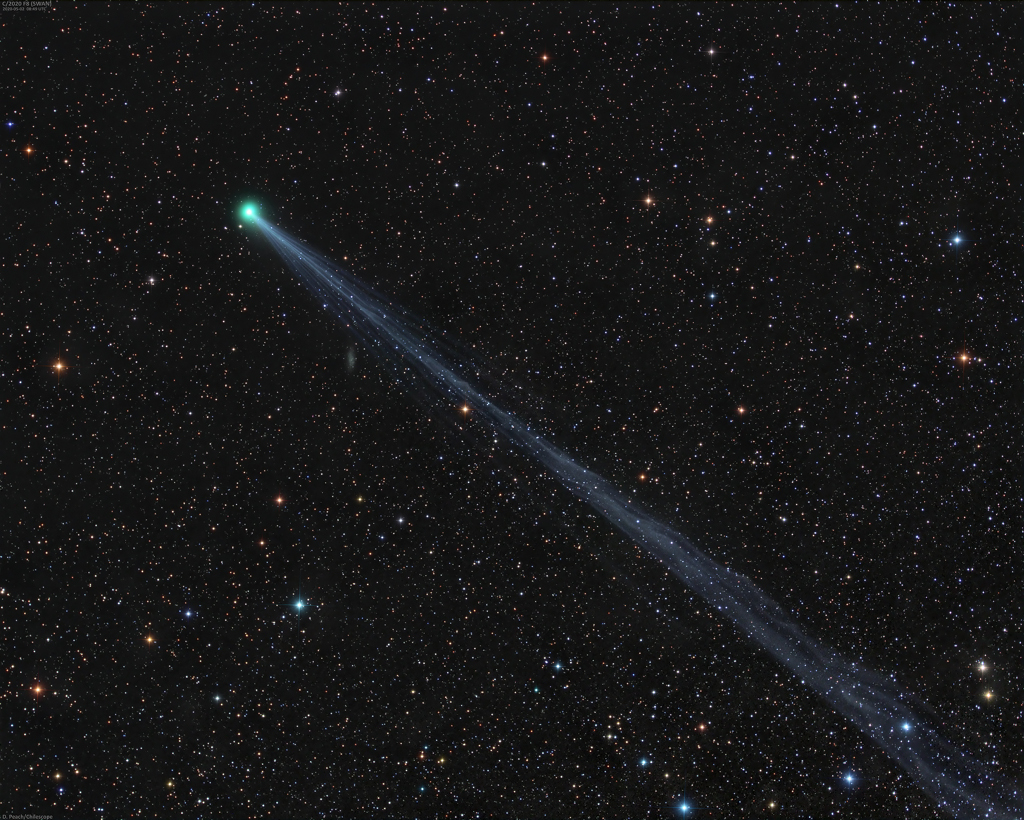
Blowing in the solar wind the spectacular ion tail of Comet SWAN (C/2020 F8) extends far across this 10 degree wide telephoto field of view. Captured on May 2 its greenish coma was about 6 light-minutes from Earth. The pretty background starfield lies near the border of the constellations Cetus and Aquarius. This comet SWAN was discovered at home by Australian amateur Michael Mattiazzo by checking images from the Sun-staring SOHO spacecraft’s SWAN (Solar Wind ANisotropies) camera. The comet has now become just visible to the naked-eye as it sweeps from southern to northern skies. Appearing in morning twilight near the eastern horizon, Comet SWAN will make its closest approach to planet Earth on May 12 and reach perihelion on May 27.
[via NASA] https://ift.tt/2SLFEgl

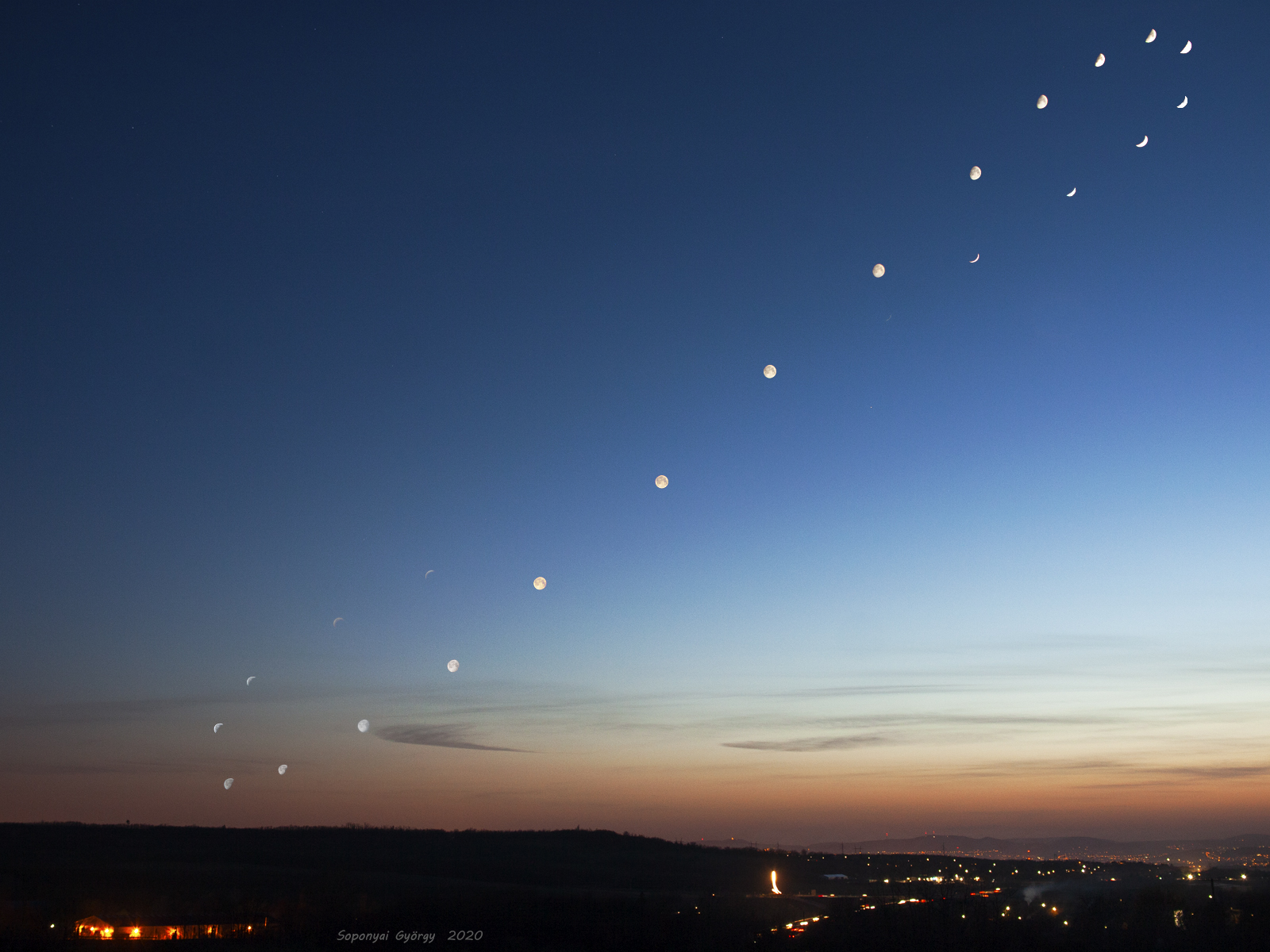
Analemma of the Moon

An analemma is that figure-8 curve you get when you mark the position of the Sun at the same time each day for one year. But the trick to imaging an analemma of the Moon is to wait bit longer. On average the Moon returns to the same position in the sky about 50 minutes and 29 seconds later each day. So photograph the Moon 50 minutes 29 seconds later on successive days. Over one lunation or lunar month it will trace out an analemma-like curve as the Moon’s actual position wanders due to its tilted and elliptical orbit. To create this composite image of a lunar analemma, astronomer Gyorgy Soponyai chose a lunar month from March 26 to April 18 with a good stretch of weather and a site close to home near Mogyorod, Hungary. Crescent lunar phases too thin and faint to capture around the New Moon are missing though. Facing southwest, the lights of Budapest are in the distance of the base image taken on March 27.
[via NASA] https://ift.tt/2YFWBfL

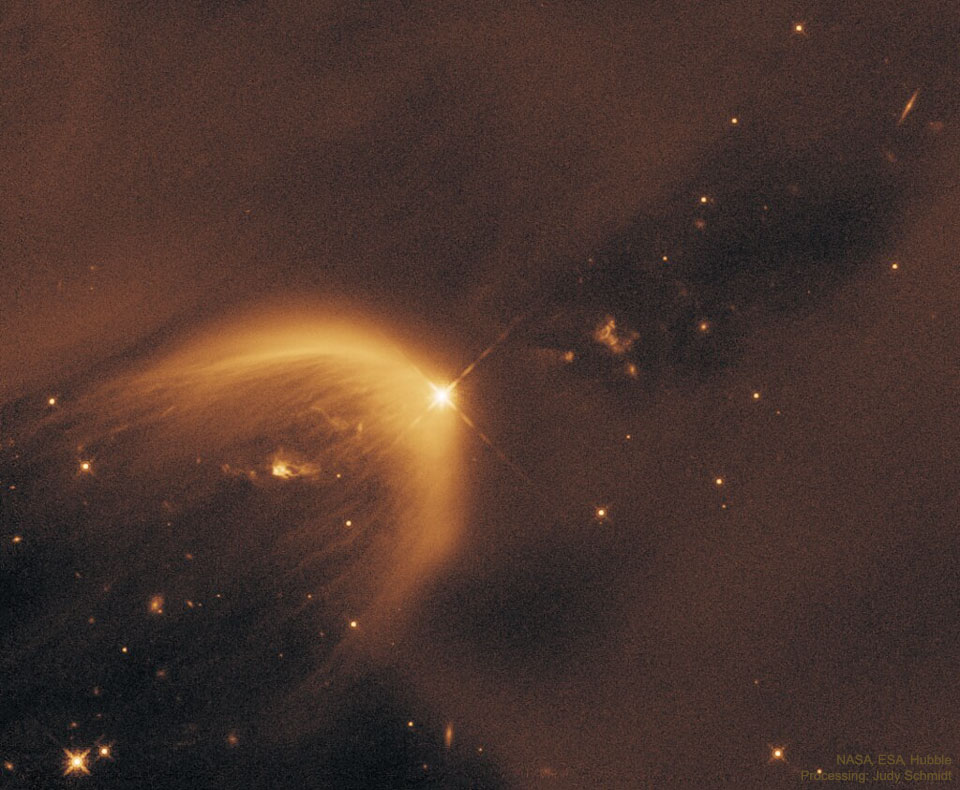
LDN 1471: A Windblown Star Cavity

What is the cause of this unusual parabolic structure? This illuminated cavity, known as LDN 1471, was created by a newly forming star, seen as the bright source at the peak of the parabola. This protostar is experiencing a stellar outflow which is then interacting with the surrounding material in the Perseus Molecular Cloud, causing it to brighten. We see only one side of the cavity — the other side is hidden by dark dust. The parabolic shape is caused by the widening of the stellar-wind blown cavity over time. Two additional structures can also be seen either side of the protostar, these are known as Herbig-Haro objects, again caused by the interaction of the outflow with the surrounding material. What causes the striations on the cavity walls, though, remains unknown. The featured image was taken by NASA and ESA’s Hubble Space Telescope after an original detection by the Spitzer Space Telescope. [via NASA] https://ift.tt/2ywsXin

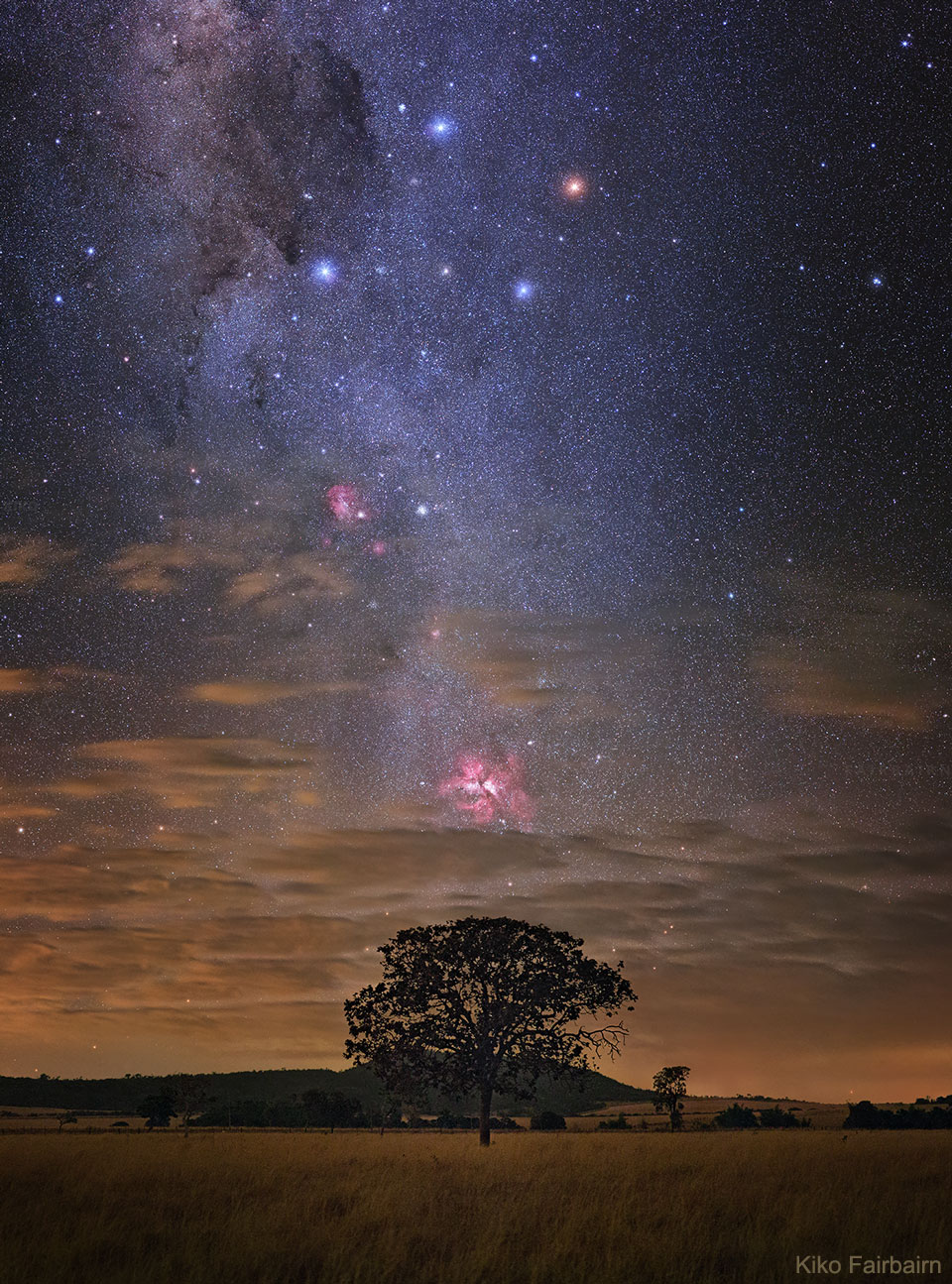
Carina in Perspective

You need to be in the south, looking south, to see such a sky. And only then if you’re lucky. Just above the picturesque tree is the impressive Carina Nebula, one of the few nebulas in the sky that is visible to the unaided eye. The featured image had to be taken from a very dark location to capture the Carina Nebula with such perspective and so near the horizon. The Great Nebula in Carina, cataloged as NGC 3372, is home to the wildly variable star Eta Carinae that sometimes flares to become one of the brightest stars in the sky. Above Carina is IC 2944, the Running Chicken Nebula, a nebula that not only looks like a chicken, but contains impressive dark knots of dust. Above these red-glowing emission nebulas are the bright stars of the Southern Cross, while on the upper left of the image is the dark Coalsack Nebula. This image was composed from six consecutive exposures taken last summer from Padre Bernardo, Goiás, Brazil. Even with careful planning, the astrophotographer felt lucky to get this shot because clouds — some still visible near the horizon — kept getting in the way. [via NASA] https://ift.tt/3c9x9Di

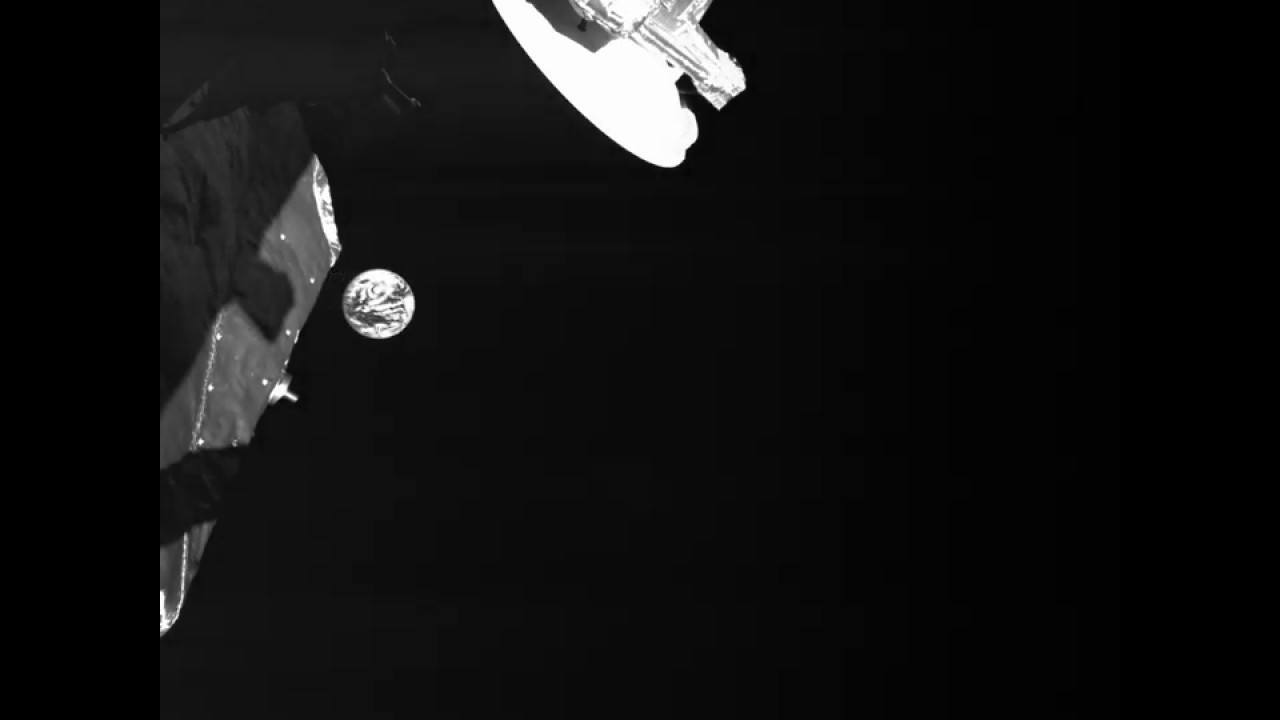
Earth Flyby of BepiColombo

What it would look like to approach planet Earth? Such an event was recorded visually in great detail by ESA’s and JAXA’s robotic BepiColombo spacecraft last month as it swung back past Earth on its journey in to the planet Mercury. Earth can be seen rotating on approach as it comes out from behind the spacecraft’s high-gain antenna in this nearly 10-hour time-lapse video. The Earth is so bright that no background stars are visible. Launched in 2018, the robotic BepiColombo used the gravity of Earth to adjust its course, the first of nine planetary flybys over the next seven years — but the only one involving Earth. Scheduled to enter orbit in 2025, BepiColombo will take images and data of the surface and magnetic field of Mercury in an effort to better understand the early evolution of our Solar System and its innermost planet. [via NASA] https://ift.tt/3dexxAE

A Message from Earth

What are these Earthlings trying to tell us? The featured message was broadcast from Earth towards the globular star cluster M13 in 1974. During the dedication of the Arecibo Observatory – still one of the largest single radio telescopes in the world – a string of 1’s and 0’s representing the diagram was sent. This attempt at extraterrestrial communication was mostly ceremonial – humanity regularly broadcasts radio and television signals out into space accidentally. Even were this message received, M13 is so far away we would have to wait almost 50,000 years to hear an answer. The featured message gives a few simple facts about humanity and its knowledge: from left to right are numbers from one to ten, atoms including hydrogen and carbon, some interesting molecules, DNA, a human with description, basics of our Solar System, and basics of the sending telescope. Several searches for extraterrestrial intelligence are currently underway, including one where you can use your own home computer. [via NASA] https://ift.tt/3d42k2S

Radio, The Big Ear, and the WOW Signal

Since the early days of radio and television we have been freely broadcasting signals into space. For some time now, we have been listening too. A large radio telescope at Ohio State University known as affectionately The Big Ear was one of the first listeners. The Big Ear was about the size of three football fields and consisted of an immense metal ground plane with two fence-like reflectors, one fixed and one tiltable. It relied on the Earth’s rotation to help scan the sky. This photo, taken by former Big Ear student volunteer Rick Scott, looks out across the ground plane toward the fixed reflector with the radio frequency receiver horns in the foreground. Starting in 1965, the Big Ear was used in an ambitious survey of the radio sky. In the 1970s, it became the first telescope to continuously listen for signals from extraterrestrial civilizations. For an exciting moment during August 1977 a very strong, unexpected signal, dubbed the Wow! Signal, was detected by the Big Ear. But alas, heard only once, the source of the signal could not be determined. In May 1998 the final pieces of the Big Ear were torn down.
[via NASA] https://ift.tt/3ddM7sd

A View Toward M106

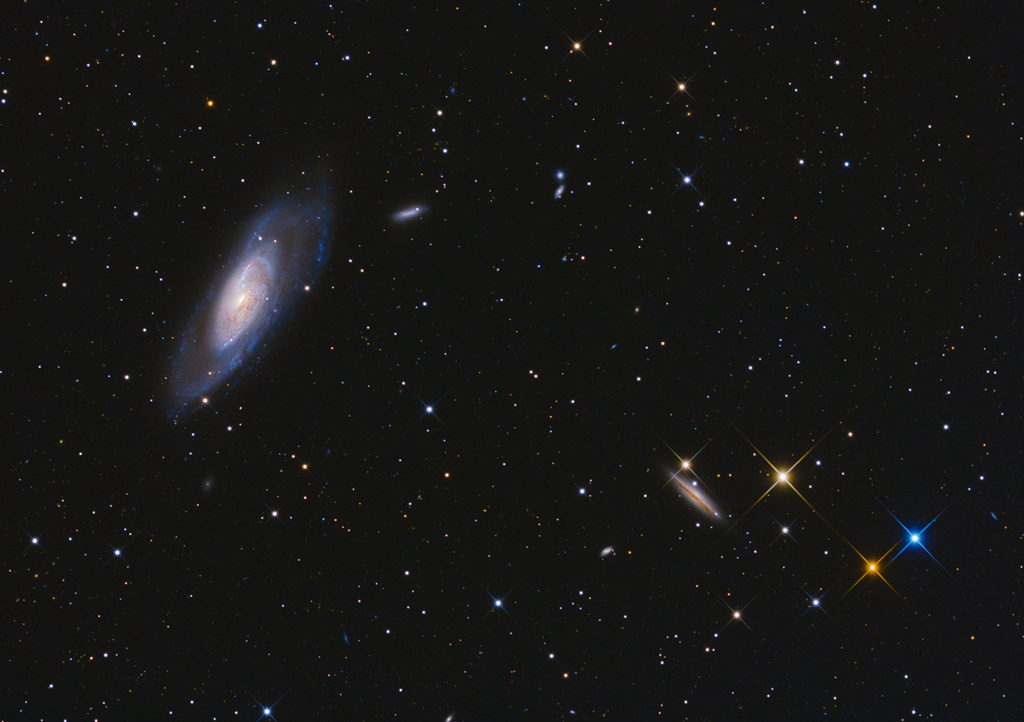
Big, bright, beautiful spiral, Messier 106 dominates this cosmic vista. The nearly two degree wide telescopic field of view looks toward the well-trained constellation Canes Venatici, near the handle of the Big Dipper. Also known as NGC 4258, M106 is about 80,000 light-years across and 23.5 million light-years away, the largest member of the Canes II galaxy group. For a far far away galaxy, the distance to M106 is well-known in part because it can be directly measured by tracking this galaxy’s remarkable maser, or microwave laser emission. Very rare but naturally occurring, the maser emission is produced by water molecules in molecular clouds orbiting its active galactic nucleus. Another prominent spiral galaxy on the scene, viewed nearly edge-on, is NGC 4217 below and right of M106. The distance to NGC 4217 is much less well-known, estimated to be about 60 million light-years, but the bright spiky stars are in the foreground, well inside our own Milky Way galaxy. Even the existence of galaxies beyond the Milky Way was questioned 100 years ago in astronomy’s Great Debate. [via NASA] https://ift.tt/2VSFy8D