Milky Way over Yellowstone

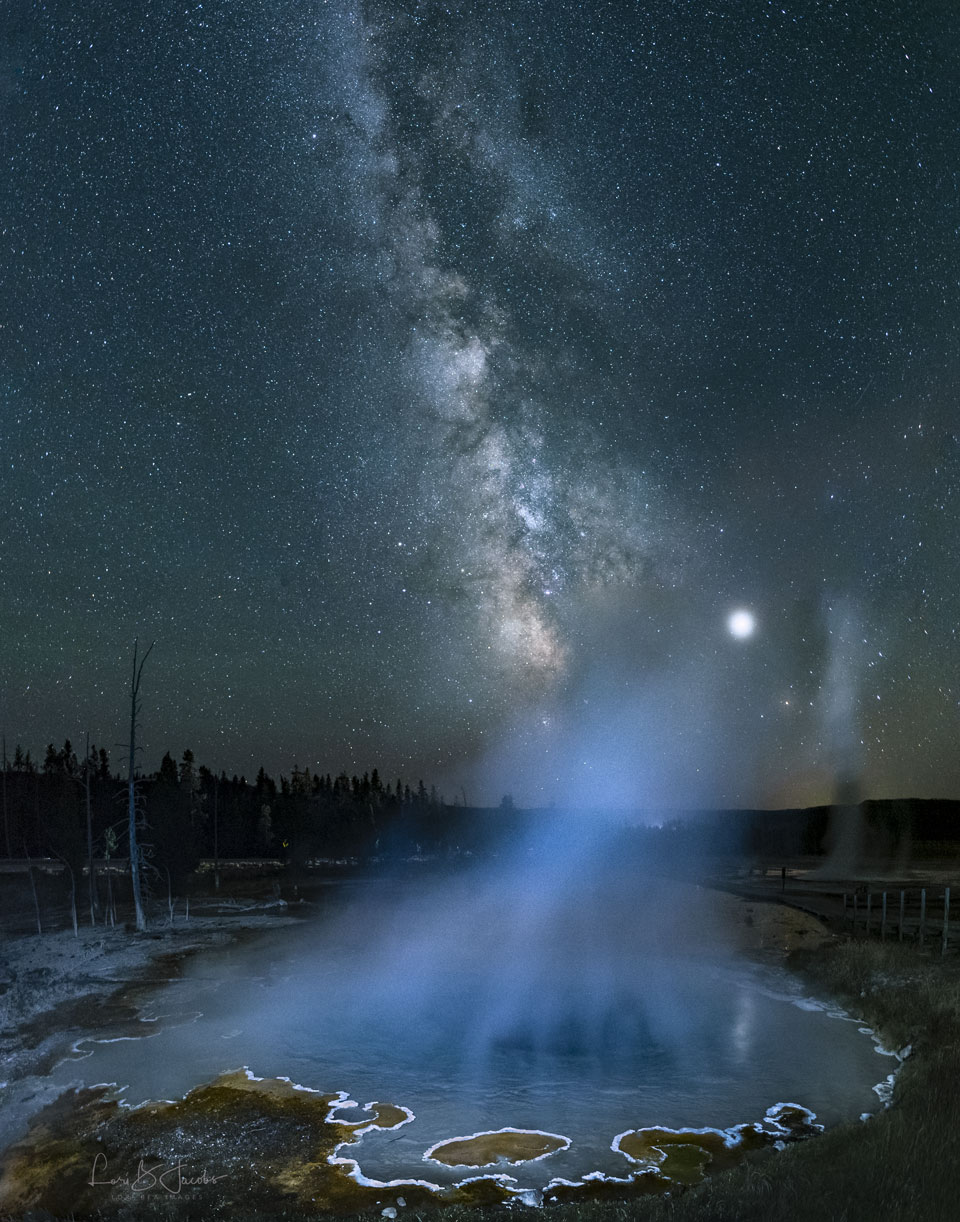
The Milky Way was not created by an evaporating lake. The pool of vivid blue water, about 10 meters across, is known as Silex Spring and is located in Yellowstone National Park in Wyoming, USA. Steam rises off the spring, heated by a magma chamber deep underneath known as the Yellowstone hotspot. The steam blurs the image of Venus, making it seem unusually large. Unrelated and far in the distance, the central band of our Milky Way Galaxy rises high overhead, a band lit by billions of stars. The featured picture is a 3-image panorama taken last August. If the Yellowstone hotspot causes another supervolcanic eruption as it did 640,000 years ago, a large part of North America would be affected. [via NASA] https://ift.tt/310DFaC
Star Formation in the Tadpole Nebula

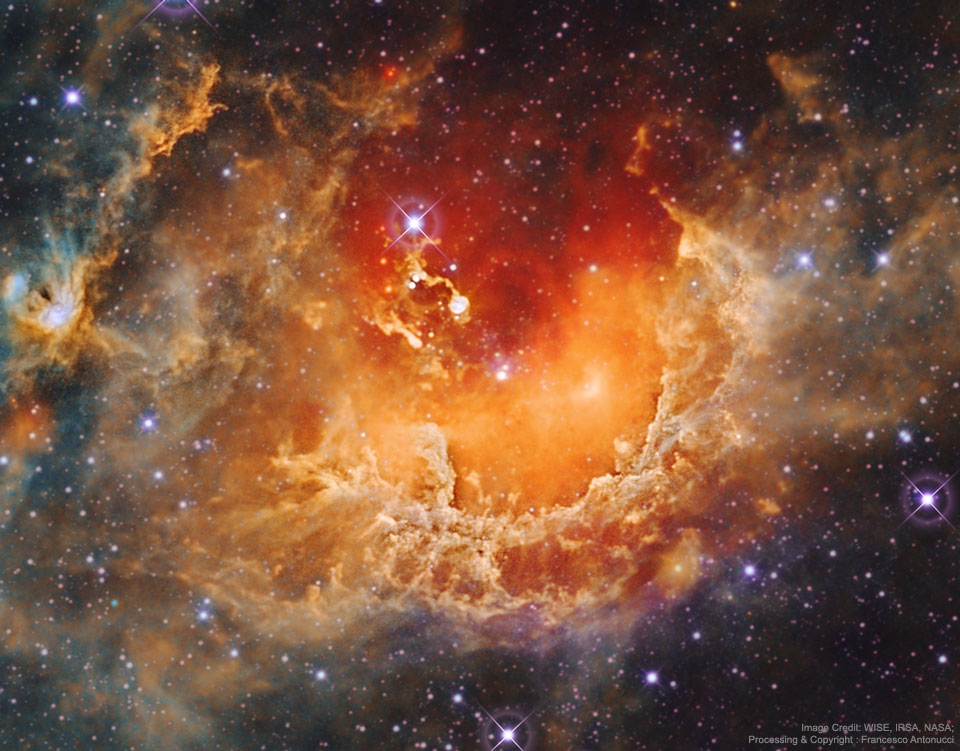
What’s all of the commotion in the Tadpole Nebula? Star formation. Dusty emission in the Tadpole Nebula, IC 410, lies about 12,000 light-years away in the northern constellation of the Charioteer (Auriga). The cloud of glowing gas is over 100 light-years across, sculpted by stellar winds and radiation from embedded open star cluster NGC 1893. Formed in the interstellar cloud a mere 4 million years ago, bright newly formed cluster stars are seen all around the star-forming nebula. Notable near the image center are two relatively dense streamers of material trailing away from the nebula’s central regions. Potentially sites of ongoing star formation in IC 410, these cosmic tadpole shapes are about 10 light-years long. The featured image was taken in infrared light by NASA’s Wide Field Infrared Survey Explorer (WISE) satellite. [via NASA] https://ift.tt/311nmus

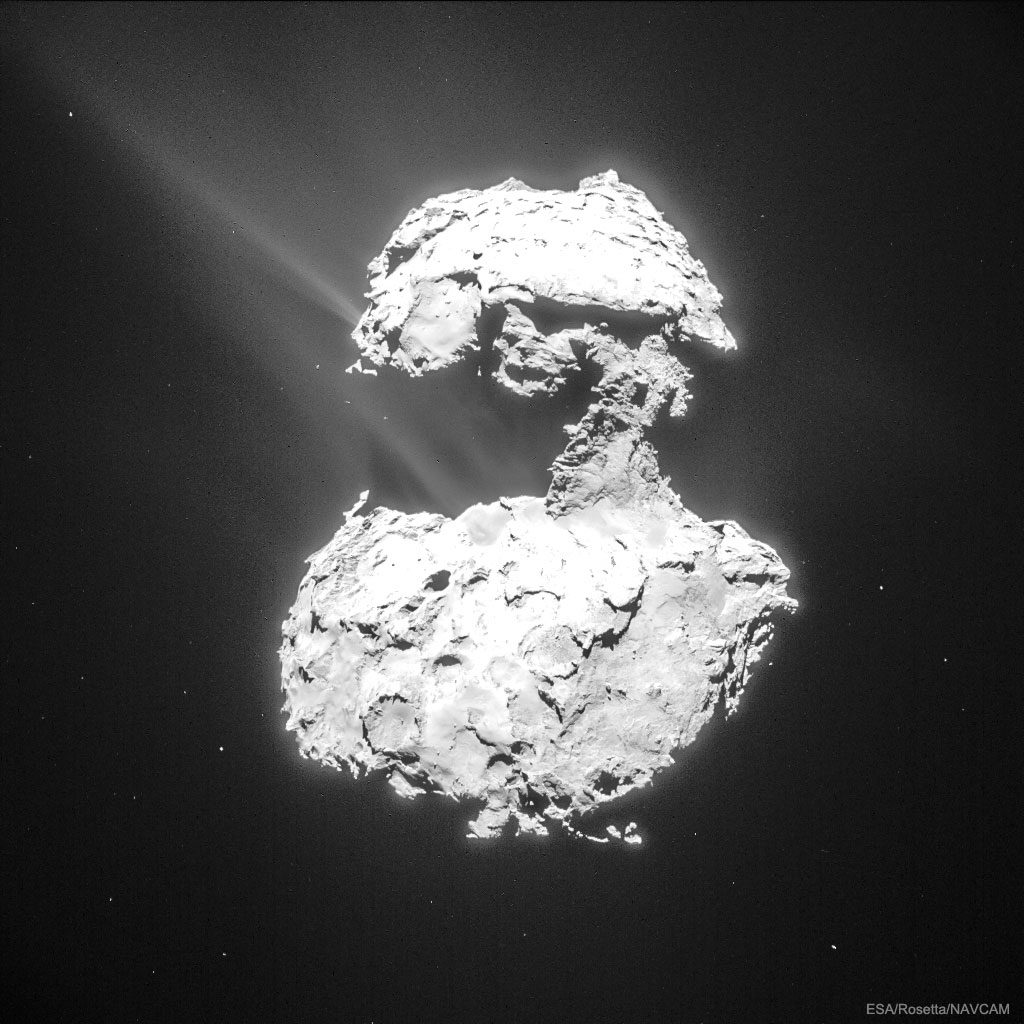
Comet CG Evaporates

Where do comet tails come from? There are no obvious places on the nuclei of comets from which the jets that create comet tails emanate. One of the best images of emerging jets is shown in the featured picture, taken in 2015 by ESA’s robotic Rosetta spacecraft that orbited Comet 67P/Churyumov-Gerasimenko (Comet CG) from 2014 to 2016. The picture shows plumes of gas and dust escaping numerous places from Comet CG’s nucleus as it neared the Sun and heated up. The comet has two prominent lobes, the larger one spanning about 4 kilometers, and a smaller 2.5-kilometer lobe connected by a narrow neck. Analyses indicate that evaporation must be taking place well inside the comet’s surface to create the jets of dust and ice that we see emitted through the surface. Comet CG (also known as Comet 67P) loses in jets about a meter of radius during each of its 6.44-year orbits around the Sun, a rate at which will completely destroy the comet in only thousands of years. In 2016, Rosetta’s mission ended with a controlled impact onto Comet CG’s surface. [via NASA] https://ift.tt/2RMSedO

Hills Ridges and Tracks on Mars

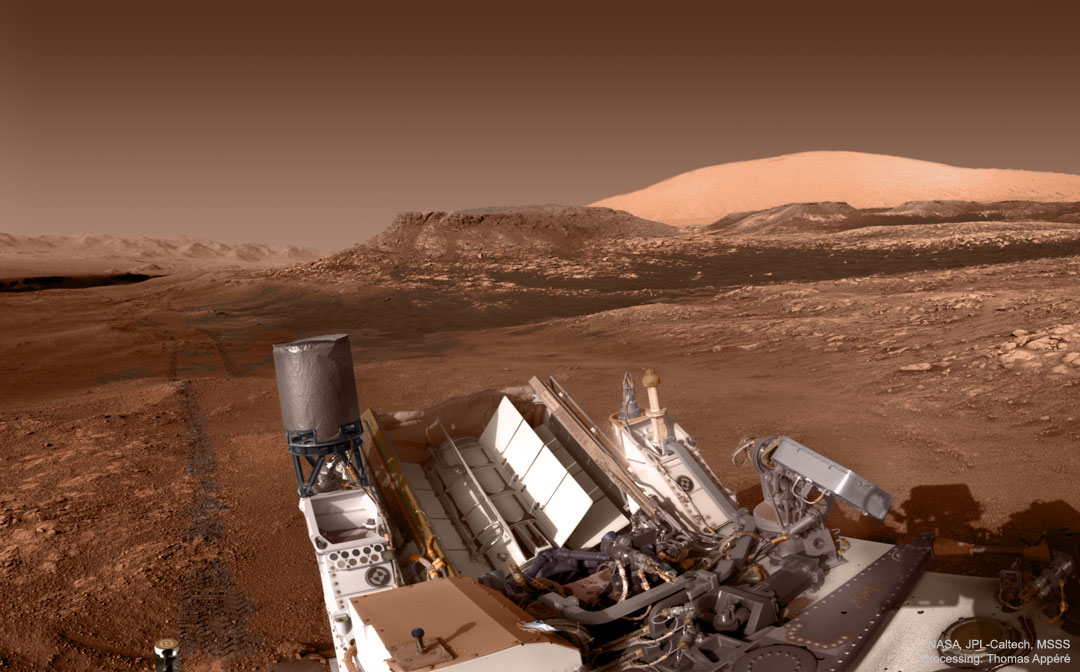
Sometimes, even rovers on Mars stop to admire the scenery. Just late last November the Curiosity rover on Mars paused to photograph its impressive surroundings. One thing to admire, straight ahead, was Central Butte, an unusual flat hill studied by Curiosity just a few days before this image was taken. To its right was distant Mount Sharp, the five-kilometer central peak of entire Gale crater, the interior of which Curiosity is exploring. Mount Sharp, covered in sulfates, appears quite bright in this colorized, red-filtered image. To the far left, shrouded in a very dark shadow, was the south slope of Vera Rubin ridge, an elevation explored previously by Curiosity. Between the ridge and butte were tracks left by Curiosity’s wheels as they rolled forward, out of the scene. In the image foreground is, of course, humanity’s current eyes on Mars: the complex robotic rover Curiosity itself. Later this year, if all goes well, NASA will have another rover — and more eyes — on Mars. Today you can help determine the name of this rover yourself, but tomorrow is the last day to cast your vote. [via NASA] https://ift.tt/37ru2UN

Rubin s Galaxy

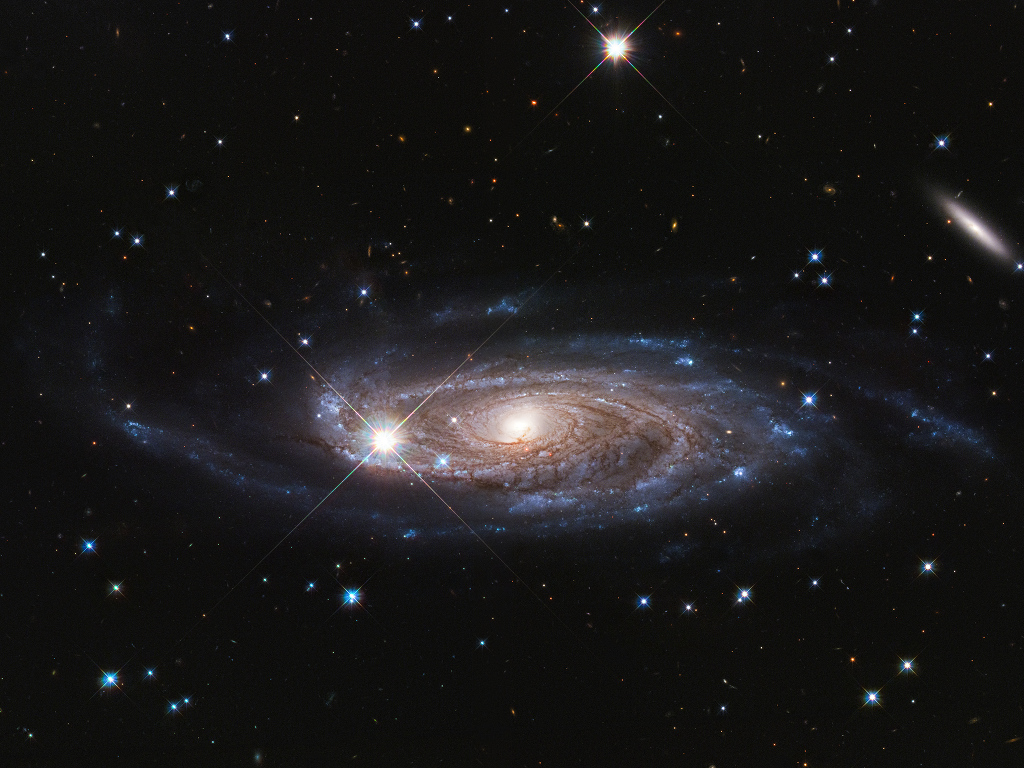
In this Hubble Space Telescope image the bright, spiky stars lie in the foreground toward the heroic northern constellation Perseus and well within our own Milky Way galaxy. In sharp focus beyond is UGC 2885, a giant spiral galaxy about 232 million light-years distant. Some 800,000 light-years across compared to the Milky Way’s diameter of 100,000 light-years or so, it has around 1 trillion stars. That’s about 10 times as many stars as the Milky Way. Part of a current investigation to understand how galaxies can grow to such enormous sizes, UGC 2885 was also part of astronomer Vera Rubin’s pioneering study of the rotation of spiral galaxies. Her work was the first to convincingly demonstrate the dominating presence of dark matter in our universe. [via NASA] https://ift.tt/30UeOVP

Into the Shadow

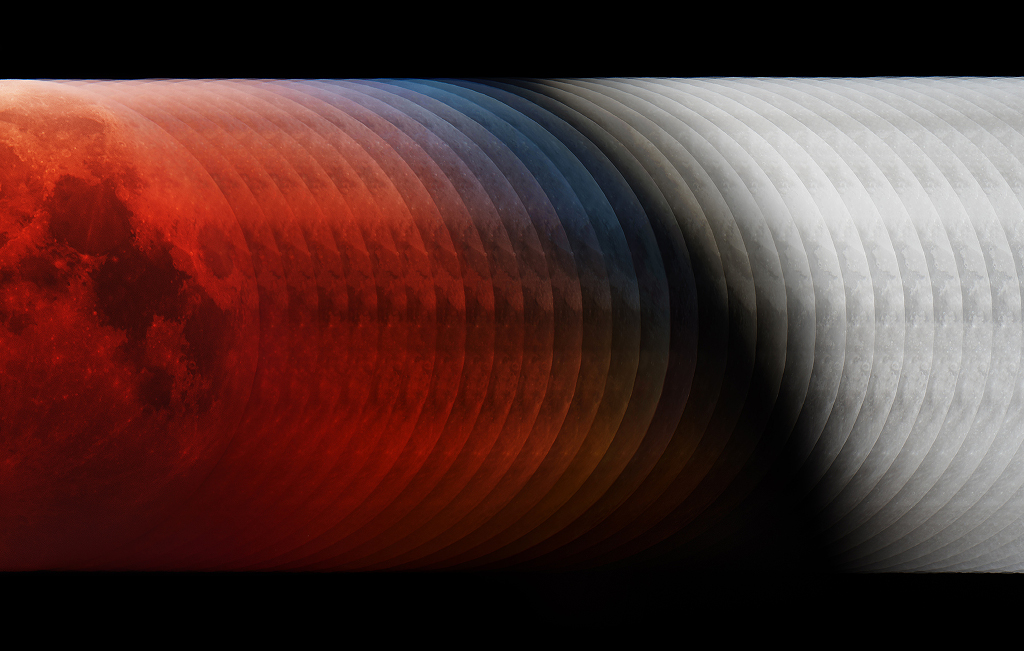
On January 21, 2019 moonwatchers on planet Earth saw a total lunar eclipse. In 35 frames this composite image follows the Moon that night as it crossed into Earth’s dark umbral shadow. Taken 3 minutes apart, they almost melt together in a continuous screen that captures the dark colors within the shadow itself and the northern curve of the shadow’s edge. Sunlight scattered by the atmosphere into the shadow causes the lunar surface to appear reddened during totality (left), but close to the umbra’s edge, the limb of the eclipsed Moon shows a remarkable blue hue. The blue eclipsed moonlight originates as rays of sunlight pass through layers high in Earth’s upper stratosphere, colored by ozone that scatters red light and transmits blue. The Moon’s next crossing into Earth’s umbral shadow, will be on May 26, 2021. [via NASA] https://ift.tt/2vliLaJ

Globular Star Cluster NGC 6752

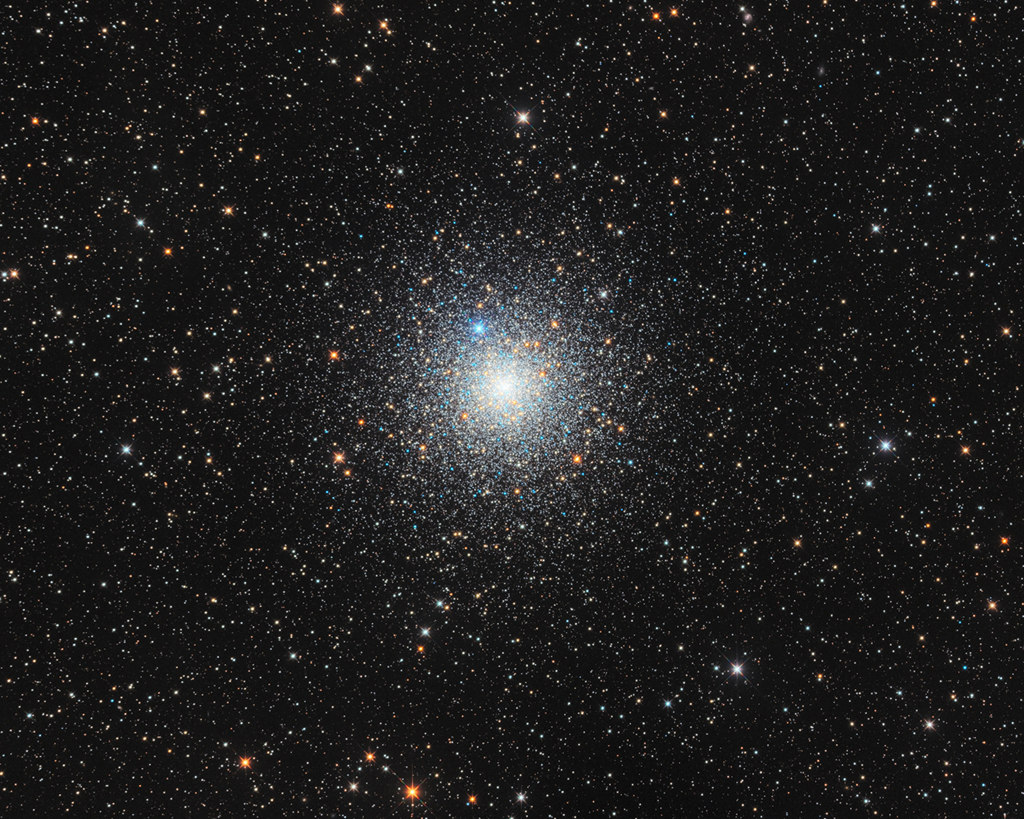
Some 13,000 light-years away toward the southern constellation Pavo, the globular star cluster NGC 6752 roams the halo of our Milky Way galaxy. Over 10 billion years old, NGC 6752 follows clusters Omega Centauri and 47 Tucanae as the third brightest globular in planet Earth’s night sky. It holds over 100 thousand stars in a sphere about 100 light-years in diameter. Telescopic explorations of the NGC 6752 have found that a remarkable fraction of the stars near the cluster’s core, are multiple star systems. They also reveal the presence of blue straggle stars, stars which appear to be too young and massive to exist in a cluster whose stars are all expected to be at least twice as old as the Sun. The blue stragglers are thought to be formed by star mergers and collisions in the dense stellar environment at the cluster’s core. This sharp color composite also features the cluster’s ancient red giant stars in yellowish hues. (Note: The bright, spiky blue star at 11 o’clock from the cluster center is a foreground star along the line-of-sight to NGC 6752) [via NASA] https://ift.tt/37iwi0A

The Hyades Star Cluster

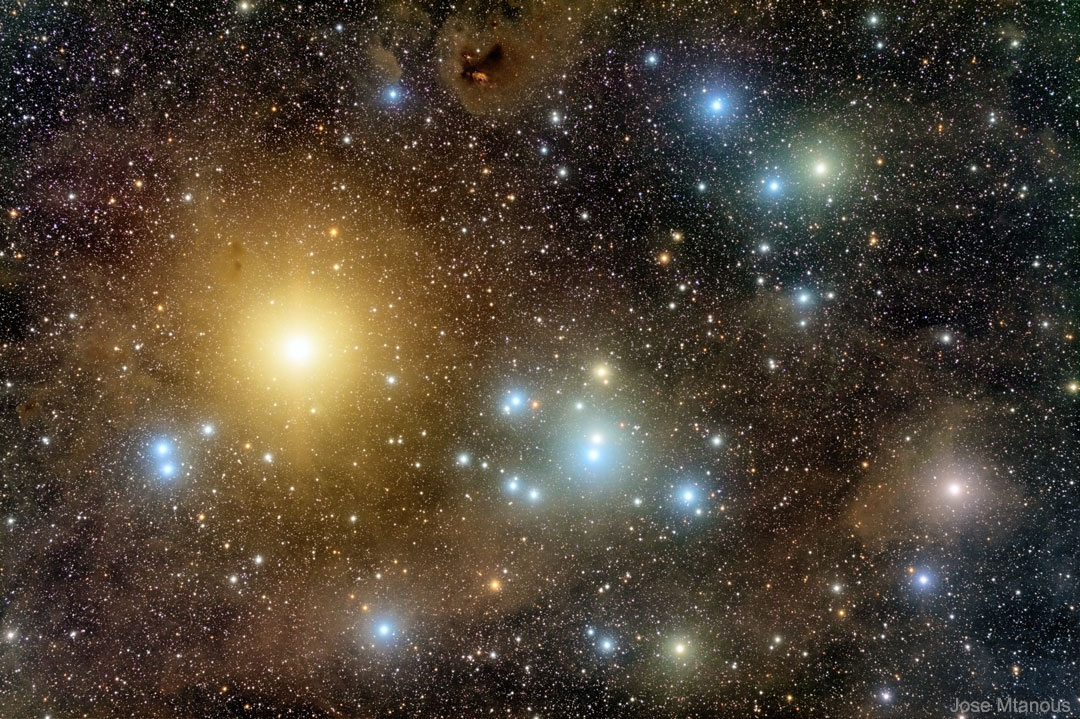
It is the closest cluster of stars to the Sun. The Hyades open cluster is bright enough to have been remarked on even thousands of years ago, yet is not as bright or compact as the nearby Pleiades (M45) star cluster. Pictured here is a particularly deep image of the Hyades which has brings out vivid star colors and faint coincidental nebulas. The brightest star in the field is yellow Aldebaran, the eye of the bull toward the constellation of Taurus. Aldebaran, at 65 light-years away, is now known to be unrelated to the Hyades cluster, which lies about 150 light-years away. The central Hyades stars are spread out over about 15 light-years. Formed about 625 million years ago, the Hyades likely shares a common origin with the Beehive cluster (M44), a naked-eye open star cluster toward the constellation of Cancer, based on M44’s motion through space and remarkably similar age. [via NASA] https://ift.tt/3aryuoF

Parker: Sounds of the Solar Wind

What does the solar wind sound like? A wind of fast moving particles blows out from our Sun, and although space transmits sound poorly, particle impact and variable-field data from NASA’s near-Sun Parker Solar Probe is being translated into sound. The disarming audio track of the featured video recounts several of these reverberations, including spooky-sounding Langmuir Waves (heard first), hurricane-sounding Whistler Mode Waves (heard next), and hard-to-describe Dispersive Chirping Waves (heard last). Also impressive is the video’s time-lapse visual track which shows Parker’s view to the side of its sun shield, and where the planets Earth, Jupiter, Mercury and Venus appear in succession, interspersed with bursts of powerful cosmic rays impacting the imager. The nature of the solar wind near Mercury is surprisingly different from near the Earth, and much study is underway to better understand the differences. [via NASA] https://ift.tt/38pEHiX

Quadrantid Meteors through Orion

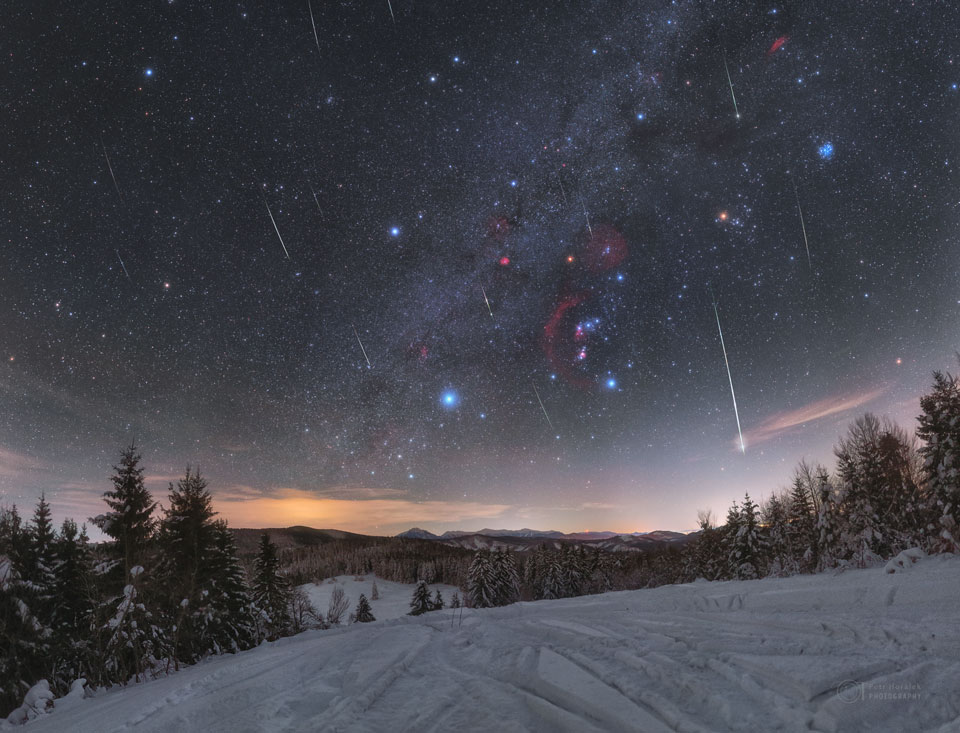
Why are these meteor trails nearly parallel? Because they were all shed by the same space rock and so can be traced back to the same direction on the sky: the radiant of the Quadrantid Meteor Shower. This direction used to be toward the old constellation of Quadrans Muralis, hence the name Quadrantids, but when the International Astronomical Union formulated its list of modern constellations in 1922, this constellation did not make the list. Even though the meteors are now considered to originate from the recognized constellation of Bootes, the old name stuck. Regardless of the designation, every January the Earth moves through a dust stream and bits of this dust glow as meteors as they heat up in Earth’s atmosphere. The featured image composite was taken on January 4 with a picturesque snowy Slovakian landscape in the foreground, and a deep-exposure sky prominently featuring the constellation Orion in the background. The red star Betelgeuse appears unusually dim — its fading over the past few months is being tracked by astronomers. [via NASA] https://ift.tt/2G64LUf