M1: The Incredible Expanding Crab Nebula

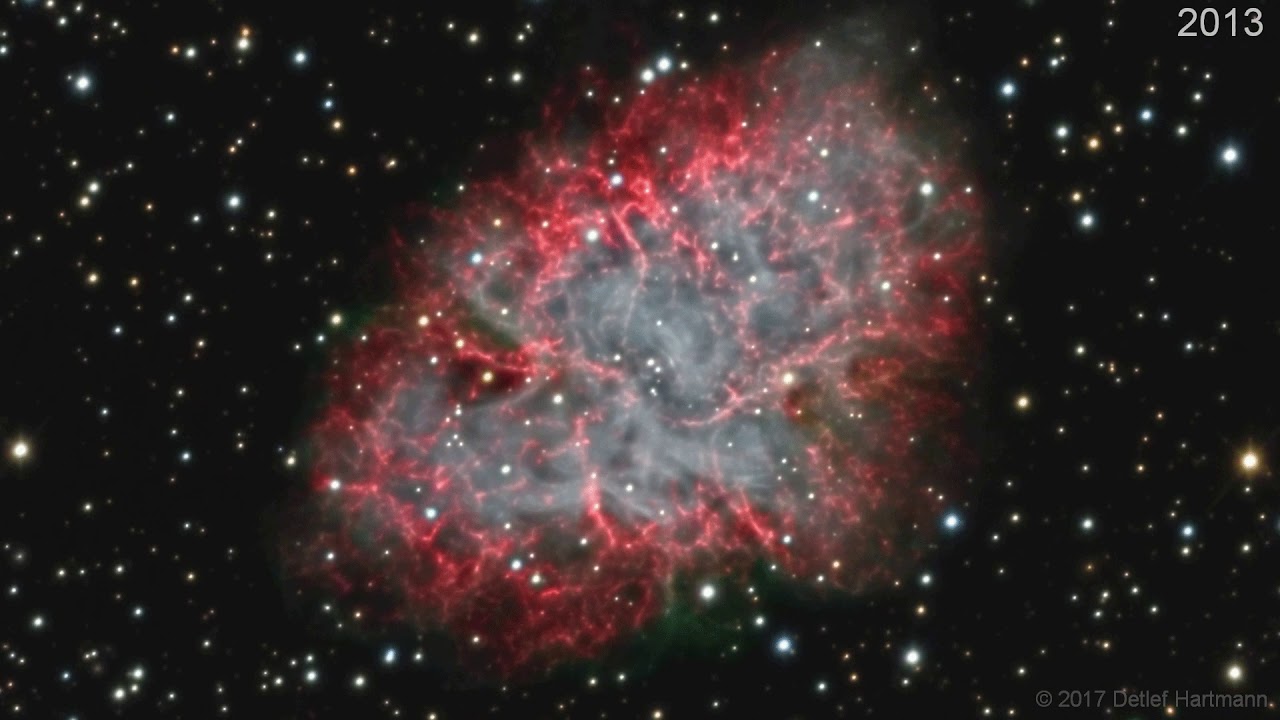
Are your eyes good enough to see the Crab Nebula expand? The Crab Nebula is cataloged as M1, the first on Charles Messier’s famous list of things which are not comets. In fact, the Crab is now known to be a supernova remnant, an expanding cloud of debris from the explosion of a massive star. The violent birth of the Crab was witnessed by astronomers in the year 1054. Roughly 10 light-years across today, the nebula is still expanding at a rate of over 1,000 kilometers per second. Over the past decade, its expansion has been documented in this stunning time-lapse movie. In each year from 2008 to 2017, an image was produced with the same telescope and camera from a remote observatory in Austria. Combined in the time-lapse movie, the 10 images represent 32 hours of total integration time. The sharp, processed frames even reveal the dynamic energetic emission within the incredible expanding Crab. The Crab Nebula lies about 6,500 light-years away in the constellation Taurus. [via NASA] https://ift.tt/2NEB296
An Almost Eclipse of the Moon

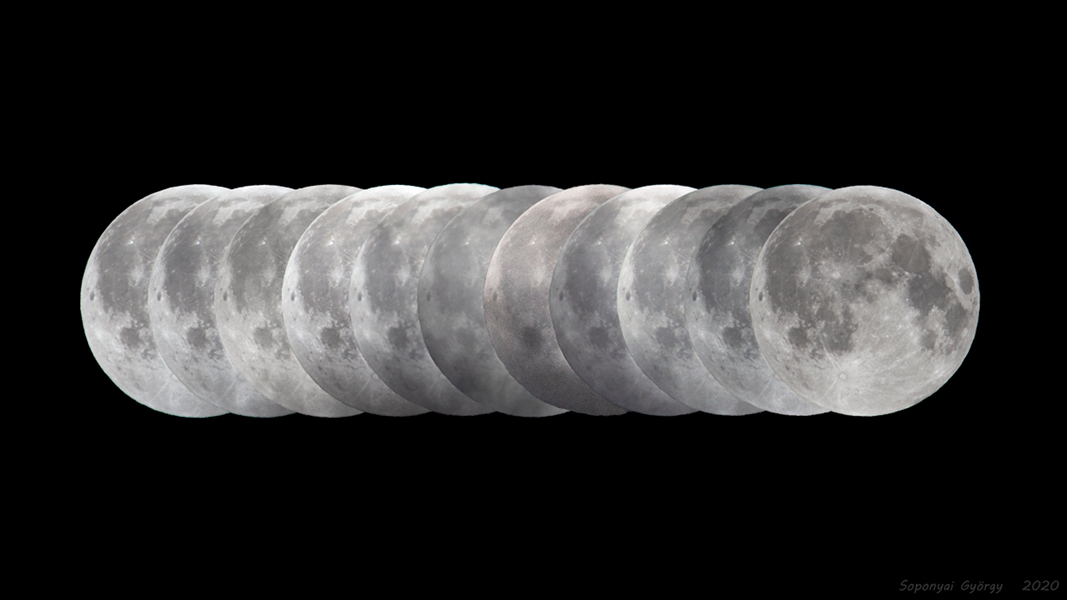
This composited series of images follows the Moon on January 10, the first Full Moon of 2020, in Hungarian skies. The lunar disk is in mid-eclipse at the center of the sequence though. It looks only slightly darker there as it passes through the light outer shadow or penumbra of planet Earth. In fact during this penumbral lunar eclipse the Moon almost crossed into the northern edge of Earth’s dark central shadow or umbra. Subtle and hard to see, this penumbral lunar eclipse was the first of four lunar eclipses in 2020, all of which will be penumbral lunar eclipses. [via NASA] https://ift.tt/30vHmVH

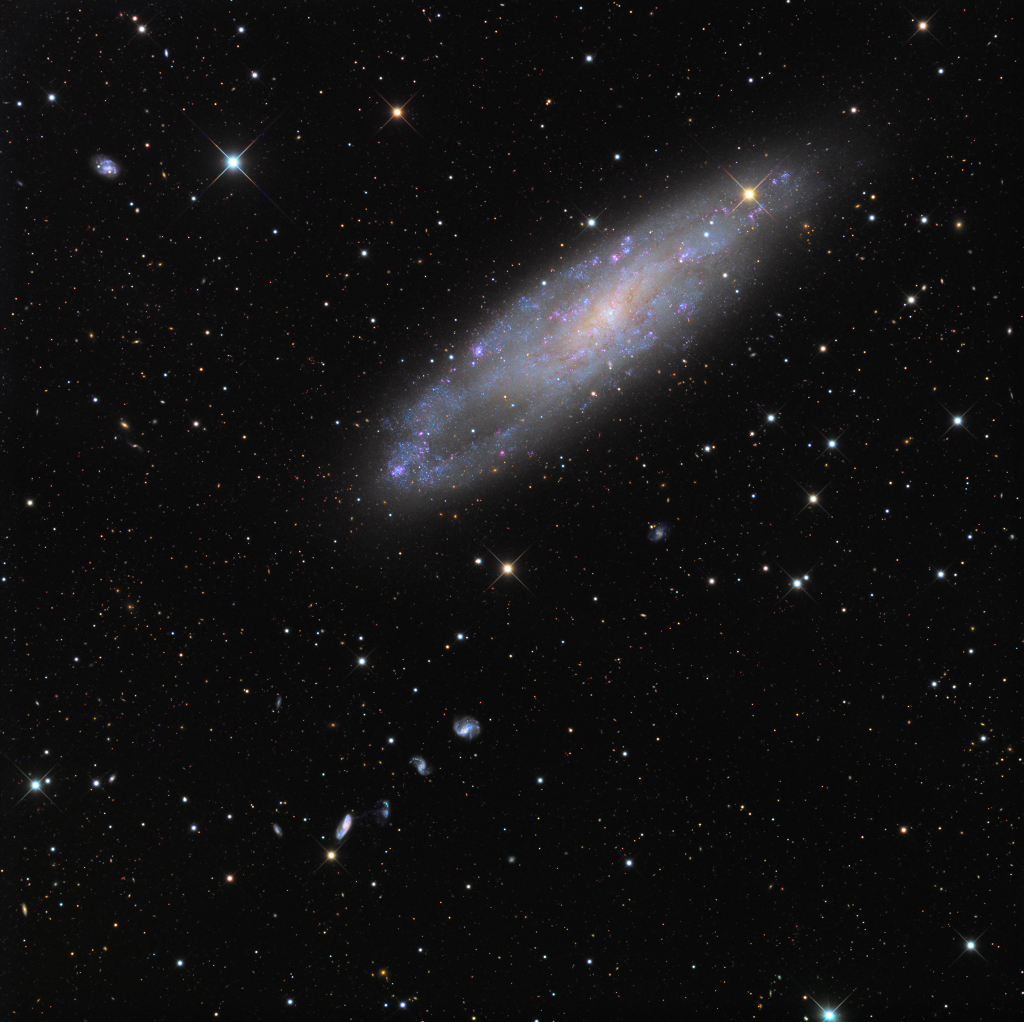
NGC 247 and Friends

About 70,000 light-years across, NGC 247 is a spiral galaxy smaller than our Milky Way. Measured to be only 11 million light-years distant it is nearby though. Tilted nearly edge-on as seen from our perspective, it dominates this telescopic field of view toward the southern constellation Cetus. The pronounced void on one side of the galaxy’s disk recalls for some its popular name, the Needle’s Eye galaxy. Many background galaxies are visible in this sharp galaxy portrait, including the remarkable string of four galaxies just below and left of NGC 247 known as Burbidge’s Chain. Burbidge’s Chain galaxies are about 300 million light-years distant. NGC 247 itself is part of the Sculptor Group of galaxies along with the shiny spiral NGC 253. [via NASA] https://ift.tt/35V1pOs

Iridescent Clouds over Sweden

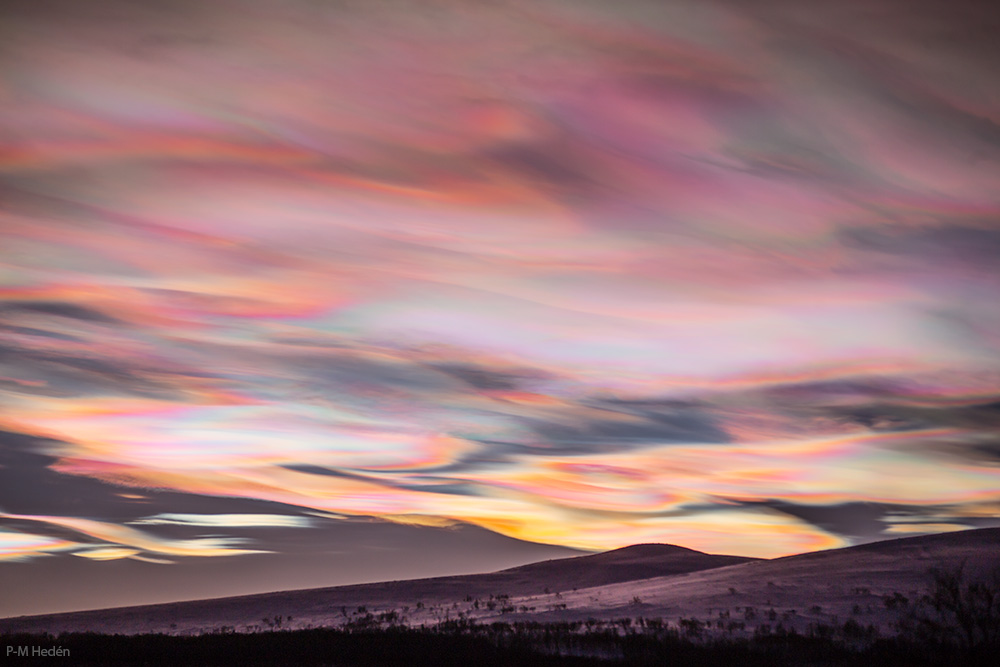
Why would these clouds multi-colored? A relatively rare phenomenon in clouds known as iridescence can bring up unusual colors vividly or even a whole spectrum of colors simultaneously. These polar stratospheric clouds clouds, also known as nacreous and mother-of-pearl clouds, are formed of small water droplets of nearly uniform size. When the Sun is in the right position and, typically, hidden from direct view, these thin clouds can be seen significantly diffracting sunlight in a nearly coherent manner, with different colors being deflected by different amounts. Therefore, different colors will come to the observer from slightly different directions. Many clouds start with uniform regions that could show iridescence but quickly become too thick, too mixed, or too angularly far from the Sun to exhibit striking colors. The featured image and an accompanying video were taken late last year over Ostersund, Sweden. [via NASA] https://ift.tt/36QLfXw

Evidence of an Active Volcano on Venus

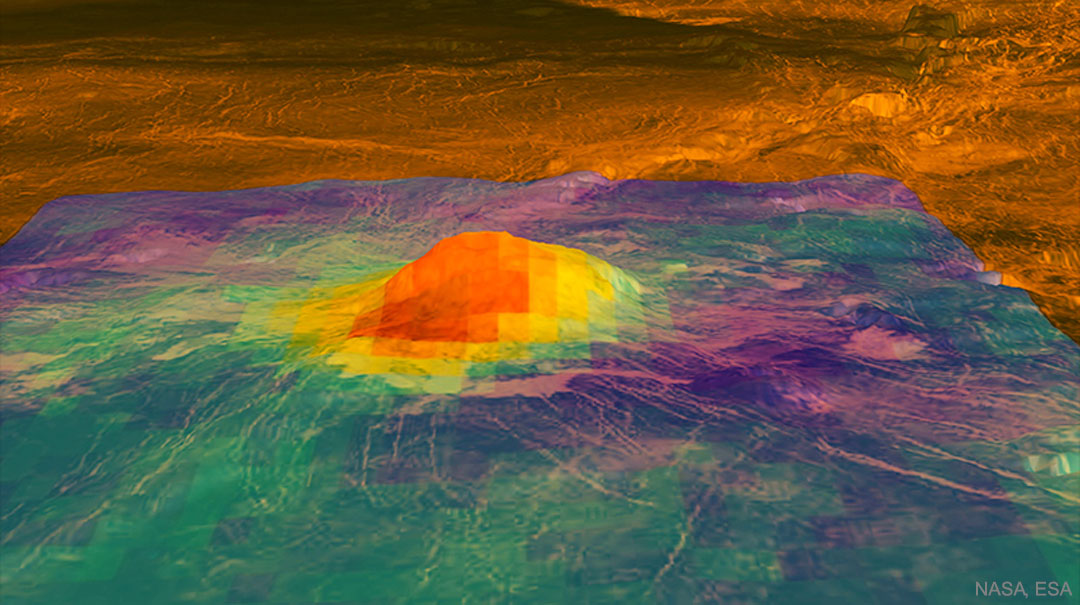
Are volcanoes still active on Venus? More volcanoes are known on Venus than Earth, but when Venusian volcanoes last erupted is not directly known. Evidence bolstering very recent volcanism on Venus has recently been uncovered, though, right here on Earth. Lab results showed that images of surface lava would become dim in the infrared in only months in the dense Venusian atmosphere, a dimming not seen in ESA’s Venus Express images. Venus Express entered orbit around Venus in 2006 and remained in contact with Earth until 2014. Therefore, the infrared glow (shown in false-color red) recorded by Venus Express for Idunn Mons and featured here on a NASA Magellan image indicates that this volcano erupted very recently — and is still active today. Understanding the volcanics of Venus might lead to insight about the volcanics on Earth, as well as elsewhere in our Solar System. [via NASA] https://ift.tt/2Npl8zk

A Desert Eclipse

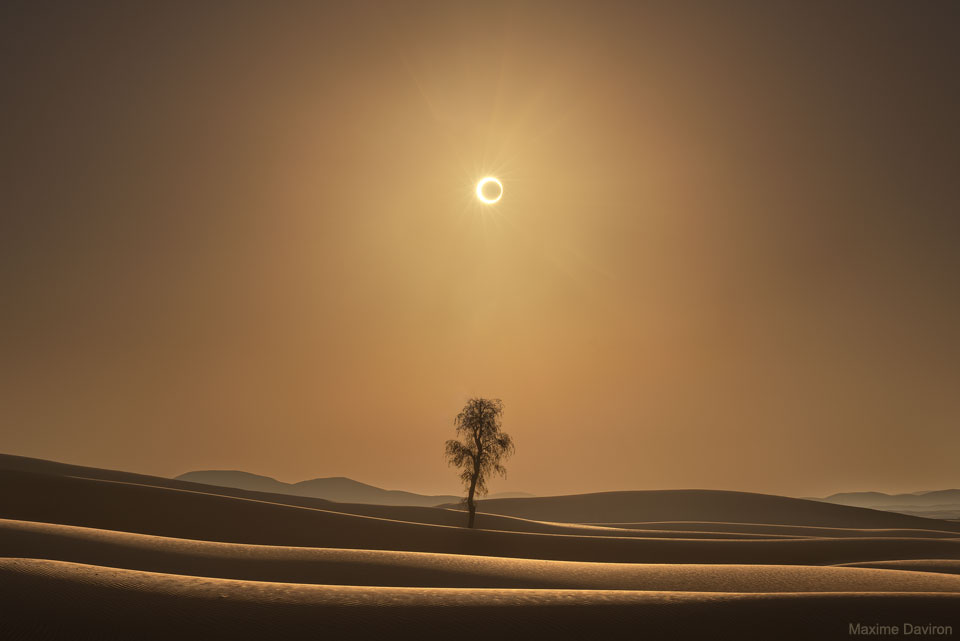
A good place to see a ring-of-fire eclipse, it seemed, would be from a desert. In a desert, there should be relatively few obscuring clouds and trees. Therefore late last December a group of photographers traveled to the United Arab Emirates and Rub al-Khali, the largest continuous sand desert in world, to capture clear images of an unusual eclipse that would be passing over. A ring-of-fire eclipse is an annular eclipse that occurs when the Moon is far enough away on its elliptical orbit around the Earth so that it appears too small, angularly, to cover the entire Sun. At the maximum of an annular eclipse, the edges of the Sun can be seen all around the edges of the Moon, so that the Moon appears to be a dark spot that covers most — but not all — of the Sun. This particular eclipse, they knew, would peak soon after sunrise. After seeking out such a dry and barren place, it turned out that some of the most interesting eclipse images actually included a tree in the foreground, because, in addition to the sand dunes, the tree gave the surreal background a contrasting sense of normalcy, scale, and texture. [via NASA] https://ift.tt/3a38Q9t

Stars and Dust in Corona Australis

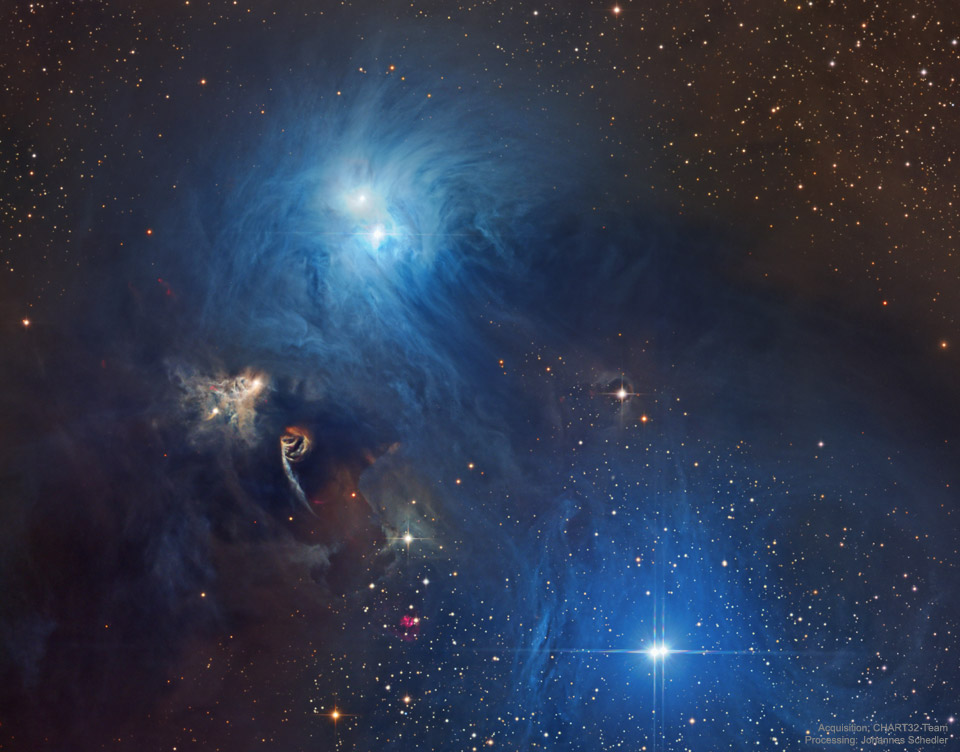
Cosmic dust clouds and young, energetic stars inhabit this telescopic vista, less than 500 light-years away toward the northern boundary of Corona Australis, the Southern Crown. The dust clouds effectively block light from more distant background stars in the Milky Way. But the striking complex of reflection nebulae cataloged as NGC 6726, 6727, and IC 4812 produce a characteristic blue color as light from the region’s young hot stars is reflected by the cosmic dust. The dust also obscures from view stars still in the process of formation. At the left, smaller yellowish nebula NGC 6729 bends around young variable star R Coronae Australis. Just below it, glowing arcs and loops shocked by outflows from embedded newborn stars are identified as Herbig-Haro objects. On the sky this field of view spans about 1 degree. That corresponds to almost 9 light-years at the estimated distance of the nearby star forming region. [via NASA] https://ift.tt/30bvcB4

NGC 602 and Beyond

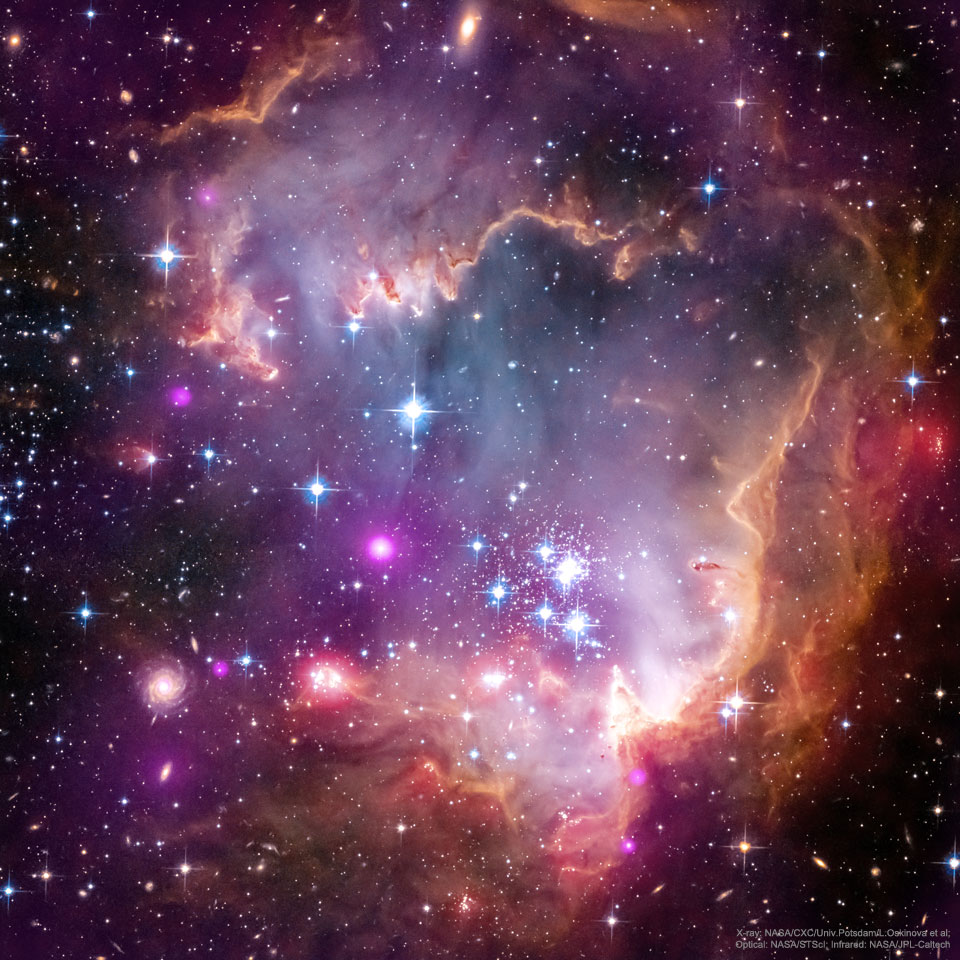
Near the outskirts of the Small Magellanic Cloud, a satellite galaxy some 200 thousand light-years distant, lies 5 million year young star cluster NGC 602. Surrounded by natal gas and dust, NGC 602 is featured in this stunning Hubble image of the region, augmented by images in the X-ray by Chandra, and in the infrared by Spitzer. Fantastic ridges and swept back shapes strongly suggest that energetic radiation and shock waves from NGC 602’s massive young stars have eroded the dusty material and triggered a progression of star formation moving away from the cluster’s center. At the estimated distance of the Small Magellanic Cloud, the Picture spans about 200 light-years, but a tantalizing assortment of background galaxies are also visible in this sharp multi-colored view. The background galaxies are hundreds of millions of light-years or more beyond NGC 602. [via NASA] https://ift.tt/2QIFKEU

Nacreous Clouds over Sweden

Vivid and lustrous, wafting iridescent waves of color filled this mountain and skyscape near Tanndalen, Sweden on January 3. Known as nacreous clouds or mother-of-pearl clouds, they are rare. This northern winter season they have been making unforgettable appearances at high latitudes, though. A type of polar stratospheric cloud, they form when unusually cold temperatures in the usually cloudless lower stratosphere form ice crystals. Still sunlit at altitudes of around 15 to 25 kilometers the clouds can diffract sunlight after sunset and before the dawn. [via NASA] https://ift.tt/36LNsni

Perihelion to Aphelion

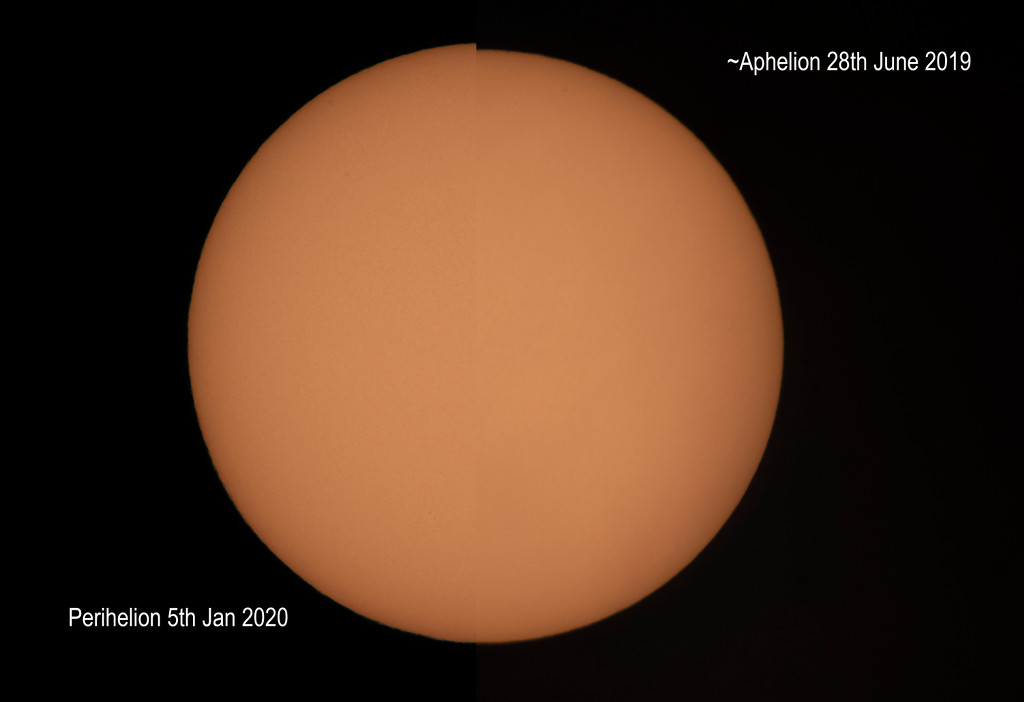
Perihelion for 2020, the point in Earth’s elliptical orbit when it is closest to the Sun, occurred on January 5th. The distance from the Sun doesn’t determine the seasons, though. Those are governed by the tilt of Earth’s axis of rotation, so January is still winter in the north and summer in southern hemisphere. But it does mean that on January 5 the Sun was at its largest apparent size. This composite neatly compares two pictures of the Sun, both taken from planet Earth with the same telescope and camera. The left half was captured on the date of the 2020 perihelion. The right was recorded only a week before the July 4 date of the 2019 aphelion, the farthest point in Earth’s orbit. Otherwise difficult to notice, the change in the Sun’s apparent diameter between perihelion and aphelion amounts to a little over 3 percent. The 2020 perihelion and the preceding 2019 aphelion correspond to the closest and farthest perihelion and aphelion of the 21st century. [via NASA] https://ift.tt/2R3jDrq