M27: Not a Comet

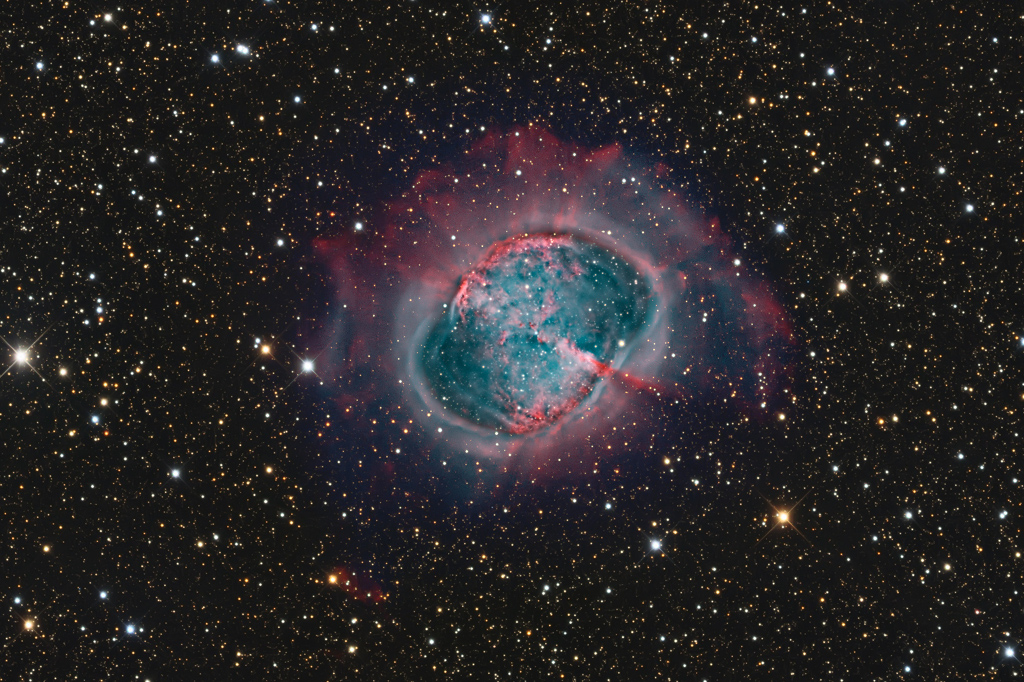
While hunting for comets in the skies above 18th century France, astronomer Charles Messier diligently kept a list of the things he encountered that were definitely not comets. This is number 27 on his now famous not-a-comet list. In fact, 21st century astronomers would identify it as a planetary nebula, but it’s not a planet either, even though it may appear round and planet-like in a small telescope. Messier 27 (M27) is an excellent example of a gaseous emission nebula created as a sun-like star runs out of nuclear fuel in its core. The nebula forms as the star’s outer layers are expelled into space, with a visible glow generated by atoms excited by the dying star’s intense but invisible ultraviolet light. Known by the popular name of the Dumbbell Nebula, the beautifully symmetric interstellar gas cloud is over 2.5 light-years across and about 1,200 light-years away in the constellation Vulpecula. This impressive color composite highlights details within the well-studied central region and fainter, seldom imaged features in the nebula’s outer halo. It incorporates broad and narrowband images recorded using filters sensitive to emission from hydrogen and oxygen atoms. [via NASA] https://ift.tt/2ZyLJNA
Messier 61 Close Up

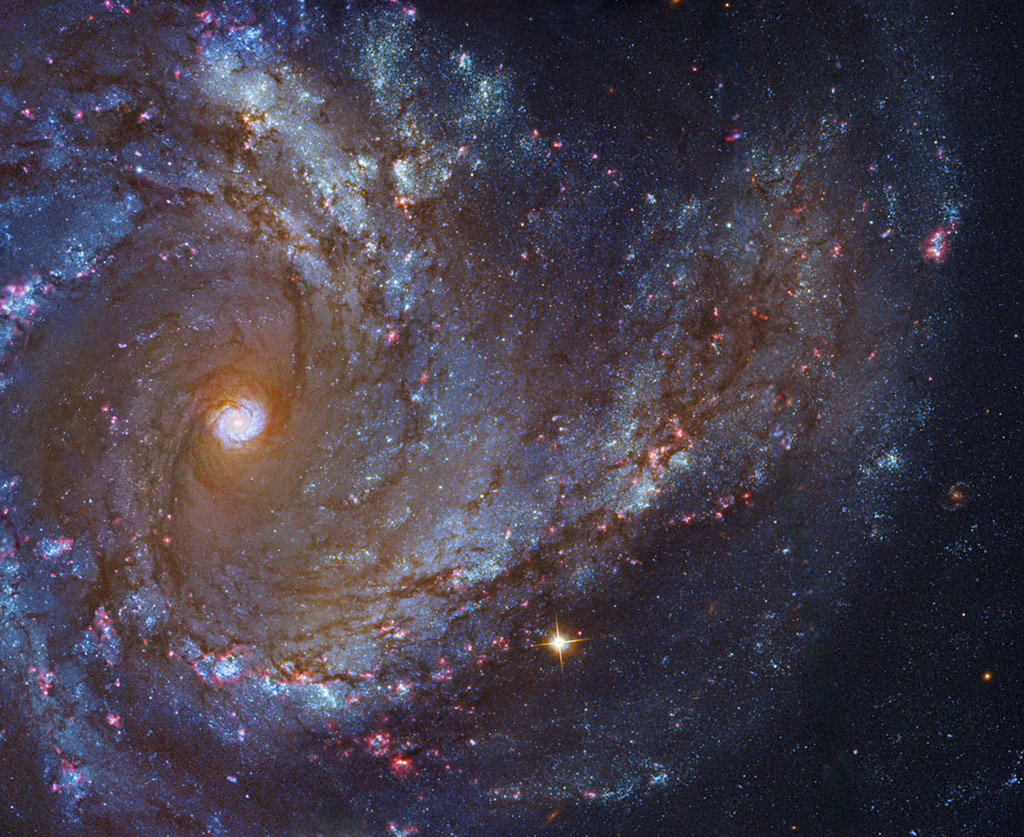
Image data from the Hubble Space Telescope, the European Southern Observatory, and small telescopes on planet Earth are combined in this magnificent portrait of face-on spiral galaxy Messier 61 (M61). A mere 55 million light-years away in the Virgo Cluster of Galaxies, M61 is also known as NGC 4303. It’s considered to be an example of a barred spiral galaxy similar to our own Milky Way. Like other spiral galaxies, M61 also features sweeping spiral arms, cosmic dust lanes, pinkish star forming regions, and young blue star clusters. The bright galactic core is offset to the left in this 50 thousand light-year wide close-up. [via NASA] https://ift.tt/2zoXBqC

Millions of Stars in Omega Centauri

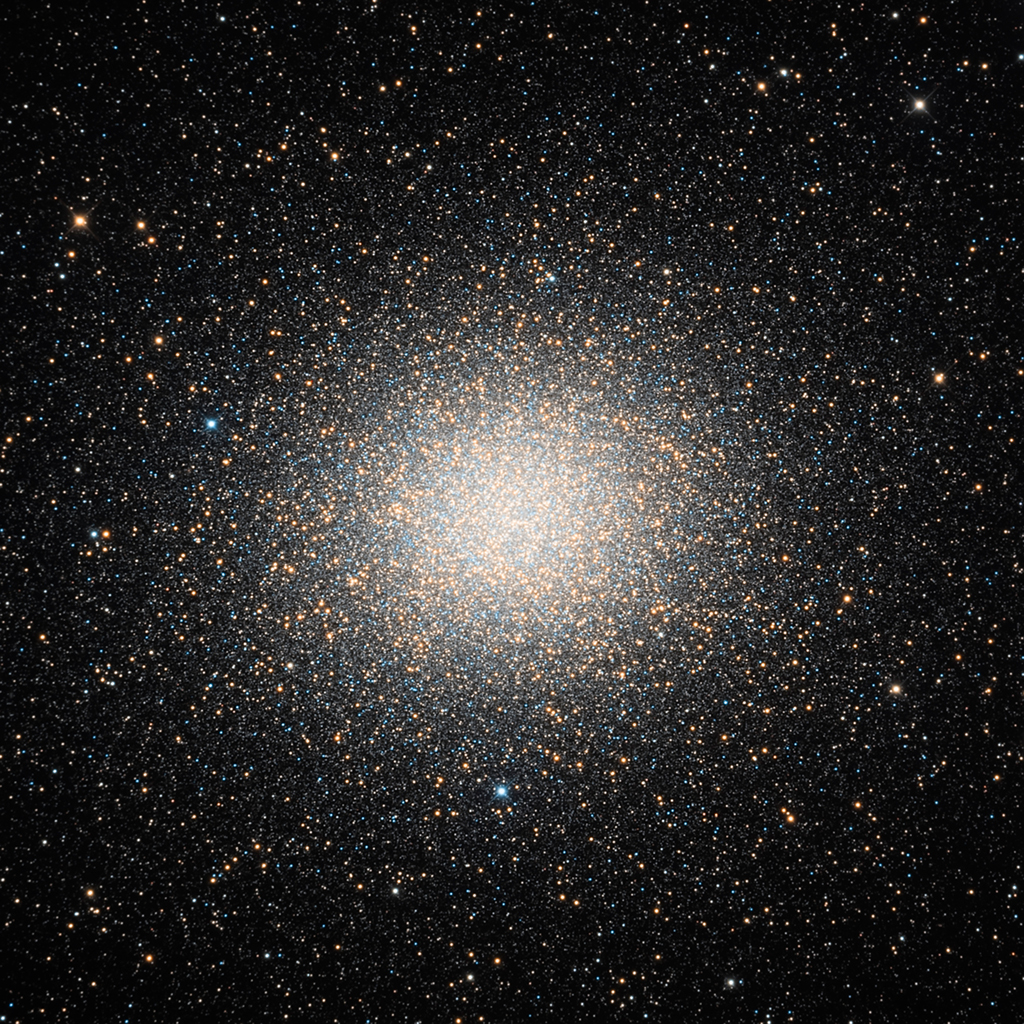
Globular star cluster Omega Centauri, also known as NGC 5139, is some 15,000 light-years away. The cluster is packed with about 10 million stars much older than the Sun within a volume about 150 light-years in diameter. It’s the largest and brightest of 200 or so known globular clusters that roam the halo of our Milky Way galaxy. Though most star clusters consist of stars with the same age and composition, the enigmatic Omega Cen exhibits the presence of different stellar populations with a spread of ages and chemical abundances. In fact, Omega Cen may be the remnant core of a small galaxy merging with the Milky Way. [via NASA] https://ift.tt/2Zk2En3

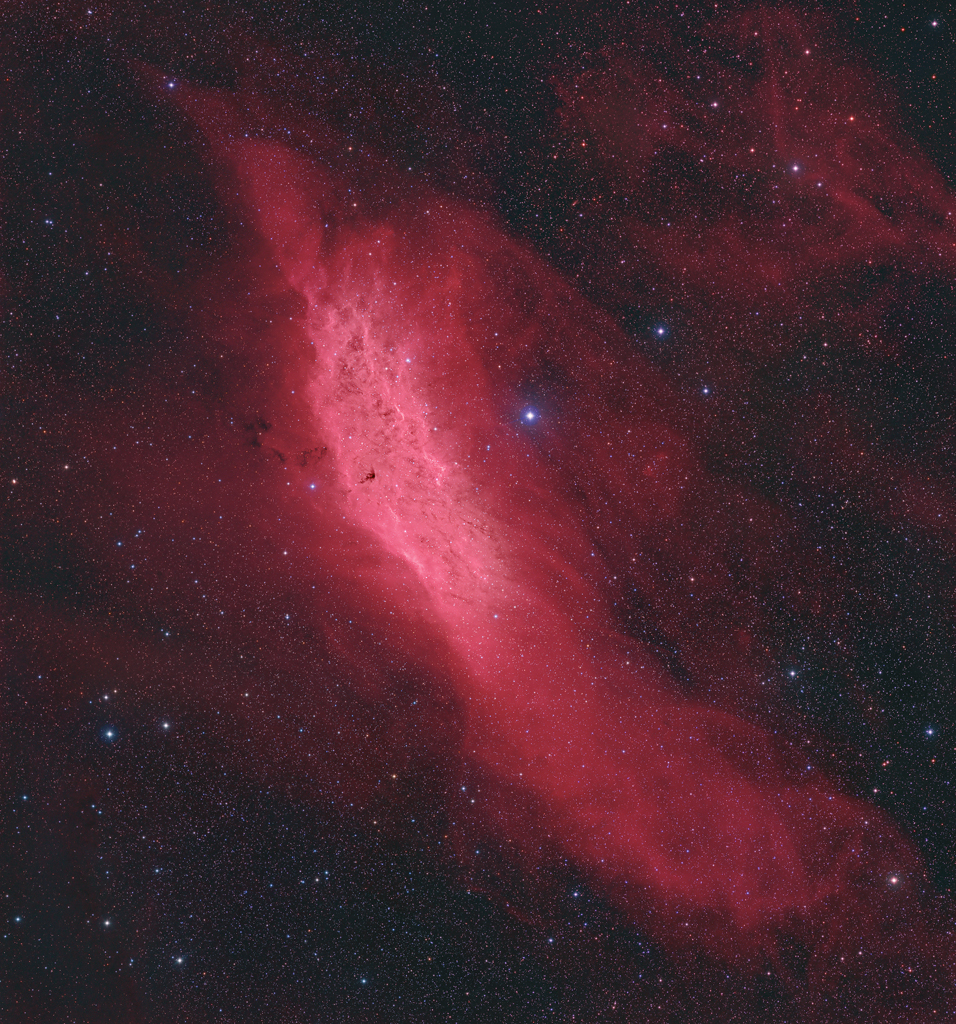
NGC 1499: The California Nebula

Drifting through the Orion Arm of the spiral Milky Way Galaxy, this cosmic cloud by chance echoes the outline of California on the west coast of the United States. Our own Sun also lies within the Milky Way’s Orion Arm, only about 1,500 light-years from the California Nebula. Also known as NGC 1499, the classic emission nebula is around 100 light-years long. The California Nebula shines with the telltale reddish glow characteristic of hydrogen atoms recombining with long lost electrons. The electrons have been stripped away, ionized by energetic starlight. Most likely providing the energetic starlight that ionizes much of the nebular gas is the bright, hot, bluish star Xi Persei just to the right of the nebula. A popular target for astrophotographers, this deep California Nebula image is a 6 panel telecopic mosaic and covers a wide field of view. The nebula lies toward the constellation Perseus, not far from the Pleiades. [via NASA] https://ift.tt/2ZolE3E

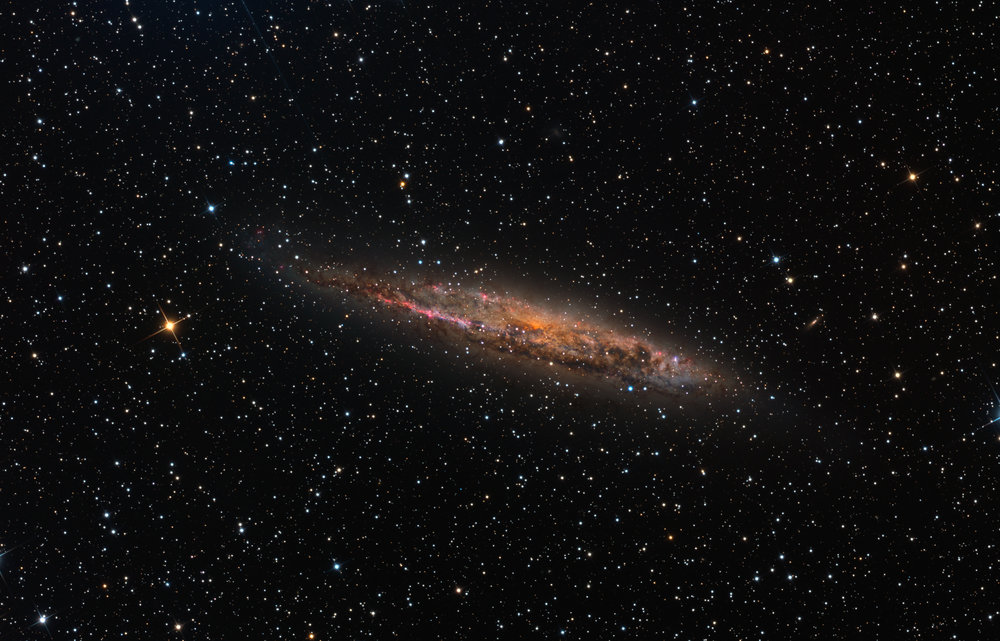
Nearby Spiral Galaxy NGC 4945

Large spiral galaxy NGC 4945 is seen edge-on near the center of this cosmic galaxy portrait. In fact, it’s almost the size of our Milky Way Galaxy. NGC 4945’s own dusty disk, young blue star clusters, and pink star forming regions standout in the sharp, colorful telescopic image. About 13 million light-years distant toward the expansive southern constellation Centaurus, NGC 4945 is only about six times farther away than Andromeda, the nearest large spiral galaxy to the Milky Way. Though this galaxy’s central region is largely hidden from view for optical telescopes, X-ray and infrared observations indicate significant high energy emission and star formation in the core of NGC 4945. Its obscured but active nucleus qualifies the gorgeous island universe as a Seyfert galaxy and home to a central supermassive black hole. [via NASA] https://ift.tt/2KLnVSm

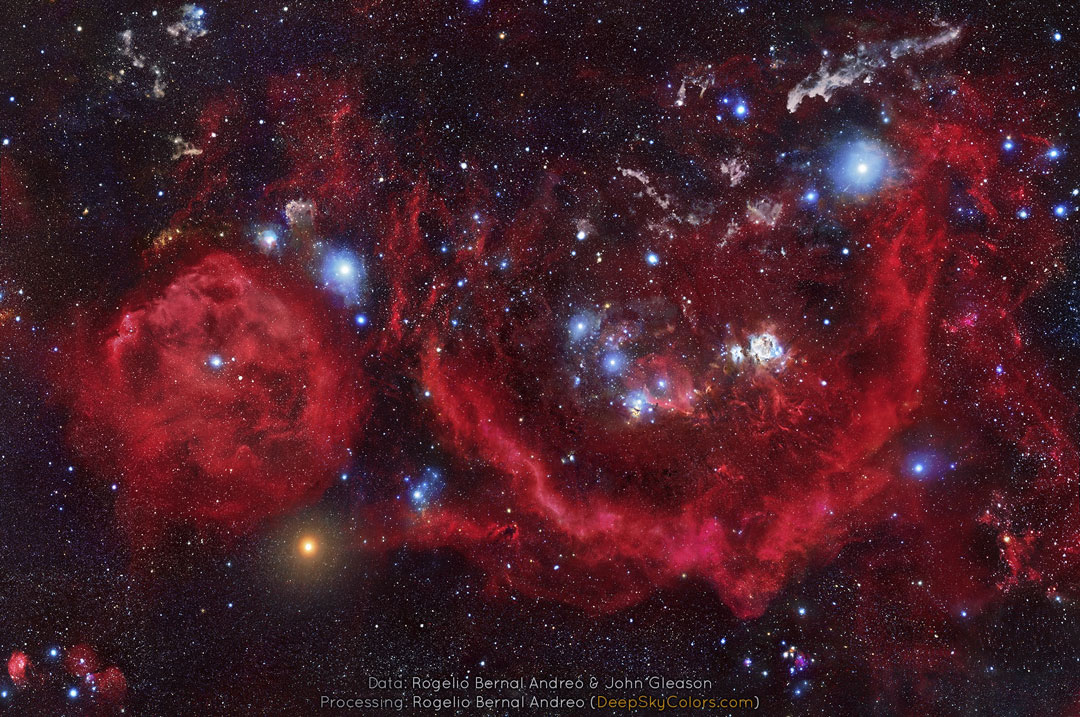
The Orion You Can Almost See

Do you recognize this constellation? Although it is one of the most recognizable star groupings on the sky, this is a more full Orion than you can see — an Orion only revealed with long exposure digital camera imaging and post-processing. Here the cool red giant Betelgeuse takes on a strong orange tint as the brightest star at the lower left. Orion’s hot blue stars are numerous, with supergiant Rigel balancing Betelgeuse on the upper right, and Bellatrix at the upper left. Lined up in Orion’s belt are three stars all about 1,500 light-years away, born from the constellation’s well-studied interstellar clouds. To the right of Orion’s belt is a bright but fuzzy patch that might also look familiar — the stellar nursery known as Orion’s Nebula. Finally, just barely visible to the unaided eye but quite striking here is Barnard’s Loop — a huge gaseous emission nebula surrounding Orion’s Belt and Nebula discovered over 100 years ago by the pioneering Orion photographer E. E. Barnard. [via NASA] https://ift.tt/2KJAZYA

Animation: Spiral Disk around a Black Hole

What would it look like to orbit a black hole? Many black holes are surrounded by swirling pools of gas known as accretion disks. These disks can be extremely hot, and much of the orbiting gas will eventually fall through the black hole’s event horizon — where it will never been seen again. The featured animation is an artist’s rendering of the curious disk spiraling around the supermassive black hole at the center of spiral galaxy NGC 3147. Gas at the inner edge of this disk is so close to the black hole that it moves unusually fast — at 10 percent of the speed of light. Gas this fast shows relativistic beaming, making the side of the disk heading toward us appear significantly brighter than the side moving away. The animation is based on images of NGC 3147 made recently with the Hubble Space Telescope. [via NASA] https://ift.tt/2L90BgD

Human as Spaceship

You are a spaceship soaring through the universe. So is your dog. We all carry with us trillions of microorganisms as we go through life. These multitudes of bacteria, fungi, and archaea have different DNA than you. Collectively called your microbiome, your shipmates outnumber your own cells. Your crew members form communities, help digest food, engage in battles against intruders, and sometimes commute on a liquid superhighway from one end of your body to the other. Much of what your microbiome does, however, remains unknown. You are the captain, but being nice to your crew may allow you to explore more of your local cosmos. [via NASA] https://ift.tt/2KYiDSG

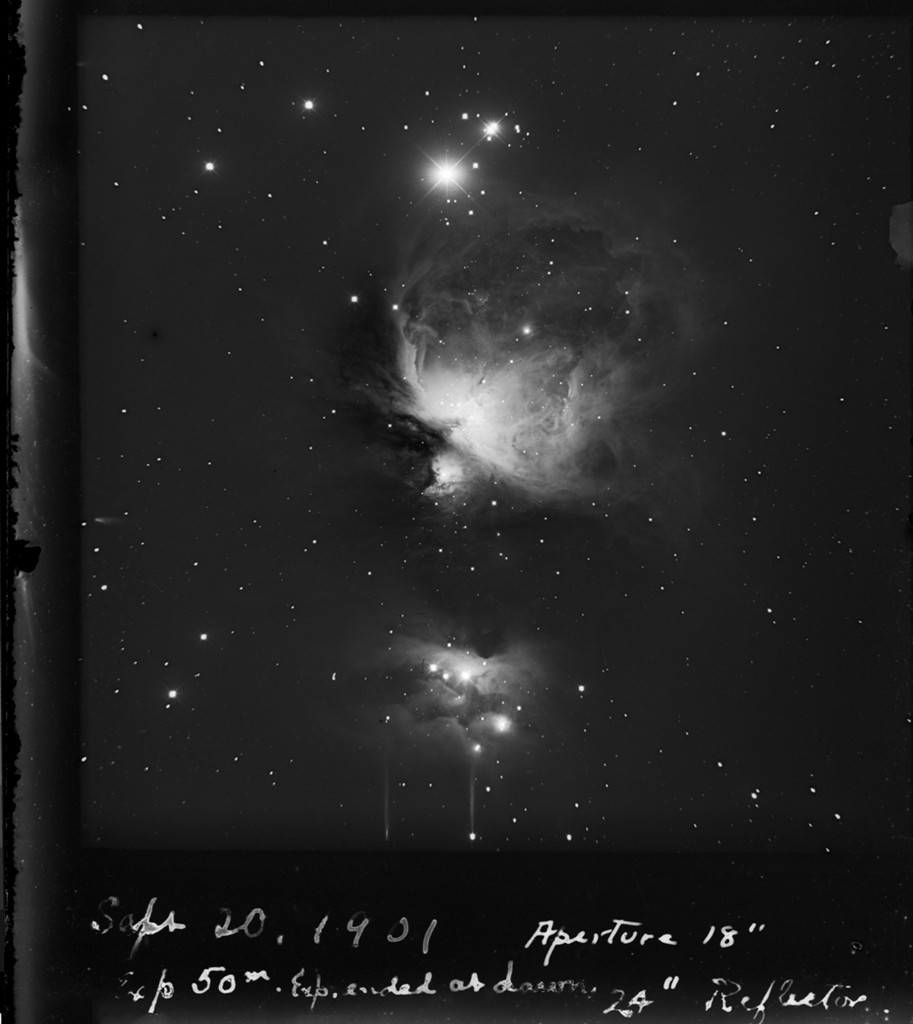
1901 Photograph: The Orion Nebula

By the turn of the 20th century advances in photography contributed an important tool for astronomers. Improving photographic materials, long exposures, and new telescope designs produced astronomical images with details not visible at the telescopic eyepiece alone. Remarkably recognizable to astrophotographers today, this stunning image of the star forming Orion Nebula was captured in 1901 by American astronomer and telescope designer George Ritchey. The original glass photographic plate, sensitive to green and blue wavelengths, has been digitized and light-to-dark inverted to produce a positive image. His hand written notes indicate a 50 minute long exposure that ended at dawn and a reflecting telescope aperture of 24 inches masked to 18 inches to improve the sharpness of the recorded image. Ritchey’s plates from over a hundred years ago preserve astronomical data and can still be used for exploring astrophysical processes. [via NASA] https://ift.tt/2TCfXxX

The Elephant s Trunk Nebula in Cepheus

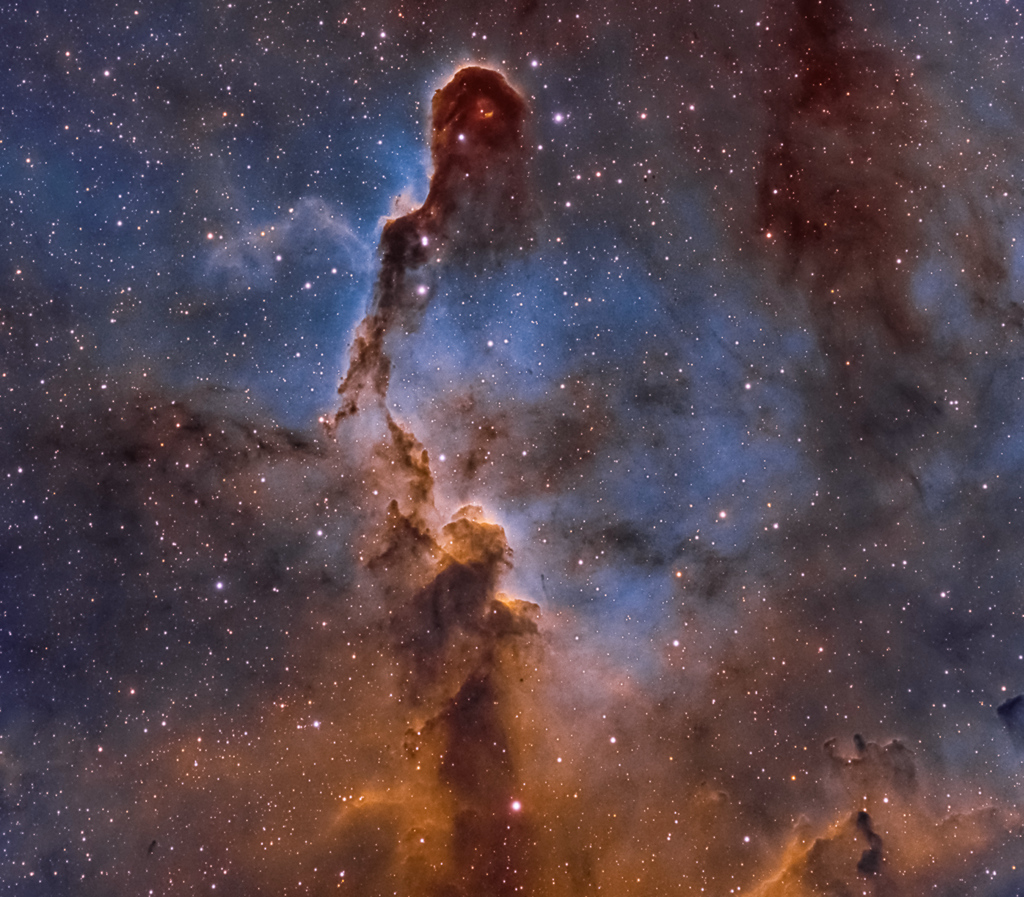
Like an illustration in a galactic Just So Story, the Elephant’s Trunk Nebula winds through the emission nebula and young star cluster complex IC 1396, in the high and far off constellation of Cepheus. Also known as vdB 142, the cosmic elephant’s trunk is over 20 light-years long. This colorful close-up view was recorded through narrow band filters that transmit the light from ionized hydrogen, sulfur, and oxygen atoms in the region. The resulting composite highlights the bright swept-back ridges that outline pockets of cool interstellar dust and gas. Such embedded, dark, tendril-shaped clouds contain the raw material for star formation and hide protostars within. Nearly 3,000 light-years distant, the relatively faint IC 1396 complex covers a large region on the sky, spanning over 5 degrees. The dramatic scene spans a 1 degree wide field, about the size of 2 Full Moons. [via NASA] https://ift.tt/2MmeE5u