NGC 6357: The Lobster Nebula

Why is the Lobster Nebula forming some of the most massive stars known? No one is yet sure. Cataloged as NGC 6357, the Lobster Nebula houses the open star cluster Pismis 24 near its center — a home to unusually bright and massive stars. The overall blue glow near the inner star forming region results from the emission of ionized hydrogen gas. The surrounding nebula, featured here, holds a complex tapestry of gas, dark dust, stars still forming, and newly born stars. The intricate patterns are caused by complex interactions between interstellar winds, radiation pressures, magnetic fields, and gravity. NGC 6357 spans about 400 light years and lies about 8,000 light years away toward the constellation of the Scorpion. [via NASA] https://go.nasa.gov/2EJYLRE

M100: A Grand Design Spiral Galaxy

Majestic on a truly cosmic scale, M100 is appropriately known as a grand design spiral galaxy. It is a large galaxy of over 100 billion stars with well-defined spiral arms that is similar to our own Milky Way Galaxy. One of the brightest members of the Virgo Cluster of galaxies, M100 (alias NGC 4321) is 56 million light-years distant toward the constellation of Berenice’s Hair (Coma Berenices). This Hubble Space Telescope image of M100 was taken recently with the Wide Field Camera 3 and accentuates bright blue star clusters and intricate winding dust lanes which are hallmarks of this class of galaxies. Studies of variable stars in M100 have played an important role in determining the size and age of the Universe. [via NASA] https://go.nasa.gov/2AcD75q

Earthrise 1: Historic Image Remastered

«Oh my God! Look at that picture over there! Here’s the Earth coming up. Wow is that pretty!» Soon after that pronouncement, 50 years ago today, one of the most famous images ever taken was snapped from the orbit of the Moon. Now known as «Earthrise», the iconic image shows the Earth rising above the limb of the Moon, as taken by the crew of Apollo 8. But the well-known Earthrise image was actually the second image taken of the Earth rising above the lunar limb — it was just the first in color. With modern digital technology, however, the real first Earthrise image — originally in black and white — has now been remastered to have the combined resolution and color of the first three images. Behold! The featured image is a close-up of the picture that Apollo 8 astronaut Bill Anders was talking about. Thanks to modern technology and human ingenuity, now we can all see it. (Historical note: A different historic black & white image of the Earth setting behind the lunar limb was taken by the robotic Lunar Orbiter 1 two years earlier.) [via NASA] https://go.nasa.gov/2BCp2hx

Earthrise: A Video Reconstruction

About 12 seconds into this video, something unusual happens. The Earth begins to rise. Never seen by humans before, the rise of the Earth over the limb of the Moon occurred 50 years ago tomorrow and surprised and amazed the crew of Apollo 8. The crew immediately scrambled to take still images of the stunning vista caused by Apollo 8’s orbit around the Moon. The featured video is a modern reconstruction of the event as it would have looked were it recorded with a modern movie camera. The colorful orb of our Earth stood out as a familiar icon rising above a distant and unfamiliar moonscape, the whole scene the conceptual reverse of a more familiar moonrise as seen from Earth. To many, the scene also spoke about the unity of humanity: that big blue marble — that’s us — we all live there. The two-minute video is not time-lapse — this is the real speed of the Earth rising through the windows of Apollo 8. Seven months and three missions later, Apollo 11 astronauts would not only circle Earth’s moon, but land on it. [via NASA] https://go.nasa.gov/2rSGQRc

A Cold December Night

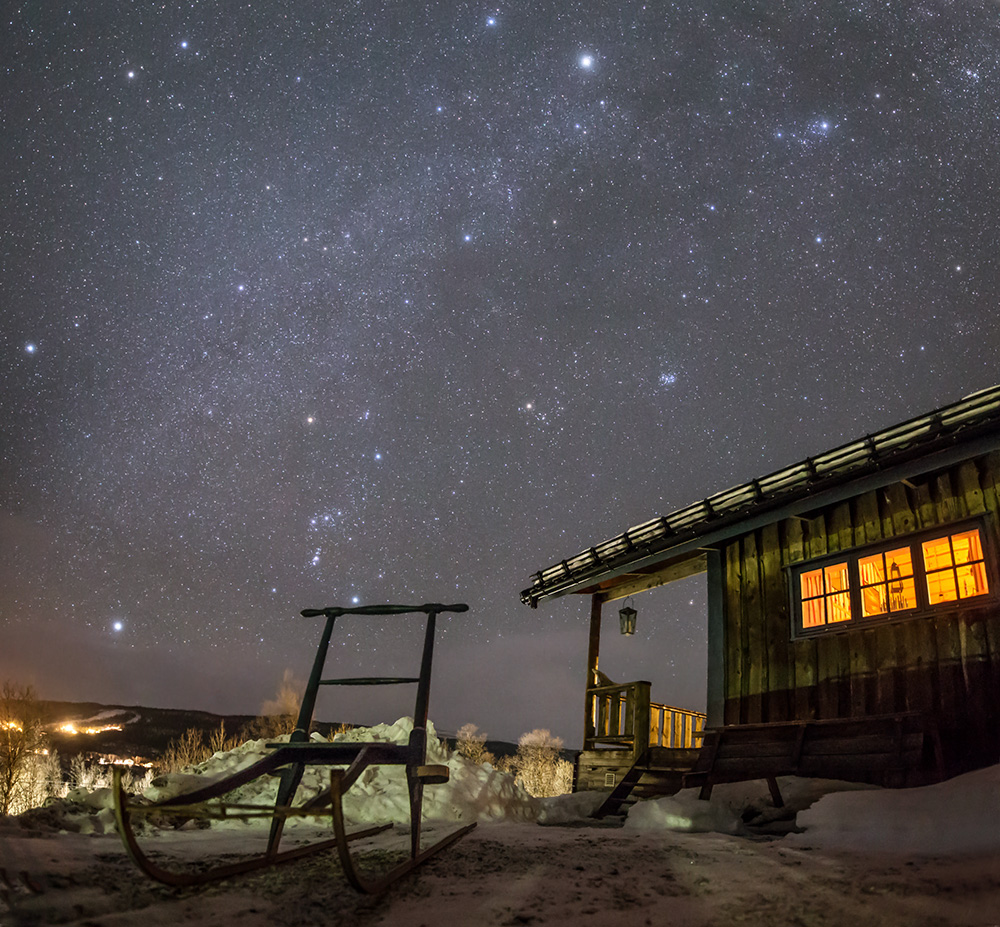
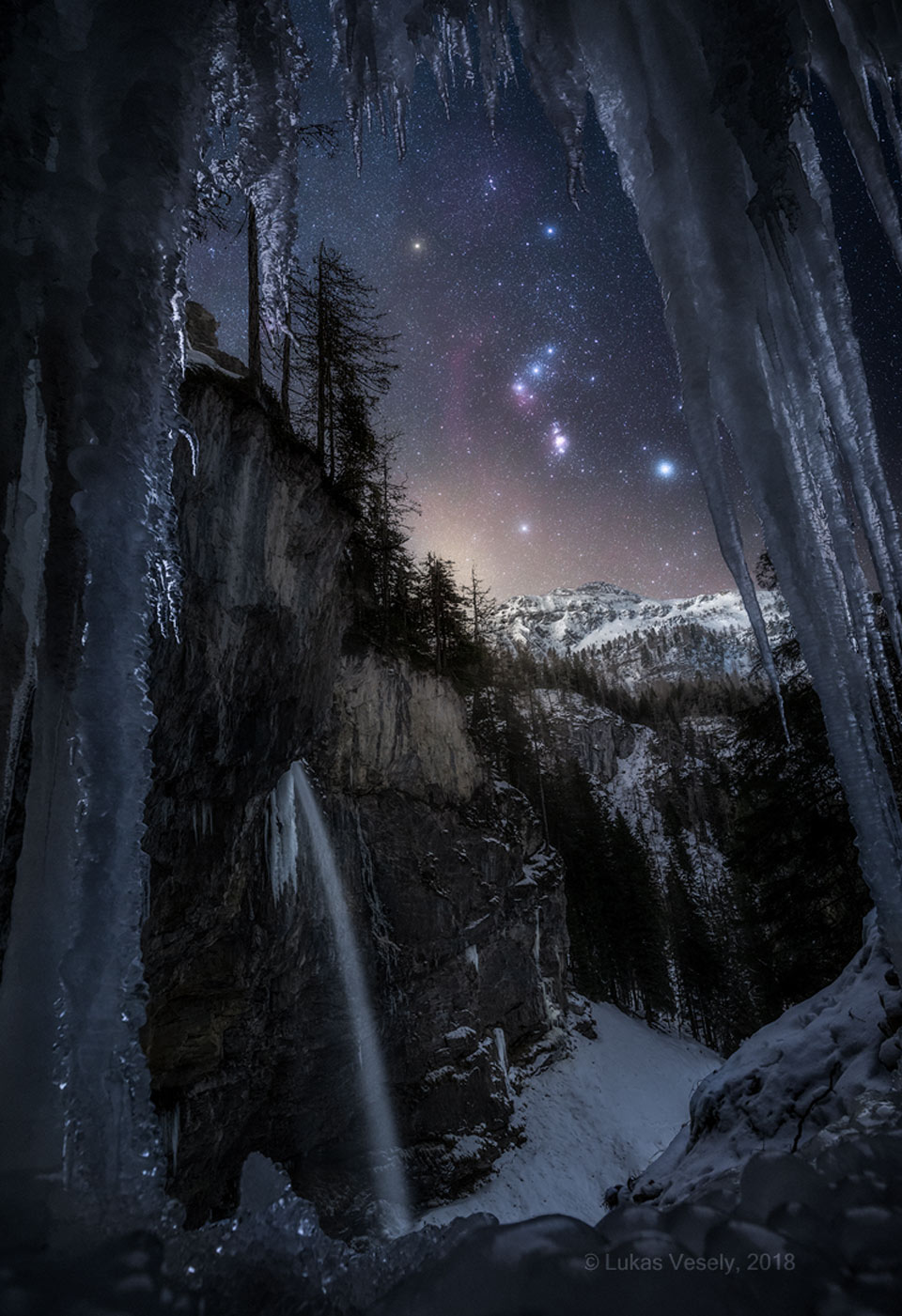
They say Orion always comes up sideways, and he does seem to on this cold December night. The bright stars of the familiar northern winter constellation lie just above the snowy tree tops surrounding a cozy cottage near the town of Ustupky in the Czech Republic. But Gemini’s meteors also seem to rain on the wintry landscape. The meteor streaks are captured in exposures made near last Friday’s peak of the annual Geminid meteor shower. They stream away from the shower’s radiant above the trees, near the two bright stars of the zodiacal constellation of the Twins. Comet Wirtanen, a visitor to planet Earth’s skies, is visible too. Look for its telltale greenish coma near the stars of the seven sisters. [via NASA] https://go.nasa.gov/2SevPVO

Red Nebula, Green Comet, Blue Stars

This festively colored skyscape was captured in the early morning hours of December 17, following Comet Wirtanen’s closest approach to planet Earth. The comet was just visible to the eye. The lovely green color of its fluorescing cometary atmosphere or coma is brought out here only by adding digital exposures registered on the comet’s position below the Pleiades star cluster. The exposures also bring out blue starlight reflected by the dust clouds surrounding the young Pleiades stars. Gaze (toward the left) across dusty dark nebulae along the edge of the Perseus molecular cloud and you’ll travel to emission nebula NGC 1499, also known as the California nebula. Too faint for the eye, the cosmic cloud’s pronounced reddish glow is from electrons recombining with ionized hydrogen atoms. Around December 23rd, Comet Wirtanen should be easy to find with binoculars when it sweeps close to bright star Capella in the northern winter constellation Auriga, the Charioteer. [via NASA] https://ift.tt/2GrWz3A

A Rainbow Geminid Meteor

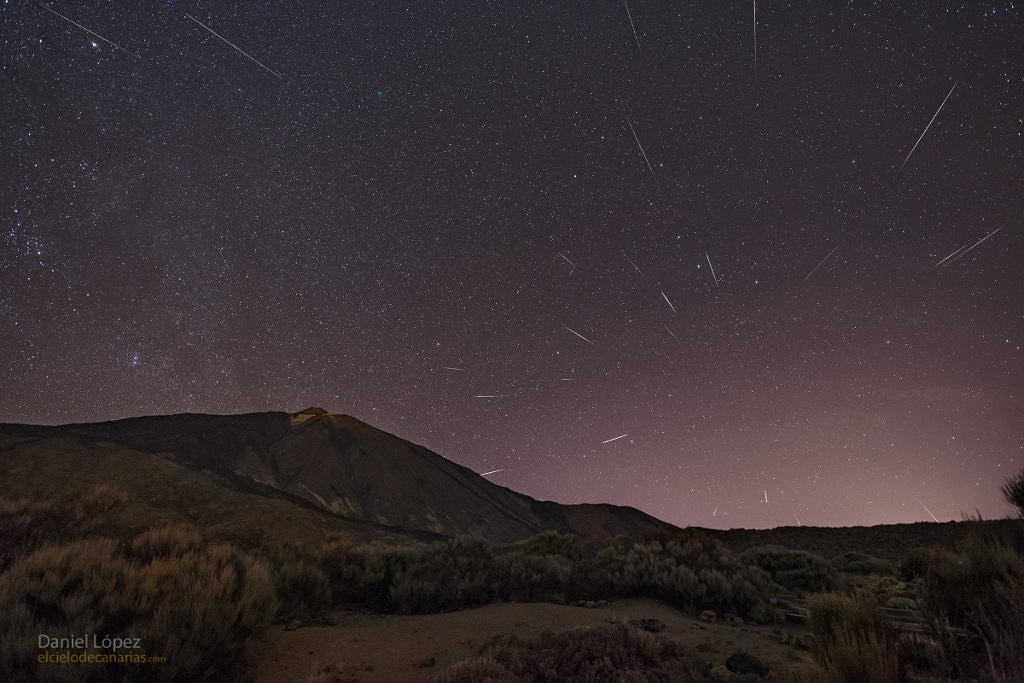
Meteors can be colorful. While the human eye usually cannot discern many colors, cameras often can. Pictured is a Geminid captured by camera during last week’s meteor shower that was not only impressively bright, but colorful. The radiant grit cast off by asteroid 3200 Phaethon blazed a path across Earth’s atmosphere longer than 60 times the angular diameter of the Moon. Colors in meteors usually originate from ionized elements released as the meteor disintegrates, with blue-green typically originating from magnesium, calcium radiating violet, and nickel glowing green. Red, however, typically originates from energized nitrogen and oxygen in the Earth’s atmosphere. This bright meteoric fireball was gone in a flash — less than a second — but it left a wind-blown ionization trail that remained visible for several minutes, the start of which can be seen here. [via NASA] https://ift.tt/2UX5vRY

Methane Bubbles Frozen in Lake Baikal

What are these bubbles frozen into Lake Baikal? Methane. Lake Baikal, a UNESCO World Heritage Site in Russia, is the world’s largest (by volume), oldest, and deepest lake, containing over 20% of the world’s fresh water. The lake is also a vast storehouse of methane, a greenhouse gas that, if released, could potentially increase the amount of infrared light absorbed by Earth’s atmosphere, and so increase the average temperature of the entire planet. Fortunately, the amount of methane currently bubbling out is not climatologically important. It is not clear what would happen, though, were temperatures to significantly increase in the region, or if the water level in Lake Baikal were to drop. Pictured, bubbles of rising methane froze during winter into the exceptionally clear ice covering the lake. [via NASA] https://ift.tt/2ECNWBN

M31: The Andromeda Galaxy

What is the nearest major galaxy to our own Milky Way Galaxy? Andromeda. In fact, our Galaxy is thought to look much like Andromeda. Together these two galaxies dominate the Local Group of galaxies. The diffuse light from Andromeda is caused by the hundreds of billions of stars that compose it. The several distinct stars that surround Andromeda’s image are actually stars in our Galaxy that are well in front of the background object. Andromeda is frequently referred to as M31 since it is the 31st object on Messier’s list of diffuse sky objects. M31 is so distant it takes about two million years for light to reach us from there. Although visible without aid, the featured image of M31 is a digital mosaic of 20 frames taken with a small telescope. Much about M31 remains unknown, including exactly how long it will before it collides with our home galaxy. [via NASA] https://ift.tt/2S67zVE

Comet Wirtanen Passes by the Earth

Today Comet Wirtanen passes by the Earth. The kilometer-sized dirty snowball orbits the Sun every 5.4 years, ranging as far out as Jupiter and as close in as the Earth. Today Comet 46P/Wirtanen passes within only 31 lunar distances to the Earth, the closest approach in 70 years. If you know where to look (Taurus), you can see the comet through binoculars as an unusual blue smudge. Pictured a week ago, Comet Wirtanen was photographed in the sky beyond an old abandoned church in Skagen, Denmark. The image composite also captures the astrophotographer. After today, the comet will begin to fade as it recedes from the Earth and the Sun. [via NASA] https://ift.tt/2QU92RG