Spiraling Supermassive Black Holes

Do black holes glow when they collide? When merging, co-orbiting black holes are sure to emit a burst of unusual gravitational radiation, but will they emit light, well before that, if they are surrounded by gas? To help find out, astrophysicists created a sophisticated computer simulation. The simulation and featured resulting video accurately depicts two spiraling supermassive black holes, including the effects of Einstein’s general relativity on the surrounding gas and light. The video first shows the system from the top, and later from the side where unusual gravitational lens distortions are more prominent. Numerical results indicate that gravitational and magnetic forces should energize the gas to emit high-energy light from the ultraviolet to the X-ray. The emission of such light may enable humanity to detect and study supermassive black hole pairs well before they spiral together. [via NASA] https://ift.tt/2QDJwjH

The Fairy of Eagle Nebula

The dust sculptures of the Eagle Nebula are evaporating. As powerful starlight whittles away these cool cosmic mountains, the statuesque pillars that remain might be imagined as mythical beasts. Featured here is one of several striking dust pillars of the Eagle Nebula that might be described as a gigantic alien fairy. This fairy, however, is ten light years tall and spews radiation much hotter than common fire. The greater Eagle Nebula, M16, is actually a giant evaporating shell of gas and dust inside of which is a growing cavity filled with a spectacular stellar nursery currently forming an open cluster of stars. This great pillar, which is about 7,000 light years away, will likely evaporate away in about 100,000 years. The featured image in scientifically re-assigned colors was released in 2005 as part of the fifteenth anniversary celebration of the launch of the Hubble Space Telescope. [via NASA] https://ift.tt/2Q7b4OL

Mount Everest Star Trails

The highest peak on planet Earth is framed in this mountain and night skyscape. On September 30, the digital stack of 240 sequential exposures made with a camera fixed to a tripod at an Everest Base Camp captured the sheer north face of the Himalayan mountain and foreground illuminated by bright moonlight. Taken over 1.5 hours, the sequence also recorded colorful star trails. Reflecting the planet’s daily rotation on its axis, their motion is along gentle concentric arcs centered on the south celestial pole, a point well below the rugged horizon. The color of the trails actually indicates the temperatures of the stars. Blueish hues are from hotter stars, and yellow to reddish hues are from stars cooler than the Sun. [via NASA] https://ift.tt/2RmZ1tf

A Cold River to Orion

Ice is forming on the river Lielupe as it flows through the landscape in this winter’s night scene. Even in motion the frigid water still reflects a starry sky, though. The well planned, Orion-centered panorama looks toward the south, taken in three exposures from a bridge near the village of Stalgene, Latvia, planet Earth. Drifting pancakes of ice leave streaks in the long exposures, while familiar stars of Orion and the northern winter night appear above and below the horizon. Village lights along the horizon include skyward beams from the local community church. This image was a first place winner in the 2018 StarSpace astrophotography competition. [via NASA] https://ift.tt/2Q0HSsA

IC 1871: Inside the Soul Nebula

This cosmic close-up looks deep inside the Soul Nebula. The dark and brooding dust clouds on the left, outlined by bright ridges of glowing gas, are cataloged as IC 1871. About 25 light-years across, the telescopic field of view spans only a small part of the much larger Heart and Soul nebulae. At an estimated distance of 6,500 light-years the star-forming complex lies within the Perseus spiral arm of our Milky Way Galaxy, seen in planet Earth’s skies toward the constellation Cassiopeia. An example of triggered star formation, the dense star-forming clouds of IC 1871 are themselves sculpted by the intense winds and radiation of the region’s massive young stars. The featured image appears mostly red due to the emission of a specific color of light emitted by excited hydrogen gas. [via NASA] https://ift.tt/2TOSGbC

InSights First Image from Mars

Welcome to Mars, NASA Insight. Yesterday NASA’s robotic spacecraft InSight made a dramatic landing on Mars after a six-month trek across the inner Solar System. Needing to brake from 20,000 km per hour to zero in about seven minutes, Insight decelerated by as much as 8 g’s and heated up to 1500 degrees Celsius as it deployed a heat shield, a parachute, and at the end, rockets. The featured image was the first taken by InSight on Mars, and welcome proof that the spacecraft had shed enough speed to land softly and function on the red planet. During its final descent, InSight’s rockets kicked up dust which can be seen stuck to the lens cap of the Instrument Context Camera. Past the spotty dirt, parts of the lander that are visible include cover bolts at the bottom and a lander footpad on the lower right. Small rocks are visible across the rusty red soil, while the arc across the top of the image is the Martian horizon dividing land and sky. Over the next few weeks InSight will deploy several scientific instruments, including a rumble-detecting seismometer. These instruments are expected to give humanity unprecedented data involving the interior of Mars, a region thought to harbor formation clues not only about Mars, but Earth. [via NASA] https://ift.tt/2FKmlzG

Rocket Launch as Seen from the Space Station

Have you ever seen a rocket launch — from space? A close inspection of the featured time-lapse video will reveal a rocket rising to Earth orbit as seen from the International Space Station (ISS). The Russian Soyuz-FG rocket was launched ten days ago from the Baikonur Cosmodrome in Kazakhstan, carrying a Progress MS-10 (also 71P) module to bring needed supplies to the ISS. Highlights in the 90-second video (condensing about 15-minutes) include city lights and clouds visible on the Earth on the lower left, blue and gold bands of atmospheric airglow running diagonally across the center, and distant stars on the upper right that set behind the Earth. A lower stage can be seen falling back to Earth as the robotic supply ship fires its thrusters and begins to close on the ISS, a space laboratory that is celebrating its 20th anniversary this month. Currently, three astronauts live aboard the Earth-orbiting ISS, and conduct, among more practical duties, numerous science experiments that expand human knowledge and enable future commercial industry in low Earth orbit. [via NASA] https://ift.tt/2DLdlrl

Shipwreck at Moonset

A crescent Moon is about to sink under the western horizon in this sea and night skyscape. The atmospheric photo was taken on September 11 from the desert shore along the Skeleton Coast of Namibia. So close to moonset, the moonlight is reddened and dimmed by the low, long line-of-sight across the Atlantic. But near the center of the frame Venus still shines brightly, its light reflected in calm ocean waters. The celestial beacon above the brilliant evening star is bright planet Jupiter. Namibia’s Skeleton Coast was so named for the many seal and whale bones that were once strewn along the shoreline. In more recent times it’s better known for shipwrecks. [via NASA] https://ift.tt/2FDUNfg

Good Morning Leonid

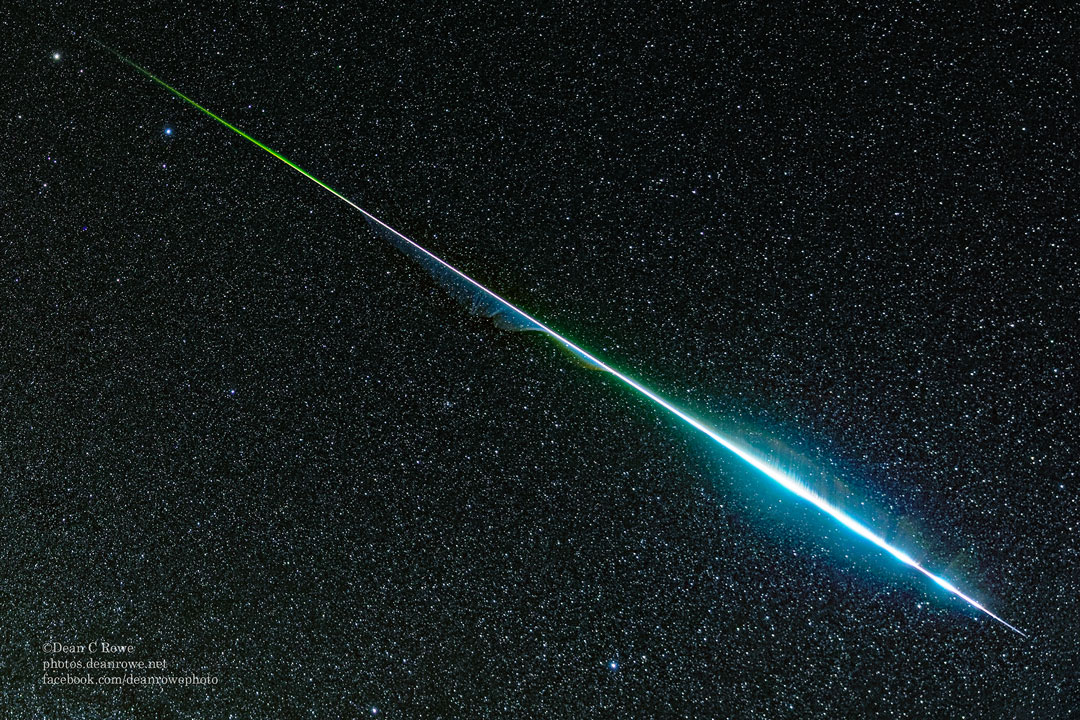
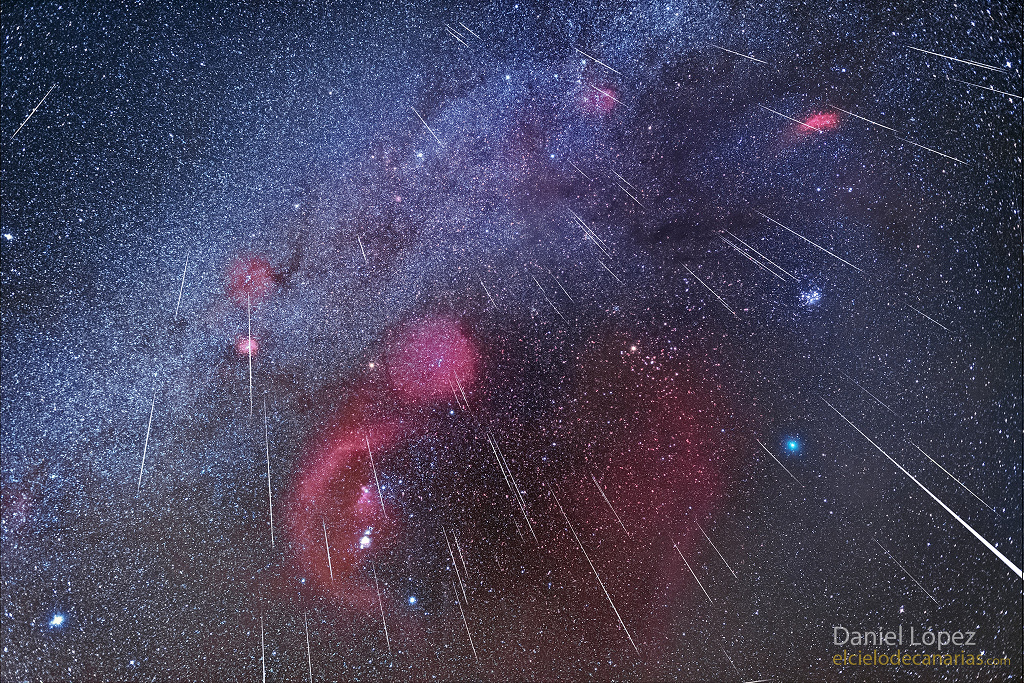
On November 17, just an hour before sunrise, this bright and colorful meteor flashed through clear predawn skies. Above a sea of clouds this striking autumn morning’s moment was captured from Hochblauen, a prominent 1165 meter high summit in southern Germany’s Black Forest. Shining through the twilight, Sirius as well as the familiar stars of Orion are recognizable near the southwestern horizon, and the meteor seems headed right for the hunter’s belt and sword. Still, as part of the annual Leonid meteor shower, the meteor trail does point back to the shower’s radiant. The constellation Leo is high above the horizon and off the top left of the frame. [via NASA] https://ift.tt/2QhCe4A

Swirls and Colors on Jupiter from Juno

What creates the colors in Jupiter’s clouds? No one is sure. The thick atmosphere of Jupiter is mostly hydrogen and helium, elements which are colorless at the low temperatures of the Jovian cloud tops. Which trace elements provide the colors remains a topic of research, although small amounts of ammonium hydrosulfide are one leading candidate. What is clear from the featured color-enhanced image — and many similar images — is that lighter clouds are typically higher up than darker ones. Pictured, light clouds swirl around reddish regions toward the lower right, while they appear to cover over some darker domains on the upper right. The featured image was taken by the robotic Juno spacecraft during its 14th low pass over Jupiter earlier this year. Juno continues in its looping elliptical orbit, swooping near the huge planet every 53 days and exploring a slightly different sector each time around. [via NASA] https://ift.tt/2zjMSyq