In the upper left corner, surrounded by blue arms and dotted with red nebulas, is spiral galaxy M81. In the lower right corner, marked by a light central line and surrounded by red glowing gas, is irregular galaxy M82. This stunning vista shows these two mammoth galaxies locked in gravitational combat, as they have been for the past billion years. The gravity from each galaxy dramatically affects the other during each hundred-million-year pass. Last go-round, M82’s gravity likely raised density waves rippling around M81, resulting in the richness of M81’s spiral arms. But M81 left M82 with violent star forming regions and colliding gas clouds so energetic the galaxy glows in X-rays. This big battle is seen from Earth through the faint glow of an Integrated Flux Nebula, a little studied complex of diffuse gas and dust clouds in our Milky Way Galaxy. In a few billion years, only one galaxy will remain. [via NASA] https://ift.tt/q2RYBuZ

If one black hole looks strange, what about two? Light rays from accretion disks around a pair of orbiting supermassive black holes make their way through the warped space-time produced by extreme gravity in this detailed computer visualization. The simulated accretion disks have been given different false color schemes, red for the disk surrounding a 200-million-solar-mass black hole, and blue for the disk surrounding a 100-million-solar-mass black hole. For these masses, though, both accretion disks would actually emit most of their light in the ultraviolet. The video allows us to see both sides of each black hole at the same time. Red and blue light originating from both black holes can be seen in the innermost ring of light, called the photon sphere, near their event horizons. In the past decade, gravitational waves from black hole collisions have actually been detected, although the coalescence of supermassive black holes remains undiscovered. [via NASA] https://ift.tt/r2EzafC

What’s causing those lines? Objects in the sky sometimes appear reflected as lines across water — but why? If the water’s surface is smooth, then reflected objects would appear similarly — as spots. But if the water is choppy, then there are many places where light from the object can reflect off the water and still come to you — and so together form, typically, a line. The same effect is frequently seen for the Sun just before sunset and just after sunrise. Pictured about 10 days ago in Ibiza, Spain, images of the setting Moon, Venus (top), and Saturn (right, faint) were captured both directly and in line-reflected forms from the Mediterranean Sea. The other bright object on the right with a water-reflected line is a beacon on a rock to warn passing boats. [via NASA] https://ift.tt/ZKmclCH

How fast can a black hole spin? If any object made of regular matter spins too fast — it breaks apart. But a black hole might not be able to break apart — and its maximum spin rate is really unknown. Theorists usually model rapidly rotating black holes with the Kerr solution to Einstein’s General Theory of Relativity, which predicts several amazing and unusual things. Perhaps its most easily testable prediction, though, is that matter entering a maximally rotating black hole should be last seen orbiting at near the speed of light, as seen from far away. This prediction was tested by NASA’s NuSTAR and ESA’s XMM satellites by observing the supermassive black hole at the center of spiral galaxy NGC 1365. The near light-speed limit was confirmed by measuring the heating and spectral line broadening of nuclear emissions at the inner edge of the surrounding accretion disk. Pictured here is an artist’s illustration depicting an accretion disk of normal matter swirling around a black hole, with a jet emanating from the top. Since matter randomly falling into the black hole should not spin up a black hole this much, the NuSTAR and XMM measurements also validate the existence of the surrounding accretion disk. [via NASA] https://ift.tt/fCj3R9g

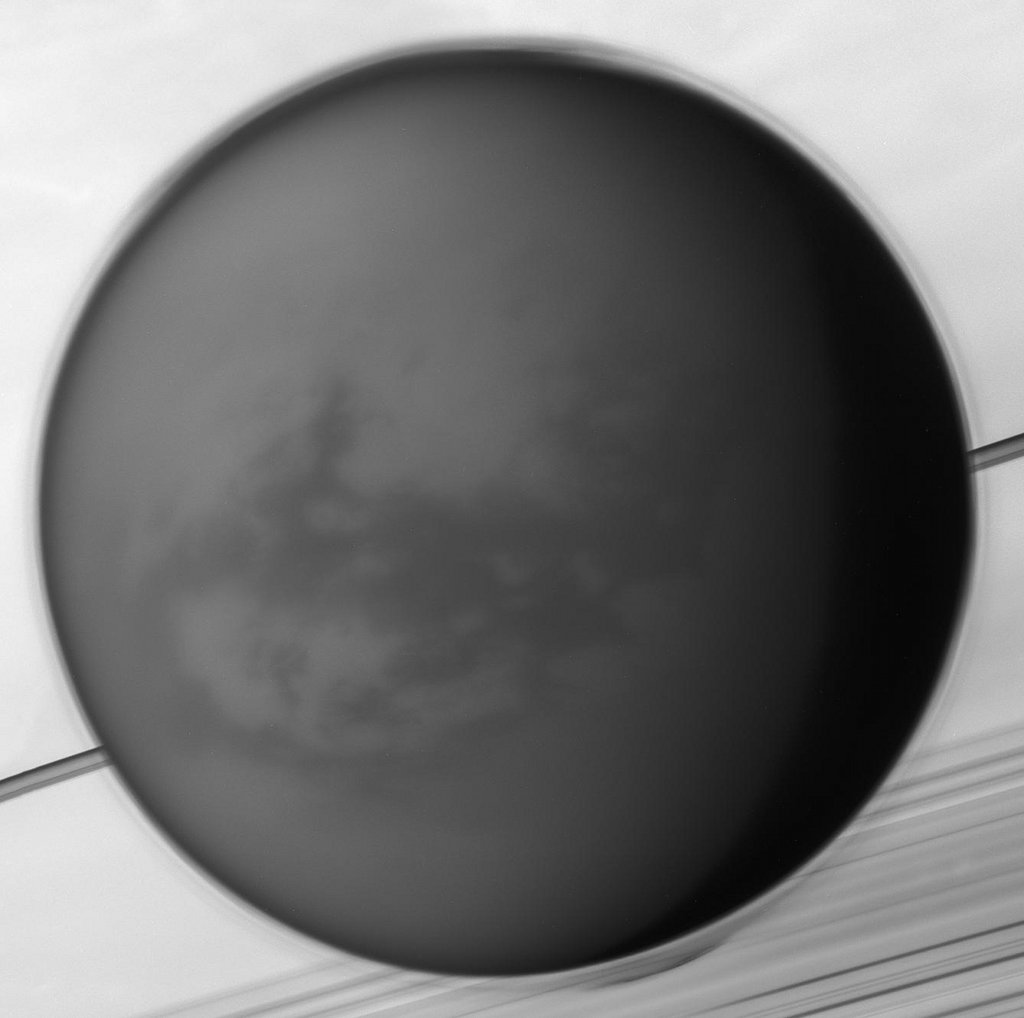
Titan: Moon over Saturn

Like Earth’s moon, Saturn’s largest moon Titan is locked in synchronous rotation with its planet. This mosaic of images recorded by the Cassini spacecraft in May of 2012 shows its anti-Saturn side, the side always facing away from the ringed gas giant. The only moon in the solar system with a dense atmosphere, Titan is the only solar system world besides Earth known to have standing bodies of liquid on its surface and an earthlike cycle of liquid rain and evaporation. Its high altitude layer of atmospheric haze is evident in the Cassini view of the 5,000 kilometer diameter moon over Saturn’s rings and cloud tops. Near center is the dark dune-filled region known as Shangri-La. The Cassini-delivered Huygens probe rests below and left of center, after the most distant landing for a spacecraft from Earth. [via NASA] https://ift.tt/z0waTZl

Young Star Cluster NGC 346

The most massive young star cluster in the Small Magellanic Cloud is NGC 346, embedded in our small satellite galaxy’s largest star forming region some 210,000 light-years distant. Of course the massive stars of NGC 346 are short lived, but very energetic. Their winds and radiation sculpt the edges of the region’s dusty molecular cloud triggering star-formation within. The star forming region also appears to contain a large population of infant stars. A mere 3 to 5 million years old and not yet burning hydrogen in their cores, the infant stars are strewn about the embedded star cluster. This spectacular infrared view of NGC 346 is from the James Webb Space Telescope’s NIRcam. Emission from atomic hydrogen ionized by the massive stars’ energetic radiation as well as molecular hydrogen and dust in the star-forming molecular cloud is detailed in pink and orange hues. Webb’s sharp image of the young star-forming region spans 240 light-years at the distance of the Small Magellanic Cloud. [via NASA] https://ift.tt/bRpf92D

MESSENGER s Last Day on Mercury

The first to orbit inner planet Mercury, the MESSENGER spacecraft came to rest on this region of Mercury’s surface on April 30, 2015. Constructed from MESSENGER image and laser altimeter data, the projected scene looks north over the northeastern rim of the broad, lava filled Shakespeare basin. The large, 48 kilometer (30 mile) wide crater Janacek is near the upper left edge. Terrain height is color coded with red regions about 3 kilometers above blue ones. MESSENGER’S final orbit was predicted to end near the center, with the spacecraft impacting the surface at nearly 4 kilometers per second (over 8,700 miles per hour) and creating a new crater about 16 meters (52 feet) in diameter. The impact on the far side of Mercury was not observed by telescopes, but confirmed when no signal was detected from the spacecraft given time to emerge from behind the planet. Launched in 2004, the MErcury Surface, Space ENvironment, GEochemisty and Ranging spacecraft completed over 4,000 orbits after reaching the Solar System’s innermost planet in 2011. [via NASA] https://ift.tt/OWFrnqt

Sometimes, the sky itself seems to smile. A few days ago, visible over much of the world, an unusual superposition of our Moon with the planets Venus and Saturn created just such an iconic facial expression. Specifically, a crescent Moon appeared to make a happy face on the night sky when paired with seemingly nearby planets. Pictured is the scene as it appeared over Zacatecas, México, with distinctive Bufa Hill in the foreground. On the far right and farthest in the distance is the planet Saturn. Significantly closer and visible to Saturn’s upper left is Venus, the brightest planet on the sky. Just above the central horizon is Earth’s Moon in a waning crescent phase. To create this gigantic icon, the crescent moon phase must be smiling in the correct direction. [via NASA] https://ift.tt/ftvdoAD

Where are Saturn’s ears? Galileo is credited, in 1610, as the first person to see Saturn’s rings. Testing out Lipperhey’s recently co-invented telescope, Galileo did not know what they were and so called them «ears». The mystery deepened in 1612, when Saturn’s ears mysteriously disappeared. Today we know exactly what happened: from the perspective of the Earth, Saturn’s rings had become too thin to see. The same drama plays out every 15 years because Saturn, like Earth, undergoes tilt-driven seasons. This means that as Saturn goes around the Sun, its equator and rings can tilt noticeably toward the Sun and inner Solar System, making them easily visible, but from other orbital locations will appear almost not at all. The featured picture from Brasilia, Brazil shows a modern version of this sequence: the top ring-dominated image was taken in 2020, while the bottom ring-obscure image taken earlier in 2025. [via NASA] https://ift.tt/Xo0eD5u

This cosmic skyscape features glowing gas and dark dust clouds alongside the young stars of NGC 3572. A beautiful emission nebula and star cluster, it sails far southern skies within the nautical constellation Carina. Stars from NGC 3572 are toward top center in the telescopic frame that would measure about 100 light-years across at the cluster’s estimated distance of 9,000 light-years. The visible interstellar gas and dust, shown in colors of the Hubble palette, is part of the star cluster’s natal molecular cloud, itself cataloged as Gum 37. Dense streamers of material within the nebula, eroded by stellar winds and radiation, clearly trail away from the energetic young stars. They are likely sites of ongoing star formation with shapes reminiscent of the Tadpoles of IC 410 — better known to northern skygazers. In the coming tens to hundreds of millions of years, gas and stars in the cluster will be dispersed though, by gravitational tides and by violent supernova explosions that end the short lives of the massive cluster stars. [via NASA] https://ift.tt/HzJ3CME