A Conjunction of Crescents

A waxing crescent Moon and a waning crescent Venus are found at opposite corners of this twilight telephoto field of view. The close conjunction of the two brightest celestial beacons in planet Earth’s western evening sky was captured on February 1 from Rosario, Argentina. On that date, the slender crescent Moon was about 3 days old. But the Moon’s visible sunlit crescent will grow to a bright Full Moon by February 14. Like the Moon, Venus cycles through phases as it orbits the Sun. And while its visible sunlit crescent narrows, the inner planet’s apparent size increases as it gets closer to Earth. In a Valentine from the Solar System, Venus, named for the Roman goddess of Love, will also reach its peak brightness in planet Earth’s evening skies around February 14. [via NASA] https://ift.tt/3VQpJiX
LEDA 1313424: The Bullseye Galaxy

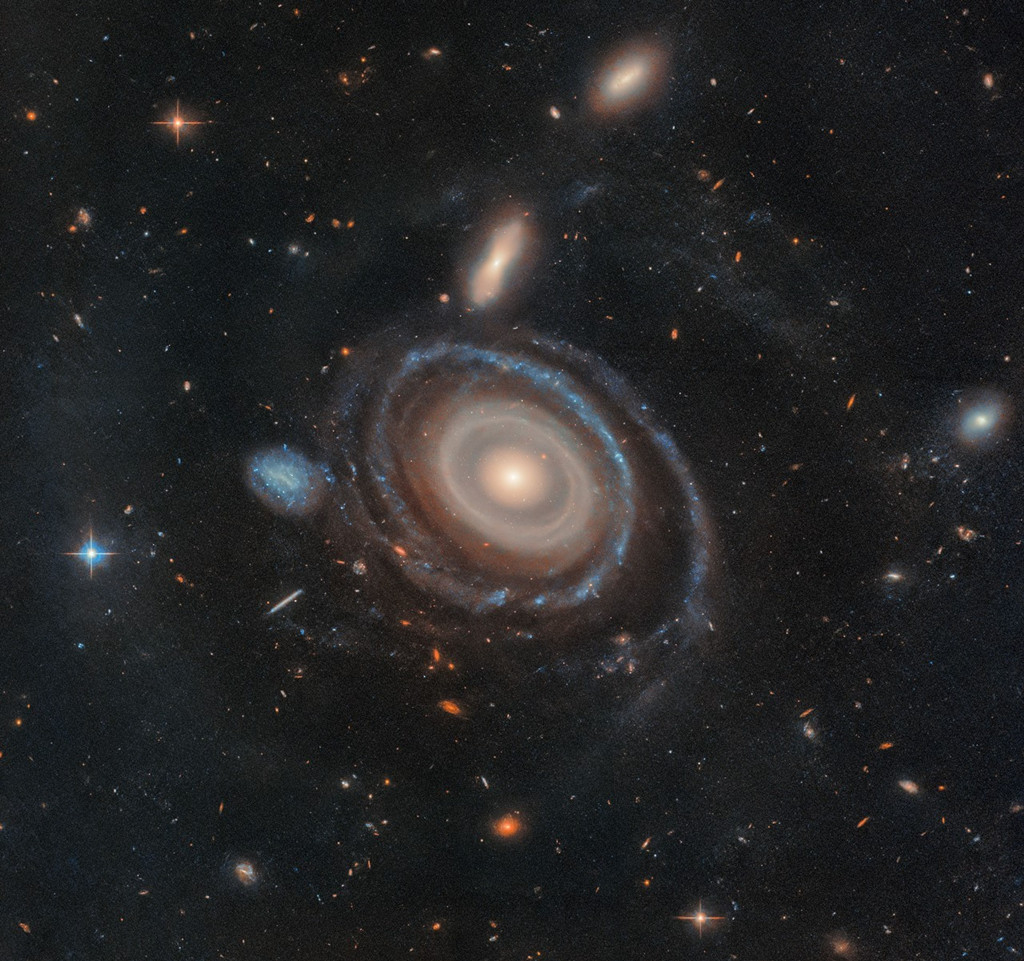
The giant galaxy cataloged as LEDA 1313424 is about two and a half times the size of our own Milky Way. Its remarkable appearance in this recently released Hubble Space Telescope image strongly suggests its nickname «The Bullseye Galaxy». Known as a collisional ring galaxy it has nine rings confirmed by telescopic observations, rippling from its center like waves from a pebble dropped into a pond. Of course, the pebble dropped into the Bullseye galaxy was a galaxy itself. Telescopic observations identify the blue dwarf galaxy at center-left as the likely collider, passing through the giant galaxy’s center and forming concentric rings in the wake of their gravitational interaction. The Bullseye Galaxy lies some 567 million light-years away toward the constellation Pisces. At that distance, this stunning Hubble image would span about 530,000 light-years. [via NASA] https://ift.tt/glWHqiN

IC 2574: Coddington’s Nebula

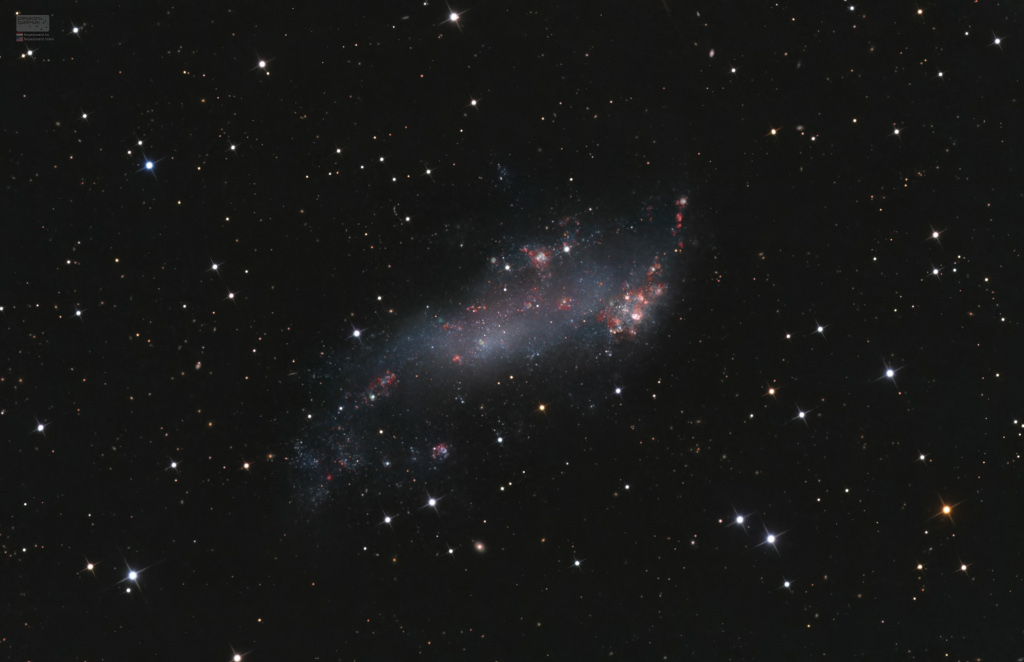
Grand spiral galaxies often seem to get all the glory, flaunting their young, bright, blue star clusters in beautiful, symmetric spiral arms. But small, irregular galaxies form stars too. In fact dwarf galaxy IC 2574 shows clear evidence of intense star forming activity in its telltale reddish regions of glowing hydrogen gas. Just as in spiral galaxies, the turbulent star-forming regions in IC 2574 are churned by stellar winds and supernova explosions spewing material into the galaxy’s interstellar medium and triggering further star formation. A mere 12 million light-years distant, IC 2574 is part of the M81 group of galaxies, seen toward the northern constellation Ursa Major. Also known as Coddington’s Nebula, the lovely island universe is about 50,000 light-years across, discovered by American astronomer Edwin Coddington in 1898. [via NASA] https://ift.tt/iwNLp5S

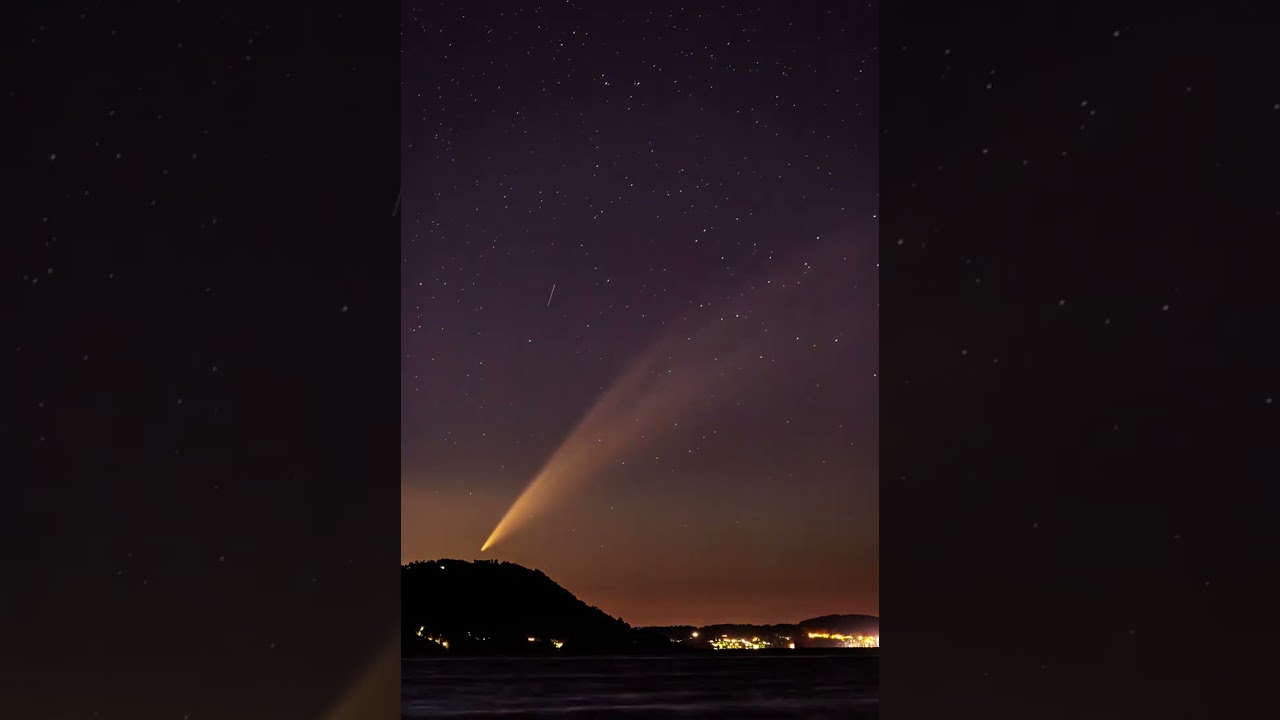
Where is Comet ATLAS going? In the featured time-lapse video, the comet is not itself moving very much, but the Earth’s rotation makes it appear to be setting over a hill. The Comet C/2024 G3 (ATLAS) sequence was captured with an ordinary camera on January 22 from the Araucanía Region in central Chile. Comet ATLAS has been an impressive site in the evening skies of Earth’s Southern Hemisphere over the past few weeks, so bright and awe-inspiring that it may eventually become known as the Great Comet of 2025. Unfortunately, Comet G3 ATLAS is not going anywhere anymore because its central nucleus broke up during its close pass to the Sun last month. Some of the comet’s scattered remains of rocks and ice will continue to orbit the Sun, some in nearly the same outward section of the orbit that the comet’s nucleus would have taken. [via NASA] https://ift.tt/5OZjCmK

Yes, but can your rainbow do this? Late in the day, the Sun set as usual toward the west. However, on this day, the more interesting display was 180 degrees around — toward the east. There, not only was a rainbow visible, but an impressive display of anticrepuscular rays from the rainbow’s center. In the featured image from Lekeitio in northern Spain, the Sun is behind the camera. The rainbow resulted from sunlight reflecting back from falling rain. Anticrepuscular rays result from sunlight, blocked by some clouds, going all the way around the sky, overhead, and appearing to converge on the opposite horizon — an optical illusion. Rainbows by themselves can be exciting to see, and anticrepuscular rays a rare treat, but capturing them both together is even more unusual — and can look both serene and surreal. [via NASA] https://ift.tt/pIwCcxl

Some stars explode in slow motion. Rare, massive Wolf-Rayet stars are so tumultuous and hot that they are slowly disintegrating right before our telescopes. Glowing gas globs each typically over 30 times more massive than the Earth are being expelled by violent stellar winds. Wolf-Rayet star WR 124, visible near the featured image center and spanning six light years across, is thus creating the surrounding nebula known as M1-67. Details of why this star has been slowly blowing itself apart over the past 20,000 years remains a topic of research. WR 124 lies 15,000 light-years away towards the constellation of the Arrow (Sagitta). The fate of any given Wolf-Rayet star likely depends on how massive it is, but many are thought to end their lives with spectacular explosions such as supernovas or gamma-ray bursts. [via NASA] https://ift.tt/IkyKlds

What’s happening to Comet G3 ATLAS? After passing near the Sun in mid-January, the head of the comet has become dimmer and dimmer. By late January, Comet C/2024 G3 (ATLAS) had become a headless wonder — even though it continued to show impressivetails after sunset in the skies of Earth’s Southern Hemisphere. Pictured are images of Comet G3 ATLAS on successive January nights taken from Río Hurtado, Chile. Clearly, the comet’s head is brighter and more centrally condensed on the earlier days (left) than on later days (right). A key reason is likely that the comet’s nucleus of ice and rock, at the head’s center, has fragmented. Comet G3 ATLAS passed well inside the orbit of planet Mercury when at its solar closest, a distance that where heat destroysmanycomets. Some of comet G3 ATLAS’ scattering remains will continue to orbit the Sun. [via NASA] https://ift.tt/RK9Pczq

Nacreous Clouds over Sweden

Vivid and lustrous, wafting iridescent waves of color wash across this skyscape from northern Sweden. Known as nacreous clouds or mother-of-pearl clouds, they are rare. But their unforgettable appearance was captured in this snapshot on January 12 with the Sun just below the local horizon. A type of polar stratospheric cloud, they form when unusually cold temperatures in the usually cloudless lower stratosphere form ice crystals. Still sunlit at altitudes of around 15 to 25 kilometers, the clouds diffract the sunlight even when the Sun itself is hidden from direct view. [via NASA] https://ift.tt/62m7LdH

The Variable Nebula NGC 2261

The interstellar cloud of dust and gas captured in this sharp telescopic snapshot is seen to change its appearance noticeably over periods as short as a few weeks. Discovered over 200 years ago and cataloged as NGC 2261, bright star R Monocerotis lies at the tip of the fan-shaped nebula. About one light-year across and 2500 light-years away, NGC 2261 was studied early last century by astronomer Edwin Hubble and the mysterious cosmic cloud is now more famous as Hubble’s Variable Nebula. So what makes Hubble’s nebula vary? NGC 2261 is composed of a dusty reflection nebula fanning out from the star R Monocerotis. The leading variability explanation holds that dense knots of obscuring dust pass close to R Mon and cast moving shadows across the dust clouds in the rest of Hubble’s Variable Nebula. [via NASA] https://ift.tt/AYZIv87

Hydrogen Clouds of M33

Gorgeous spiral galaxy Messier 33 seems to have more than its fair share of glowing hydrogen gas. A prominent member of the local group of galaxies, M33 is also known as the Triangulum Galaxy and lies a mere 3 million light-years away. The galaxy’s central 60,000 light-years or so are shown in this sharp galaxy portrait. The portrait features M33’s reddish ionized hydrogen clouds or HII regions. Sprawling along loose spiral arms that wind toward the core, M33’s giant HII regions are some of the largest known stellar nurseries, sites of the formation of short-lived but very massive stars. Intense ultraviolet radiation from the luminous, massive stars ionizes the surrounding hydrogen gas and ultimately produces the characteristic red glow. In this image, broadband data were combined with narrowband data recorded through a filter that transmits the light of the strongest visible hydrogen and oxygen emission lines. [via NASA] https://ift.tt/zBdcSrI