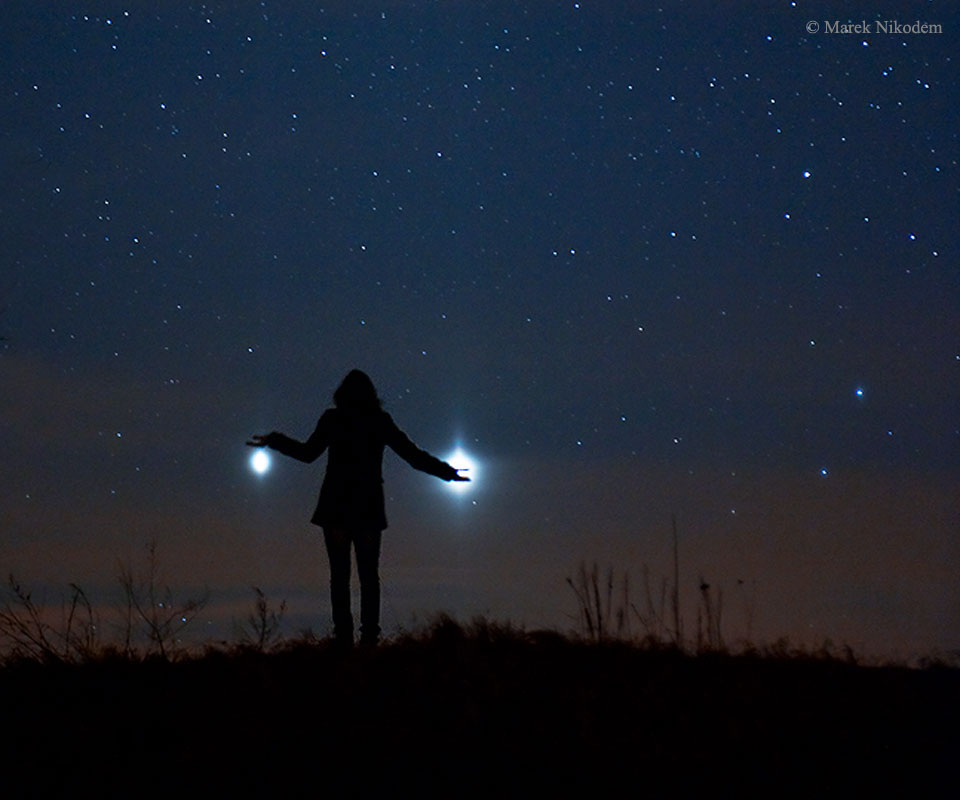
It was visible around the world. The sunset conjunction of Jupiter and Venus in 2012 was visible almost no matter where you lived on Earth. Anyone on the planet with a clear western horizon at sunset could see them. Pictured here in 2012, a creative photographer traveled away from the town lights of Szubin, Poland to image a near closest approach of the two planets. The bright planets were then separated only by three degrees and his daughter struck a humorous pose. A faint red sunset still glowed in the background. Jupiter and Venus are together again this month after sunset, passing within a degree of each other about a week ago. [via NASA] https://ift.tt/PLI6OsM
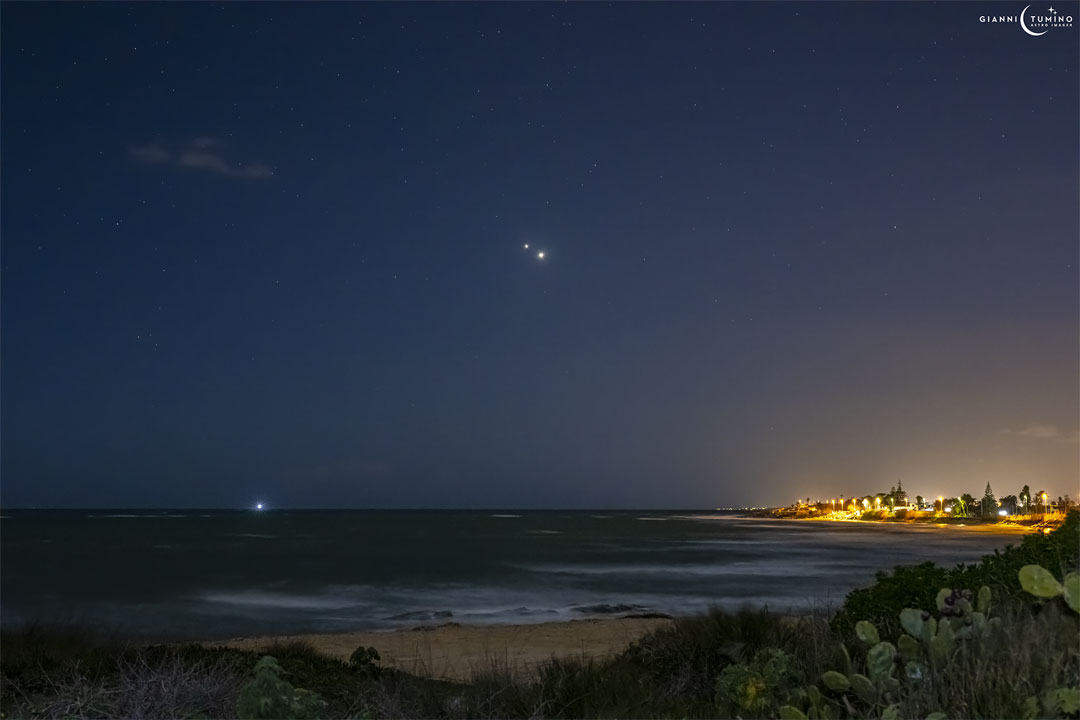
What are those two bright spots? Planets. A few days ago, the two brightest planets in the night sky passed within a single degree of each other in what is termed a conjunction. Visible just after sunset in much of the world, the two bright spots were Jupiter (left) and Venus (right). The featured image was taken near closest approach from Cirica, Sicily, Italy. The week before, Venus was rising higher in the sunset sky to meet the dropping Jupiter. Now they have switched places. Of course, Venus remains much closer to both the Sun and the Earth than Jupiter — the apparent closeness between the planets in the sky of Earth was only angular. You can still see the popular pair for an hour or so after sunset this month although they continue to separate, and Jupiter continues to set earlier each night. [via NASA] https://ift.tt/iY9fLha

10 Days of Venus and Jupiter

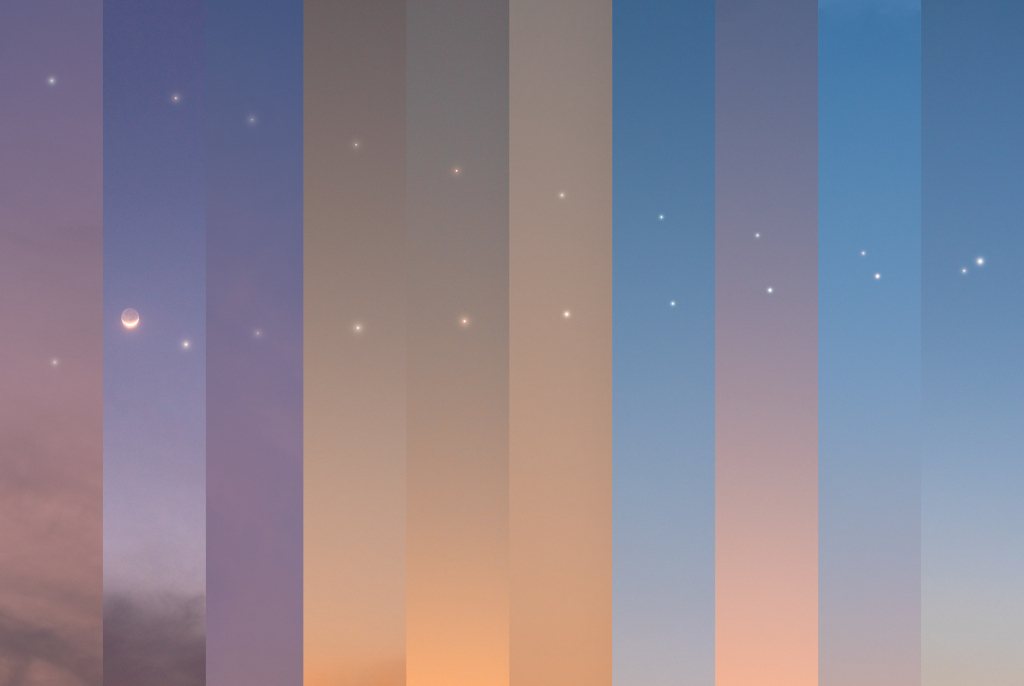
Venus and Jupiter may have caught your attention lately. The impending close conjunction of the two brightest planets visible in clear evening skies has been hard to miss. With Jupiter at the top, starting on February 21 and ending on March 2, their close approach is chronicled daily, left to right, in these panels recorded from Dhanbad, India. Near the western horizon, the evening sky colors and exposures used for each panel depend on the local conditions near sunset. On February 22, Jupiter and Venus were joined by the young crescent Moon. The celestial pair appeared to be only the width of a full moon apart by March 2. Of course on that date the two planets were physically separated by over 600 million kilometers in their orbits around the Sun. In the coming days Jupiter will slowly settle into the glare at sunset, but Venus will continue to move farther from the Sun in the western sky to excel in its current role as the brilliant evening star. [via NASA] https://ift.tt/EnabqD5

RCW 86: Historical Supernova Remnant

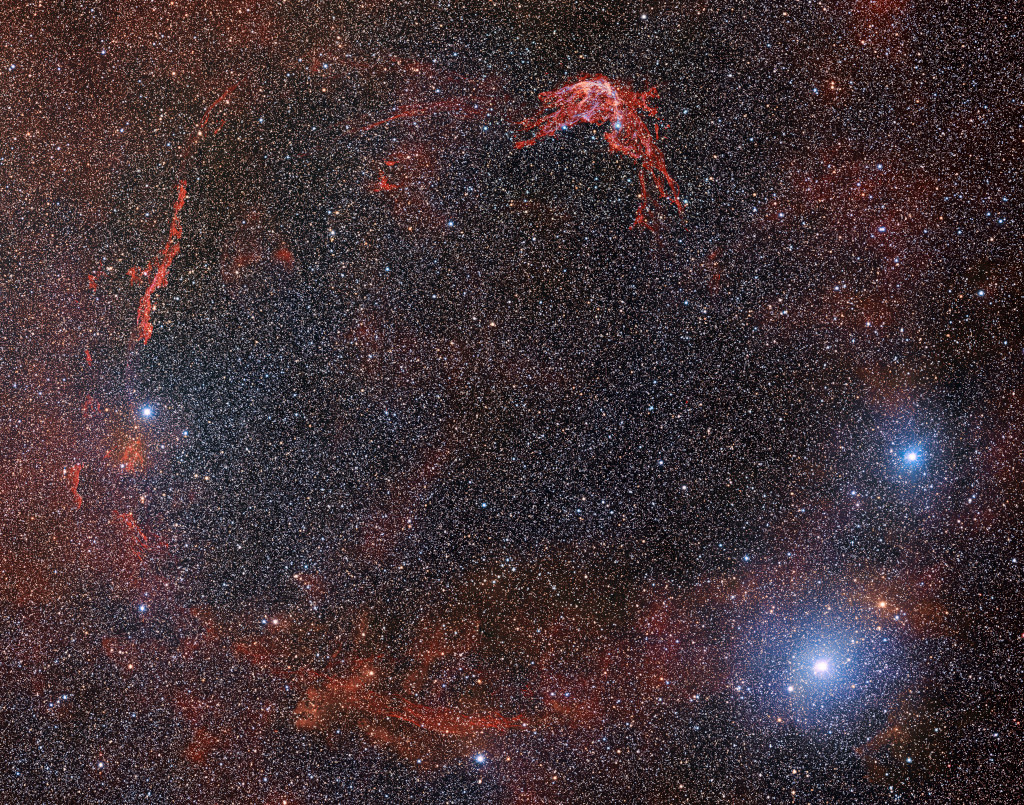
In 185 AD, Chinese astronomers recorded the appearance of a new star in the Nanmen asterism. That part of the sky is identified with Alpha and Beta Centauri on modern star charts. The new star was visible to the naked-eye for months, and is now thought to be the earliest recorded supernova. This deep telescopic view reveals the wispy outlines of emission nebula RCW 86, just visible against the starry background, understood to be the remnant of that stellar explosion. Captured by the wide-field Dark Energy Camera operating at Cerro Tololo Inter-American Observatory in Chile, the image traces the full extent of a ragged shell of gas ionized by the still expanding shock wave. Space-based images indicate an abundance of the element iron in RCW 86 and the absence of a neutron star or pulsar within the remnant, suggesting that the original supernova was Type Ia. Unlike the core collapse supernova explosion of a massive star, a Type Ia supernova is a thermonuclear detonation on a white dwarf star that accretes material from a companion in a binary star system. Near the plane of our Milky Way galaxy and larger than the full moon on the sky this supernova remnant is too faint to be seen by eye though. RCW 86 is some 8,000 light-years distant and around 100 light-years across. [via NASA] https://ift.tt/kJdgizY

Unraveling NGC 3169

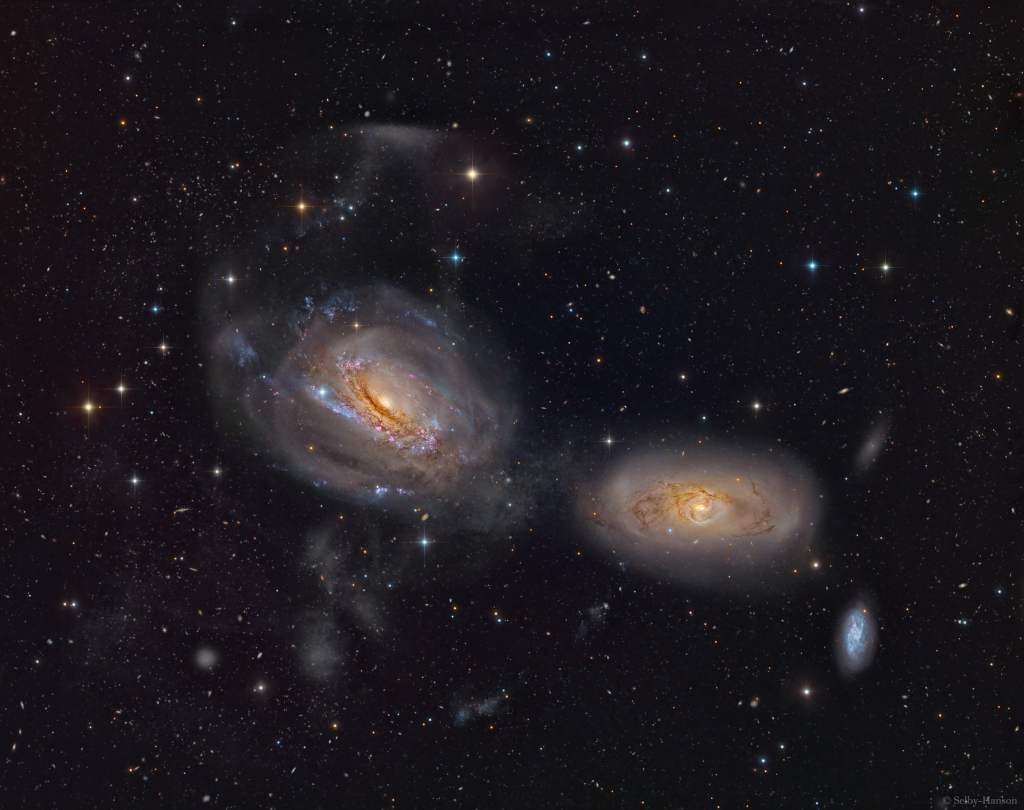
Spiral galaxy NGC 3169 looks to be unraveling like a ball of cosmic yarn. It lies some 70 million light-years away, south of bright star Regulus toward the faint constellation Sextans. Wound up spiral arms are pulled out into sweeping tidal tails as NGC 3169 (left) and neighboring NGC 3166 interact gravitationally. Eventually the galaxies will merge into one, a common fate even for bright galaxies in the local universe. Drawn out stellar arcs and plumes are clear indications of the ongoing gravitational interactions across the deep and colorful galaxy group photo. The telescopic frame spans about 20 arc minutes or about 400,000 light-years at the group’s estimated distance, and includes smaller, bluish NGC 3165 at the right. NGC 3169 is also known to shine across the spectrum from radio to X-rays, harboring an active galactic nucleus that is the site of a supermassive black hole. [via NASA] https://ift.tt/OJkjRpu

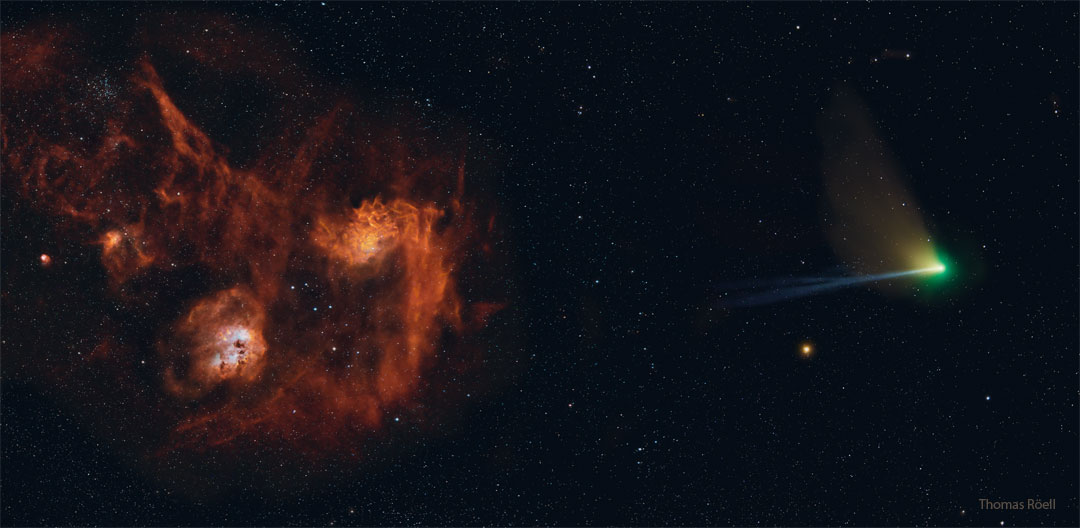
Is star AE Aurigae on fire? No. Even though AE Aurigae is named the Flaming Star and the surrounding nebula IC 405 is named the Flaming Star Nebula, and even though the nebula appears to some like a swirling flame, there is no fire. Fire, typically defined as the rapid molecular acquisition of oxygen, happens only when sufficient oxygen is present and is not important in such high-energy, low-oxygen environments such as stars. The bright star AE Aurigae occurs near the center of the Flaming Star Nebula and is so hot it glows blue, emitting light so energetic it knocks electrons away from surrounding gas. When a proton recaptures an electron, light is emitted, as seen in the surrounding emission nebula. Captured here three weeks ago, the Flaming Star Nebula is visible near the composite image’s center, between the red Tadpole Nebula on the left and blue-tailed Comet ZTF on the right. The Flaming Star Nebula lies about 1,500 light years distant, spans about 5 light years, and is visible with a small telescope toward the constellation of the Charioteer (Auriga). [via NASA] https://ift.tt/gZufJD1

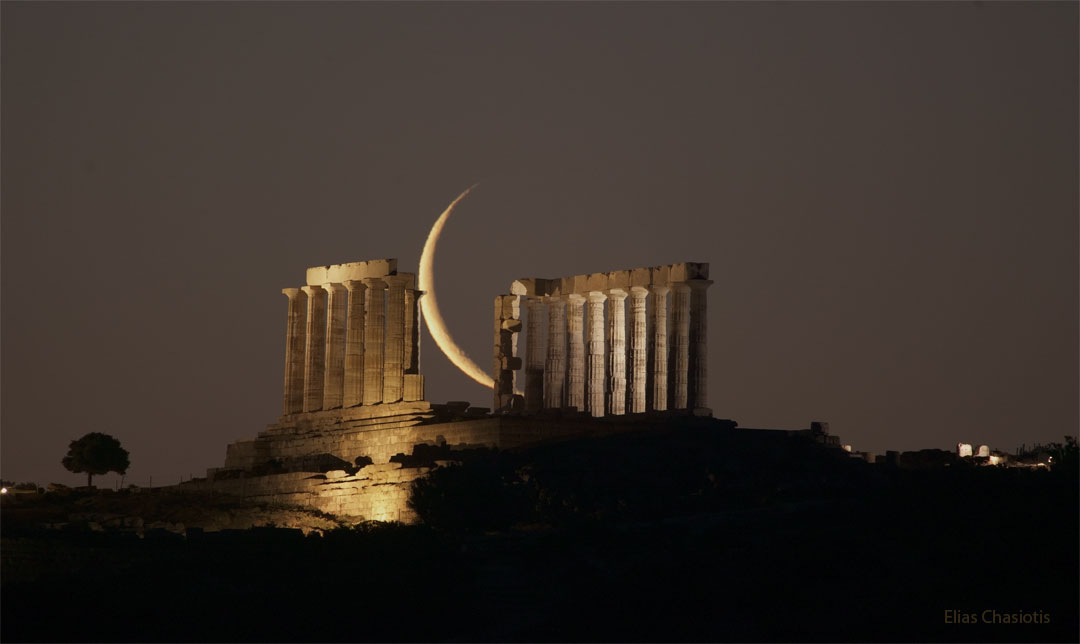
Why is a thin crescent moon never seen far from a horizon? Because the only geometry that gives a thin crescent lunar phase occurs when the Moon appears close to the Sun in the sky. The crescent is not caused by the shadow of the Earth, but by seeing only a small part of the Moon directly illuminated by the Sun. Moreover, the thickest part of the crescent always occurs in the direction of the Sun. In the evening, a thin crescent Moon will set shortly after the Sun and not be seen for the rest of the night. Alternatively, in the morning, a crescent Moon will rise shortly before the Sun after not being seen for most of the night. Pictured two weeks ago, a crescent moon was captured near the horizon, just before sunrise, far behind remnants of the ancient Temple of Poseidon in Greece. [via NASA] https://ift.tt/EZ8cvTs

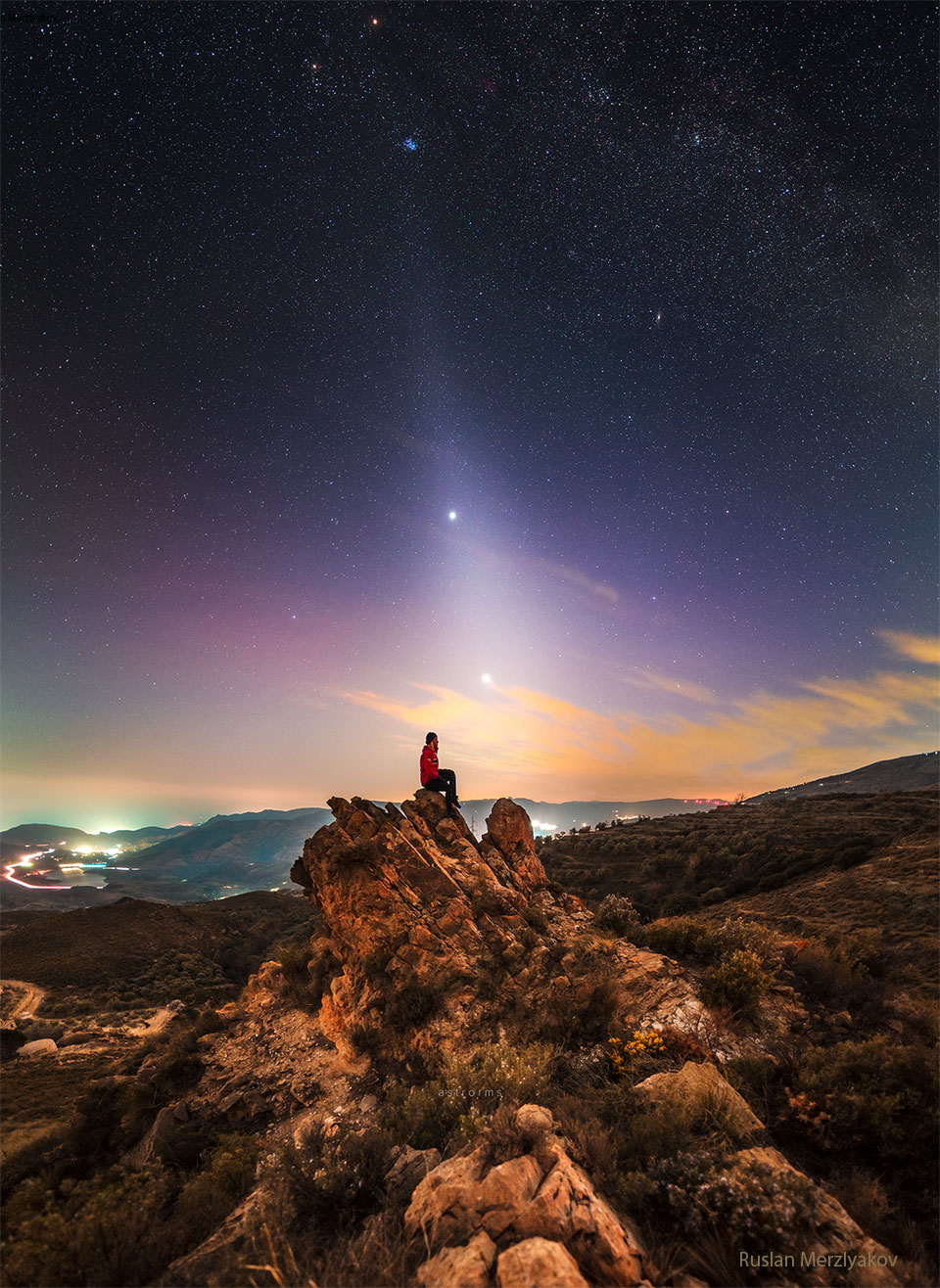
What’s causing that unusual ray of light extending from the horizon? Dust orbiting the Sun. At certain times of the year, a band of sun-reflecting dust from the inner Solar System appears prominently after sunset or before sunrise and is called zodiacal light. The dust was emitted mostly from faint Jupiter-family comets and slowly spirals into the Sun. The featured HDR image, acquired in mid-February from the Sierra Nevada National Park in Spain, captures the glowing band of zodiacal light going right in front of the bright evening planets Jupiter (upper) and Venus (lower). Emitted from well behind the zodiacal light is a dark night sky that prominently includes the Pleiades star cluster. Jupiter and Venus are slowly switching places in the evening sky, and just in the next few days nearing their closest angular approach. [via NASA] https://ift.tt/f3T4eCX

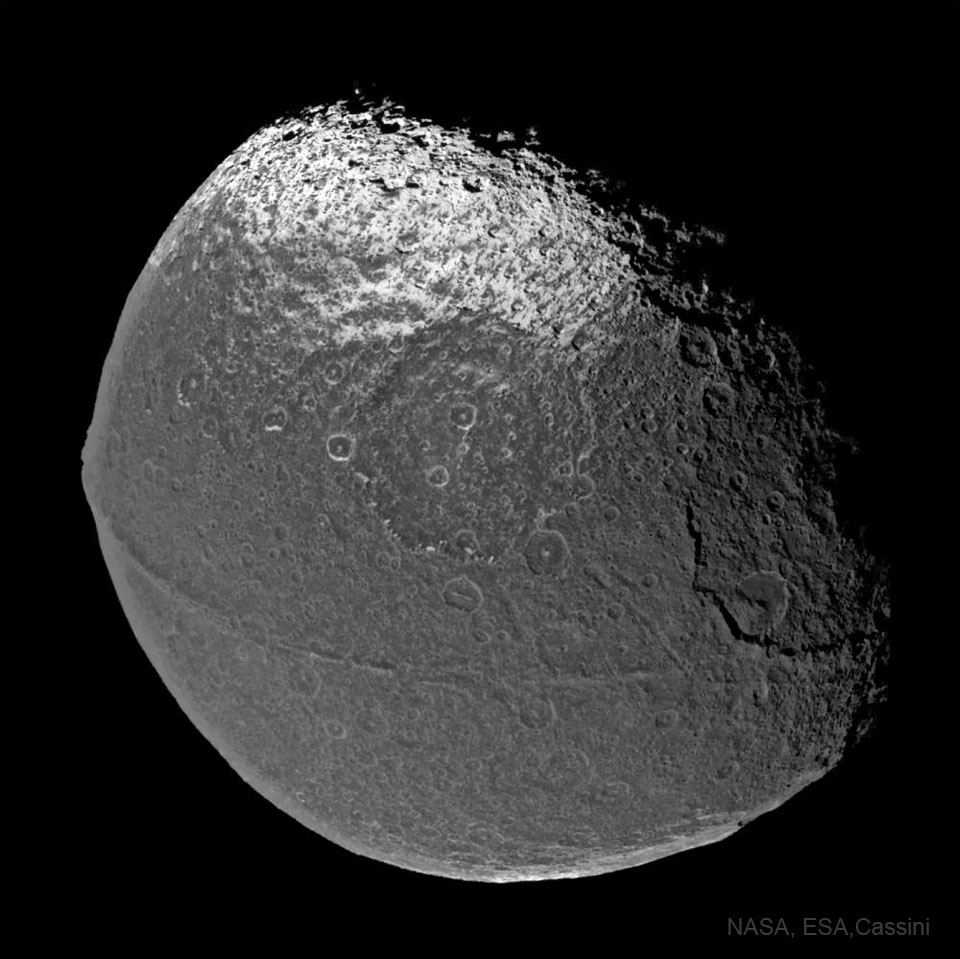
What would make a moon look like a walnut? A strange ridge that circles Saturn’s moon Iapetus’s equator, visible near the bottom of the featured image, makes it appear similar to a popular edible nut. The origin of the ridge remains unknown, though, with hypotheses including ice that welled up from below, a ring that crashed down from above, and structure left over from its formation perhaps 100 million years ago. Also strange is that about half of Iapetus is so dark that it can nearly disappear when viewed from Earth, while the rest is, reflectively, quite bright. Observations show that the degree of darkness of the terrain is strangely uniform, as if a dark coating was somehow recently applied to an ancient and highly cratered surface. Last, several large impact basins occur around Iapetus, with a 400-kilometer wide crater visible near the image center, surrounded by deep cliffs that drop sharply to the crater floor. The featured image was taken by the Saturn-orbiting Cassini spacecraft during a flyby of Iapetus at the end of 2004. [via NASA] https://ift.tt/lTwaIFj

Crescent Moon Occultation

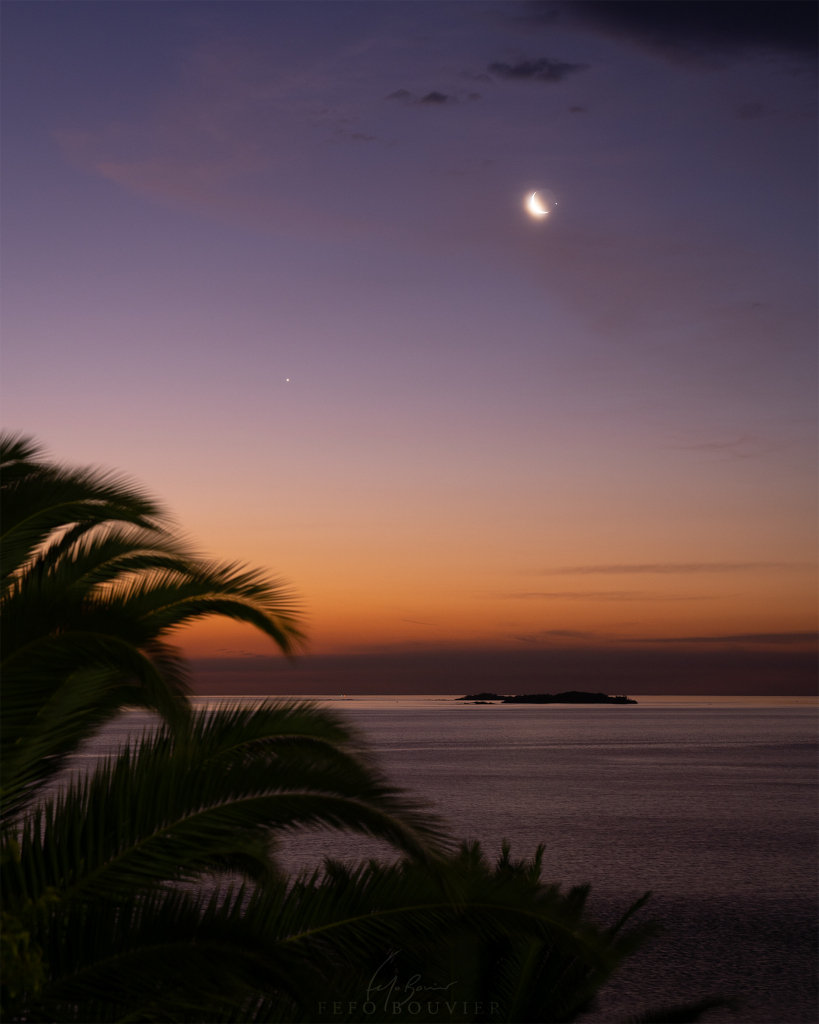
On February 22, a young Moon shared the western sky at sunset with bright planets Venus and Jupiter along the ecliptic plane. The beautiful celestial conjunction was visible around planet Earth. But from some locations Jupiter hid for a while, occulted by the crescent lunar disk. The Solar System’s ruling gas giant was captured here just before it disappeared behind the the Moon’s dark edge, seen over the Río de la Plata at Colonia del Sacramento, Uruguay. In the serene river and skyscape Venus is not so shy, shining brightly closer to the horizon through the fading twilight. Next week Venus and Jupiter will appear even closer in your evening sky. [via NASA] https://ift.tt/7LU1c50