Lunar Eclipse over a Skyscraper

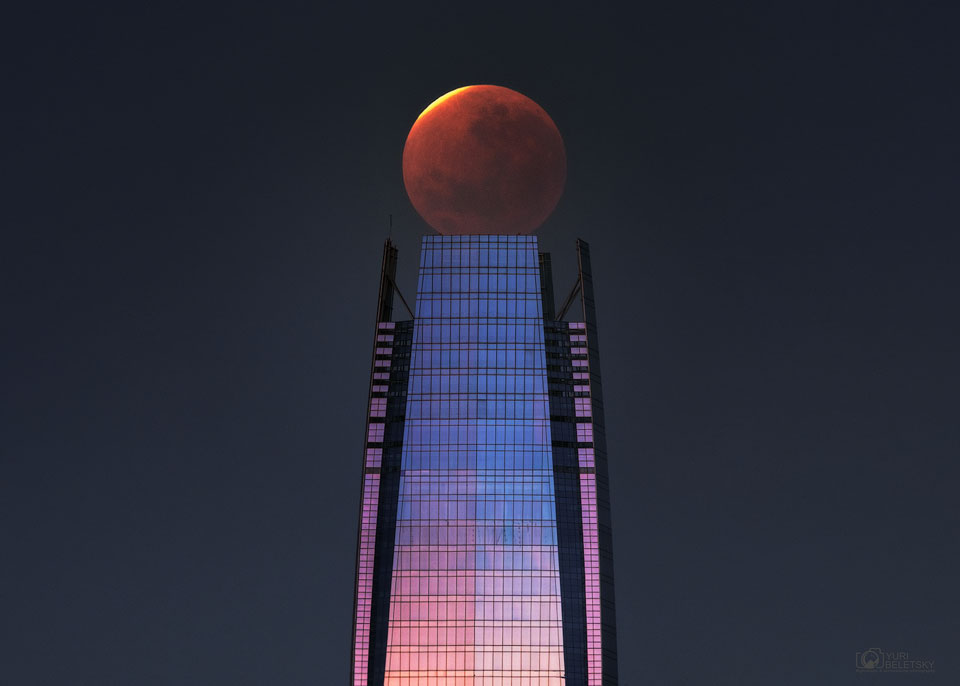
Why is the Moon on top of this building? Planning. It took the astrophotographer careful planning — including figuring out exactly where to place the camera and exactly when to take the shot — to create this striking superposition. The single image featured was taken in the early morning hours of November 19, near the peak of the partial lunar eclipse that was occurring as the Moon passed through the Earth’s shadow. At this time, almost the entire Moon — 99.1 percent of its area — was in the darkest part of the Earth’s shadow. The building is the Gran Torre Santiago building in Chile, the tallest building in South America. Although the entire eclipse lasted an impressive six hours, this image had to be taken within just a few seconds to get the alignment right — the Earth’s rotation soon moved the building out of alignment. The next Earth-Moon eclipse will be a total eclipse of the Sun that will occur on December 4 — but only be visible from the bottom of our world. [via NASA] https://ift.tt/3xdTJ9k
Introducing Comet Leonard

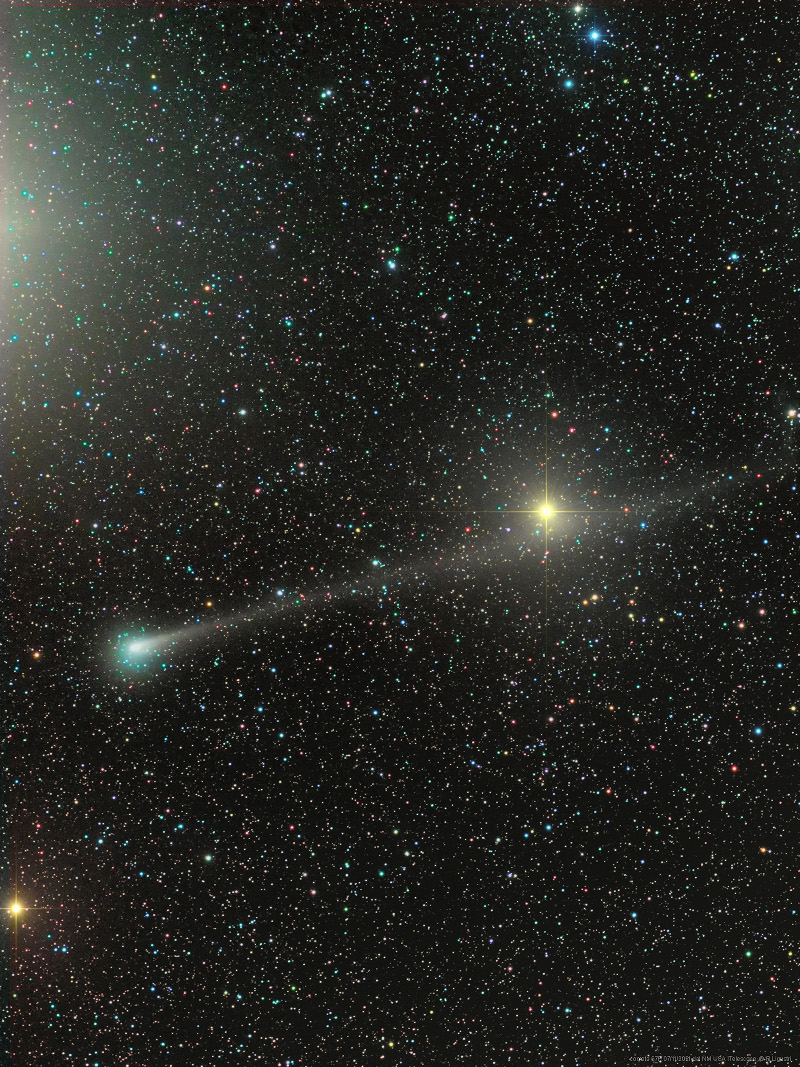
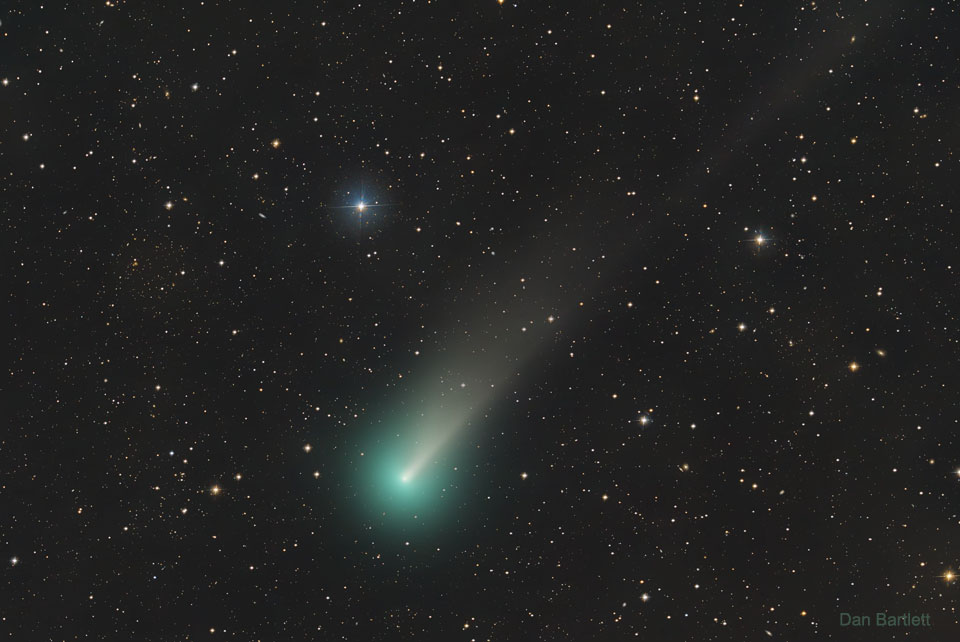
Here comes Comet Leonard. Comet C/2021 A1 (Leonard) was discovered as a faint smudge in January 2021 when it was out past Mars — but its orbit will take the giant shedding ice-ball into the inner Solar System, passing near both Earth and Venus in December before it swoops around the Sun in early January 2022. Although comets are notoriously hard to predict, some estimations have Comet Leonard brightening to become visible to the unaided eye in December. Comet Leonard was captured just over a week ago already sporting a green-tinged coma and an extended dust tail. The featured picture was composed from 62 images taken through a moderate-sized telescope — one set of exposures tracking the comet, while another set tracking the background stars. The exposures were taken from the dark skies above the Eastern Sierra Mountains, near June Lake in California, USA. Soon after passing near the Earth in mid-December, the comet will shift from northern to southern skies. [via NASA] https://ift.tt/3kV7hS4

Full Moonlight

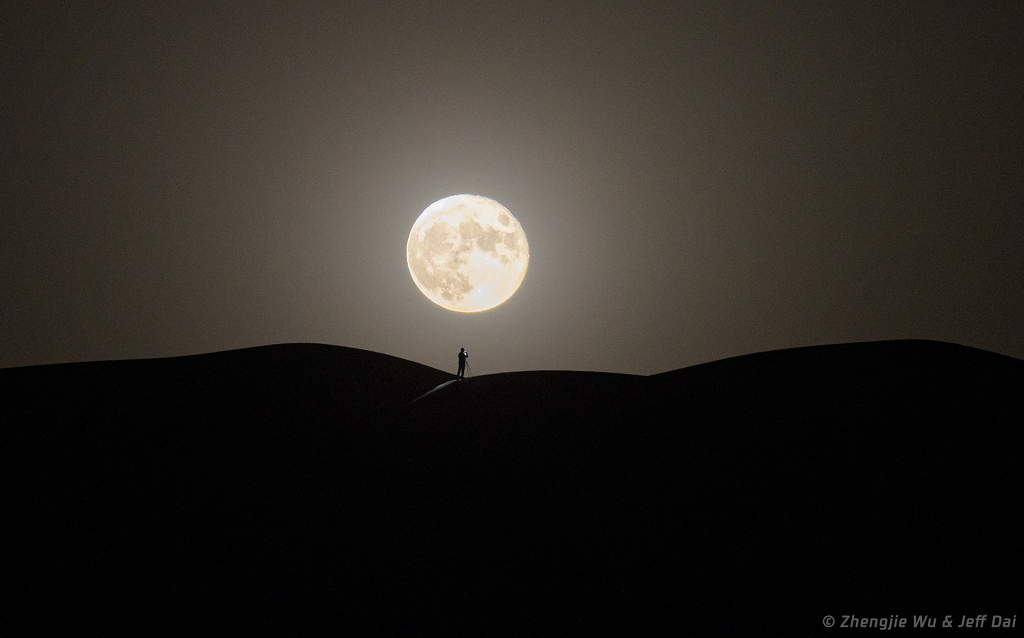
A photographer in silhouette stands in bright moonlight as the Full Moon rises in this well-planned telephoto image. Of course, the Full Moon is normally the brightest lunar phase. But on November 18/19, the Full Moon’s light will be dimmed during a deep partial lunar eclipse seen across much of planet Earth. At maximum eclipse only a few percent of the lunar disk’s diameter should remain outside the Earth’s dark umbral shadow when the Moon slides close to the shadow’s southern edge. Near apogee, the farthest point in its orbit, the Moon’s motion will be slow. That should make this second lunar eclipse of 2021 an exceptionally long partial lunar eclipse. For most of North America the eclipse partial phases will be visible in predawn hours. Since eclipses tend to come in pairs, this lunar eclipse will be followed by a solar eclipse in two weeks on December 4. [via NASA] https://ift.tt/3CyHTrq

NGC 3314: When Galaxies Overlap

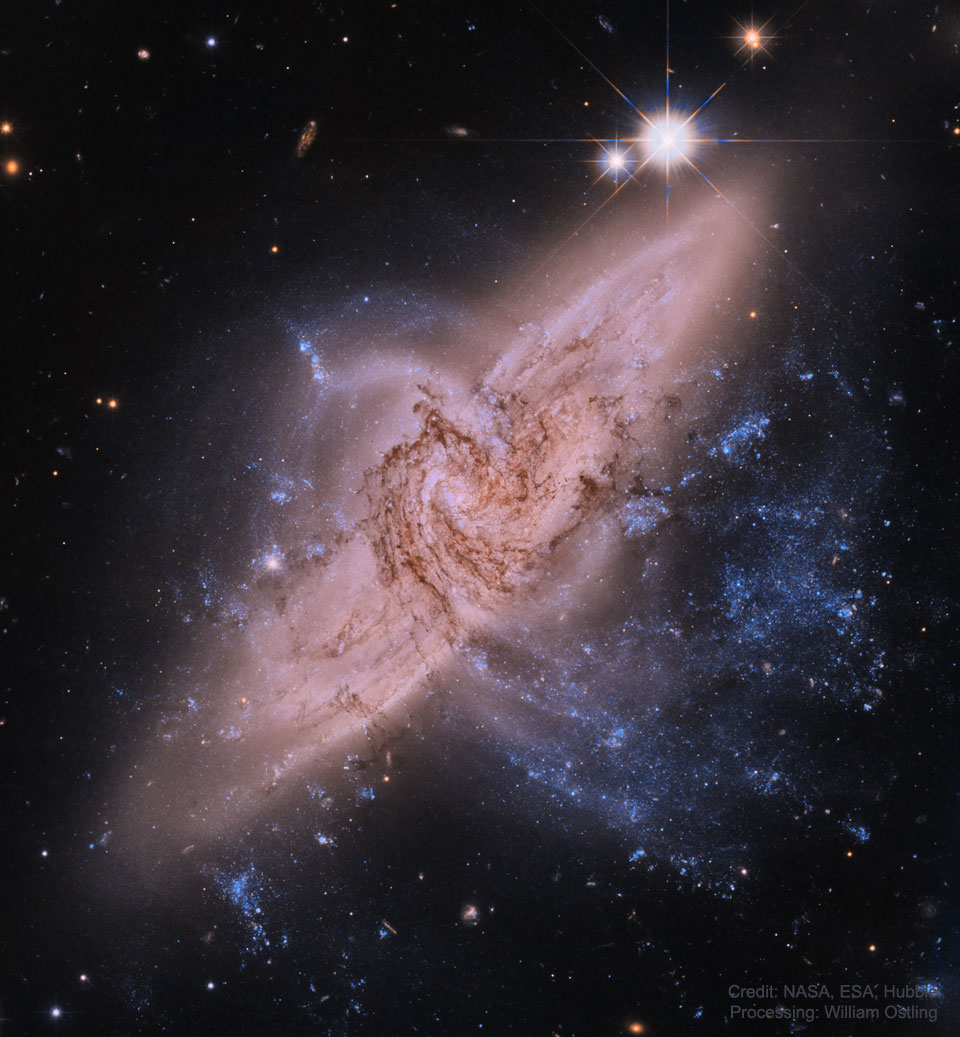
Why doesn’t the nearby galaxy create a gravitational lensing effect on the background galaxy? It does, but since both galaxies are so nearby, the angular shift is much smaller than the angular sizes of the galaxies themselves. The featured Hubble image of NGC 3314 shows two large spiral galaxies which happen to line up exactly. The foreground spiral NGC 3314a appears nearly face-on with its pinwheel shape defined by young bright star clusters. Against the glow of the background galaxy NGC 3314b, though, dark swirling lanes of interstellar dust can also be seen tracing the nearer spiral’s structure. Both galaxies appear on the edge of the Hydra Cluster of Galaxies, a cluster that is about 200 million light years away. Gravitational lens distortions are much easier to see when the lensing galaxy is smaller and further away. Then, the background galaxy may even be distorted into a ring around the nearer. Fast gravitational lens flashes due to stars in the foreground galaxy momentarily magnifying the light from stars in the background galaxy might one day be visible in future observing campaigns with high-resolution telescopes. [via NASA] https://ift.tt/3oDTssa

Geminids from Gemini

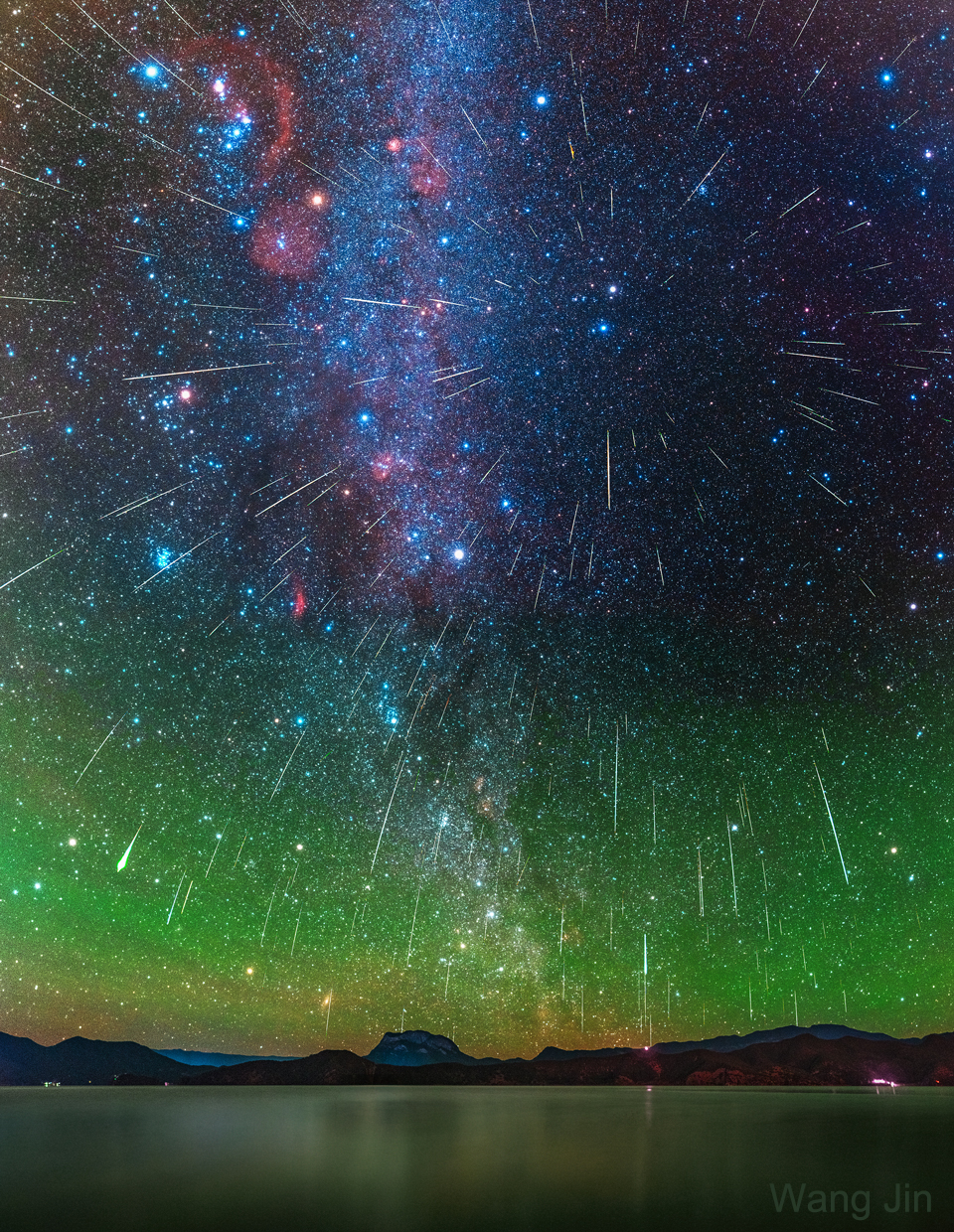
Where are all of these meteors coming from? In terms of direction on the sky, the pointed answer is the constellation of Gemini. That is why the major meteor shower in December is known as the Geminids — because shower meteors all appear to come from a radiant toward Gemini. Three dimensionally, however, sand-sized debris expelled from the unusual asteroid 3200 Phaethon follows a well-defined orbit about our Sun, and the part of the orbit that approaches Earth is superposed in front of the constellation of Gemini. Therefore, when Earth crosses this orbit, the radiant point of falling debris appears in Gemini. Featured here, a composite of many images taken during the 2020 Geminids meteor shower shows over 200 bright meteorss that streaked through the sky during the night December 14. The best meteor shower in November, the Leonids, peaks tonight and tomorrow. Unfortunately, this year, dim meteors during the early-morning peak will be hard to see against a sky lit by a bright gibbous moon. Still, a few bright Leonid meteors should be visible each hour. [via NASA] https://ift.tt/3nlNTz2

Light Pillar over Volcanic Etna

What happening above that volcano? Something very unusual — a volcanic light pillar. More typically, light pillars are caused by sunlight and so appear as a bright column that extends upward above a rising or setting Sun. Alternatively, other light pillars — some quite colorful — have been recorded above street and house lights. This light pillar, though, was illuminated by the red light emitted by the glowing magma of an erupting volcano. The volcano is Italy’s Mount Etna, and the featured image was captured with a single shot a few hours after sunset in mid-June. Freezing temperatures above the volcano’s ash cloud created ice-crystals either in cirrus clouds high above the volcano — or in condensed water vapor expelled by Mount Etna. These ice crystals — mostly flat toward the ground but fluttering — then reflected away light from the volcano’s caldera. [via NASA] https://ift.tt/3CkbBA2

How to Identify that Light in the Sky

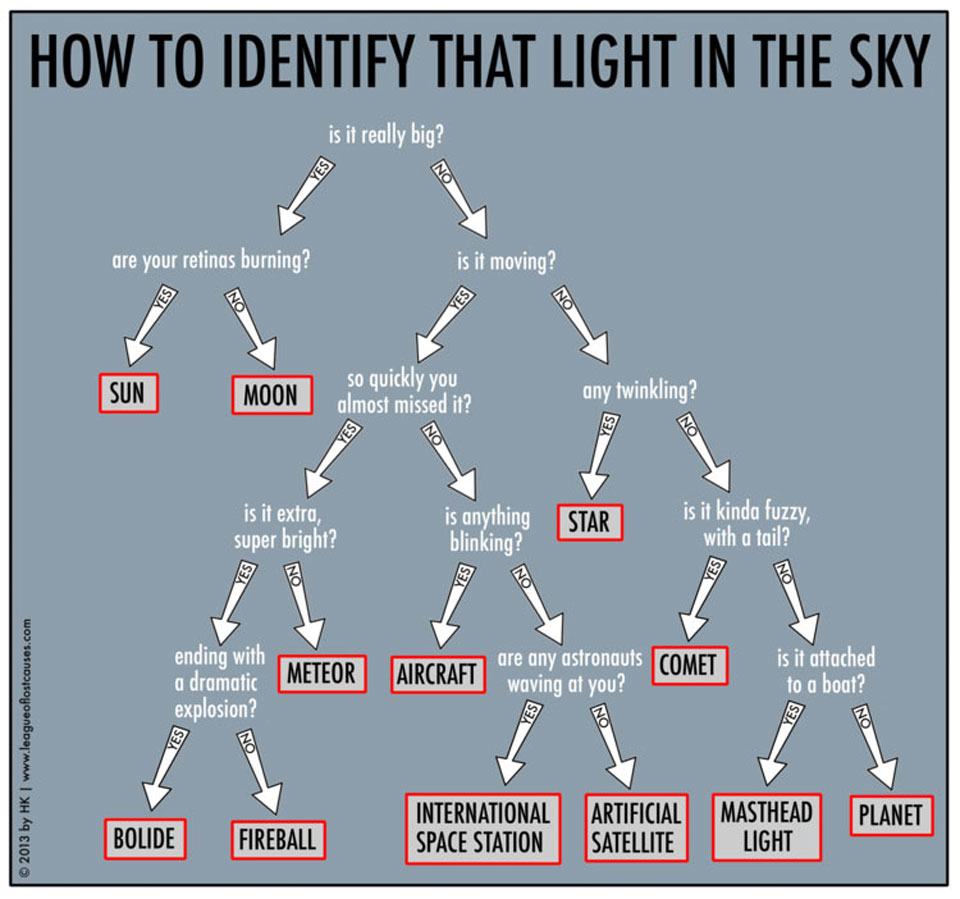
What is that light in the sky? Perhaps one of humanity’s more common questions, an answer may result from a few quick observations. For example — is it moving or blinking? If so, and if you live near a city, the answer is typically an airplane, since planes are so numerous and so few stars and satellites are bright enough to be seen over the din of artificial city lights. If not, and if you live far from a city, that bright light is likely a planet such as Venus or Mars — the former of which is constrained to appear near the horizon just before dawn or after dusk. Sometimes the low apparent motion of a distant airplane near the horizon makes it hard to tell from a bright planet, but even this can usually be discerned by the plane’s motion over a few minutes. Still unsure? The featured chart gives a sometimes-humorous but mostly-accurate assessment. Dedicated sky enthusiasts will likely note — and are encouraged to provide — polite corrections. [via NASA] https://ift.tt/3nc3i52

Rosetta s Comet in Gemini

Returning along its 6.4 year orbit, periodic comet Churyumov-Gerasimenko (67P) is caught in this telescopic frame from November 7. Sweeping past background stars in the constellation Gemini the comet’s dusty tail stretches toward the upper right to Upsilon Geminorum. Also known as Pollux, Beta Geminorum, Gemini’s brightest star, shines just off the upper left edge of the field-of-view. Churyumov-Gerasimenko reached its 2021 perihelion or closest approach to the Sun on November 2. At perigee, its closest approach to planet Earth on November 12, this comet was about 0.42 astronomical units away, though it remains too faint to be seen by eye alone. The well-studied comet was explored by robots from planet Earth during its last trip through the inner solar system. It’s now famous as the final resting place for the historic Rosetta spacecraft and Philae lander. [via NASA] https://ift.tt/3Faz9ZX

M33: The Triangulum Galaxy

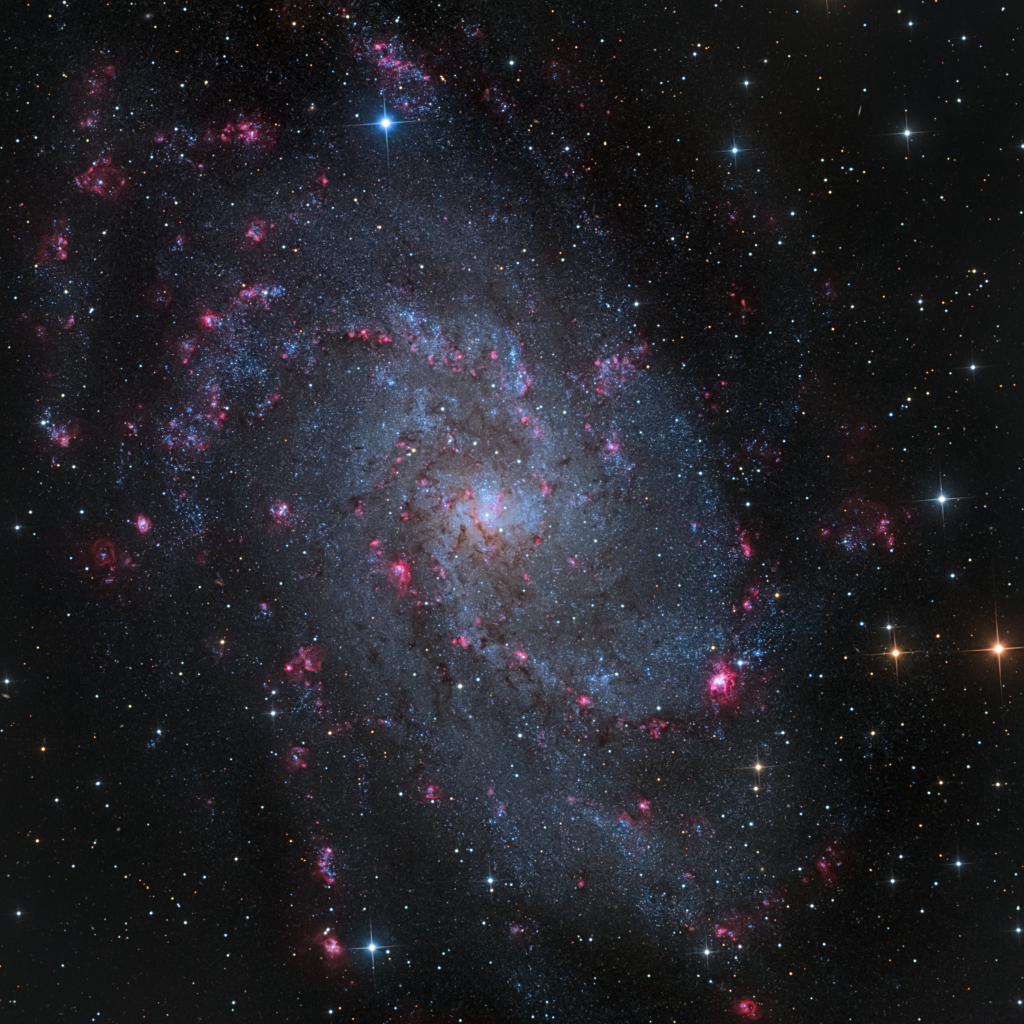
The small, northern constellation Triangulum harbors this magnificent face-on spiral galaxy, M33. Its popular names include the Pinwheel Galaxy or just the Triangulum Galaxy. M33 is over 50,000 light-years in diameter, third largest in the Local Group of galaxies after the Andromeda Galaxy (M31), and our own Milky Way. About 3 million light-years from the Milky Way, M33 is itself thought to be a satellite of the Andromeda Galaxy and astronomers in these two galaxies would likely have spectacular views of each other’s grand spiral star systems. As for the view from planet Earth, this sharp image shows off M33’s blue star clusters and pinkish star forming regions along the galaxy’s loosely wound spiral arms. In fact, the cavernous NGC 604 is the brightest star forming region, seen here at about the 4 o’clock position from the galaxy center. Like M31, M33’s population of well-measured variable stars have helped make this nearby spiral a cosmic yardstick for establishing the distance scale of the Universe. [via NASA] https://ift.tt/3cb3riJ

NGC 1333: Stellar Nursery in Perseus

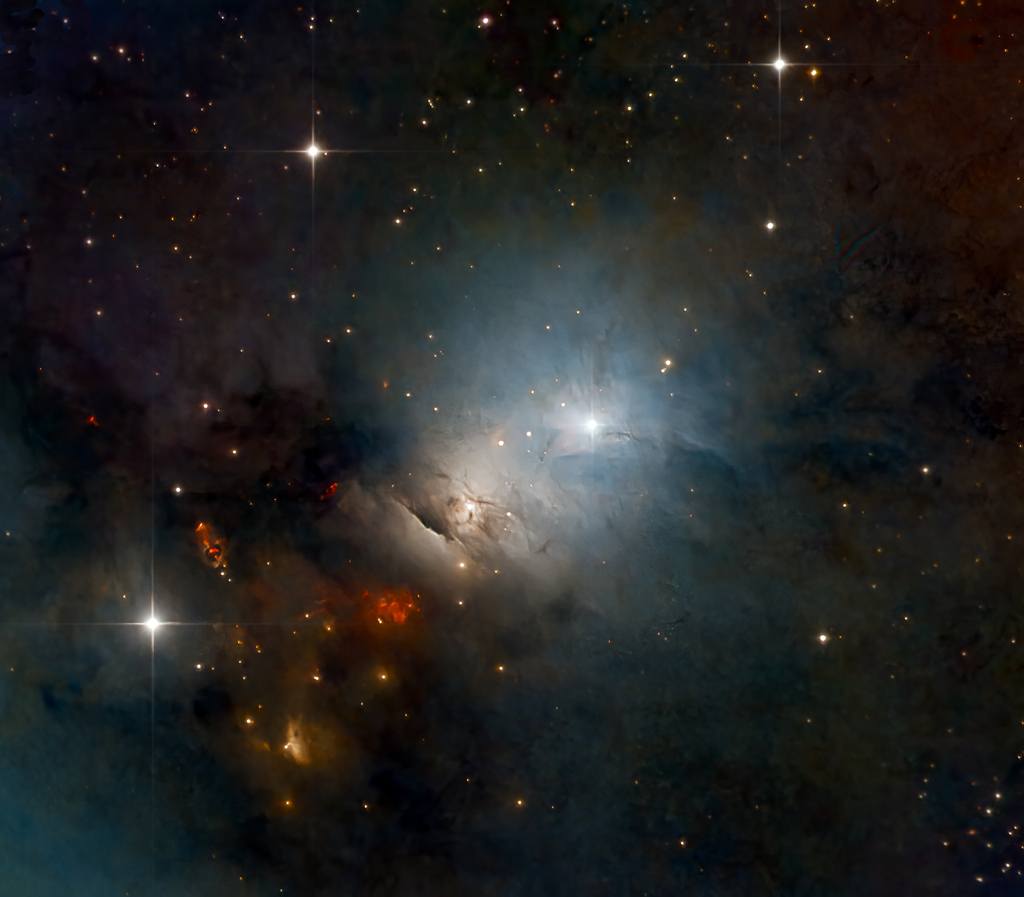
NGC 1333 is seen in visible light as a reflection nebula, dominated by bluish hues characteristic of starlight reflected by interstellar dust. A mere 1,000 light-years distant toward the heroic constellation Perseus, it lies at the edge of a large, star-forming molecular cloud. This telescopic close-up spans about two full moons on the sky or just over 15 light-years at the estimated distance of NGC 1333. It shows details of the dusty region along with telltale hints of contrasty red emission from Herbig-Haro objects, jets and shocked glowing gas emanating from recently formed stars. In fact, NGC 1333 contains hundreds of stars less than a million years old, most still hidden from optical telescopes by the pervasive stardust. The chaotic environment may be similar to one in which our own Sun formed over 4.5 billion years ago. [via NASA] https://ift.tt/3C7Jvbf