Apollo 14 Heads for Home

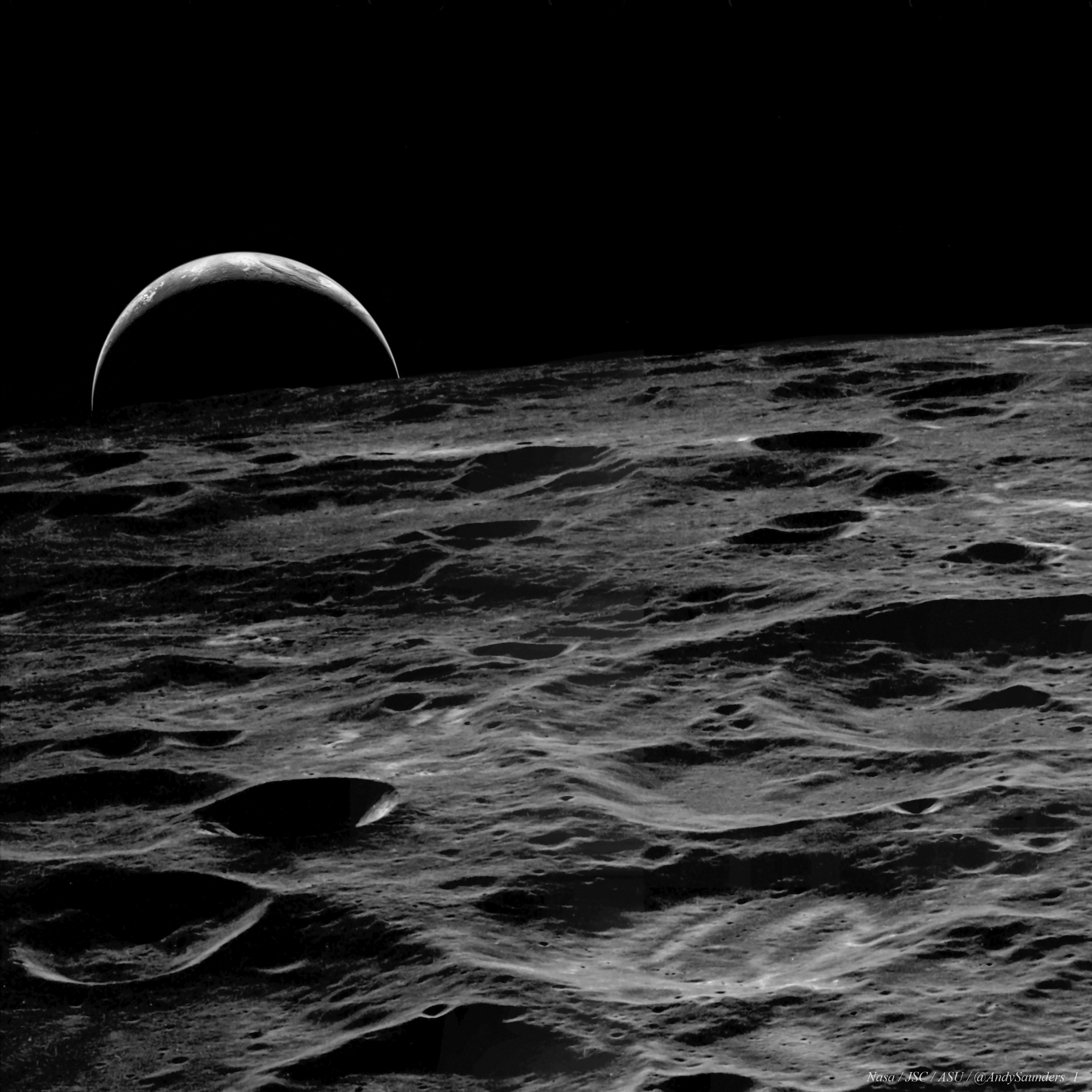
Fifty years ago this Sunday (February 7, 1971), the crew of Apollo 14 left lunar orbit and headed for home. They watched this Earthrise from their command module Kittyhawk. With Earth’s sunlit crescent just peeking over the lunar horizon, the cratered terrain in the foreground is along the lunar farside. Of course, while orbiting the Moon, the crew could watch Earth rise and set, but from the lunar surface the Earth hung stationary in the sky over their landing site at Fra Mauro Base. Rock samples returned from Fra Mauro included a 20 pound rock nicknamed Big Bertha, determined to contain a likely fragment of a meteorite from planet Earth. Kept on board the Kittyhawk during the Apollo 14 mission was a cannister of 400-500 seeds that were later grown into Moon Trees. [via NASA] https://ift.tt/3oTBMa2
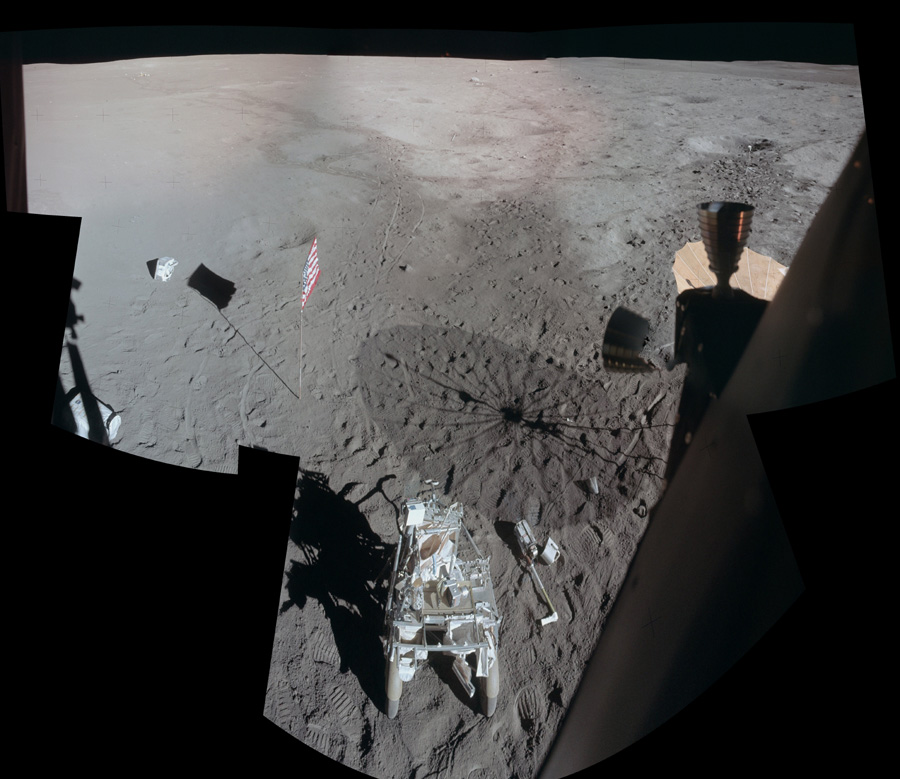
Apollo 14: A View from Antares

Fifty years ago this Friday, Apollo 14’s Lunar Module Antares landed on the Moon. Toward the end of the stay astronaut Ed Mitchell snapped a series of photos of the lunar surface while looking out a window, assembled into this detailed mosaic by Apollo Lunar Surface Journal editor Eric Jones. The view looks across the Fra Mauro highlands to the northwest of the landing site after the Apollo 14 astronauts had completed their second and final walk on the Moon. Prominent in the foreground is their Modular Equipment Transporter, a two-wheeled, rickshaw-like device used to carry tools and samples. Near the horizon at top center is a 1.5 meter wide boulder dubbed Turtle rock. In the shallow crater below Turtle rock is the long white handle of a sampling instrument, thrown there javelin-style by Mitchell. Mitchell’s fellow moonwalker and first American in space, Alan Shepard, also used a makeshift six iron to hit two golf balls. One of Shepard’s golf balls is just visible as a white spot below Mitchell’s javelin. [via NASA] https://ift.tt/39LRCzp

Found on the Moon: Candidate for Oldest Known Earth Rock

Was the oldest known rock on Earth found on the Moon? Quite possibly. The story opens with the Apollo 14 lunar mission. Lunar sample 14321, a large rock found in Cone crater by astronaut Alan Shepard, when analyzed back on Earth, was found to have a fragment that was a much better match to Earth rocks than other Moon rocks. Even more surprising, that rock section has recently been dated back 4 billion years, making it older, to within measurement uncertainty, than any rock ever found on Earth. A leading hypothesis now holds that an ancient comet or asteroid impact launched Earth rocks into the Solar System, some of which fell back to the Moon, became mixed with heated lunar soil and other rocks, cooled, and re-fragmented. The video features an internal X-ray scan of 14321 showing multiple sections with markedly different chemistries. Moon rocks will continue to be studied to learn a more complete history of the Moon, the Earth, and the early Solar System. Friday marks the 50th Anniversary of the Apollo 14 landing on the Moon. [via NASA] https://ift.tt/3jjtzuH

A Colorful Quadrantid Meteor

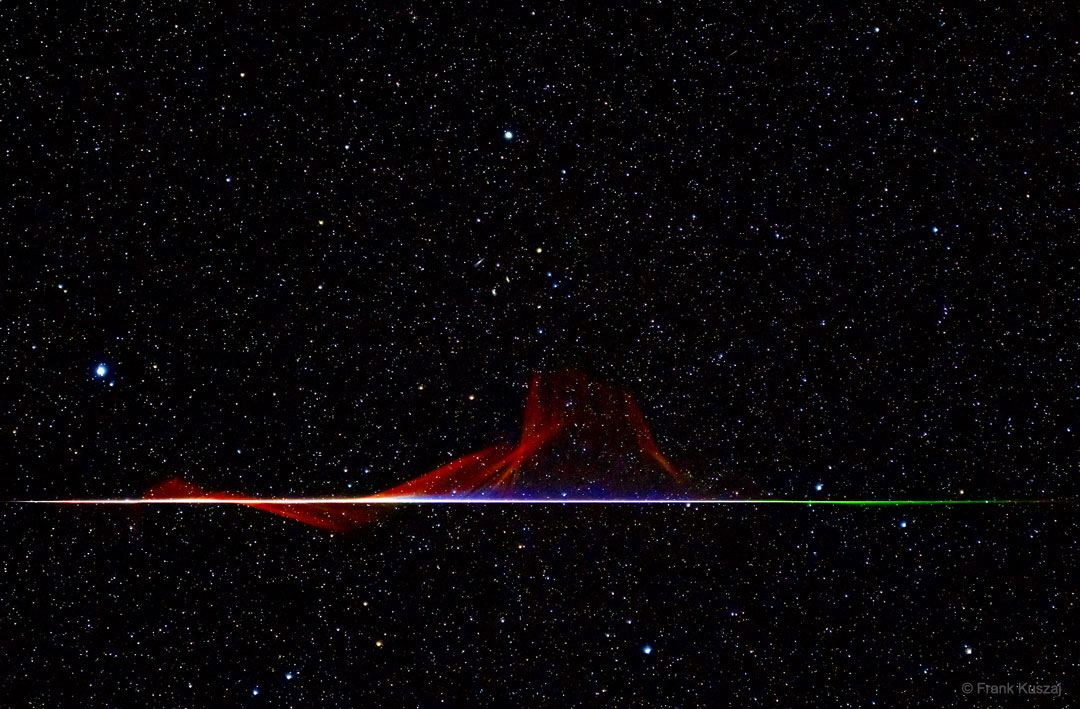
Meteors can be colorful. While the human eye usually cannot discern many colors, cameras often can. Pictured is a Quadrantids meteor captured by camera over Missouri, USA, early this month that was not only impressively bright, but colorful. The radiant grit, likely cast off by asteroid 2003 EH1, blazed a path across Earth’s atmosphere. Colors in meteors usually originate from ionized elements released as the meteor disintegrates, with blue-green typically originating from magnesium, calcium radiating violet, and nickel glowing green. Red, however, typically originates from energized nitrogen and oxygen in the Earth’s atmosphere. This bright meteoric fireball was gone in a flash — less than a second — but it left a wind-blown ionization trail that remained visible for several minutes. [via NASA] https://ift.tt/3oJ9C1s

Lunar Halo over Snowy Trees

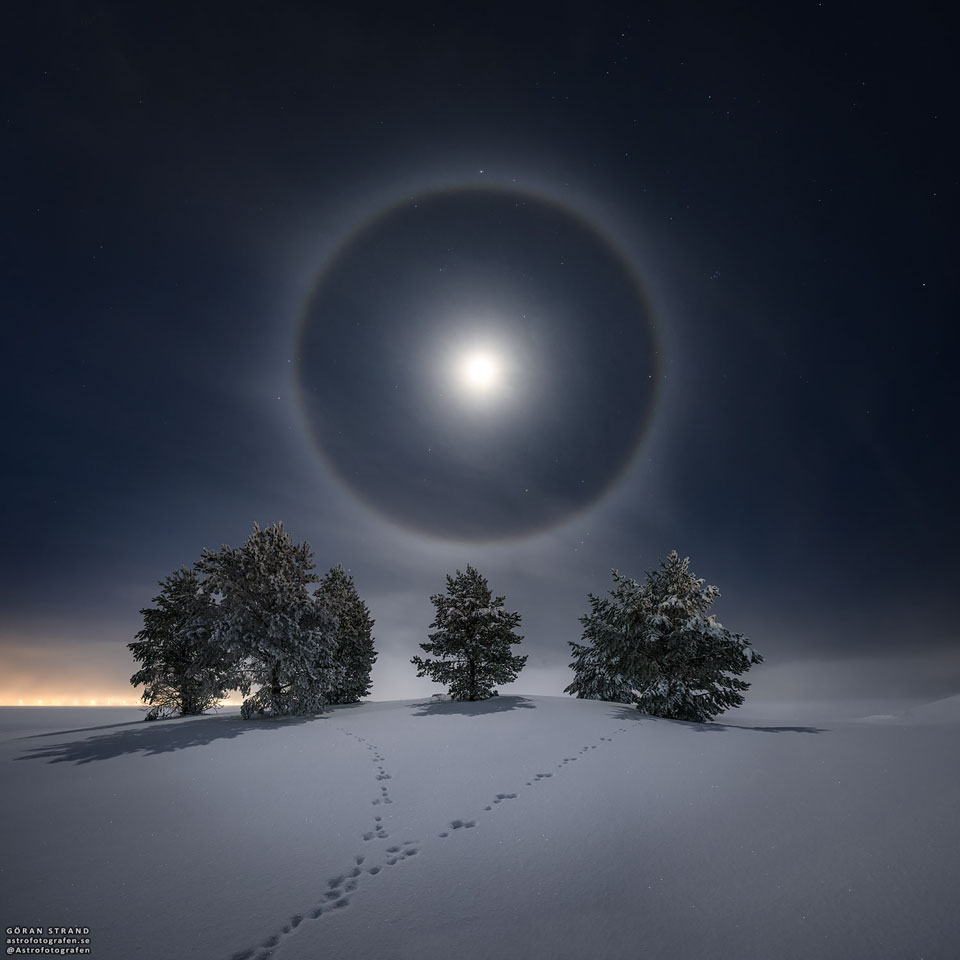
Have you ever seen a halo around the Moon? This fairly common sight occurs when high thin clouds containing millions of tiny ice crystals cover much of the sky. Each ice crystal acts like a miniature lens. Because most of the crystals have a similar elongated hexagonal shape, light entering one crystal face and exiting through the opposing face refracts 22 degrees, which corresponds to the radius of the Moon Halo. A similar Sun Halo may be visible during the day. Exactly how ice-crystals form in clouds remains a topic of research. In the featured image taken last week from Östersund, Sweden, a complete lunar halo was captured over snowy trees and rabbit tracks. [via NASA] https://ift.tt/3oI2qms

Asteroids in the Distance

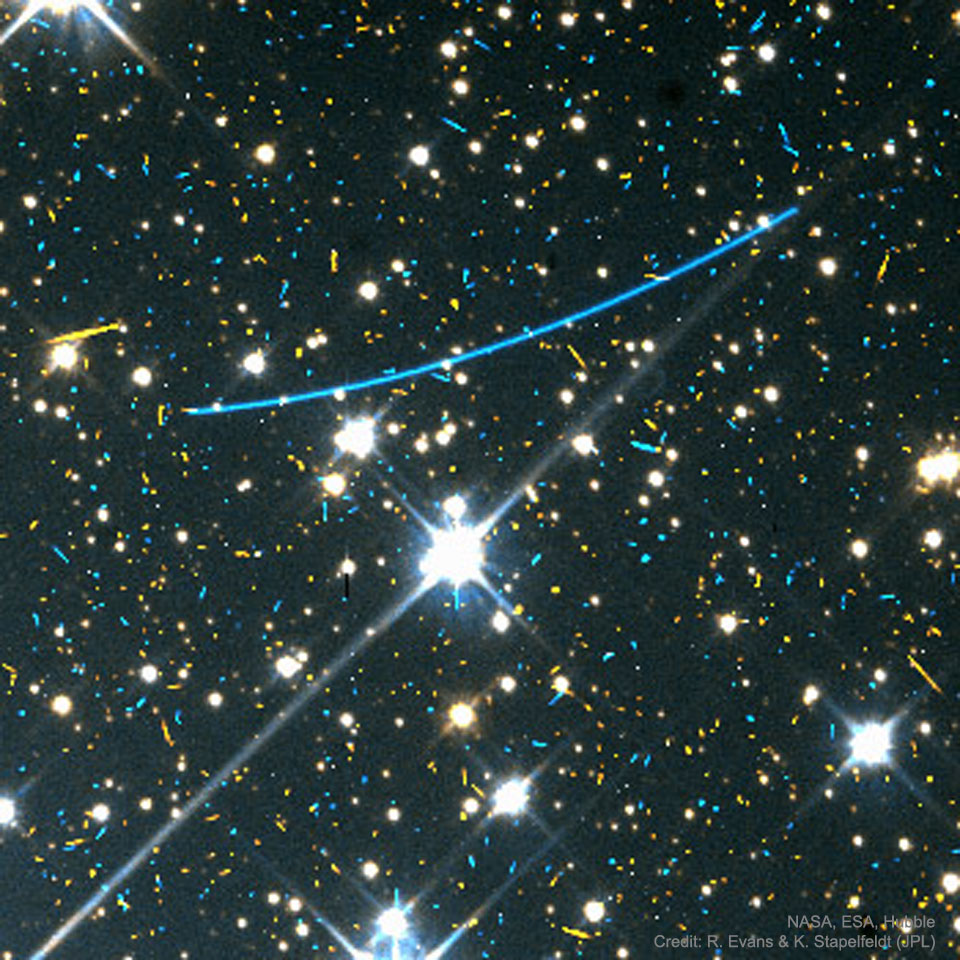
Rocks from space hit Earth every day. The larger the rock, though, the less often Earth is struck. Many kilograms of space dust pitter to Earth daily. Larger bits appear initially as a bright meteor. Baseball-sized rocks and ice-balls streak through our atmosphere daily, most evaporating quickly to nothing. Significant threats do exist for rocks near 100 meters in diameter, which strike the Earth roughly every 1000 years. An object this size could cause significant tsunamis were it to strike an ocean, potentially devastating even distant shores. A collision with a massive asteroid, over 1 km across, is more rare, occurring typically millions of years apart, but could have truly global consequences. Many asteroids remain undiscovered. In the featured image, one such asteroid — shown by the long blue streak — was found by chance in 1998 by the Hubble Space Telescope. A collision with a large asteroid would not affect Earth’s orbit so much as raise dust that would affect Earth’s climate. One likely result is a global extinction of many species of life, possibly dwarfing the ongoing extinction occurring now. [via NASA] https://ift.tt/3py7f2I

Southern Sky at 38,000 Feet

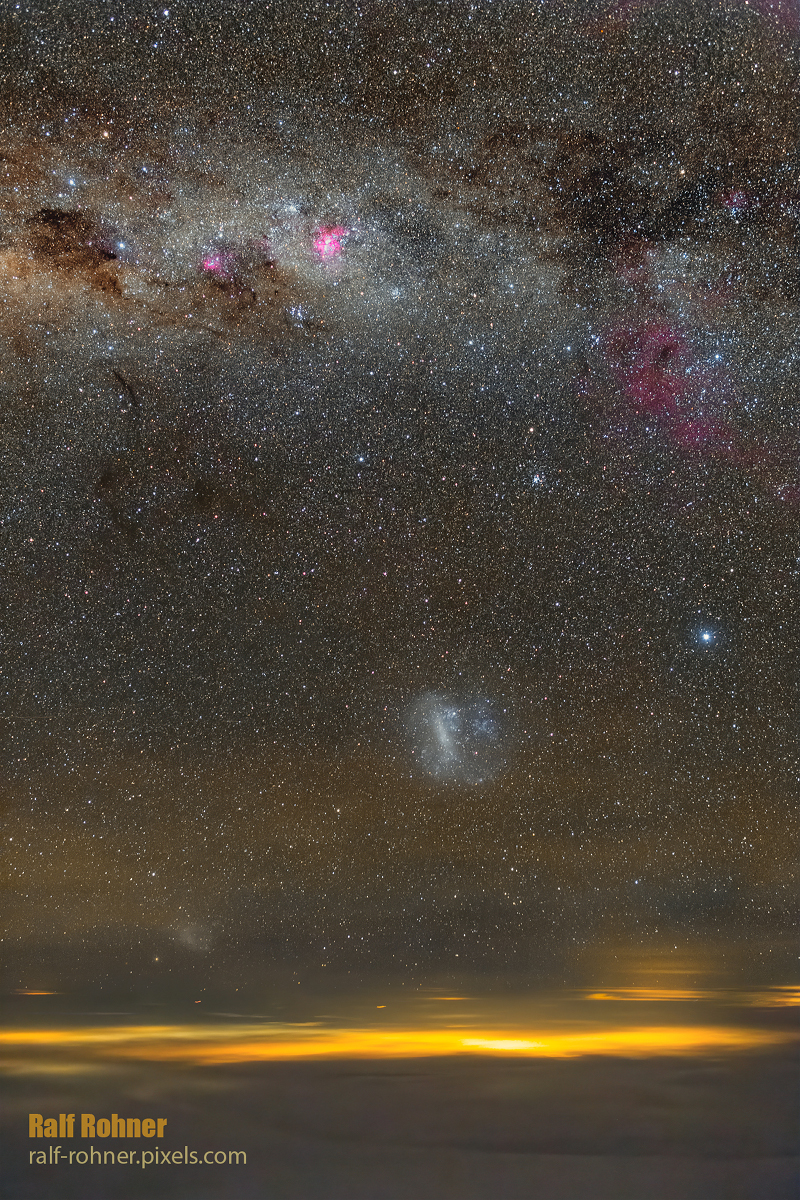
Celestial sights of the southern sky shine above a cloudy planet Earth in this gorgeous night sky view. The scene was captured from an airliner’s flight deck at 38,000 feet on a steady westbound ride to Lima, Peru. To produce the sharp airborne astrophotograph, the best of a series of short exposures were selected and digitally stacked. The broad band of the southern Milky Way begins at top left with the dark Coalsack Nebula and Southern Cross. Its expanse of diffuse starlight encompasses the the Carina Nebula and large Gum Nebula toward the right. Canopus, alpha star of Carina and second brightest star in Earth’s night is easy to spot below the Milky Way, as is the dwarf galaxy known as the Large Magellanic Cloud. The Small Magellanic cloud just peeks above the cloudy horizon. Of course, the South Celestial Pole also lies within the starry southern frame. [via NASA] https://ift.tt/36m6ceI

North American Nightscape

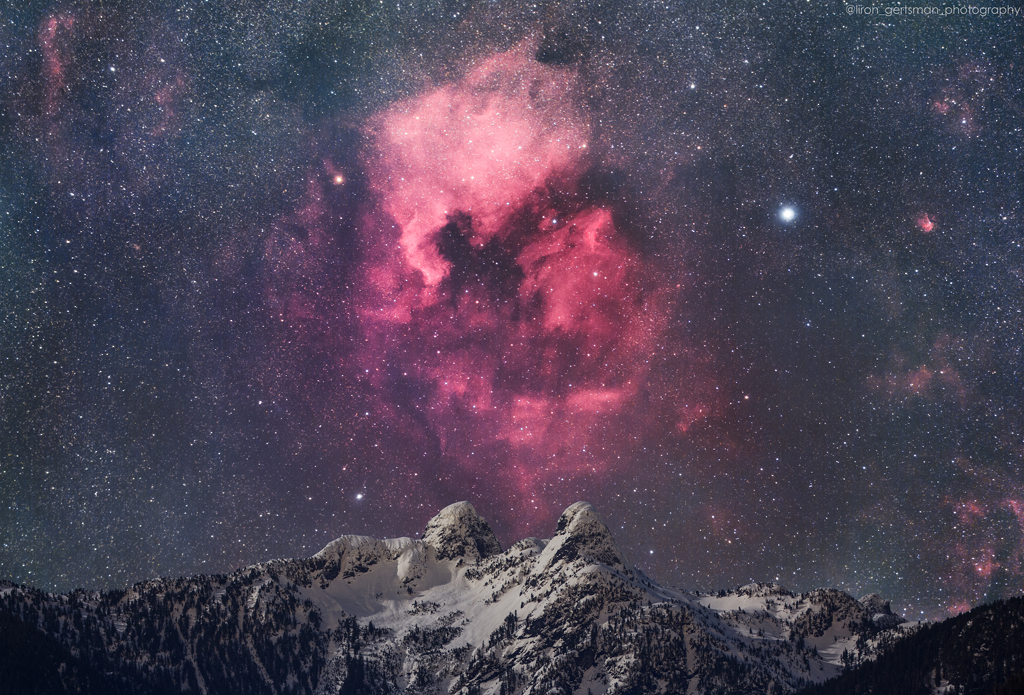
On January 21, light from the Moon near first quarter illuminated the foreground in this snowy mountain and night scene. Known as The Lions, the striking pair of mountain peaks are north of Vancouver, British Colombia, Canada, North America, planet Earth. Poised above the twin summits, left of Deneb alpha star of the constellation Cygnus, are emission regions NGC 7000 and IC 5070. Part of a large star forming complex about 1,500 light-years from Vancouver, they shine with the characteristic red glow of atomic hydrogen gas. Outlines of the bright emission regions suggest their popular names, The North America Nebula and The Pelican Nebula. The well-planned, deep nightscape is a composite of consecutive exposures made with a modified digital camera and telephoto lens. Foreground exposures were made with camera fixed to a tripod, background exposures were made tracking the sky. The result preserves sharp natural detail and reveals a range of brightness and color that your eye can’t quite see on its own. [via NASA] https://ift.tt/39tNgN7

Messier 66 Close Up

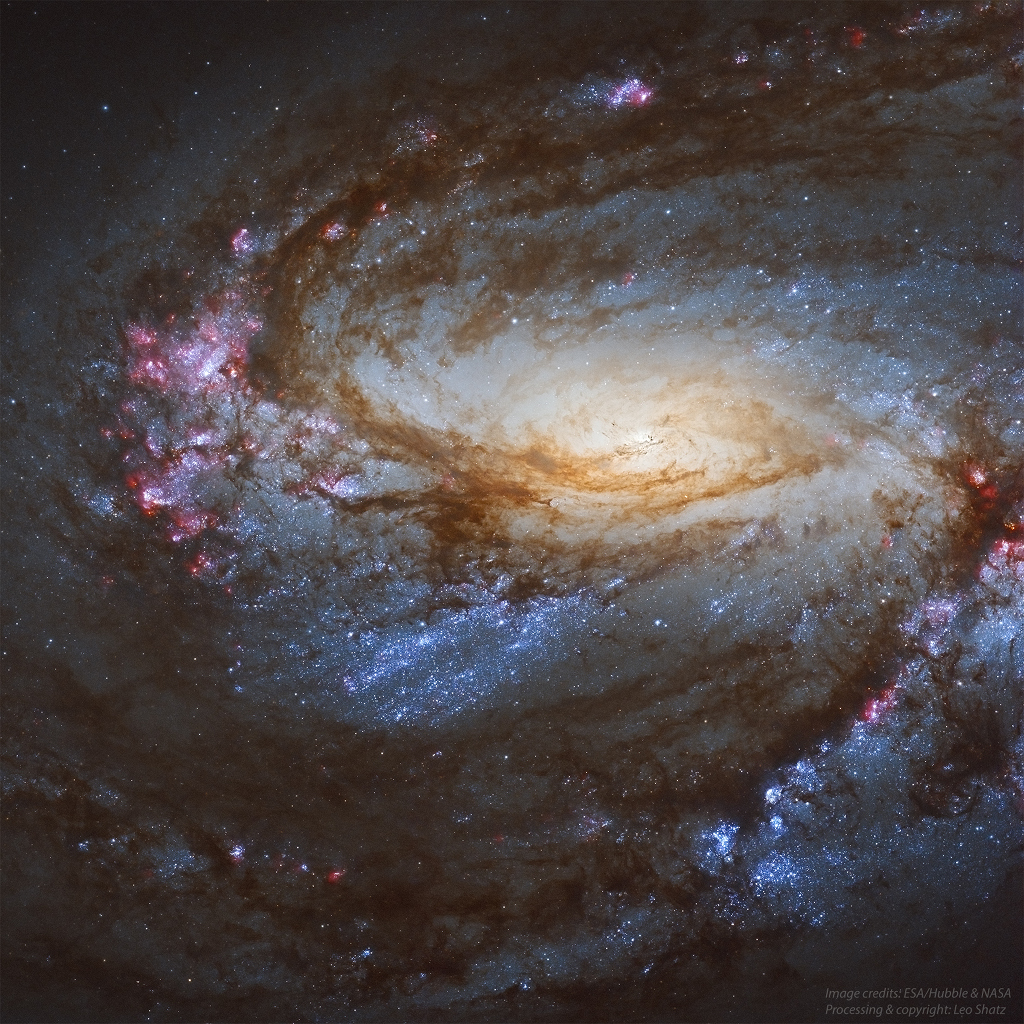
Big, beautiful spiral galaxy Messier 66 lies a mere 35 million light-years away. The gorgeous island universe is about 100 thousand light-years across, similar in size to the Milky Way. This reprocessed Hubble Space Telescope close-up view spans a region about 30,000 light-years wide around the galactic core. It shows the galaxy’s disk dramatically inclined to our line-of-sight. Surrounding its bright core, the likely home of a supermassive black hole, obscuring dust lanes and young, blue star clusters sweep along spiral arms dotted with the tell-tale glow of pinksh star forming regions. Messier 66, also known as NGC 3627, is the brightest of the three galaxies in the gravitationaly interacting Leo Triplet. [via NASA] https://ift.tt/3onyifF

The Vertical Magnetic Field of NGC 5775

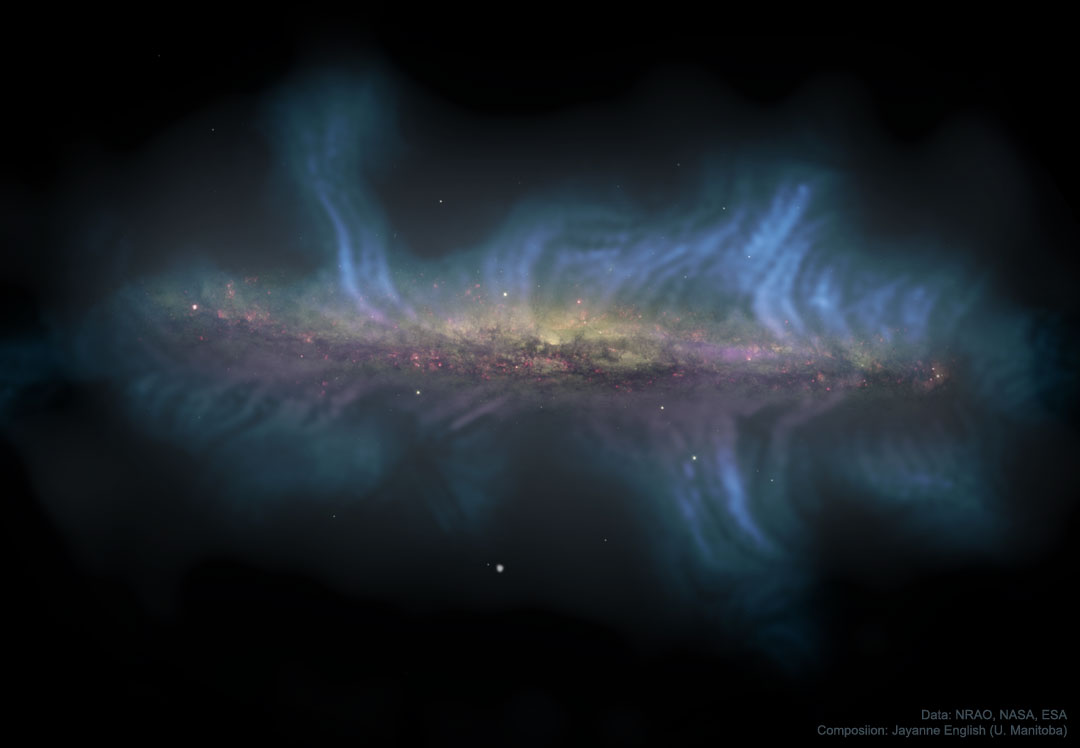
How far do magnetic fields extend up and out of spiral galaxies? For decades astronomers knew only that some spiral galaxies had magnetic fields. However, after NRAO’s Very Large Array (VLA) radio telescope (popularized in the movie Contact) was upgraded in 2011, it was unexpectedly discovered that these fields could extend vertically away from the disk by several thousand light-years. The featured image of edge-on spiral galaxy NGC 5775, observed in the CHANG-ES (Continuum Halos in Nearby Galaxies) survey, also reveals spurs of magnetic field lines that may be common in spirals. Analogous to iron filings around a bar magnet, radiation from electrons trace galactic magnetic field lines by spiraling around these lines at almost the speed of light. The filaments in this image are constructed from those tracks in VLA data. The visible light image, constructed from Hubble Space Telescope data, shows pink gaseous regions where stars are born. It seems that winds from these regions help form the magnificently extended galactic magnetic fields. [via NASA] https://ift.tt/3plzUrS