Savudrija Star Trails

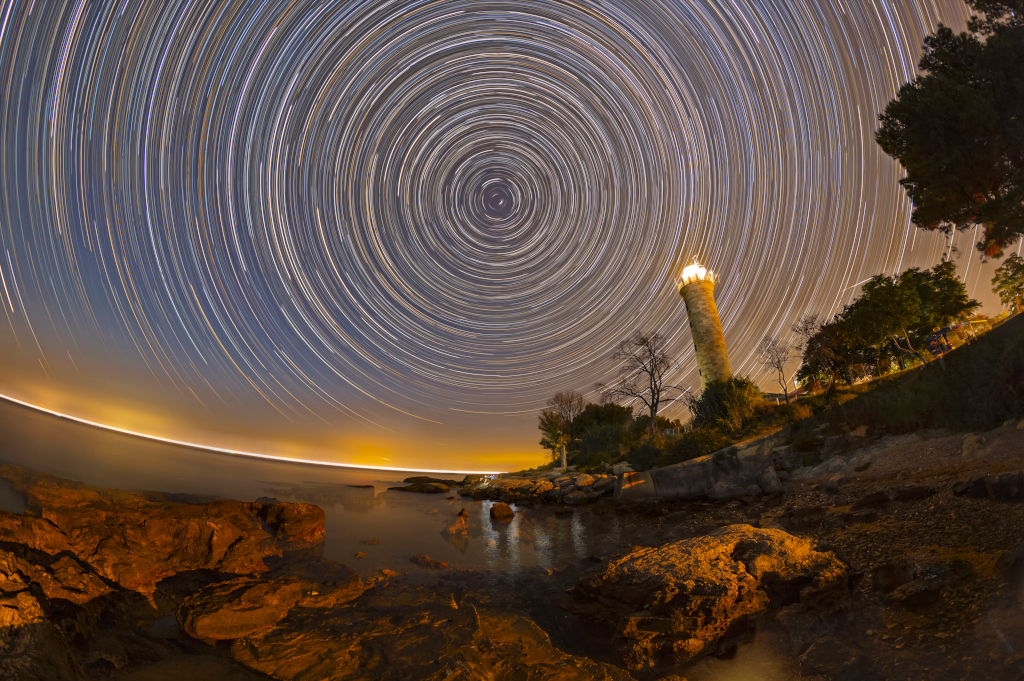
Savudrija lighthouse shines along the coast near the northern end of the Istrian peninsula in this well-composed night skyscape. A navigational aid for sailors on the Adriatic Sea, the historic lighthouse was constructed in the early 19th century. But an even older aid to navigation shines in the sky above, Polaris, alpha star of the constellation Ursa Minor and also known as the North Star. In this scene Polaris forms the shortest bright arc near the North Celestial Pole, the extension of Earth’s axis of rotation into space. Of course, the North Celestial Pole lies exactly at the center of all the concentric startrails. The composite image is a digital stack of 400 exposures, each 30 seconds long, taken with camera and tripod fixed to a rotating planet. [via NASA] https://ift.tt/P20zZMn

Is the sky the same every night? No — the night sky changes every night in many ways. To better explore how the night sky changes, the USA’s NSF and DOE commissioned the Vera C. Rubin Observatory in Cerro Pachón, Chile. In final testing before routine operations, Rubin will begin to explore these nightly changes — slight differences that can tell us much about our amazing universe and its surprising zoo of objects. With a mirror over 8 meters across, Rubin will continually reimage the entire visible sky every few nights to discover new supernovas, potentially dangerous asteroids, faint comets, and variable stars — as well as mapping out the visible universe’s large-scale structure. Pictured, the distant central band of our Milky Way Galaxy appears to flow out from the newly operational observatory. Taken last month, the featured picture is a composite of 21 images across the night sky, capturing airglow on the horizon and the Small Magellanic Cloud galaxy on the lower left. [via NASA] https://ift.tt/BQpiOas

Why would the sky glow like a giant repeating rainbow? Airglow. Now, air glows all of the time, but it is usually hard to see. A disturbance however — like an approaching storm — may cause noticeable rippling in the Earth’s atmosphere. These gravity waves are oscillations in air analogous to those created when a rock is thrown in calm water. The long-duration exposure nearly along the vertical walls of airglow likely made the undulating structure particularly visible. OK, but where do the colors originate? The deep red glow likely originates from OH molecules about 87 kilometers high, excited by ultraviolet light from the Sun. The orange and green airglow is likely caused by sodium and oxygen atoms slightly higher up. The featured image was captured during a climb up Mount Pico in the Azores of Portugal. Ground lights originate from the island of Faial in the Atlantic Ocean. A spectacular sky is visible through this banded airglow, with the central band of our Milky Way Galaxy running up the image center, and M31, the Andromeda Galaxy, visible near the top left. [via NASA] https://ift.tt/492MkgH

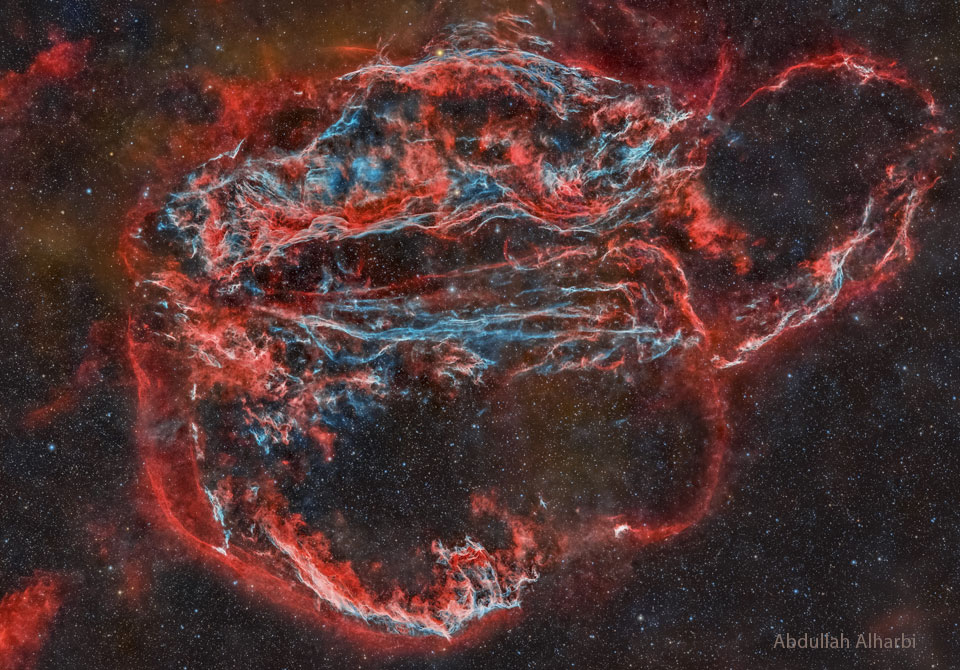
Wisps like this are all that remain visible of a Milky Way star. About 7,000 years ago that star exploded in a supernova, leaving the Veil Nebula. At the time, the expanding cloud was likely as bright as a crescent Moon, remaining visible for weeks to people living at the dawn of recorded history. Today, the resulting supernova remnant, also known as the Cygnus Loop, has faded and is now visible only through a small telescope directed toward the constellation of the Swan (Cygnus). The remaining Veil Nebula is physically huge, however, and even though it lies about 1,400 light-years distant, it covers over five times the size of the full Moon. The featured picture was taken in Kuwait in mid-2024 and features light emitted by hydrogen in red and oxygen in blue. In deep images of the complete Veil Nebula like this, even studious readers might not be able to identify the iconic filaments. [via NASA] https://ift.tt/3x8DvCn

What’s happening to this spiral galaxy? Although details remain uncertain, it surely has to do with an ongoing battle with its smaller galactic neighbor. The featured galaxy is labelled UGC 1810 by itself, but together with its collisional partner is known as Arp 273. The overall shape of UGC 1810 — in particular its blue outer ring — is likely a result of wild and violentgravitationalinteractions. This ring’s blue color is caused by massive stars that are blue hot and have formed only in the past few million years. The inner galaxy appears older, redder, and threaded with coolfilamentary dust. A few bright stars appear well in the foreground, unrelated to UGC 1810, while several galaxies are visible well in the background. Arp 273 lies about 300 million light years away toward the constellation of Andromeda. Quite likely, UGC 1810 will devour its galactic sidekick over the next billion years and settle into a classic spiral form. [via NASA] https://ift.tt/DfAh1x4

Sunset Afterimage

On May 7, the Sun setting behind a church bell tower was captured in this filtered and manipulated digital skyscape from Ragusa, Sicily, planet Earth. In this version of the image the colors look bizarre. Still, an intriguing optical illusion known as an afterimage can help you experience the same scene with a more natural looking appearance. To try it, find the sunspots of active region AR4079 grouped near the bottom of the blue solar disk. Relax and stare at the dark sunspot group for about 30 seconds, then close your eyes or shift your gaze to a plain white surface. In a moment an afterimage of the sunset should faintly appear. But the afterimage sunset will have this image’s complementary colors and a more normal yellow Sun against a familiar blue sky. [via NASA] https://ift.tt/inc64IL

Mars in the Loop

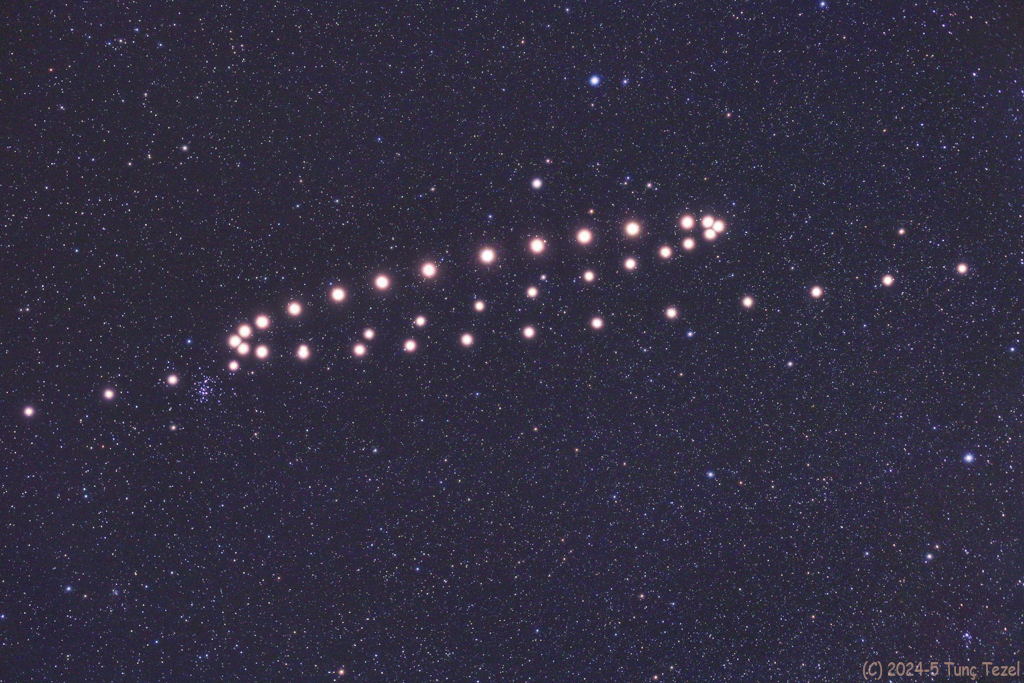
This composite of images spaced a weather-permitting 5 to 9 days apart, from 2024 September 19 (top right) through 2025 May 18 (bottom left), faithfully traces ruddy-colored Mars as it makes a clockwise loop through the constellations Gemini and Cancer in planet Earth’s night sky. You can connect the dots and dates with your cursor over the image, but be sure to check out this animation of the Red Planet’s 2024/25 retrograde motion. Of course Mars didn’t actually reverse the direction of its orbit. Instead, the apparent backwards motion with respect to the background stars is a reflection of the orbital motion of Earth itself. Retrograde motion can be seen each time Earth overtakes and laps planets orbiting farther from the Sun, the Earth moving more rapidly through its own relatively close-in orbit. In this case Mars’ apparent eastward motion began to reverse around December 8, when it seemed to linger near open star cluster M44 in Cancer. After wandering back to the west, under Gemini’s bright stars Castor and Pollux, Mars returned to pose near M44 by early May. At its brightest near opposition on 2025 January 16, Mars was a mere 96 million kilometers away. [via NASA] https://ift.tt/GyXOPRw

Irregular Dwarf Galaxy Sextans A

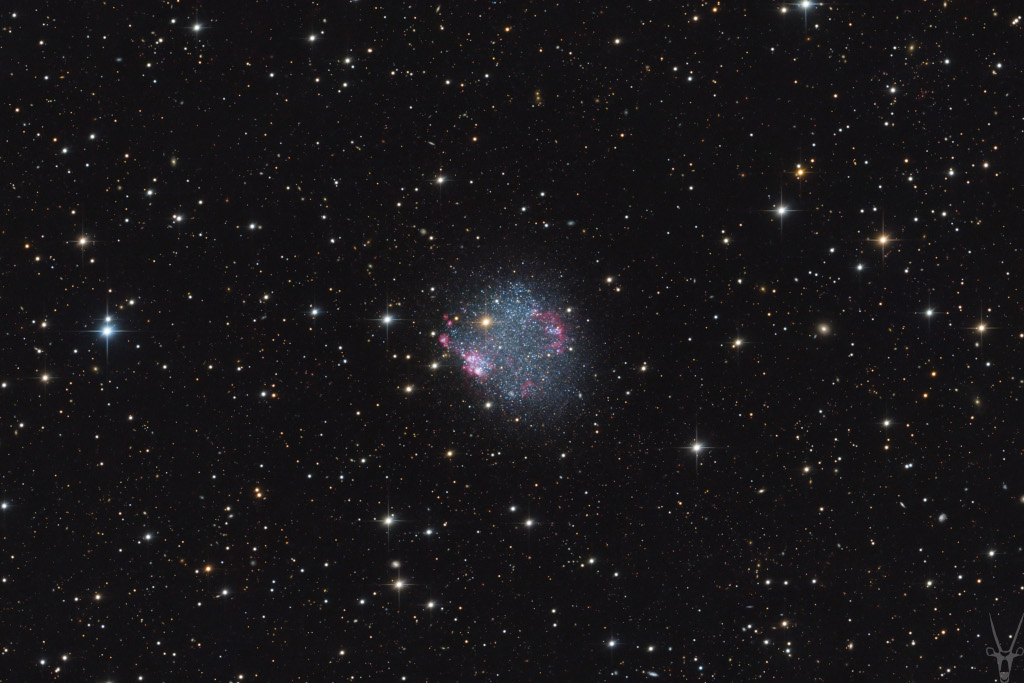
Grand spiral galaxies often seem to get all the attention, flaunting young, bright, blue star clusters and pinkish star forming regions along graceful, symmetric spiral arms. But small galaxies form stars too, like irregular dwarf galaxy Sextans A. Its young star clusters and star forming regions are gathered into a gumdrop-shaped region a mere 5,000 light-years across. Seen toward the navigational constellation Sextans, the small galaxy lies some 4.5 million light-years distant. That puts it near the outskirts of the local group of galaxies, that includes the large, massive spirals Andromeda and our own Milky Way. Brighter Milky Way foreground stars appear spiky and yellowish in this colorful telescopic view of Sextans A. [via NASA] https://ift.tt/0ronWzB

Herbig Haro 24

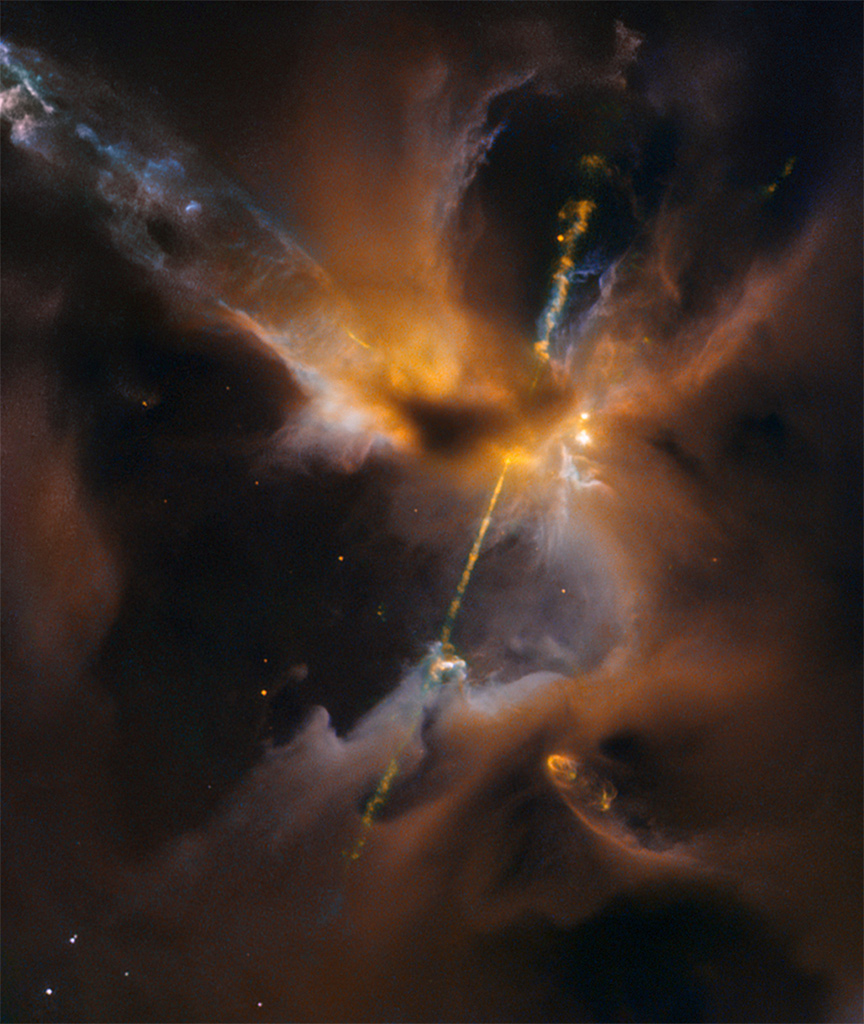
This might look like a double-bladed lightsaber, but these two cosmic jets actually beam outward from a newborn star in a galaxy near you. Constructed from Hubble Space Telescope image data, the stunning scene spans about half a light-year across Herbig-Haro 24 (HH 24), some 1,300 light-years or 400 parsecs away in the stellar nurseries of the Orion B molecular cloud complex. Hidden from direct view, HH 24’s central protostar is surrounded by cold dust and gas flattened into a rotating accretion disk. As material from the disk falls toward the young stellar object, it heats up. Opposing jets are blasted out along the system’s rotation axis. Cutting through the region’s interstellar matter, the narrow, energetic jets produce a series of glowing shock fronts along their path. [via NASA] https://ift.tt/dKTzFvg

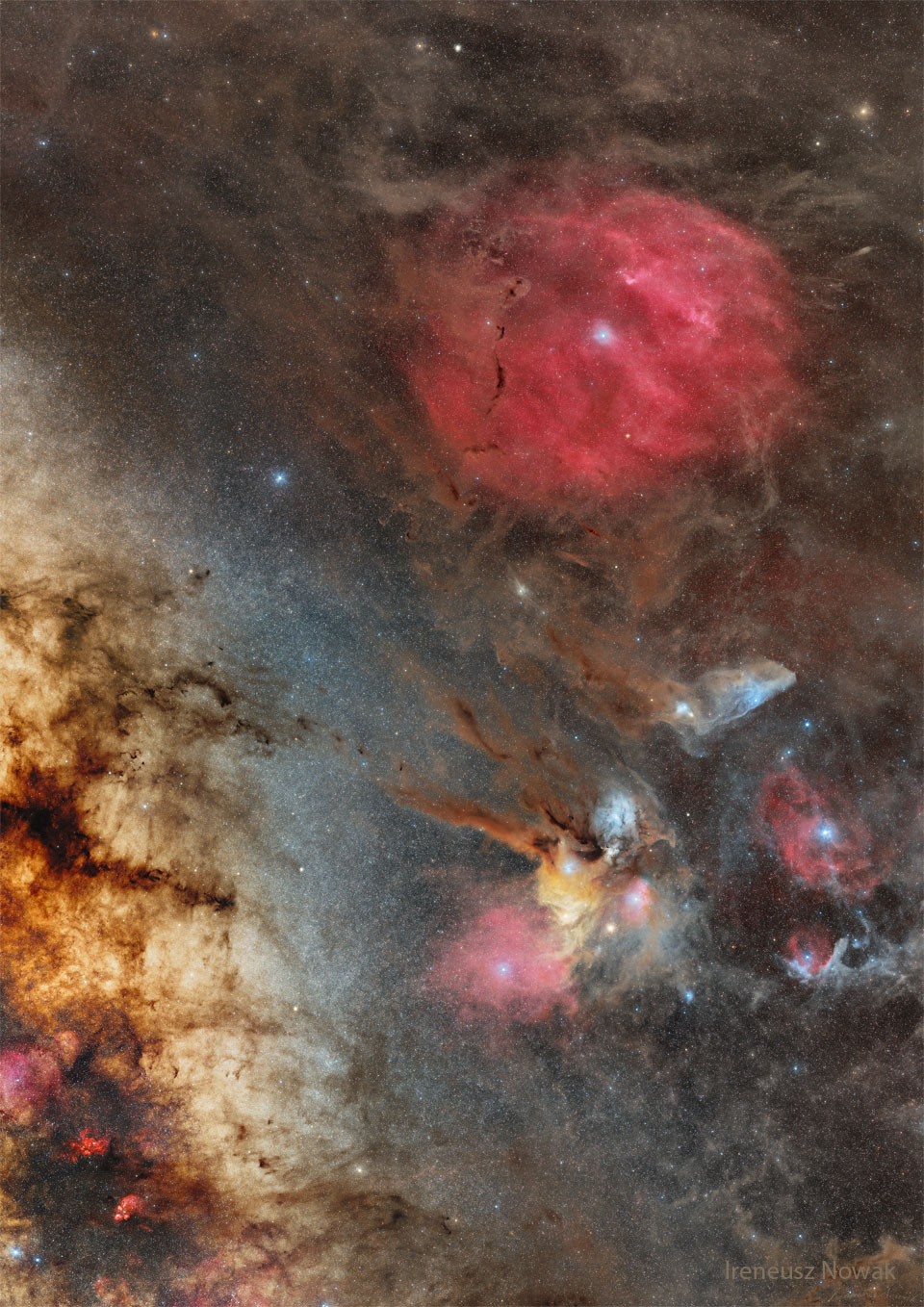
Behold one of the most photogenic regions of the night sky, captured impressively. Featured, the band of our Milky Way Galaxy runs diagonally along the bottom-left corner, while the colorful Rho Ophiuchi cloud complex is visible just right of center and the large red circular Zeta Ophiuchi Nebula appears near the top. In general, red emanates from nebulas glowing in the light of excited hydrogen gas, while blue marks interstellar dust preferentially reflecting the light of bright young stars. Thick dust usually appears dark brown. Many iconic objects of the night sky appear, including (can you find them?) the bright star Antares, the globular star cluster M4, and the Blue Horsehead nebula. This wide field composite, taken over 17 hours, was captured from South Africa last June. [via NASA] https://ift.tt/SKPiC78