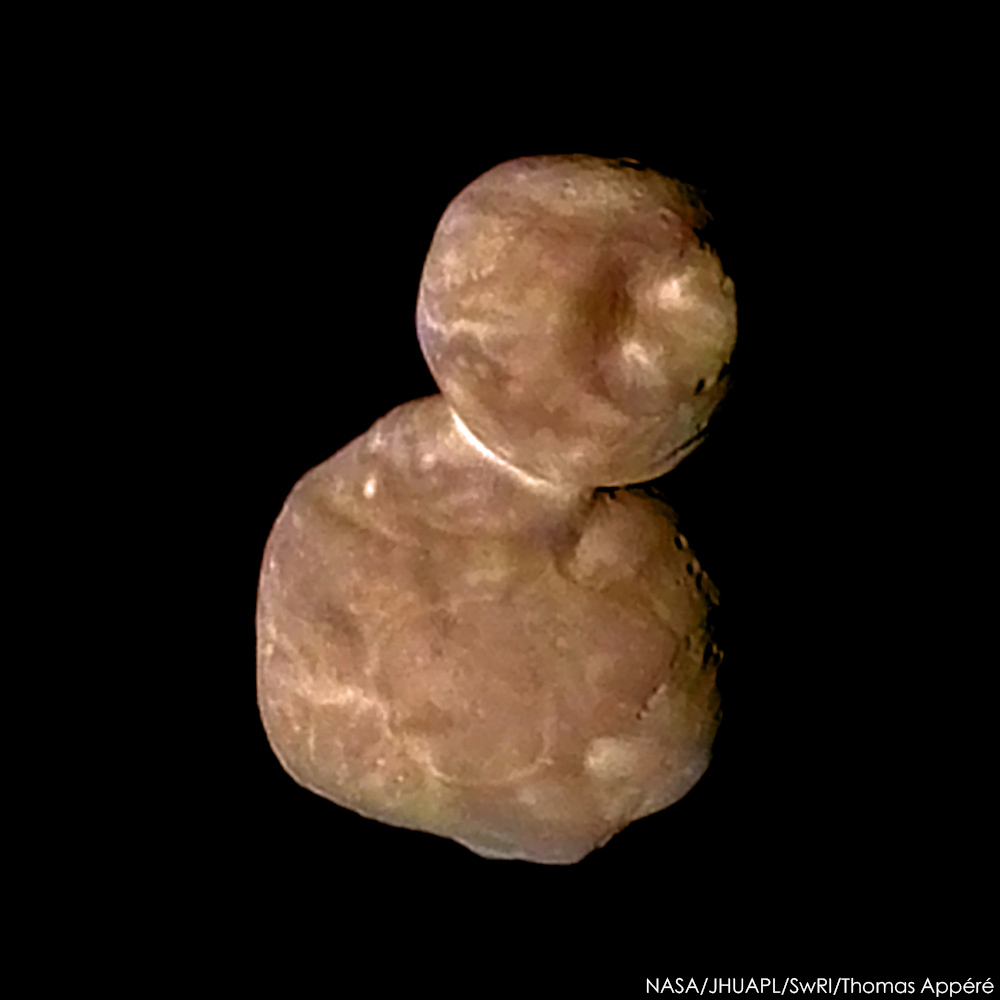
Ultima Thule is the most distant world explored by a spacecraft from Earth. In the dim light 6.5 billion kilometers from the Sun, the New Horizons spacecraft captured these two frames 38 minutes apart as it sped toward the Kuiper belt world on January 1 at 51,000 kilometers per hour. A contact binary, the two lobes of Ultima Thule rotate together once every 15 hours or so. Shown as a blinking gif, the rotation between the frames produces a tantalizing 3D perspective of the most primitive world ever seen. Dubbed separately by the science team Ultima and Thule, the larger lobe Ultima, is about 19 kilometers in diameter. Smaller Thule is 14 kilometers across. [via NASA] https://go.nasa.gov/2R6JMIF

Ultima and Thule

On January 1 New Horizons encountered the Kuiper Belt object nicknamed Ultima Thule. Some 6.5 billion kilometers from the Sun, Ultima Thule is the most distant world ever explored by a spacecraft from Earth. This historic image, the highest resolution image released so far, was made at a range of about 28,000 kilometers only 30 minutes before the New Horizons closest approach. Likely the result of a gentle collision shortly after the birth of the Solar System, Ultima Thule is revealed to be a contact binary, two connected sphere-like shapes held in contact by mutual gravity. Dubbed separately by the science team Ultima and Thule, the larger lobe Ultima is about 19 kilometers in diameter. Smaller Thule is 14 kilometers across. [via NASA] https://go.nasa.gov/2TjLMdk

The Orion Nebula in Infrared from WISE

The Great Nebula in Orion is an intriguing place. Visible to the unaided eye, it appears as a small fuzzy patch in the constellation of Orion. But this image, an illusory-color four-panel mosaic taken in different bands of infrared light with the Earth orbiting WISE observatory, shows the Orion Nebula to be a bustling neighborhood of recently formed stars, hot gas, and dark dust. The power behind much of the Orion Nebula (M42) is the stars of the Trapezium star cluster, seen near the center of the featured image. The orange glow surrounding the bright stars pictured here is their own starlight reflected by intricate dust filaments that cover much of the region. The current Orion Nebula cloud complex, which includes the Horsehead Nebula, will slowly disperse over the next 100,000 years. [via NASA] https://go.nasa.gov/2QdYuII

The Witch Head Nebula

Double, double toil and trouble; Fire burn, and cauldron bubble …. maybe Macbeth should have consulted the Witch Head Nebula. A frighteningly shaped reflection nebula, this cosmic crone is about 800 light-years away though. Its malevolent visage seems to glare toward nearby bright star Rigel in Orion, just off the right edge of this frame. More formally known as IC 2118, the interstellar cloud of dust and gas is nearly 70 light-years across, its dust grains reflecting Rigel’s starlight. In this composite portrait, the nebula’s color is caused not only by the star’s intense bluish light but because the dust grains scatter blue light more efficiently than red. The same physical process causes Earth’s daytime sky to appear blue, although the scatterers in planet Earth’s atmosphere are molecules of nitrogen and oxygen. [via NASA] https://go.nasa.gov/2EYholA

The Galaxy Tree

First came the trees. In the town of Salamanca, Spain, the photographer noticed how distinctive a grove of oak trees looked after being pruned. Next came the galaxy. The photographer stayed up until 2 am, waiting until the Milky Way Galaxy rose above the level of a majestic looking oak. From this carefully chosen perspective, dust lanes in the galaxy appear to be natural continuations to branches of the tree. Last came the light. A flashlight was used on the far side of the tree to project a silhouette. By coincidence, other trees also appeared as similar silhouettes across the relatively bright horizon. The featured image was captured as a single 30-second frame earlier this month and processed to digitally enhance the Milky Way. [via NASA] https://go.nasa.gov/2LLZcwp

New Horizons at Ultima Thule

When we celebrate the start of 2019, on January 1 the New Horizons spacecraft will flyby Ultima Thule. A world of the Kuiper belt 6.5 billion kilometers from the Sun, the nickname Ultima Thule (catalog designation 2014 MU69) fittingly means «beyond the known world». Following its 2015 flyby of Pluto, New Horizons was targeted for this journey, attempting the most distant flyby for a spacecraft from Earth by approaching Ultima Thule to within about 3500 kilometers. The tiny world itself is about 30 kilometers in size. This year, an observing campaign with Earth-based telescopes determined the shape of the object to be a contact binary or a close binary sytem as in this artist’s illustration. New Horizons will image close up its unexplored surface in the dim light of the distant Sun. [via NASA] https://go.nasa.gov/2QbItTP

NGC 1365: Majestic Island Universe

Barred spiral galaxy NGC 1365 is truly a majestic island universe some 200,000 light-years across. Located a mere 60 million light-years away toward the chemical constellation Fornax, NGC 1365 is a dominant member of the well-studied Fornax galaxy cluster. This impressively sharp color image shows intense star forming regions at the ends of the bar and along the spiral arms, and details of dust lanes cutting across the galaxy’s bright core. At the core lies a supermassive black hole. Astronomers think NGC 1365’s prominent bar plays a crucial role in the galaxy’s evolution, drawing gas and dust into a star-forming maelstrom and ultimately feeding material into the central black hole. [via NASA] https://go.nasa.gov/2SlQAPi

NGC 6357: The Lobster Nebula

Why is the Lobster Nebula forming some of the most massive stars known? No one is yet sure. Cataloged as NGC 6357, the Lobster Nebula houses the open star cluster Pismis 24 near its center — a home to unusually bright and massive stars. The overall blue glow near the inner star forming region results from the emission of ionized hydrogen gas. The surrounding nebula, featured here, holds a complex tapestry of gas, dark dust, stars still forming, and newly born stars. The intricate patterns are caused by complex interactions between interstellar winds, radiation pressures, magnetic fields, and gravity. NGC 6357 spans about 400 light years and lies about 8,000 light years away toward the constellation of the Scorpion. [via NASA] https://go.nasa.gov/2EJYLRE

M100: A Grand Design Spiral Galaxy

Majestic on a truly cosmic scale, M100 is appropriately known as a grand design spiral galaxy. It is a large galaxy of over 100 billion stars with well-defined spiral arms that is similar to our own Milky Way Galaxy. One of the brightest members of the Virgo Cluster of galaxies, M100 (alias NGC 4321) is 56 million light-years distant toward the constellation of Berenice’s Hair (Coma Berenices). This Hubble Space Telescope image of M100 was taken recently with the Wide Field Camera 3 and accentuates bright blue star clusters and intricate winding dust lanes which are hallmarks of this class of galaxies. Studies of variable stars in M100 have played an important role in determining the size and age of the Universe. [via NASA] https://go.nasa.gov/2AcD75q

Earthrise 1: Historic Image Remastered

«Oh my God! Look at that picture over there! Here’s the Earth coming up. Wow is that pretty!» Soon after that pronouncement, 50 years ago today, one of the most famous images ever taken was snapped from the orbit of the Moon. Now known as «Earthrise», the iconic image shows the Earth rising above the limb of the Moon, as taken by the crew of Apollo 8. But the well-known Earthrise image was actually the second image taken of the Earth rising above the lunar limb — it was just the first in color. With modern digital technology, however, the real first Earthrise image — originally in black and white — has now been remastered to have the combined resolution and color of the first three images. Behold! The featured image is a close-up of the picture that Apollo 8 astronaut Bill Anders was talking about. Thanks to modern technology and human ingenuity, now we can all see it. (Historical note: A different historic black & white image of the Earth setting behind the lunar limb was taken by the robotic Lunar Orbiter 1 two years earlier.) [via NASA] https://go.nasa.gov/2BCp2hx