This pretty nebula lies some 1,500 light-years away, its shape and color in this telescopic view reminiscent of a robin’s egg. The cosmic cloud spans about 3 light-years, nestled securely within the boundaries of the southern constellation of the Furnace (Fornax). Recognized as a planetary nebula, egg-shaped NGC 1360 doesn’t represent a beginning, though. Instead, it corresponds to a brief and final phase in the evolution of an aging star. In fact, visible at the center of the nebula, the central star of NGC 1360 is known to be a binary star system likely consisting of two evolved white dwarf stars, less massive but much hotter than the Sun. Their intense and otherwise invisible ultraviolet radiation has stripped away electrons from the atoms in their mutually surrounding gaseous shroud. The blue-green hue inside of NGC 1360 seen here is the strong emission produced as electrons recombine with doubly ionized oxygen atoms. [via NASA] https://ift.tt/StMuC02

What does our Milky Way Galaxy look like from the top? Because we are on the inside, humanity can’t get an actual picture. Recently, however, just such a map has been made using location data for over a billion stars from ESA’s Gaia mission. The resulting featured illustration shows that just like manyotherspiralgalaxies, our Milky Way has distinct spiral arms. Our Sun and most of the bright stars we see at night are in just one arm: Orion. Gaia data bolsters previous indications that our Milky Way has more than two spiral arms. Our Galaxy’s center sports a prominent bar. The colors of our Galaxy’s thin disk derive mostly from dark dust, bright blue stars, and red emission nebula. Although data analysis is ongoing, Gaia was deactivated in March after a succession mission. [via NASA] https://ift.tt/ZR7SYDv

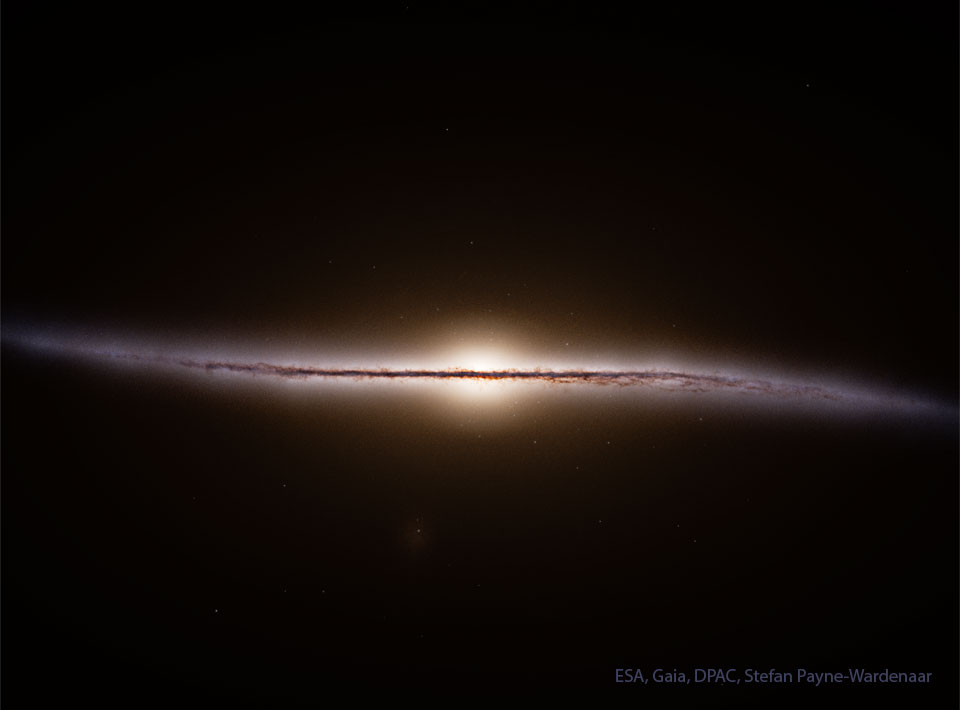
What does our Milky Way Galaxy look like from the side? Because we are on the inside, humanity can’t get an actual picture. Recently, however, just such a map has been made using location data for over a billion stars from ESA’s Gaia mission. The resulting featured illustration shows that just like manyotherspiralgalaxies, our Milky Way has a very thin central disk. Our Sun and all the stars we see at night are in this disk. Although hypothesized before, perhaps more surprising is that the disk appears curved at the outer edges. The colors of our Galaxy’s warped central band derive mostly from dark dust, bright blue stars, and red emission nebulas. Although data analysis is ongoing, Gaia was deactivated in March after a successful mission. [via NASA] https://ift.tt/8Mr6oxI

If you could stand on Venus — what would you see? Pictured is the view from Venera 14, a robotic Soviet lander which parachuted and air-braked down through the thick Venusian atmosphere in March of 1982. The desolate landscape it saw included flat rocks, vast empty terrain, and a featureless sky above Phoebe Regio near Venus’ equator. On the lower left is the spacecraft’s penetrometer used to make scientific measurements, while the light piece on the right is part of an ejected lens-cap. Enduring temperatures near 450 degrees Celsius and pressures 75 times that on Earth, the hardened Venera spacecraft lasted only about an hour. Although data from Venera 14 was beamed across the inner Solar System over 40 years ago, digital processing and merging of Venera’s unusual images continues even today. Recent analyses of infrared measurements taken by ESA’s orbiting Venus Express spacecraft indicate that active volcanoes may currently exist on Venus. [via NASA] https://ift.tt/Dg9M1j6

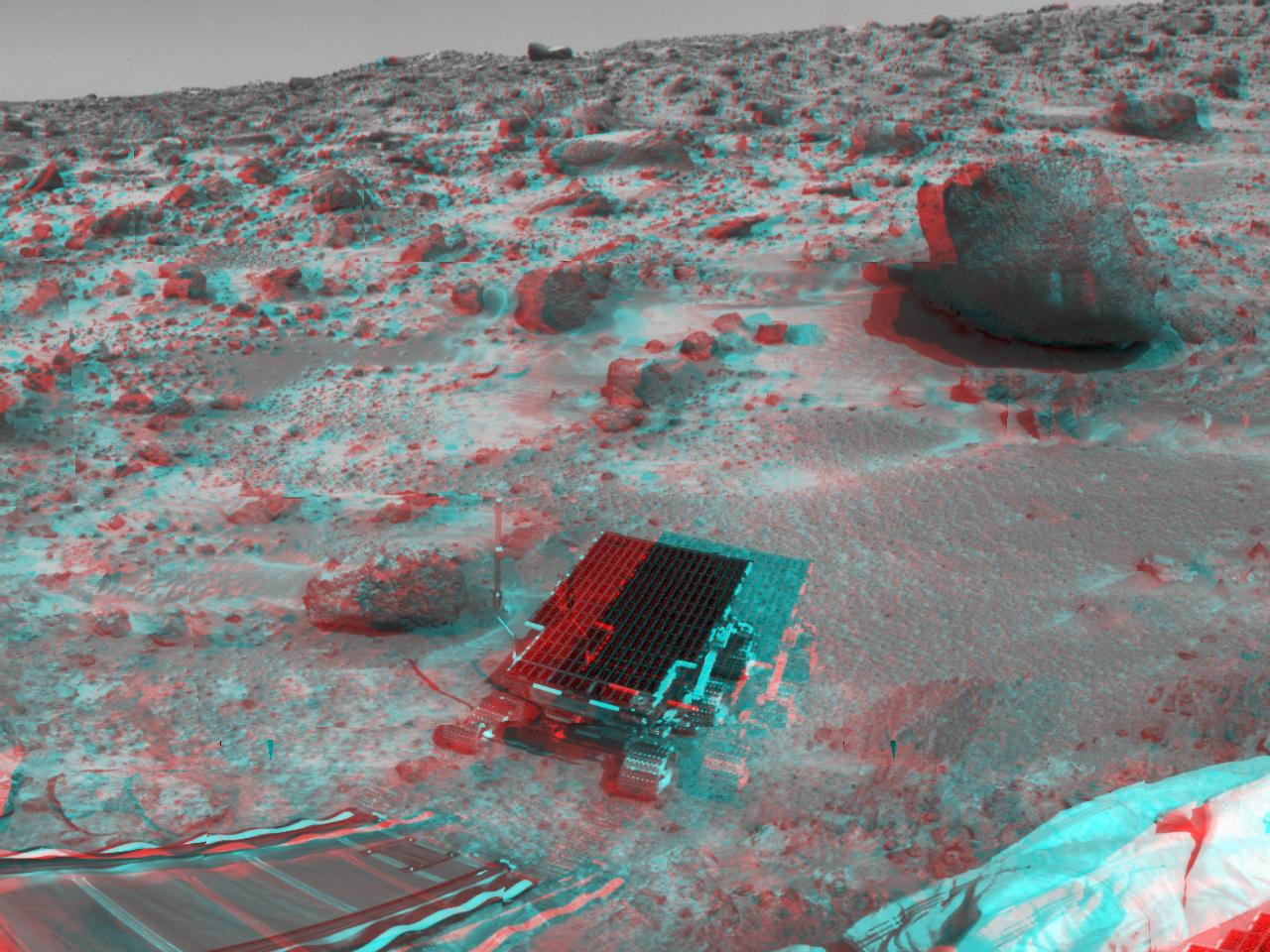
Yogi and Friends in 3D

This picture from July 1997 shows a ramp from the Pathfinder lander, the Sojourner robot rover, deflated landing airbags, a couch, Barnacle Bill and Yogi Rock appear together in this 3D stereo view of the surface of Mars. Barnacle Bill is the rock just left of the house cat-sized, solar-paneled Sojourner. Yogi is the big friendly-looking boulder at top right. The «couch» is the angular rock shape visible near center on the horizon. Look at the image with red/blue glasses (or just hold a piece of clear red plastic over your left eye and blue or green over your right) to get the dramatic 3D perspective. The stereo view was recorded by the remarkable Imager for Mars Pathfinder (IMP) camera. The IMP had two optical paths for stereo imaging and ranging and was equipped with an array of color filters for spectral analysis. Operating as the first astronomical observatory on Mars, the IMP also recorded images of the Sun and Deimos, the smallest of Mars’ two tiny moons. [via NASA] https://ift.tt/kBynxPZ

How do black holes create X-rays? Answering this long-standing question was significantly advanced recently with data taken by NASA’s IXPE satellite. X-rays cannot exit a black hole, but they can be created in the energetic environment nearby, in particular by a jet of particles moving outward. By observing X-ray light arriving from near the supermassive black hole at the center of galaxy BL Lac, called a blazar, it was discovered that these X-rays lacked significant polarization, which is expected when created more by energetic electrons than protons. In the featured artistic illustration, a powerful jet is depicted emanating from an orange-colored accretion disk circling the black hole. Understanding highly energetic processes across the universe helps humanity to understand similarprocesses that occur on or near our Earth. [via NASA] https://ift.tt/03QCWUn

M1: The Incredible Expanding Crab

Cataloged as M1, the Crab Nebula is the first on Charles Messier’s famous list of things which are not comets. In fact, the Crab Nebula is now known to be a supernova remnant, an expanding cloud of debris from the death explosion of a massive star. The violent birth of the Crab was witnessed by astronomers in the year 1054. Roughly 10 light-years across, the nebula is still expanding at a rate of about 1,500 kilometers per second. You can see the expansion by comparing these sharp images from the Hubble Space Telescope and James Webb Space Telescope. The Crab’s dynamic, fragmented filaments were captured in visible light by Hubble in 2005 and Webb in infrared light in 2023. This cosmic crustacean lies about 6,500 light-years away in the constellation Taurus. [via NASA] https://ift.tt/ZlsD7UV

In the upper left corner, surrounded by blue arms and dotted with red nebulas, is spiral galaxy M81. In the lower right corner, marked by a light central line and surrounded by red glowing gas, is irregular galaxy M82. This stunning vista shows these two mammoth galaxies locked in gravitational combat, as they have been for the past billion years. The gravity from each galaxy dramatically affects the other during each hundred-million-year pass. Last go-round, M82’s gravity likely raised density waves rippling around M81, resulting in the richness of M81’s spiral arms. But M81 left M82 with violent star forming regions and colliding gas clouds so energetic the galaxy glows in X-rays. This big battle is seen from Earth through the faint glow of an Integrated Flux Nebula, a little studied complex of diffuse gas and dust clouds in our Milky Way Galaxy. In a few billion years, only one galaxy will remain. [via NASA] https://ift.tt/q2RYBuZ

If one black hole looks strange, what about two? Light rays from accretion disks around a pair of orbiting supermassive black holes make their way through the warped space-time produced by extreme gravity in this detailed computer visualization. The simulated accretion disks have been given different false color schemes, red for the disk surrounding a 200-million-solar-mass black hole, and blue for the disk surrounding a 100-million-solar-mass black hole. For these masses, though, both accretion disks would actually emit most of their light in the ultraviolet. The video allows us to see both sides of each black hole at the same time. Red and blue light originating from both black holes can be seen in the innermost ring of light, called the photon sphere, near their event horizons. In the past decade, gravitational waves from black hole collisions have actually been detected, although the coalescence of supermassive black holes remains undiscovered. [via NASA] https://ift.tt/r2EzafC

What’s causing those lines? Objects in the sky sometimes appear reflected as lines across water — but why? If the water’s surface is smooth, then reflected objects would appear similarly — as spots. But if the water is choppy, then there are many places where light from the object can reflect off the water and still come to you — and so together form, typically, a line. The same effect is frequently seen for the Sun just before sunset and just after sunrise. Pictured about 10 days ago in Ibiza, Spain, images of the setting Moon, Venus (top), and Saturn (right, faint) were captured both directly and in line-reflected forms from the Mediterranean Sea. The other bright object on the right with a water-reflected line is a beacon on a rock to warn passing boats. [via NASA] https://ift.tt/ZKmclCH