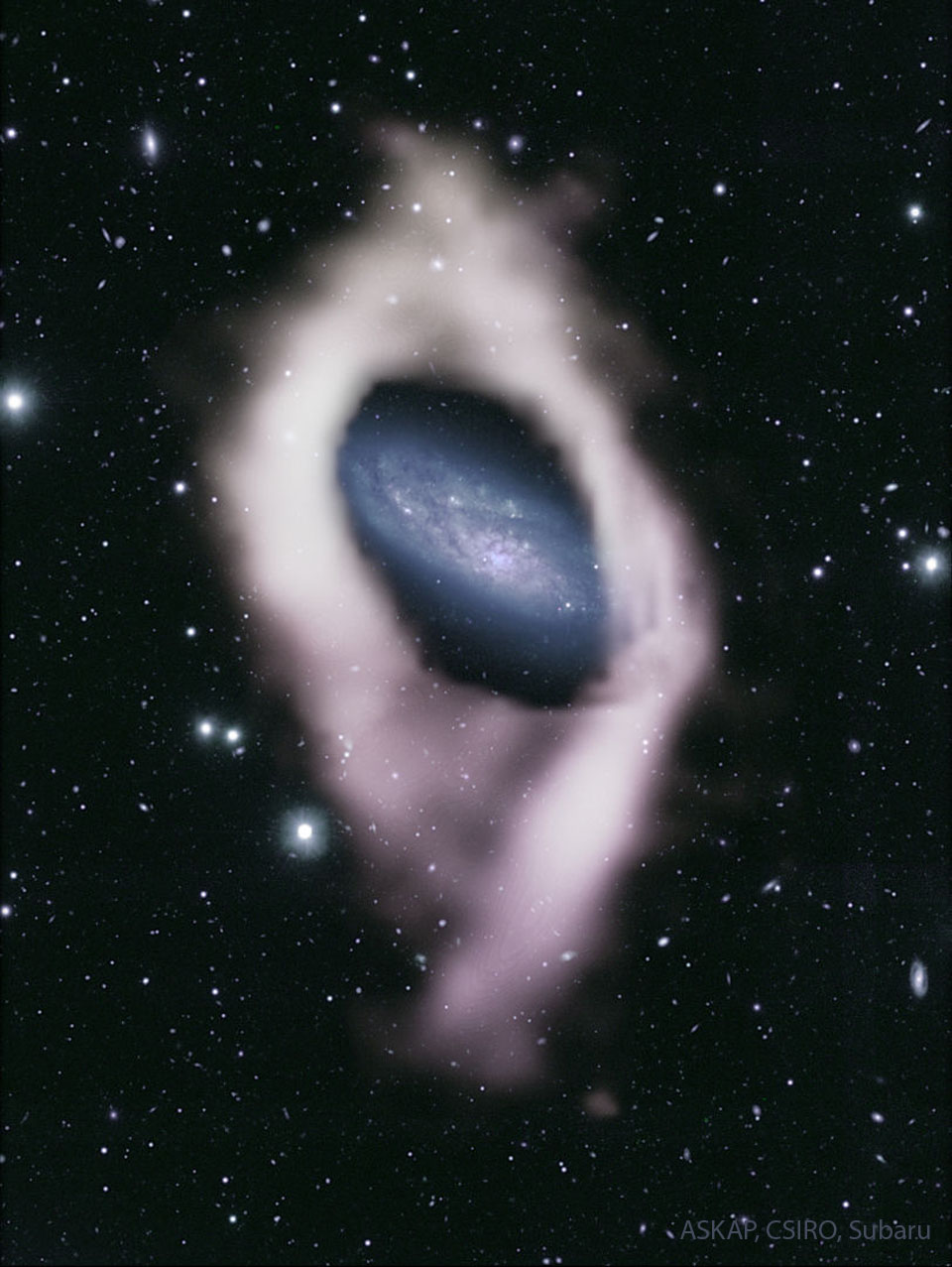
Galaxy NGC 4632 hides a secret from optical telescopes. It is surrounded by a ring of cool hydrogen gas orbiting at 90 degrees to its spiral disk. Such polar ring galaxies have previously been discovered using starlight. However, NGC 4632 is among the first in which a radio telescope survey revealed a polar ring. The featured composite image combines this gas ring, observed with the highly sensitive ASKAP telescope, with optical data from the Subaru telescope. Using virtual reality, astronomers separated out the gas in the main disk of the galaxy from the ring, and the subtle color gradient traces its orbital motion. Why do polar rings exist? They could be material pulled from one galaxy as it gravitationally interacts with a companion. Or hydrogen gas flows along the filaments of the cosmic web and accretes into a ring around a galaxy, some of which gravitationally contracts into stars. [via NASA] https://ift.tt/8q2pm4r
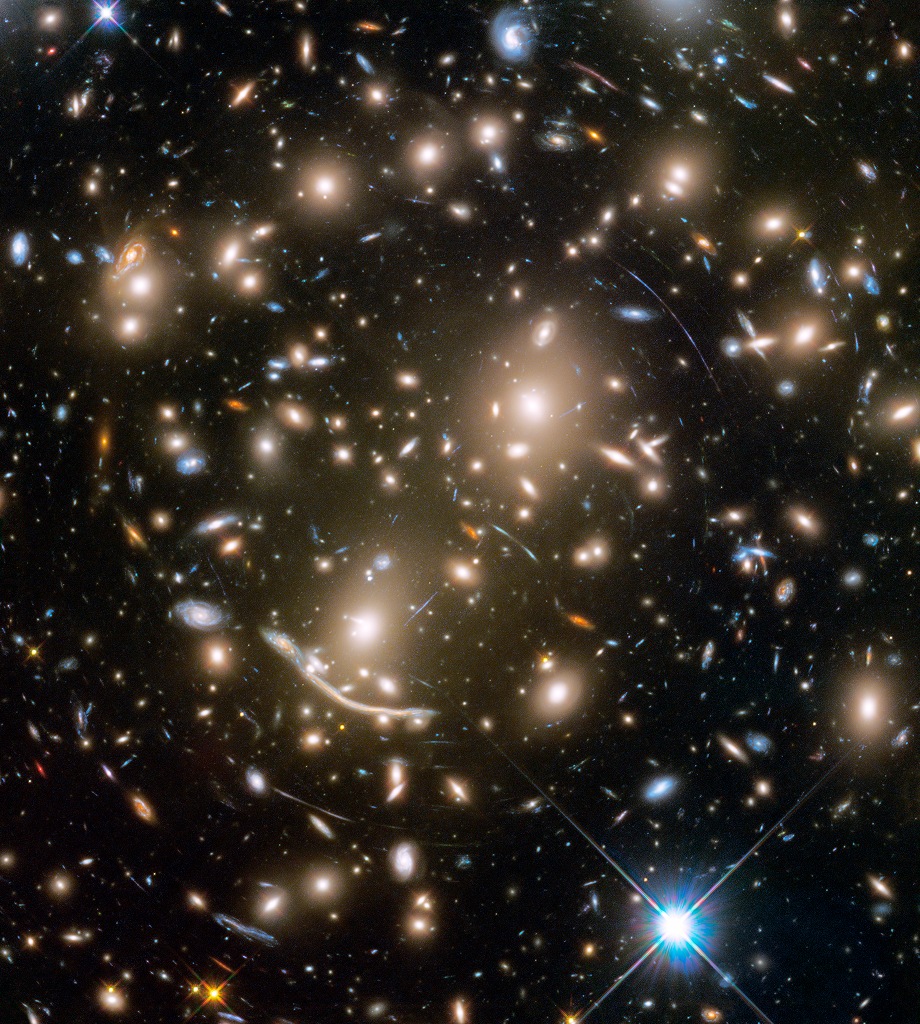
Galaxy Cluster Abell 370 and Beyond

Some 4 billion light-years away, massive galaxy cluster Abell 370 is captured in this sharp Hubble Space Telescope snapshot. The cluster of galaxies only appears to be dominated by two giant elliptical galaxies and infested with faint arcs. In reality, the fainter, scattered bluish arcs, along with the dramatic dragon arc below and left of center, are images of galaxies that lie far beyond Abell 370. About twice as distant, their otherwise undetected light is magnified and distorted by the cluster’s enormous gravitational mass, overwhelmingly dominated by unseen dark matter. Providing a tantalizing glimpse of galaxies in the early universe, the effect is known as gravitational lensing. A consequence of warped spacetime, lensing was predicted by Einstein almost a century ago. Far beyond the spiky foreground Milky Way star at lower right, Abell 370 is seen toward the constellation Cetus, the Sea Monster. It was the last of six galaxy clusters imaged in the Frontier Fields project. [via NASA] https://ift.tt/Nxl3R6P

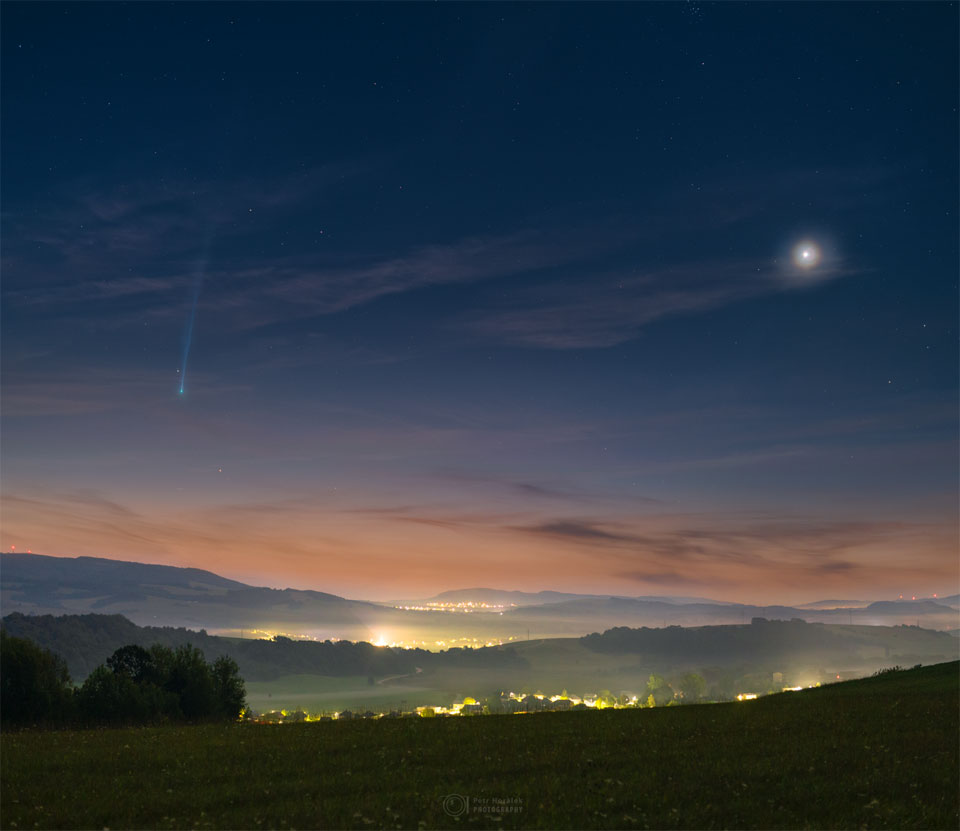
This scene would be beautiful even without the comet. By itself, the sunrise sky is an elegant deep blue on high, with faint white stars peeking through, while near the horizon is a pleasing tan. By itself, the foreground hills of eastern Slovakia are appealingly green, with the Zadňa hura and Veľká hora hills in the distance, and with the lights of small towns along the way. Venus, by itself on the right, appears unusually exquisite, surrounded by a colorful atmospheric corona. But what attracts the eye most is the comet. On the left, in this composite image taken just before dawn yesterday morning, is Comet Nishimura. On recent mornings around the globe, its bright coma and long ion tail make many a morning panoramic photo unusually beautiful. Tomorrow, C/2023 P1 (Nishimura) will pass its nearest to the Earth for about the next 434 years. [via NASA] https://ift.tt/tjIvL3a

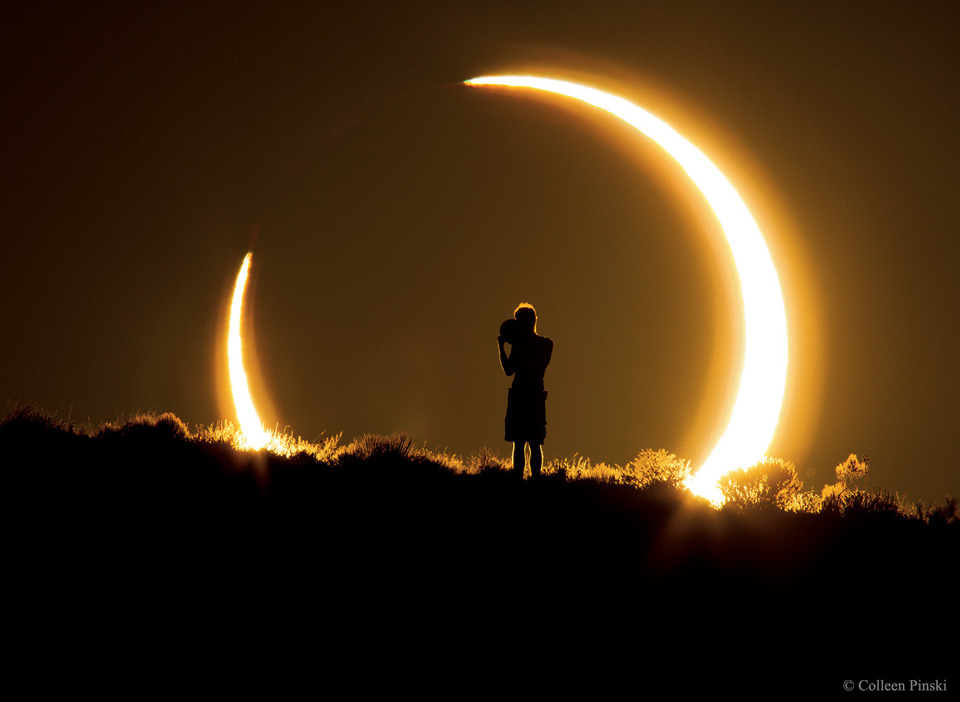
What is this person doing? In 2012, an annular eclipse of the Sun was visible over a narrow path that crossed the northern Pacific Ocean and several western US states. In an annular solar eclipse, the Moon is too far from the Earth to block out the entire Sun, leaving the Sun peeking out over the Moon’s disk in a ring of fire. To capture this unusual solar event, an industrious photographer drove from Arizona to New Mexico to find just the right vista. After setting up and just as the eclipsed Sun was setting over a ridge about 0.5 kilometers away, a person unknowingly walked right into the shot. Although grateful for the unexpected human element, the photographer never learned the identity of the silhouetted interloper. It appears likely that the person is holding a circular device that would enable them to get their own view of the eclipse. The shot was taken at sunset on 2012 May 20 at 7:36 pm local time from a park near Albuquerque. Next month, on October 14, a different narrow swath across North and South America will be exposed to a different annular solar eclipse, if the sky is clear. Simultaneously, cloud-free observers almost anywhere on either continent will be able to see a partial solar eclipse. [via NASA] https://ift.tt/RYCi69l

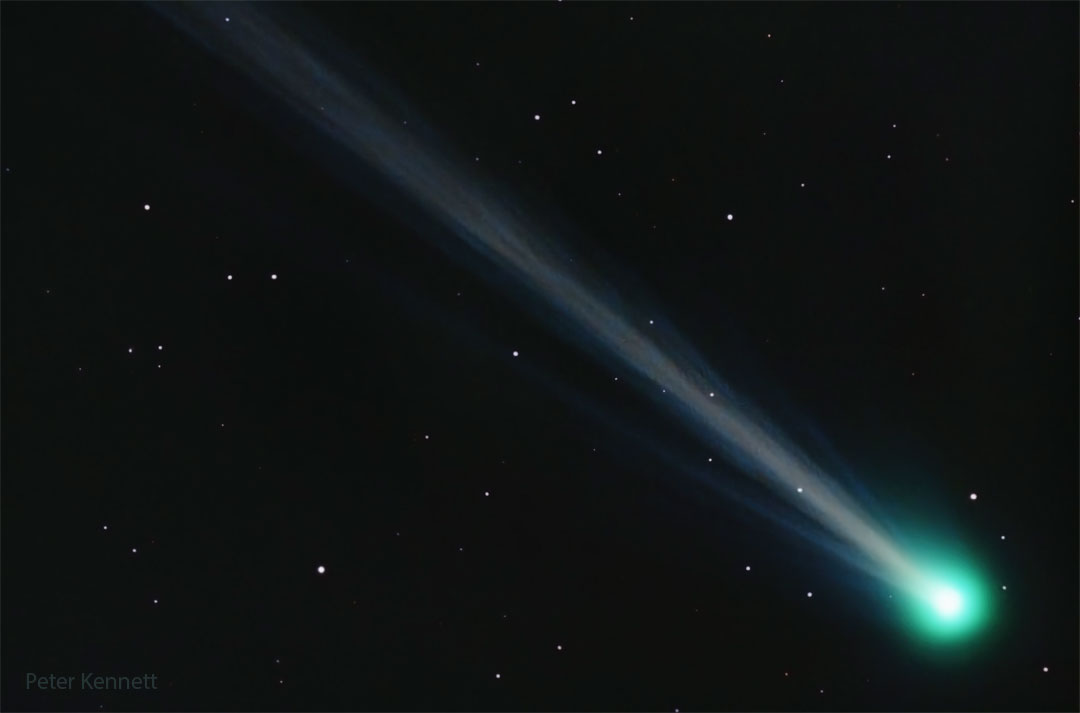
Comet Nishimura is growing. More precisely, the tails C/2023 P1 (Nishimura) are growing as it nears the Sun. Discovered only last month, the comet is already near naked eye brightness as it now moves inside the Earth’s orbit. The comet will be nearest the Earth next week, but nearest the Sun the week after — on September 17. Speculation holds that expelled ice and dust from Comet Nishimura’s last visit to the inner Solar System may have created the Sigma Hydrids meteor shower which peaks yearly in December. If so, then this meteor shower may become more active, refreshed with new comet debris. Pictured, Comet Nishimura was captured from Edgewood, New Mexico, USA four nights ago, showing a long ion tail structured by interactions with the Sun’s wind. Look for this comet near your eastern horizon just before sunrise for the next few mornings, but very near your western horizon just after sunset next week — as its coma continues to brighten and its tails continue to grow. [via NASA] https://ift.tt/IJ17EVa

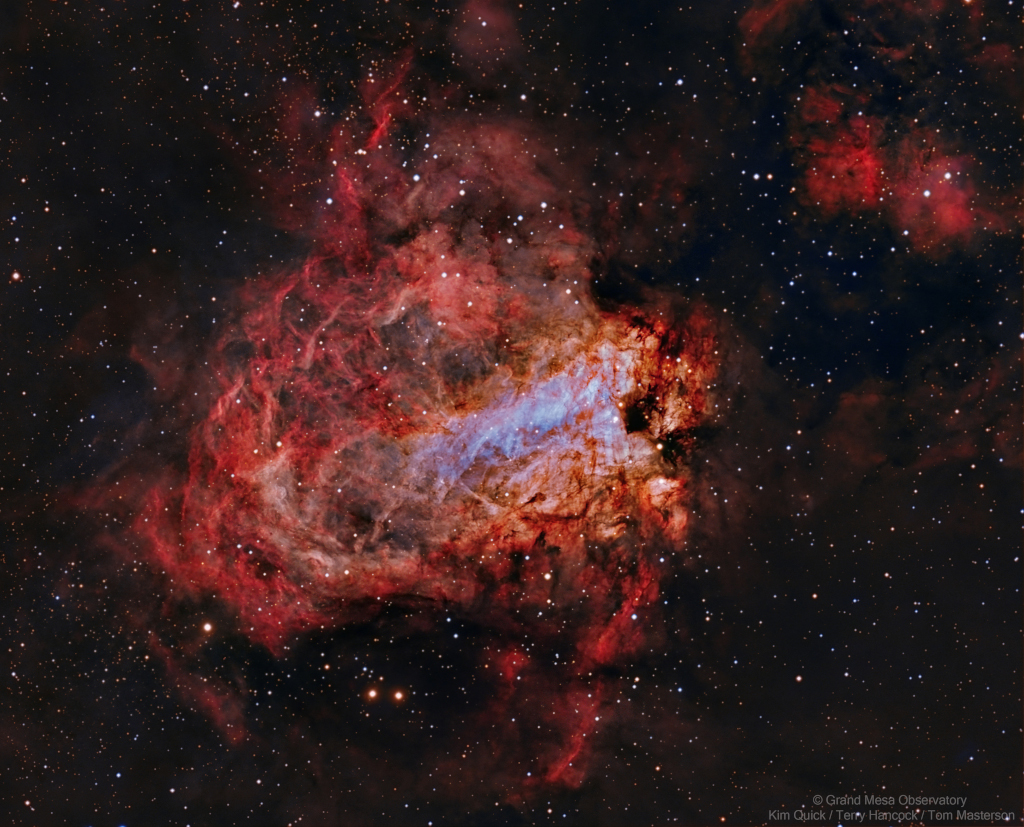
Star Factory Messier 17

Sculpted by stellar winds and radiation, the star factory known as Messier 17 lies some 5,500 light-years away in the nebula-rich constellation Sagittarius. At that distance, this 1/3 degree wide field of view spans over 30 light-years. The sharp composite, color image highlights faint details of the region’s gas and dust clouds against a backdrop of central Milky Way stars. Stellar winds and energetic light from hot, massive stars formed from M17’s stock of cosmic gas and dust have slowly carved away at the remaining interstellar material, producing the cavernous appearance and undulating shapes. M17 is also known as the Omega Nebula or the Swan Nebula. [via NASA] https://ift.tt/fjwF1qW

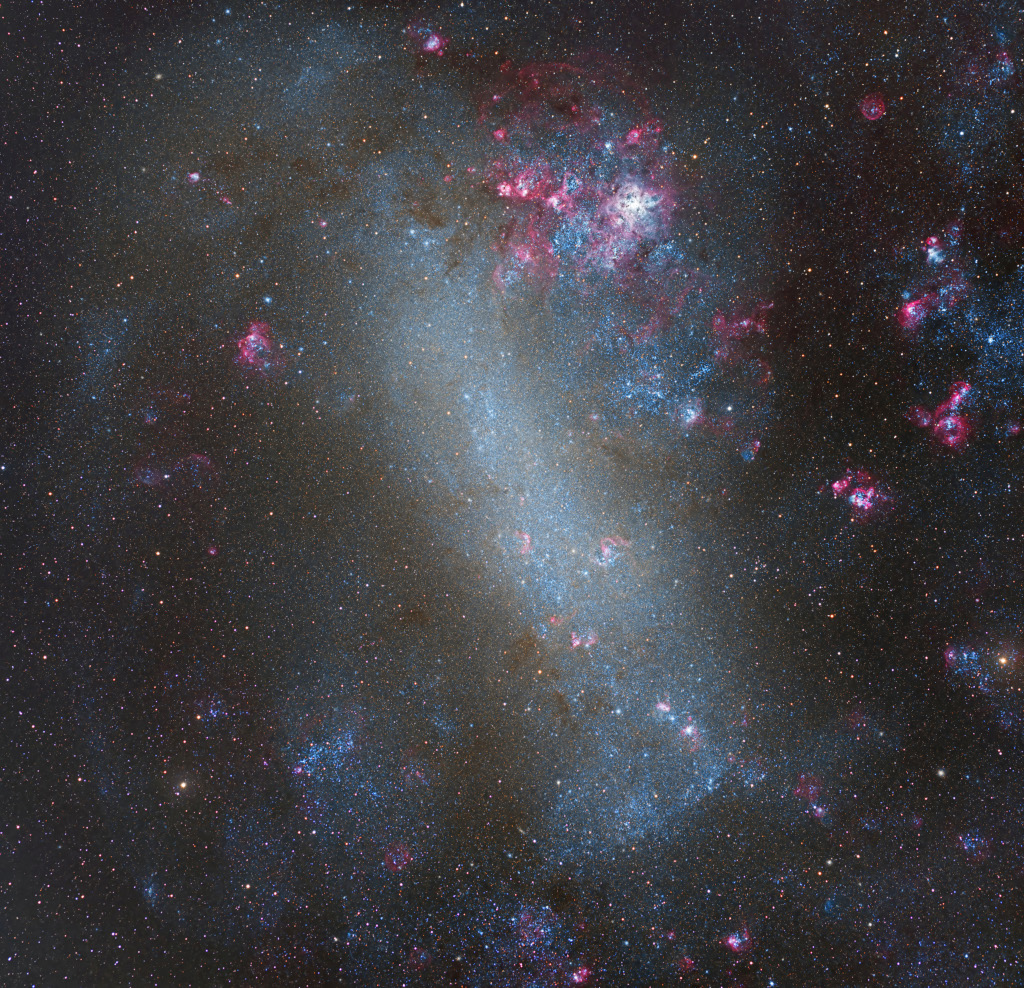
The Large Cloud of Magellan

The 16th century Portuguese navigator Ferdinand Magellan and his crew had plenty of time to study the southern sky during the first circumnavigation of planet Earth. As a result, two fuzzy cloud-like objects easily visible to southern hemisphere skygazers are known as the Clouds of Magellan, now understood to be satellite galaxies of our much larger, spiral Milky Way galaxy. About 160,000 light-years distant in the constellation Dorado, the Large Magellanic Cloud is seen in this sharp galaxy portrait. Spanning about 15,000 light-years or so, it is the most massive of the Milky Way’s satellite galaxies and is the home of the closest supernova in modern times, SN 1987A. The prominent patch above center is 30 Doradus, also known as the magnificent Tarantula Nebula, a giant star-forming region about 1,000 light-years across. [via NASA] https://ift.tt/QMrdN4O

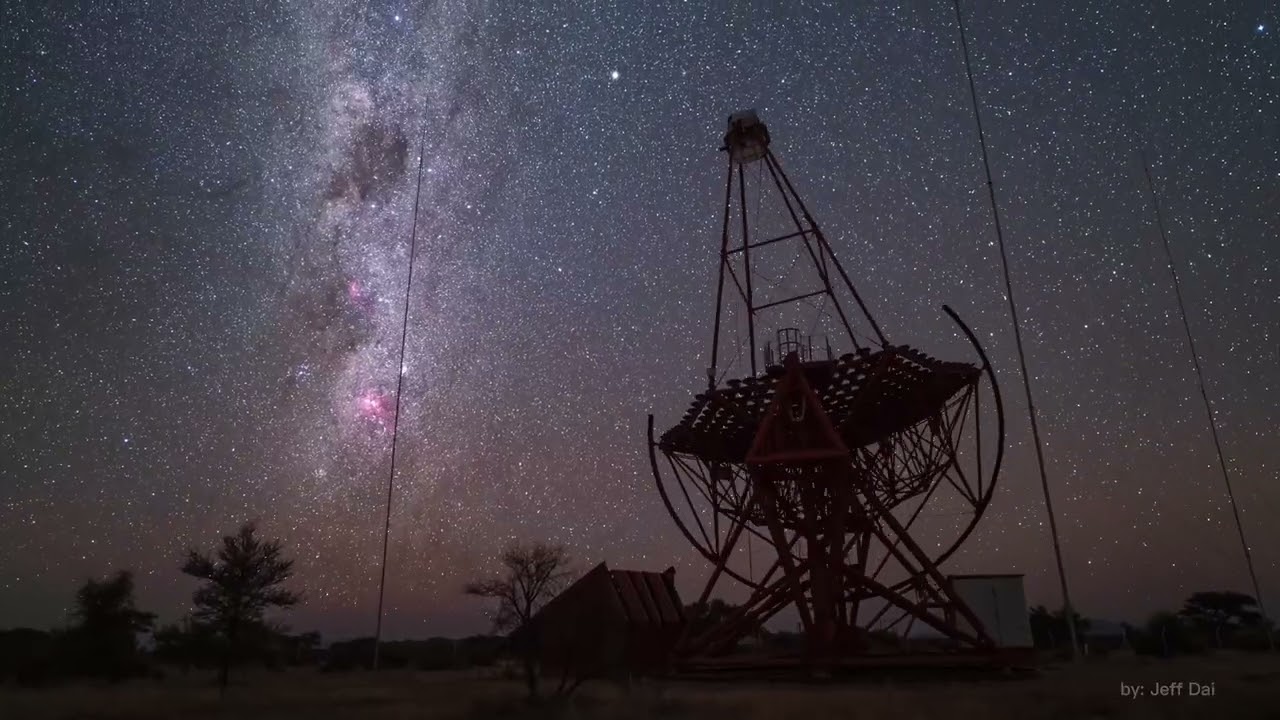
They may look like modern mechanical dinosaurs, but they are enormous swiveling eyes that watch the sky. The High Energy Stereoscopic System (H.E.S.S.) Observatory is composed of four 12-meter reflecting-mirror telescopes surrounding a larger telescope housing a 28-meter mirror. They are designed to detect strange flickers of blue light — Cherenkov radiation –emitted when charged particles move slightly faster than the speed of light in air. This light is emitted when a gamma ray from a distant source strikes a molecule in Earth’s atmosphere and starts a charged-particle shower. H.E.S.S. is sensitive to some of the highest energy photons (TeV) crossing the universe. Operating since 2003 in Namibia, H.E.S.S. has searched for dark matter and has discovered over 50 sources emitting high energy radiation including supernova remnants and the centers of galaxies that contain supermassive black holes. Pictured in June, H.E.S.S. telescopes swivel and stare in time-lapse sequences shot in front of our Milky Way Galaxy and the Magellanic Clouds — as the occasional Earth-orbiting satellite zips by. [via NASA] https://ift.tt/MqFeIfE

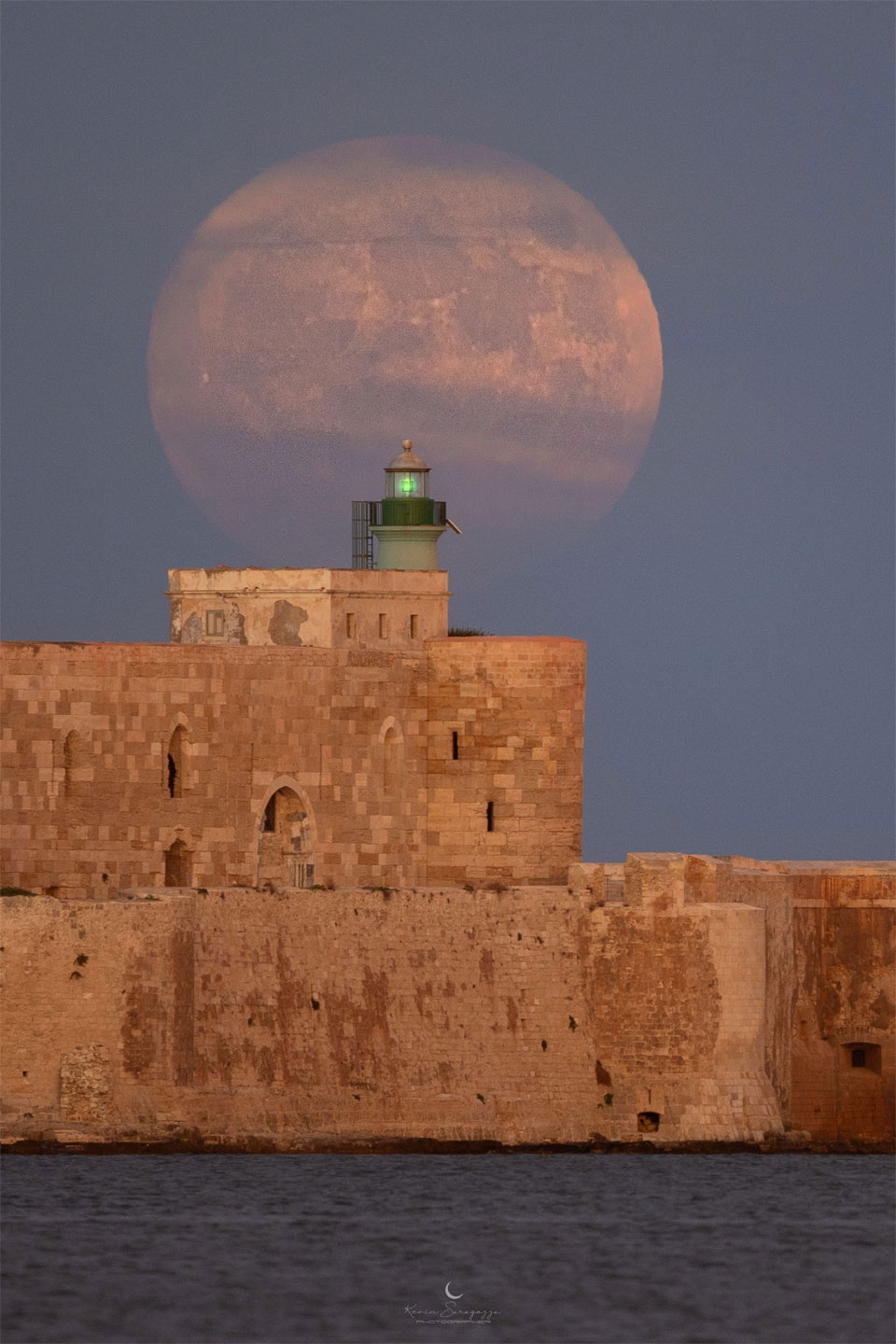
The last full moon was doubly unusual. First of all, it was a blue moon. A modern definition of a blue moon is a second full moon to occur during one calendar month. Since there are 13 full moons in 2023, one month has to have two — and that month was August. The first full moon was on August 1 and named a Sturgeon Moon. The second reason that the last full moon was unusual was because it was a supermoon. A modern definition of supermoon is a moon that reaches its full phase when it is relatively close to Earth — and so appears a bit larger and brighter than average. Pictured, the blue supermoon of 2023 was imaged hovering far behind a historic castle and lighthouse in Syracuse, Sicily, Italy. [via NASA] https://ift.tt/RPnsl4C

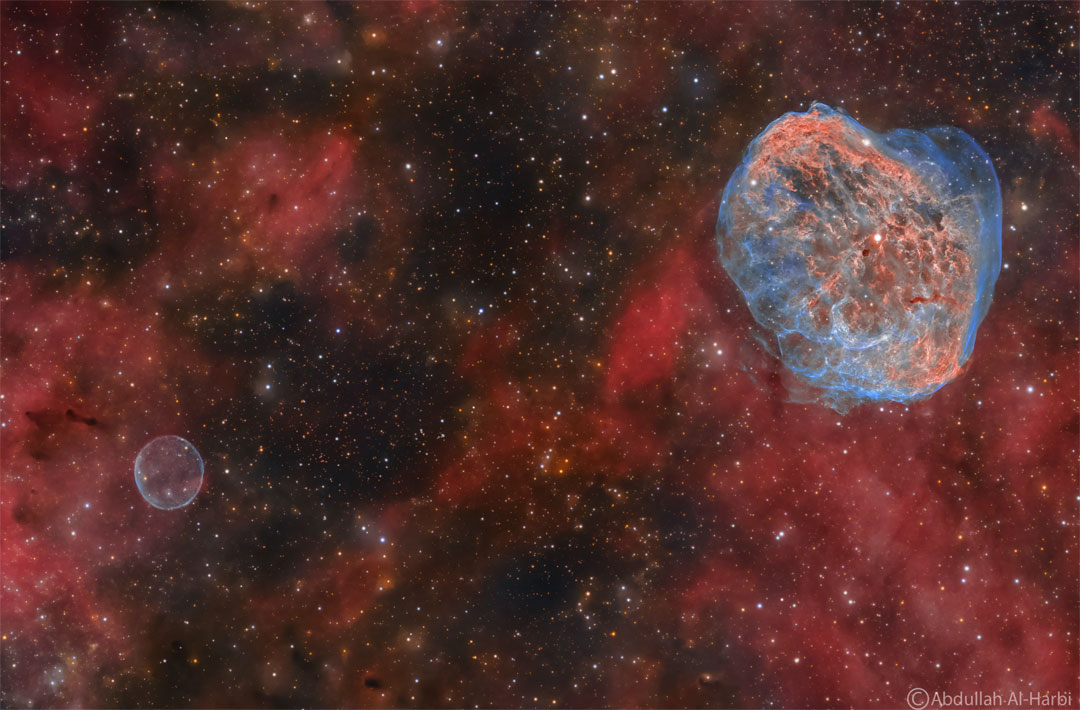
As stars die, they create clouds. Two stellar death clouds of gas and dust can be found toward the high-flying constellation of the Swan (Cygnus) as they drift through rich star fields in the plane of our Milky Way Galaxy. Caught here within the telescopic field of view are the Soap Bubble (lower left) and the Crescent Nebula (upper right). Both were formed at the final phase in the life of a star. Also known as NGC 6888, the Crescent Nebula was shaped as its bright, central massive Wolf-Rayet star, WR 136, shed its outer envelope in a strong stellar wind. Burning through fuel at a prodigious rate, WR 136 is near the end of a short life that should finish in a spectacular supernova explosion. Discovered in 2013, the Soap Bubble Nebula is likely a planetary nebula, the final shroud of a lower mass, long-lived, Sun-like star destined to become a slowly cooling white dwarf. Both stellar nebulas are about 5,000 light-years distant, with the larger Crescent Nebula spanning about 25 light-years across. Within a few million years, both will likely have dispersed. [via NASA] https://ift.tt/wRkgCT7