Zodiacal Light and Mars

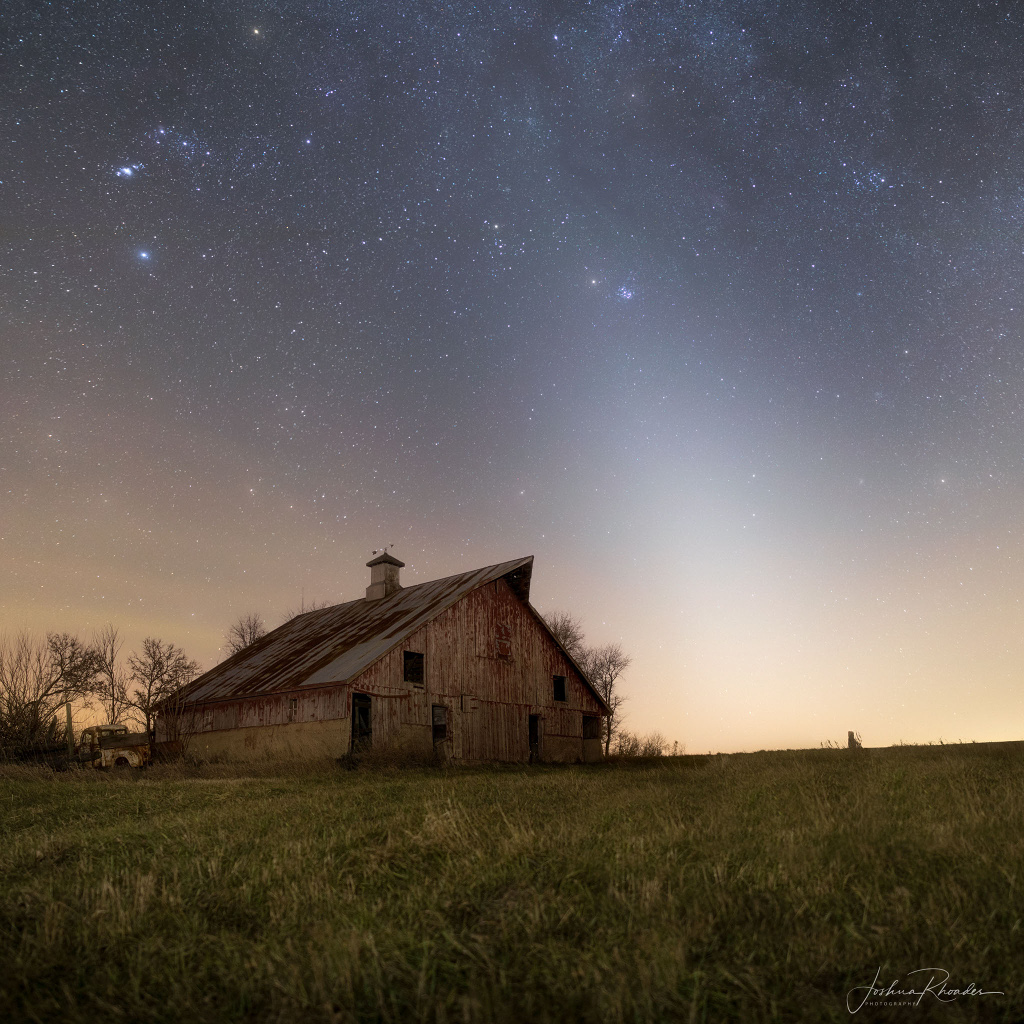
Just after sunset on March 7, a faint band of light still reaches above the western horizon in this serene, rural Illinois, night skyscape. Taken from an old farmstead, the luminous glow is zodiacal light, prominent in the west after sunset during planet Earth’s northern hemisphere spring. On that clear evening the band of zodiacal light seems to engulf bright yellowish Mars and the Pleiades star cluster. Their close conjunction is in the starry sky above the old barn’s roof. Zodiacal light is sunlight scattered by interplanetary dust particles that lie near the Solar System’s ecliptic plane. Of course all the Solar System’s planets orbit near the plane of the ecliptic, within the band of zodiacal light. But zodiacal light and Mars may have a deeper connection. A recent analysis of serendipitous detections of interplanetary dust by the Juno spacecraft during its Earth to Jupiter voyage suggest Mars is the likely source of the dust that produces zodiacal light. [via NASA] https://ift.tt/38u50a8
NGC 1499: The California Nebula

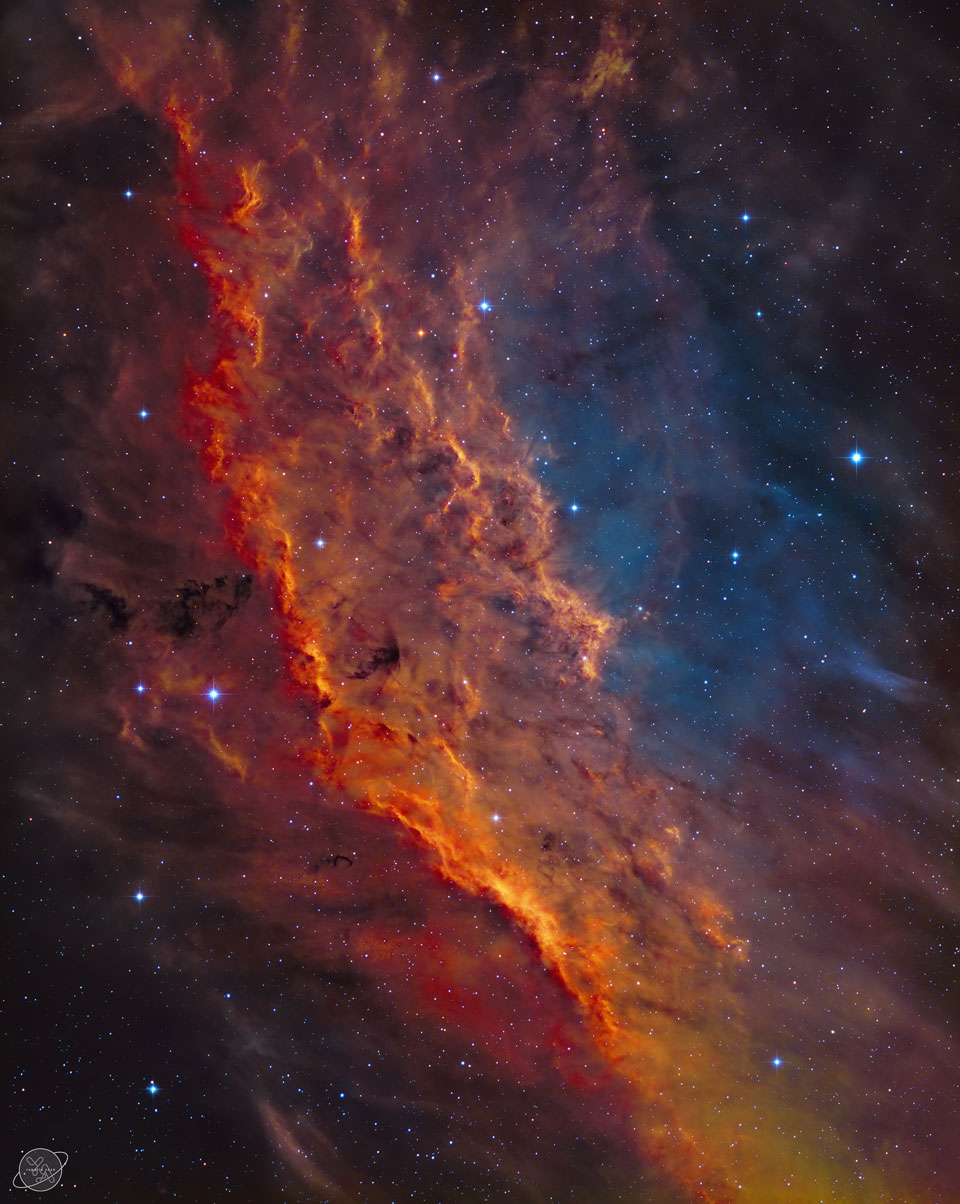
Could Queen Calafia’s mythical island exist in space? Perhaps not, but by chance the outline of this molecular space cloud echoes the outline of the state of California, USA. Our Sun has its home within the Milky Way’s Orion Arm, only about 1,000 light-years from the California Nebula. Also known as NGC 1499, the classic emission nebula is around 100 light-years long. On the featured image, the most prominent glow of the California Nebula is the red light characteristic of hydrogen atoms recombining with long lost electrons, stripped away (ionized) by energetic starlight. The star most likely providing the energetic starlight that ionizes much of the nebular gas is the bright, hot, bluish Xi Persei just to the right of the nebula. A regular target for astrophotographers, the California Nebula can be spotted with a wide-field telescope under a dark sky toward the constellation of Perseus, not far from the Pleiades. [via NASA] https://ift.tt/3l9sFly

Three Tails of Comet NEOWISE

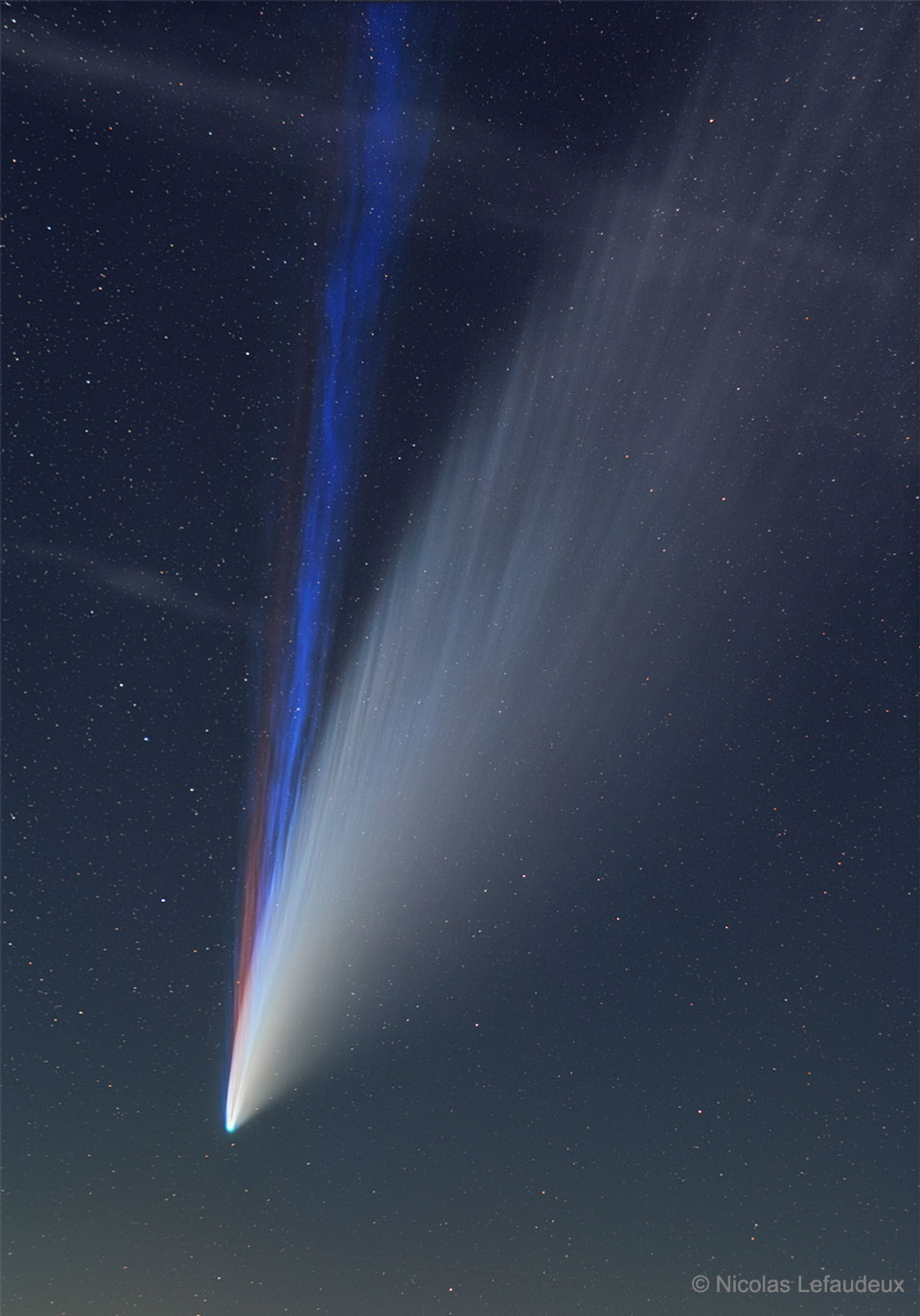
What created the unusual red tail in Comet NEOWISE? Sodium. A spectacular sight back in the summer of 2020, Comet NEOWISE, at times, displayed something more than just a surprisingly striated white dust tail and a pleasingly patchy blue ion tail. Some color sensitive images showed an unusual red tail, and analysis showed much of this third tail’s color was emitted by sodium. Gas rich in sodium atoms might have been liberated from Comet NEOWISE’s warming nucleus in early July by bright sunlight, electrically charged by ultraviolet sunlight, and then pushed out by the solar wind. The featured image was captured in mid-July from Brittany, France and shows the real colors. Sodium comet tails have been seen before but are rare — this one disappeared by late July. Comet C/2020 F3 (NEOWISE) has since faded, lost all of its bright tails, and now approaches the orbit of Jupiter as it heads back to the outer Solar System, to return only in about 7,000 years. [via NASA] https://ift.tt/3bn69Cn

Pillars of the Eagle Nebula in Infrared

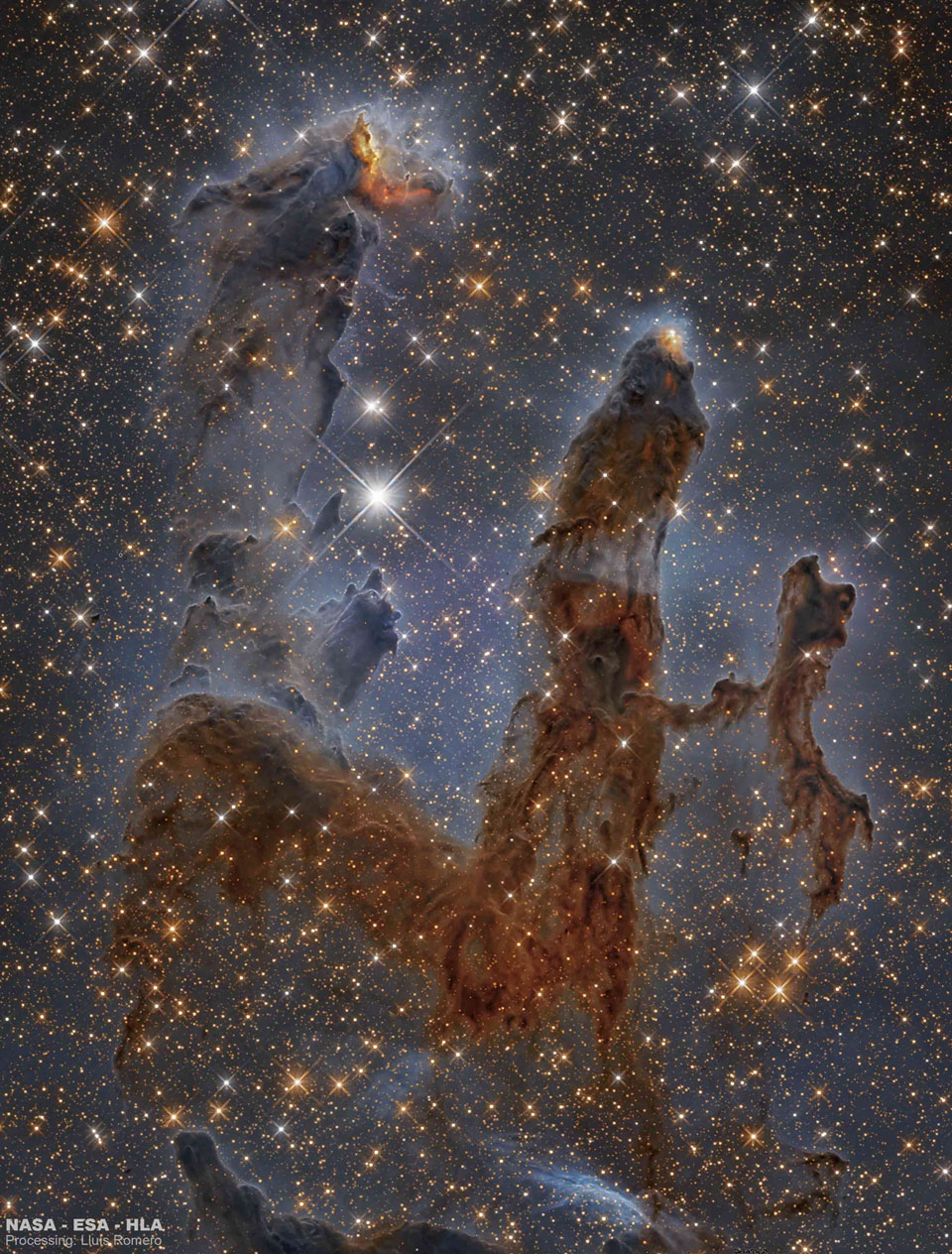
Newborn stars are forming in the Eagle Nebula. Gravitationally contracting in pillars of dense gas and dust, the intense radiation of these newly-formed bright stars is causing surrounding material to boil away. This image, taken with the Hubble Space Telescope in near infrared light, allows the viewer to see through much of the thick dust that makes the pillars opaque in visible light. The giant structures are light years in length and dubbed informally the Pillars of Creation. Associated with the open star cluster M16, the Eagle Nebula lies about 6,500 light years away. The Eagle Nebula is an easy target for small telescopes in a nebula-rich part of the sky toward the split constellation Serpens Cauda (the tail of the snake). [via NASA] https://ift.tt/3roqTPR

Perseverance Takes a Spin

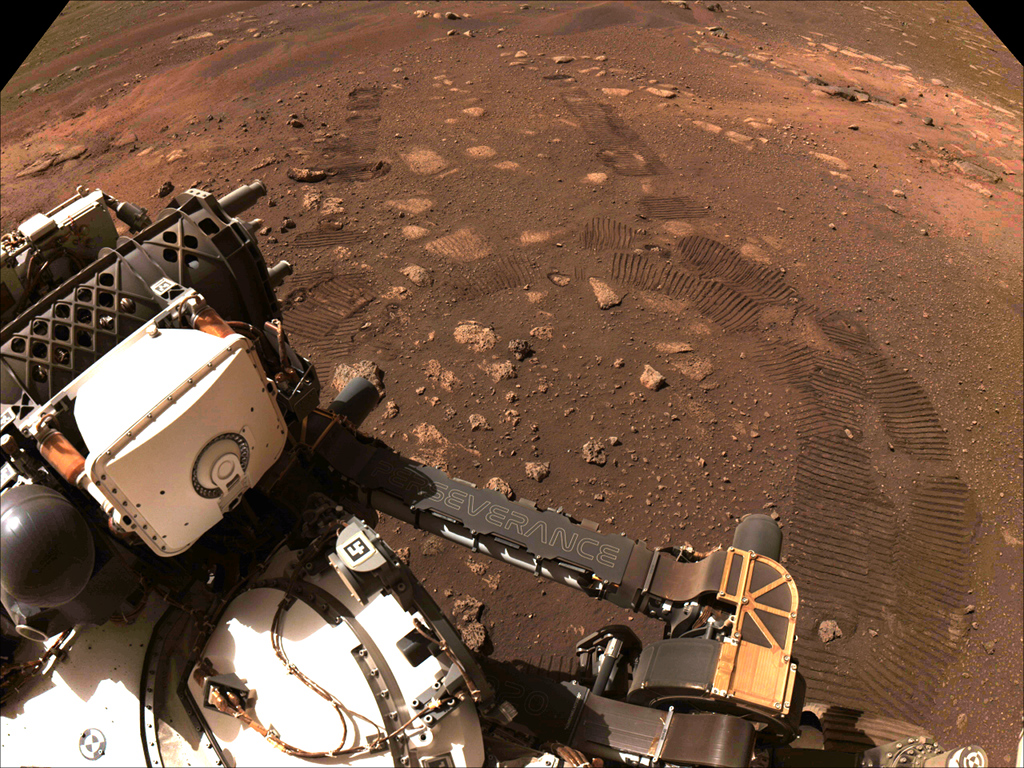
After arriving at Jezero Crater on Mars, Perseverance went for a spin on March 4. This sharp image from the car-sized rover’s Navcam shows tracks left by its wheels in the martian soil. In preparation for operations on the surface of the Red Planet, its first drive lasted about 33 minutes. On a short and successful test drive Perseverance moved forward 4 meters, made a 150 degree turn, backed up for 2.5 meters, and now occupies a different parking space at its newly christened Octavia E. Butler Landing location. Though the total travel distance of the rover’s first outing was about 6.5 meters (21 feet), regular commutes of 200 meters or more can be expected in the future. [via NASA] https://ift.tt/30kIiwG

A Little Like Mars

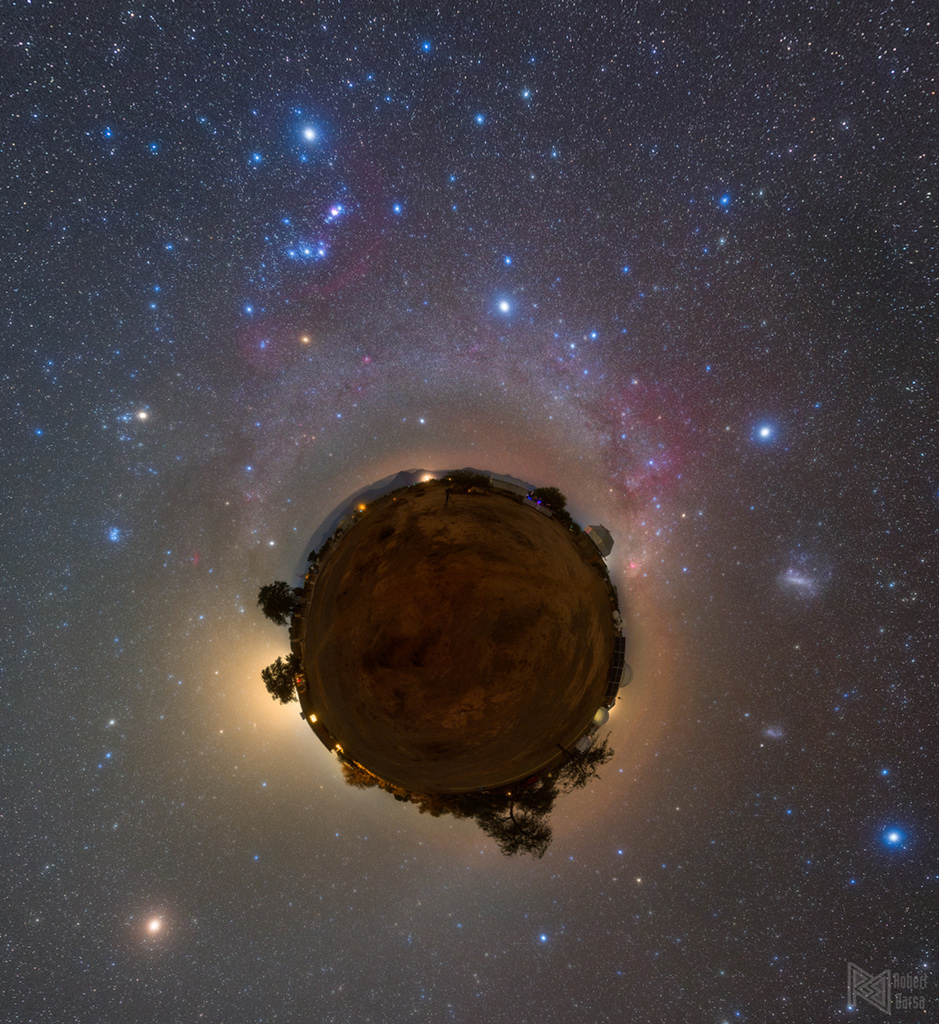
The surface of this planet looks a little like Mars. It’s really planet Earth though. In a digitally stitched little planet projection, the 360 degree mosaic was captured near San Pedro in the Chilean Atacama desert. Telescopes in domes on the horizon are taking advantage of the region’s famously dark, clear nights. Taken in early December, a magnificent Milky Way arcs above the horizon for almost 180 degrees around the little planet with Orion prominent in the southern sky. A familiar constellation upside down for northern hemisphere skygazers, Orion shares that southern December night almost opposite the Large and Small Magellanic clouds. But the Red Planet itself is the brightest yellowish celestial beacon in this little planet sky. [via NASA] https://ift.tt/3kMUFuR

Mars in Taurus

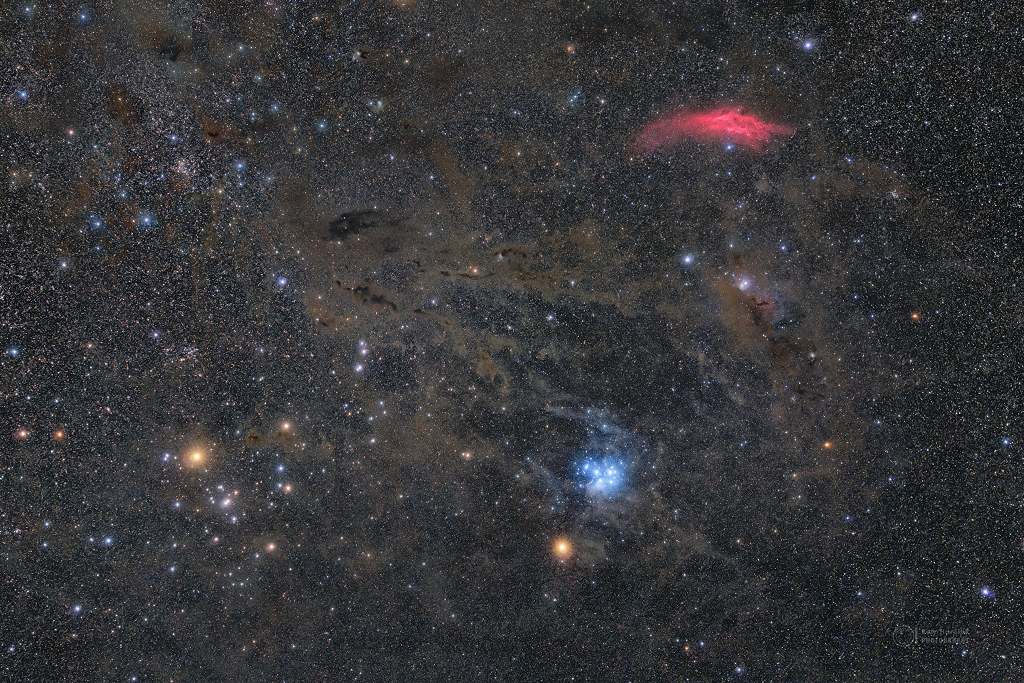
You can spot Mars in the evening sky tonight. Now home to the Perseverance rover, the Red Planet is presently wandering through the constellation Taurus, close on the sky to the Seven Sisters or Pleiades star cluster. In fact this deep, widefield view of the region captures Mars near its closest conjunction to the Pleiades on March 3. Below center, Mars is the bright yellowish celestial beacon only about 3 degrees from the pretty blue star cluster. Competing with Mars in color and brightness, Aldebaran is the alpha star of Taurus. The red giant star is toward the lower left edge of the frame, a foreground star along the line-of-sight to the more distant Hyades star cluster. Otherwise too faint for your eye to see, the dark, dusty nebulae lie along the edge of the massive Perseus molecular cloud, with the striking reddish glow of NGC 1499, the California Nebula, at the upper right. [via NASA] https://ift.tt/388u4nb

Stars over an Erupting Volcano

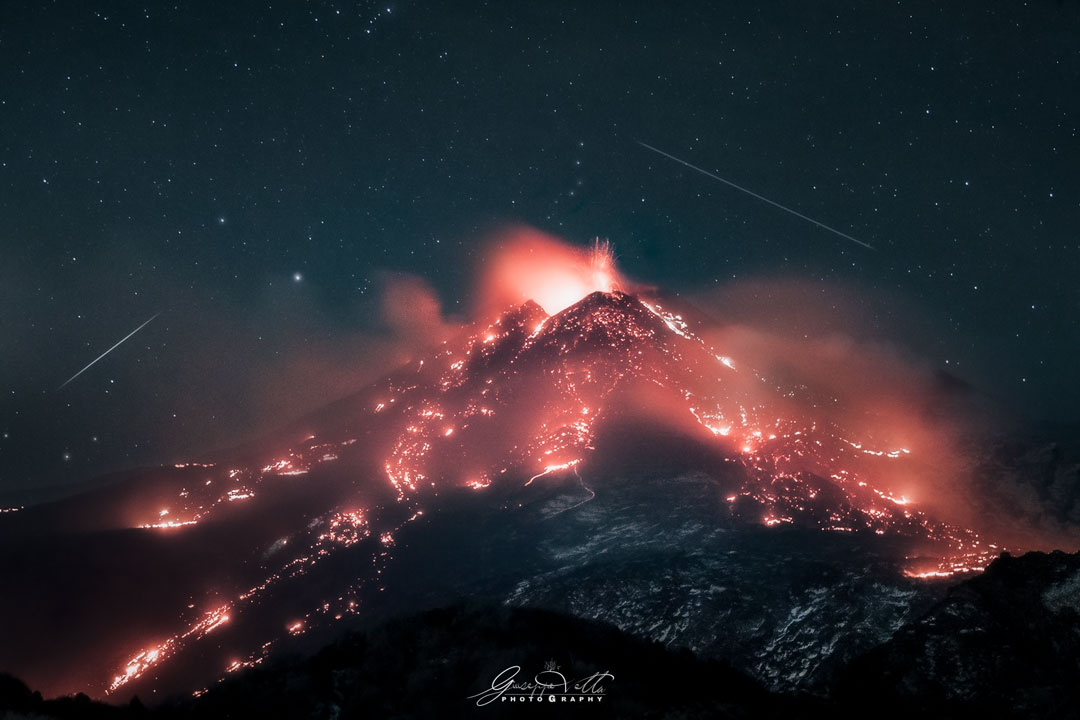
Mt. Etna has been erupting for hundreds of thousands of years. Located in Sicily, Italy, the volcano produces lava fountains over one kilometer high. Mt. Etna is not only one of the most active volcanoes on Earth, it is one of the largest, measuring over 50 kilometers at its base and rising nearly 3 kilometers high. Pictured erupting last month, a lava plume shoots upwards, while hot lava flows down the volcano’s exterior. Likely satellite trails appear above, while ancient stars dot the sky far in the distance. This volcanic eruption was so strong that nearby airports were closed to keep planes from flying through the dangerous plume. The image foreground and background were captured consecutively by the same camera and from the same location. [via NASA] https://ift.tt/3b95NPr

Ingenuity: A Mini Helicopter Now on Mars

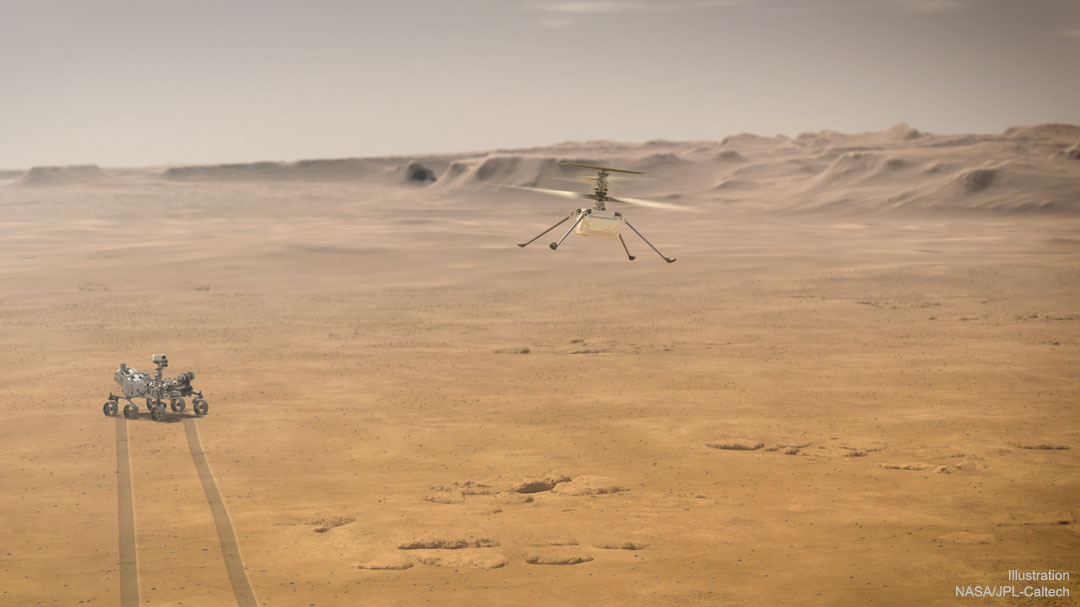
What if you could fly around Mars? NASA may have achieved that capability last month with the landing of Perseverance, a rover which included a small flight-worthy companion called Ingenuity, nicknamed Ginny. Even though Ginny is small — a toaster-sized helicopter with four long legs and two even-longer (1.2-meter) rotors, she is the first of her kind — there has never been anything like her before. After being deployed, possibly in April, the car-sized Perseverance («Percy») will back away to give Ginny ample room to attempt her unprecedented first flight. In the featured artistic illustration, Ginny’s long rotors are depicted giving her the lift she needs to fly into the thin Martian atmosphere and explore the area near Perseverance. Although Ingenuity herself will not fly very far, she is a prototype for all future airborne Solar-System robots that may fly far across not only Mars, but Titan. [via NASA] https://ift.tt/3q8gZ3k

The Pelican Nebula in Red and Blue

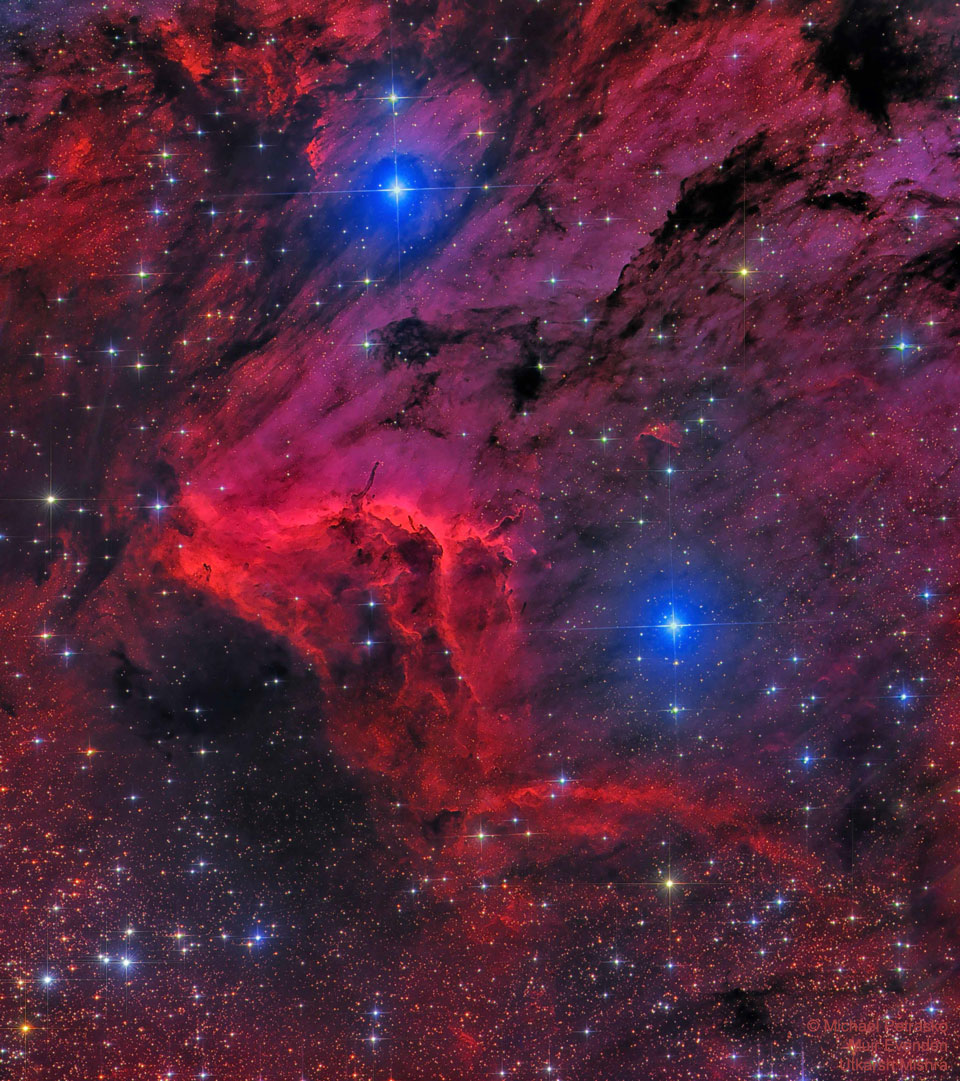
The Pelican Nebula is changing. The entire nebula, officially designated IC 5070, is divided from the larger North America Nebula by a molecular cloud filled with dark dust. The Pelican, however, is particularly interesting because it is an unusually active mix of star formation and evolving gas clouds. The featured picture was processed to bring out two main colors, red and blue, with the red dominated by light emitted by interstellar hydrogen. Ultraviolet light emitted by young energetic stars is slowly transforming cold gas in the nebula to hot gas, with the advancing boundary between the two, known as an ionization front, visible in bright red across the image center. Particularly dense tentacles of cold gas remain. Millions of years from now this nebula might no longer be known as the Pelican, as the balance and placement of stars and gas will surely leave something that appears completely different. [via NASA] https://ift.tt/3r9aNJC