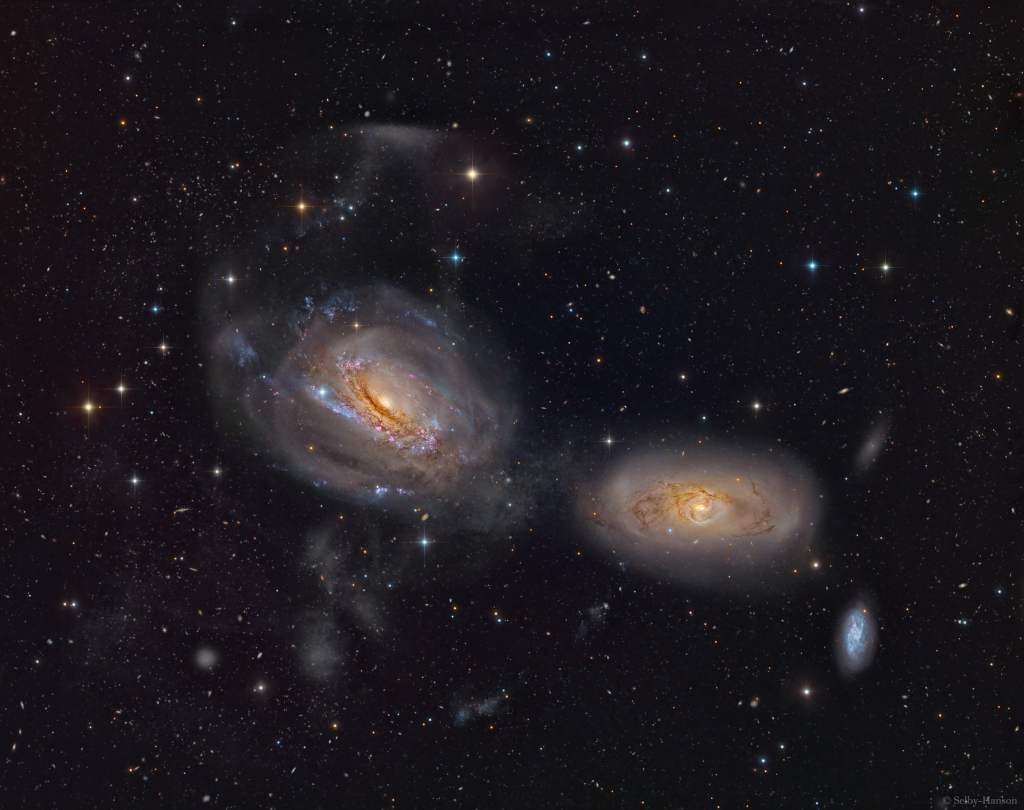
Two galaxies are squaring off in Virgo and here are the latest pictures. When two galaxies collide, the stars that compose them usually do not. This is because galaxies are mostly empty space and, however bright, stars only take up only a small fraction of that space. But during the collision, one galaxy can rip the other apart gravitationally, and dust and gas common to both galaxies does collide. If the two galaxies merge, black holes that likely resided in each galaxy center may eventually merge. Because the distances are so large, the whole thing takes place in slow motion — over hundreds of millions of years. Besides the two large spiral galaxies, a smaller third galaxy is visible on the far left of the featured image of Arp 274, also known as NGC 5679. Arp 274 spans about 200,000 light years across and lies about 400 million light years away toward the constellation of Virgo. [via NASA] https://ift.tt/C6IU5s0

Raise your arms if you see an aurora. With those instructions, two nights went by with, well, clouds — mostly. On the third night of returning to same peaks, though, the sky not only cleared up but lit up with a spectacular auroral display. Arms went high in the air, patience and experience paid off, and the creative featured image was captured as a composite from three separate exposures. The setting is a summit of the Austnesfjorden fjord close to the town of Svolvear on the Lofoten islands in northern Norway. The time was early 2014. Although our Sun passed the solar minimum of its 11-year cycle only a few years ago, surface activity is picking up and already triggering more spectacular auroras here on Earth. [via NASA] https://ift.tt/7p3Okxq

Naked Eye Comet ZTF

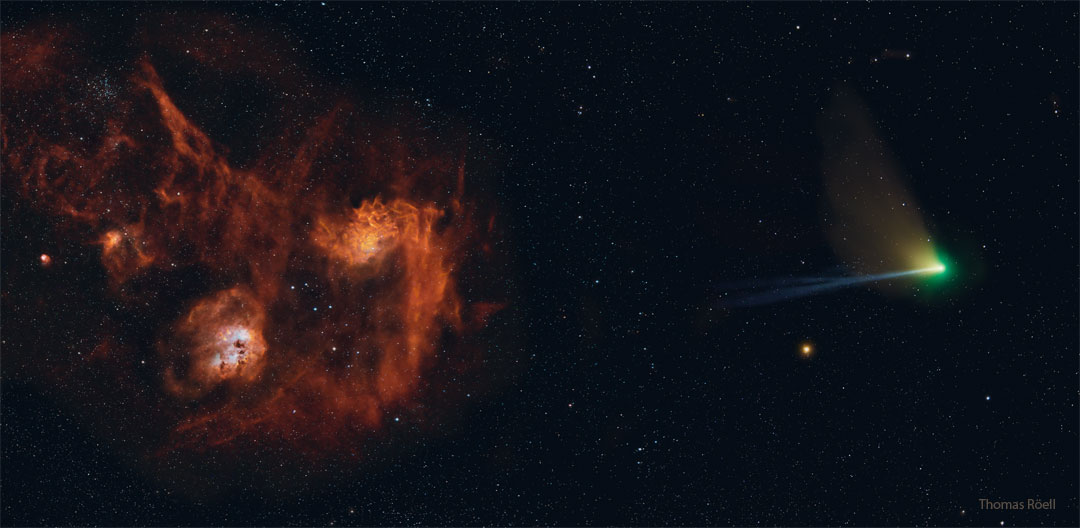
Comet C/2022E3 (ZTF) is no longer too dim to require a telescope for viewing. By January 19, it could just be seen with the naked eye in this rural sky with little light pollution from a location about 20 kilometers from Salamanca, Spain. Still, telescopic images are needed to show any hint of the comet’s pretty green coma, stubby whitish dust tail, and long ion tail. Its faint ion tail has been buffeted by recent solar activity. This visitor from the distant Oort cloud rounded the Sun on January 12. and is now sweeping through stars near the northern boundary of the constellation Bootes. Outward bound but still growing brighter, Comet ZTF makes its closest approach on February 2, coming to within about 2.4 light-minutes of our fair planet. [via NASA] https://ift.tt/POdoWrj

Galaxy Wars: M81 and M82

The two dominant galaxies near center are far far away, 12 million light-years distant toward the northern constellation of the Great Bear. On the right, with grand spiral arms and bright yellow core is spiral galaxy M81. Also known as Bode’s galaxy, M81 spans some 100,000 light-years. On the left is cigar-shaped irregular galaxy M82. The pair have been locked in gravitational combat for a billion years. Gravity from each galaxy has profoundly affected the other during a series of cosmic close encounters. Their last go-round lasted about 100 million years and likely raised density waves rippling around M81, resulting in the richness of M81’s spiral arms. M82 was left with violent star forming regions and colliding gas clouds so energetic that the galaxy glows in X-rays. In the next few billion years, their continuing gravitational encounters will result in a merger, and a single galaxy will remain. This extragalactic scenario also includes other members of the interacting M81 galaxy group with NGC 3077 below and right of the large spiral, and NGC 2976 at upper right in the frame. Captured under dark night skies in the Austrian Alps, the foreground of the wide-field image is filled with integrated flux nebulae. Those faint, dusty interstellar clouds reflect starlight above the plane of our own Milky Way galaxy. [via NASA] https://ift.tt/tlf9Or7

The Seagull Nebula

A broad expanse of glowing gas and dust presents a bird-like visage to astronomers from planet Earth, suggesting its popular moniker – The Seagull Nebula. Using narrowband image data, this 3-panel mosaic of the cosmic bird covers a 2.5 degree swath across the plane of the Milky Way, near the direction of Sirius, alpha star of the constellation Canis Major. Likely part of a larger shell structure swept up by successive supernova explosions, the broad Seagull Nebula is cataloged as Sh2-296 and IC 2177. The prominent bluish arc below and right of center is a bow shock from runaway star FN Canis Majoris. This complex of gas and dust clouds with other stars of the Canis Majoris OB1 association spans over 200 light-years at the Seagull Nebula’s estimated 3,800 light-year distance. [via NASA] https://ift.tt/8Zx2VzD

Gravitational lensing by the galaxy cluster MACS0647 — in which the massive foreground cluster distorts and lenses the light emitted by distant background galaxies along the line of sight — is on vivid display here in this recent multi-color infrared image from the James Webb Space Telescope (JWST). In particular, the background source MACS0647-JD is seen to be lensed three times by the cluster. When first discovered with the Hubble Space Telescope, MACS0647-JD was observed as an amorphous blob. With Webb though, this single source is revealed to be a pair or small group of galaxies. The colors of the MACS0647-JD objects are different as well — indicating differences potentially in the age or dust content of these galaxies. These new images provide rare examples of galaxies in an era only a few 100 million years after the Big Bang. [via NASA] https://ift.tt/SAnm3Yw

Why are there oxygen-emitting arcs near the direction of the Andromeda galaxy? No one is sure. The gas arcs, shown in blue, were discovered and first confirmed by amateur astronomers just last year. The two main origin hypotheses for the arcs are that they really are close to Andromeda (M31), or that they are just coincidentally placed gas filaments in our Milky Way galaxy. Adding to the mystery is that arcs were not seen in previous deep images of M31 taken primarily in light emitted by hydrogen, and that other, more distant galaxies have not been generally noted as showing similar oxygen-emitting structures. Dedicated amateurs using commercial telescopes made this discovery because, in part, professional telescopes usually investigate angularly small patches of the night sky, whereas these arcs span several times the angular size of the full moon. Future observations — both in light emitted by oxygen and by other elements — are sure to follow. [via NASA] https://ift.tt/IbRrhX1

Our Moon doesn’t really look like this. Earth’s Moon, Luna, doesn’t naturally show this rich texture, and its colors are more subtle. But this digital creation is based on reality. The featured image is a composite of multiple images and enhanced to bring up real surface features. The enhancements, for example, show more clearly craters that illustrate the tremendous bombardment our Moon has been through during its 4.6-billion-year history. The dark areas, called maria, have fewer craters and were once seas of molten lava. Additionally, the image colors, although based on the moon’s real composition, are changed and exaggerated. Here, a blue hue indicates a region that is iron rich, while orange indicates a slight excess of aluminum. Although the Moon has shown the same side to the Earth for billions of years, modern technology is allowing humanity to learn much more about it — and how it affects the Earth. [via NASA] https://ift.tt/M6sbImn

This is the mess that is left when a star explodes. The Crab Nebula, the result of a supernova seen in 1054 AD, is filled with mysterious filaments. The filaments are not only tremendously complex, but appear to have less mass than expelled in the original supernova and a higher speed than expected from a free explosion. The featured image, taken by the Hubble Space Telescope, is presented in three colors chosen for scientific interest. The Crab Nebula spans about 10 light-years. In the nebula’s very center lies a pulsar: a neutron star as massive as the Sun but with only the size of a small town. The Crab Pulsar rotates about 30 times each second. [via NASA] https://ift.tt/3DZT0mn

Perihelion Sun 2023

Perihelion for 2023, Earth’s closest approach to the Sun, was on January 4 at 16:17 UTC. That was less than 24 hours after this sharp image of the Sun’s disk was recorded with telescope and H-alpha filter from Sidney, Australia, planet Earth. An H-alpha filter transmits a characteristic red light from hydrogen atoms. In views of the Sun it emphasizes the Sun’s chromosphere, a region just above the solar photosphere or normally visible solar surface. In this H-alpha image of the increasingly active Sun planet-sized sunspot regions are dominated by bright splotches called plages. Dark filaments of plasma snaking across the solar disk transition to bright prominences when seen above the solar limb. [via NASA] https://ift.tt/jTHuGm4