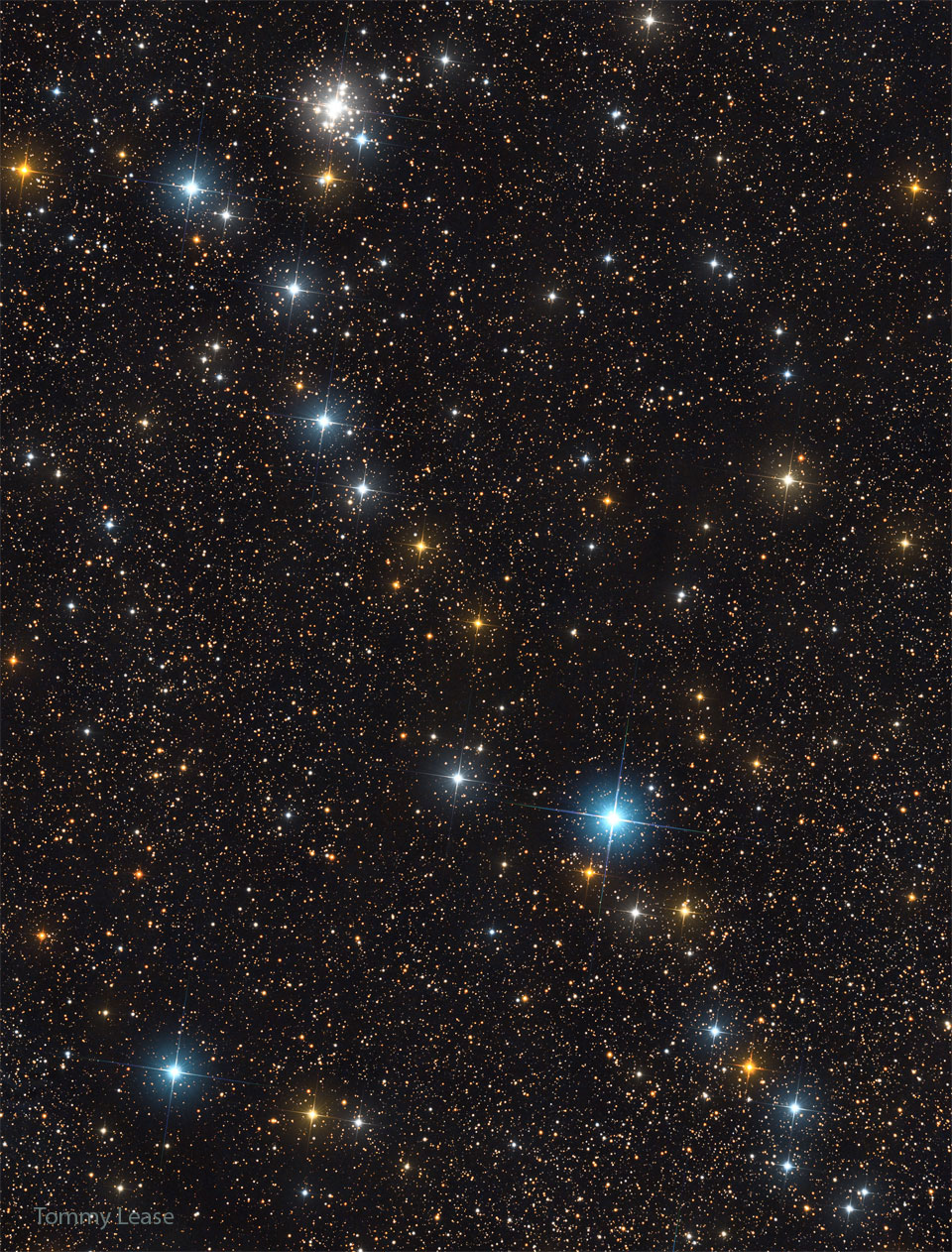
Lynds Dark Nebula 1251

Stars are forming in Lynds Dark Nebula (LDN) 1251. About 1,000 light-years away and drifting above the plane of our Milky Way galaxy, the dusty molecular cloud is part of a complex of dark nebulae mapped toward the Cepheus flare region. Across the spectrum, astronomical explorations of the obscuring interstellar clouds reveal energetic shocks and outflows associated with newborn stars, including the telltale reddish glow from scattered Herbig-Haro objects hiding in the image. Distant background galaxies also lurk on the scene, almost buried behind the dusty expanse. This alluring view spans over four full moons on the sky, or 35 light-years at the estimated distance of LDN 1251. [via NASA] https://ift.tt/r1T4xRa

Earthset from Orion

Eight billion people are about to disappear in this snapshot from space. Taken on November 21, the sixth day of the Artemis 1 mission, their home world is setting behind the Moon’s bright edge as viewed by an external camera on the outbound Orion spacecraft. The Orion was headed for a powered flyby that took it to within 130 kilometers of the lunar surface. Velocity gained in the flyby maneuver will be used to reach a distant retrograde orbit around the Moon. That orbit is considered distant because it’s another 92,000 kilometers beyond the Moon, and retrograde because the spacecraft will orbit in the opposite direction of the Moon’s orbit around planet Earth. Orion will enter its distant retrograde orbit on Friday, November 25. Swinging around the Moon, Orion will reach a maximum distance (just over 400,000 kilometers) from Earth on Monday November 28 exceeding a record set by Apollo 13 for most distant spacecraft designed for human space exploration. [via NASA] https://ift.tt/B2E0r3V

A Double Star Cluster in Perseus

Few star clusters this close to each other. Visible to the unaided eye from dark sky areas, it was cataloged in 130 BC by Greek astronomer Hipparchus. Some 7,000 light-years away, this pair of open star clusters is also an easy binocular target, a striking starfield in the northern constellation of the mythical Greek hero Perseus. Now known as h and chi Persei, or NGC 869 (above right) and NGC 884, the clusters themselves are separated by only a few hundred light-years and contain stars much younger and hotter than the Sun. In addition to being physically close together, the clusters’ ages based on their individual stars are similar – evidence that both clusters were likely a product of the same star-forming region. [via NASA] https://ift.tt/YaMEjZx

The Butterfly Nebula from Hubble

Stars can make beautiful patterns as they age — sometimes similar to flowers or insects. NGC 6302, the Butterfly Nebula, is a notable example. Though its gaseous wingspan covers over 3 light-years and its estimated surface temperature exceeds 200,000 degrees C, the aging central star of NGC 6302, the featured planetary nebula, has become exceptionally hot, shining brightly in visible and ultraviolet light but hidden from direct view by a dense torus of dust. This sharp close-up was recorded by the Hubble Space Telescope and is processed here to show off remarkable details of the complex planetary nebula, highlighting in particular light emitted by oxygen (shown as blue), hydrogen (green), and nitrogen (red). NGC 6302 lies about 3,500 light-years away in the arachnologically correct constellation of the Scorpion (Scorpius). Planetary nebulas evolve from outer atmospheres of stars like our Sun, but usually fade in about 20,000 years. [via NASA] https://ift.tt/5JxFlRf

Airglow Ripples over Tibet

Why would the sky look like a giant target? Airglow. Following a giant thunderstorm over Bangladesh in late April, giant circular ripples of glowing air appeared over Tibet, China, as pictured here. The unusual pattern is created by atmospheric gravity waves, waves of alternating air pressure that can grow with height as the air thins, in this case about 90-kilometers up. Unlike auroras powered by collisions with energetic charged particles and seen at high latitudes, airglow is due to chemiluminescence, the production of light in a chemical reaction. More typically seen near the horizon, airglow keeps the night sky from ever being completely dark. [via NASA] https://ift.tt/X7wgfLm

Artemis 1 Moonshot

When the Artemis 1 mission’s Orion spacecraft makes its November 21 powered flyby of the Moon, denizens of planet Earth will see the Moon in a waning crescent phase. The spacecraft will approach to within about 130 kilometers of the lunar surface on its way to a distant retrograde orbit some 70,000 kilometers beyond the Moon. But the Moon was at last quarter for the November 16 launch and near the horizon in the dark early hours after midnight. It’s captured here in skies over Kennedy Space Center along with the SLS rocket engines and solid rocket boosters lofting the uncrewed Orion to space. Ragged fringes appearing along the bright edge of the sunlit lunar nearside are caused as pressure waves generated by the rocket’s passage change the index of refraction along the camera’s line of sight. [via NASA] https://ift.tt/eDfBjG3

The Protostar within L1527

The protostar within dark cloud L1527 is a mere 100,000 years old, still embedded in the cloud of gas and dust that feeds its growth. In this NIRCam image from the James Webb Space Telescope, the dark band at the neck of the infrared nebula is a thick disk that surrounds the young stellar object. Viewed nearly edge-on and a little larger than our Solar System, the disk ultimately supplies material to the protostar while hiding it from Webb’s direct infrared view. The nebula itself is seen in stunning detail though. Illuminated by infrared light from the protostar, the hourglass-shaped nebula’s cavities are created as material ejected in the star-forming process plows through the surrounding medium. As the protostar gains mass it will eventually become a full-fledged star, collapsing and igniting nuclear fusion in its core. A likely analog to our own Sun and Solar System in their early infancy, the protostar within dark cloud L1527 lies some 460 light-years distant in the Taurus star-forming region. Webb’s NIRCam image spans about 0.3 light-years. [via NASA] https://ift.tt/OqWdB6v

Planet Earth from Orion

A Space Launch System rocket left planet Earth on Wednesday, November 16 at 1:47am EST carrying the Orion spacecraft on the Artemis 1 mission, the first integrated test of NASA’s deep space exploration systems. Over an hour after liftoff from Kennedy Space Center’s historic Launch Complex 39B, one of Orion’s external video cameras captured this view of its new perspective from space. In the foreground are Orion’s Orbital Maneuvering System engine and auxillary engines, at the bottom of the European Service Module. Beyond one of the module’s 7-meter long extended solar array wings lies the spacecraft’s beautiful home world. The Artemis 1 mission will last almost four weeks, testing capabilities to enable human exploration of the Moon and Mars. The uncrewed Orion spacecraft is expected to fly by the Moon on November 21, performing a close approach to the lunar surface on its way to a retrograde orbit 70,000 kilometers beyond the Moon.   [via NASA] https://ift.tt/7Gf1D0V

In the Arms of NGC 1097

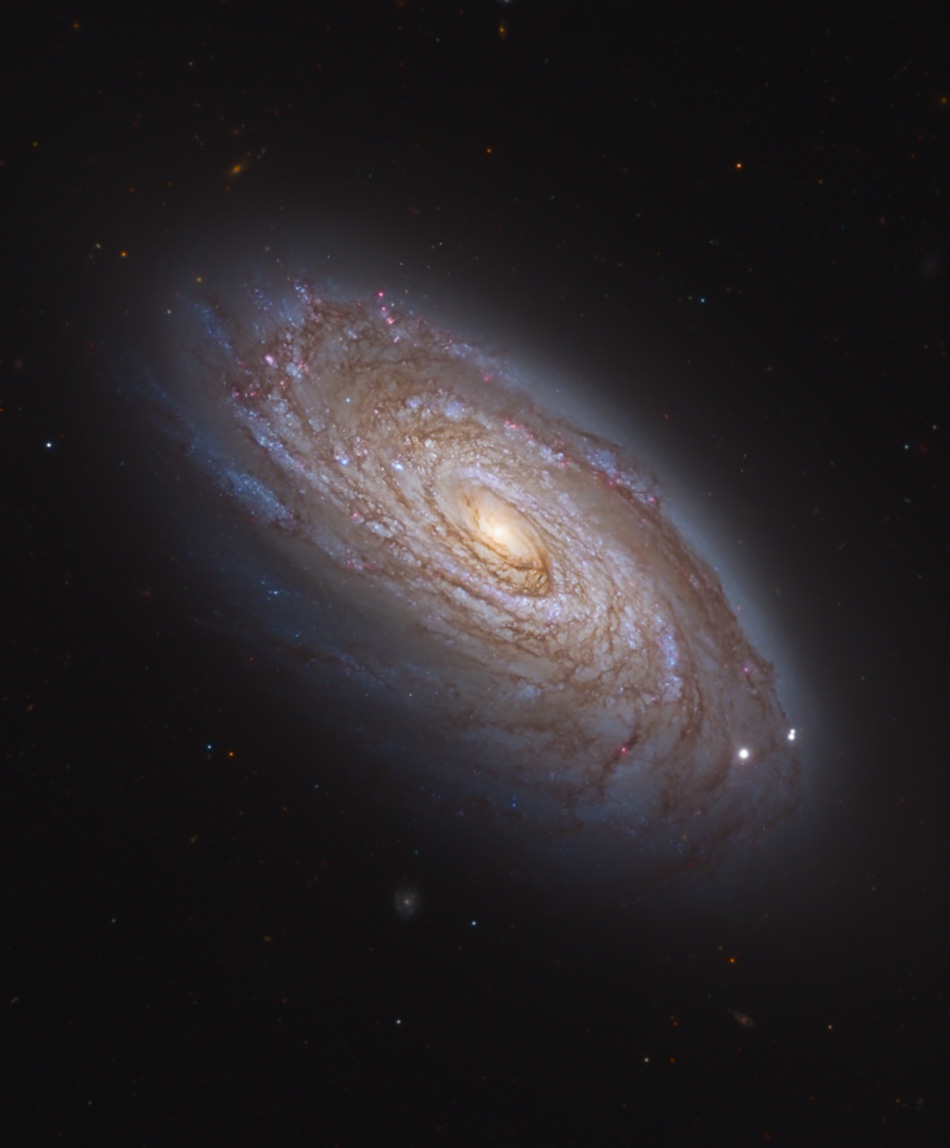
Spiral galaxy NGC 1097 shines in southern skies, about 45 million light-years away in the heated constellation Fornax. Its blue spiral arms are mottled with pinkish star forming regions in this colorful galaxy portrait. They seem to have wrapped around a small companion galaxy above and right of center, about 40,000 light-years from the spiral’s luminous core. That’s not NGC 1097’s only peculiar feature, though. This very deep exposure hints of faint, mysterious jets, seen to extend well beyond the bluish arms. In fact, four faint jets are ultimately recognized in optical images of NGC 1097. The jets trace an X centered on the galaxy’s nucleus, but probably don’t originate there. Instead, they could be fossil star streams, trails left over from the capture and disruption of a much smaller galaxy in the large spiral’s ancient past. A Seyfert galaxy, NGC 1097’s nucleus also harbors a supermassive black hole. [via NASA] https://ift.tt/Hx4jUkt

Wolfs Cave Nebula

The mysterious blue reflection nebula found in catalogs as VdB 152 or Ced 201 really is very faint. It lies at the tip of the long dark nebula Barnard 175 in a dusty complex that has also been called Wolf’s Cave. At the center of this deep telescopic view, the cosmic apparitions are nearly 1,400 light-years away along the northern Milky Way in the royal constellation Cepheus. Interstellar dust in the region blocks light from background stars and scatters light from the embedded bright star, giving the end nebula its characteristic blue color. Though stars do form in molecular clouds, this star seems to have only accidentally wandered into the area, as its measured velocity through space is very different from the cloud’s velocity. At the image bottom is the planetary nebula Dengel-Hartl 5, while red glowing gas from an ancient supernova remnant is also visible along the image’s right side. [via NASA] https://ift.tt/AVMtq8i