NGC 7380: The Wizard Nebula

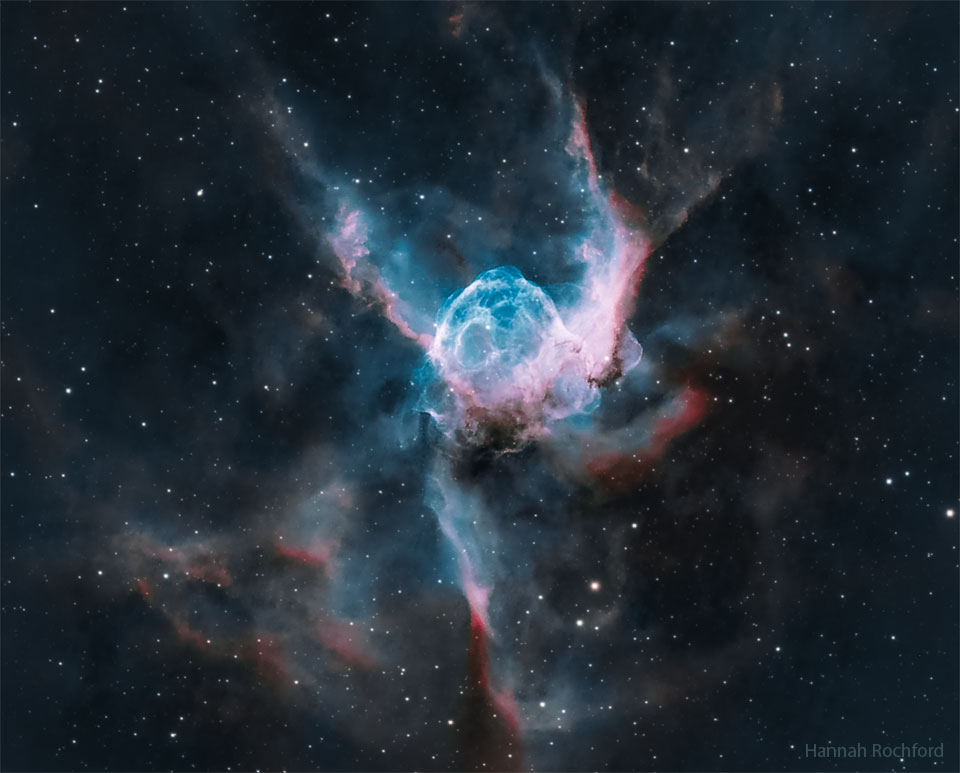
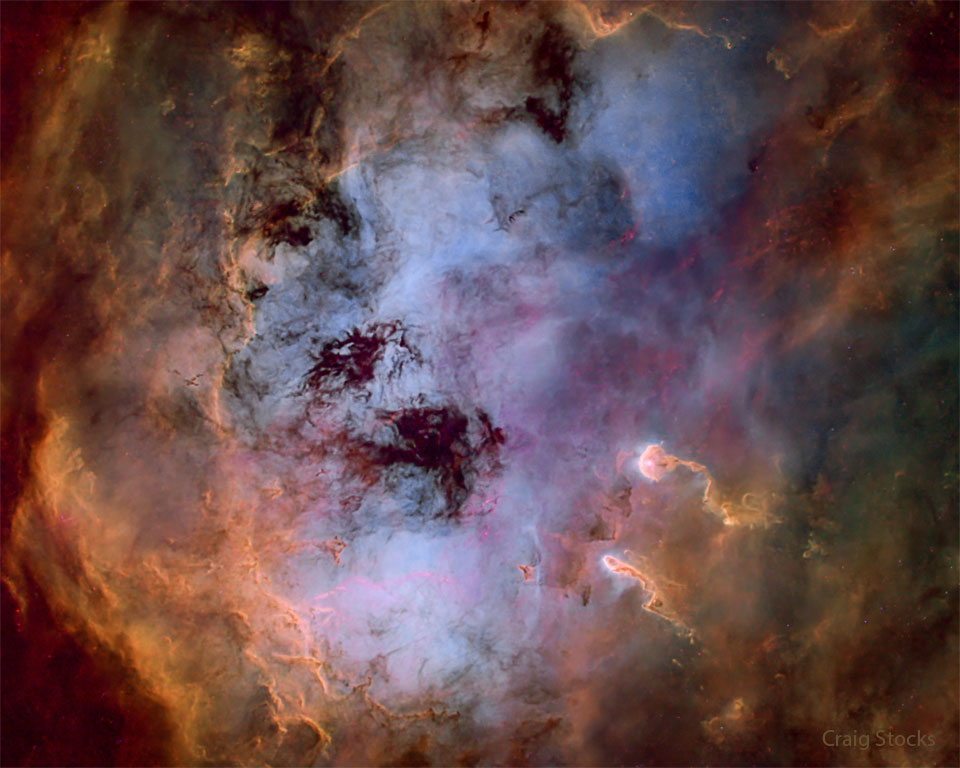
What powers are being wielded in the Wizard Nebula? Gravitation strong enough to form stars, and stellar winds and radiations powerful enough to create and dissolve towers of gas. Located only 8,000 light years away, the Wizard nebula, featured here, surrounds developing open star cluster NGC 7380. Visually, the interplay of stars, gas, and dust has created a shape that appears to some like a fictional medieval sorcerer. The active star forming region spans 100 about light years, making it appear larger than the angular extent of the Moon. The Wizard Nebula can be located with a small telescope toward the constellation of the King of Aethiopia (Cepheus). Although the nebula may last only a few million years, some of the stars being formed may outlive our Sun. [via NASA] https://ift.tt/J5YTrkd

Flying Saucer Crash Lands in Utah Desert

A flying saucer from outer space crash-landed in the Utah desert after being tracked by radar and chased by helicopters. The year was 2004, and no space aliens were involved. The saucer, pictured here, was the Genesis sample return capsule, part of a human-made robot Genesis spaceship launched in 2001 by NASA itself to study the Sun. The unexpectedly hard landing at over 300 kilometers per hour occurred because the parachutes did not open as planned. The Genesis mission had been orbiting the Sun collecting solar wind particles that are usually deflected away by Earth’s magnetic field. Despite the crash landing, many return samples remained in good enough condition to analyze. So far, Genesis-related discoveries include new details about the composition of the Sun and how the abundance of some types of elements differ across the Solar System. These results have provided intriguing clues into details of how the Sun and planets formed billions of years ago. [via NASA] https://ift.tt/cqSw3xf

Eclipse in the City

A darker Moon sets over Manhattan in this night skyscape. The 16 frame composite was assembled from consecutive exposures recorded during the November 8 total lunar eclipse. In the timelapse sequence stars leave short trails above the urban skyline, while the Moon remains immersed in Earth’s shadow. But the International Space Station was just emerging from the shadow into the sunlit portion of its low Earth orbit. As seen from New York City, the visible streak of this ISS flyover starts near a star in Taurus and tracks right to left, through the belt of Orion and over Sirius, alpha star of Canis Major. Gaps along the bright trail of the fast moving orbital outpost (and an aircraft flying closer to the horizon) mark the time between individual exposures in the sequence. The trail of bright planet Mars is at the top of the frame. Pleiades star cluster trails are high over the eclipsed Moon and Empire State Building. [via NASA] https://ift.tt/GVA9e7b

Blood Moon, Ice Giant

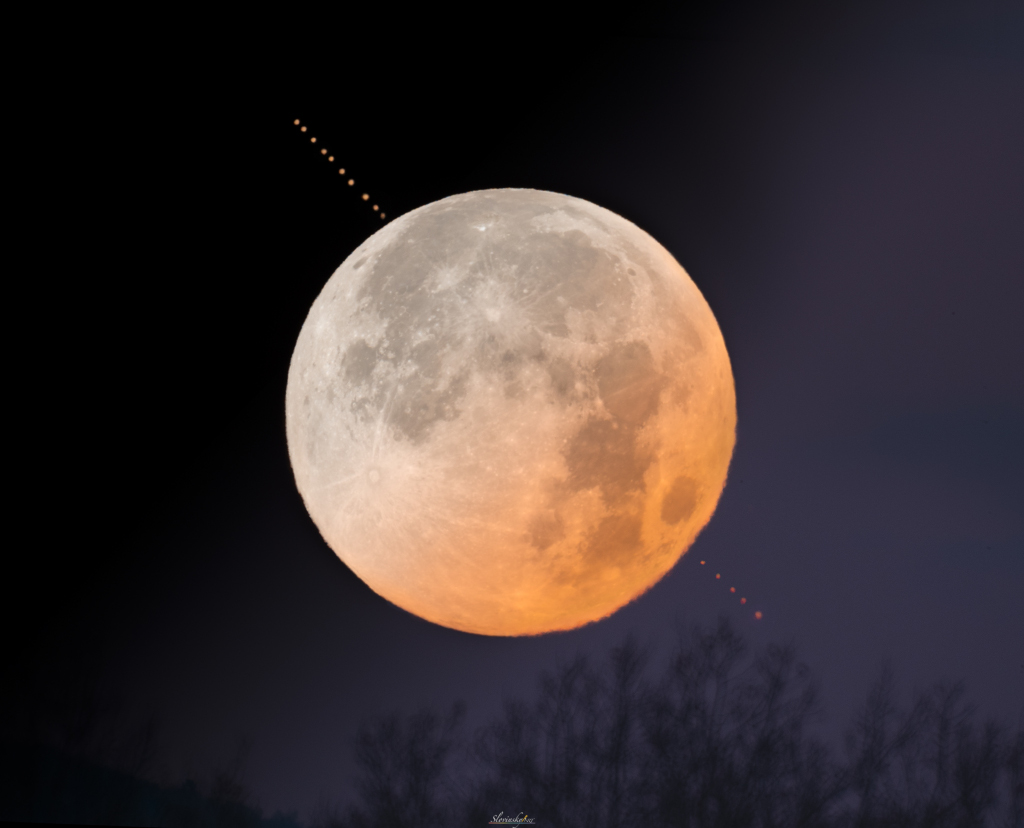
On November 8 the Full Moon turned blood red as it slid through Earth’s shadow in a beautiful total lunar eclipse. During totality it also passed in front of, or occulted, outer planet Uranus for eclipse viewers located in parts of northern America and Asia. For a close-up and wider view these two images were taken just before the occultation began, captured with different telescopes and cameras from the same roof top in Shanghai, China. Normally very faint compared to a Full Moon, the tiny, pale, greenish disk of the distant ice giant is just to the left of the Moon’s edge and about to disappear behind the darkened, red lunar limb. Though only visible from certain locations across planet Earth, lunar occultations of planets are fairly common. But for this rare «lunar eclipse occultation» to take place, at the time of the total eclipse the outer planet had to be both at opposition and very near the ecliptic plane to fall in line with Sun, Earth, and Moon. [via NASA] https://ift.tt/juFwRvL

Total Lunar Eclipse

The beginning, middle, and end of a journey through planet Earth’s colorful umbral shadow is captured in this timelapse composite image of a total lunar eclipse. Taken on November 8 from Kitt Peak National Observatory this eclipse’s 1 hour and 25 minute long total phase starts on the right and finishes on the left. Reddened sunlight, scattered into the central shadow by Earth’s dusty atmosphere produces the dramatic dark red hues reflected by the lunar disk. For this eclipse, additional reddening is likely due to scattering from ash lingering in the atmosphere after a large volcanic eruption in the southern Pacific earlier this year. Seen at the right and left, the Earth’s shadow is still lighter along its edge though. That faint bluish fringe along the lunar limb is colored by sunlight filtered through Earth’s stratospheric ozone layer. [via NASA] https://ift.tt/IxAdODa

The Asymmetric Nebula Surrounding Wolf Rayet Star 18

Why does the nebula around the star WR-18 shine brighter on one side? Also known as NGC 3199, this active star and its surrounding nebula lie about 12,000 light-years away toward the nautical southern constellation of Carina. The featured deep image has been highly processed to bring out filamentary details of the glowing gas in the bubble-shaped nebula. The nebula is about 75 light-years across. Near the nebula’s center is a Wolf-Rayet star, WR-18, which is a massive, hot, short-lived star that generates an intense and complex stellar wind. In fact, Wolf-Rayet stars are known to create nebulas with interesting shapes as their powerful winds sweep up surrounding interstellar material. In this case, the bright right edge was initially thought to indicate that a bow shock was being produced as the star plowed through a uniform medium, like a boat through water. Recent measurements and analyses, however, have shown the star is not moving quickly toward the bright edge. A more likely explanation has emerged that the material surrounding the star is not uniform, but clumped and denser near the bright edge. [via NASA] https://ift.tt/6RnyeAa

Galaxies: Wilds Triplet from Hubble

How many galaxies are interacting here? This grouping of galaxies is called the Wild Triplet, not only for the discoverer, but for the number of bright galaxies that appear. It had been assumed that all three galaxies, collectively cataloged as Arp 248, are interacting, but more recent investigations reveal that only the brightest two galaxies are sparring gravitationally: the big galaxies at the top and bottom. The spiral galaxy in the middle of the featured image by the Hubble Space Telescope is actually far in the distance, as is the galaxy just below it and all of the other numerous galaxies in the field. A striking result of these giants jousting is a tremendous bridge of stars, gas, and dust that stretches between them — a bridge almost 200,000 light-years long. Light we see today from Wild’s Triplet left about 200 million years ago, when dinosaurs roamed the Earth. In perhaps a billion years or so, the two interacting galaxies will merge to form a single large spiral galaxy. [via NASA] https://ift.tt/H1EkTRz

Dark Ball in Inverted Starfield

Does this strange dark ball look somehow familiar? If so, that might be because it is our Sun. In the featured image from 2012, a detailed solar view was captured originally in a very specific color of red light, then rendered in black and white, and then color inverted. Once complete, the resulting image was added to a starfield, then also color inverted. Visible in the image of the Sun are long light filaments, dark active regions, prominences peeking around the edge, and a moving carpet of hot gas. The surface of our Sun can be a busy place, in particular during Solar Maximum, the time when its surface magnetic field is wound up the most. Besides an active Sun being so picturesque, the plasma expelled can also become picturesque when it impacts the Earth’s magnetosphere and creates auroras. [via NASA] https://ift.tt/cNDZu2O

Lunar Eclipse at the South Pole

Last May 16 the Moon slid through Earth’s shadow, completely immersed in the planet’s dark umbra for about 1 hour and 25 minutes during a total lunar eclipse. In this composited timelapse view, the partial and total phases of the eclipse were captured as the Moon tracked above the horizon from Amundsen-Scott South Pole Station. There it shared a cold and starry south polar night with a surging display of the aurora australis and central Milky Way. In the foreground are the BICEP (right) and South Pole telescopes at the southernmost station’s Dark Sector Laboratory. But while polar skies can be spectacular, you won’t want to go to the South Pole to view the total lunar eclipse coming up on November 8. Instead, that eclipse can be seen from locations in Asia, Australia, the Pacific, the Americas and Northern Europe. It will be your last chance to watch a total lunar eclipse until 2025. [via NASA] https://ift.tt/IZFpCKv

InSight’s Final Selfie

The Mars InSight lander returned its first image from the Red Planet’s flat, equatorial Elysium Planitia after a successful touchdown on November 26, 2018. The history making mission to explore the martian Interior using Seismic investigations, geodesy, and heat transport has been operating for over 1,400 martian days or sols. In that time the InSight mission has detected more than 1,300 marsquakes and recorded data from Mars-shaking meteoroid impacts, observing how the seismic waves travel to provide a glimpse inside Mars. Analyzing the archive of data collected is expected to yield discoveries for decades. But InSight’s final operational sol is likely not far off. The reason is evident in this selfie recorded earlier this year showing its deck and large, 2-meter-wide solar panels covered with dust. Kicked up by martian winds the dust continues to accumulate and drastically reduce the power that can be generated by InSight’s solar panels. [via NASA] https://ift.tt/qvrB5Fc