The Falcon and the Hunter s Moon

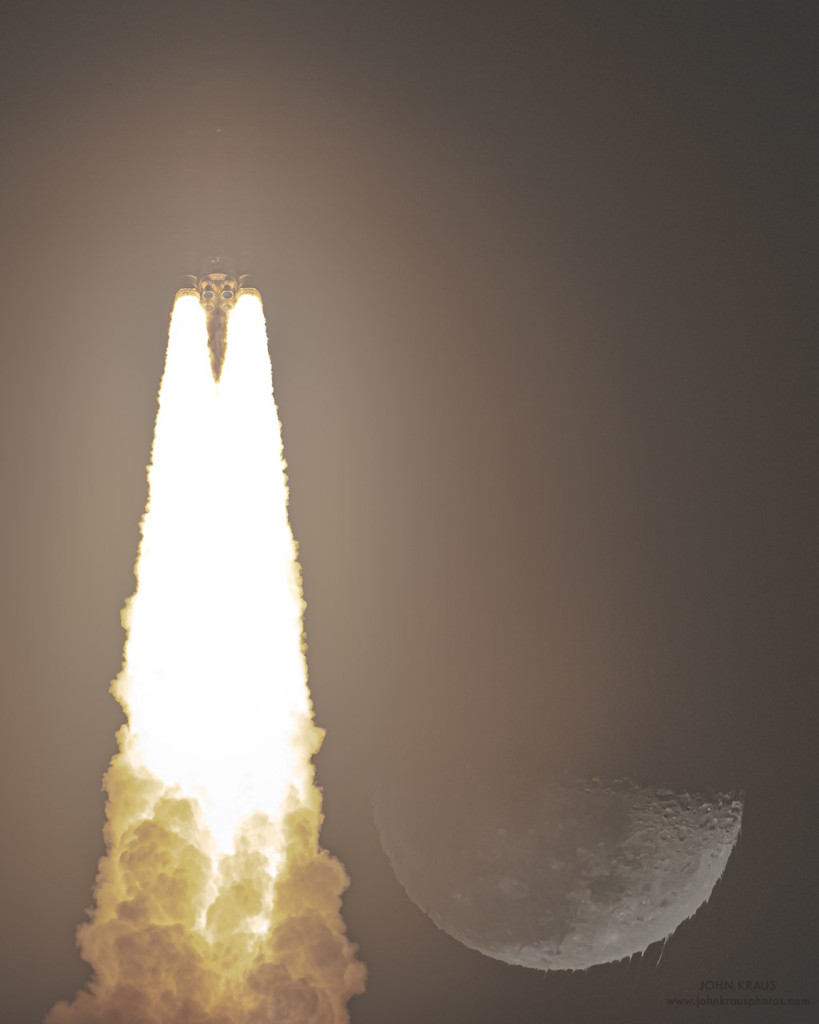
The Full Moon of October 9th was the second Full Moon after the northern hemisphere autumnal equinox, traditionally called the Hunter’s Moon. According to lore, the name is a fitting one because this Full Moon lights the night during a time for hunting in preparation for the coming winter months. In this snapshot, a nearly full Hunter’s Moon was captured just after sunset on October 8, rising in skies over Florida’s Space Coast. Rising from planet Earth a Falcon 9 rocket pierces the bright lunar disk from the photographer’s vantage point. Ripples and fringes along the edge of the lunar disk appear as supersonic shock waves generated by the rocket’s passage change the atmosphere’s index of refraction. [via NASA] https://ift.tt/imh7ast

Dust Shells around WR 140 from Webb

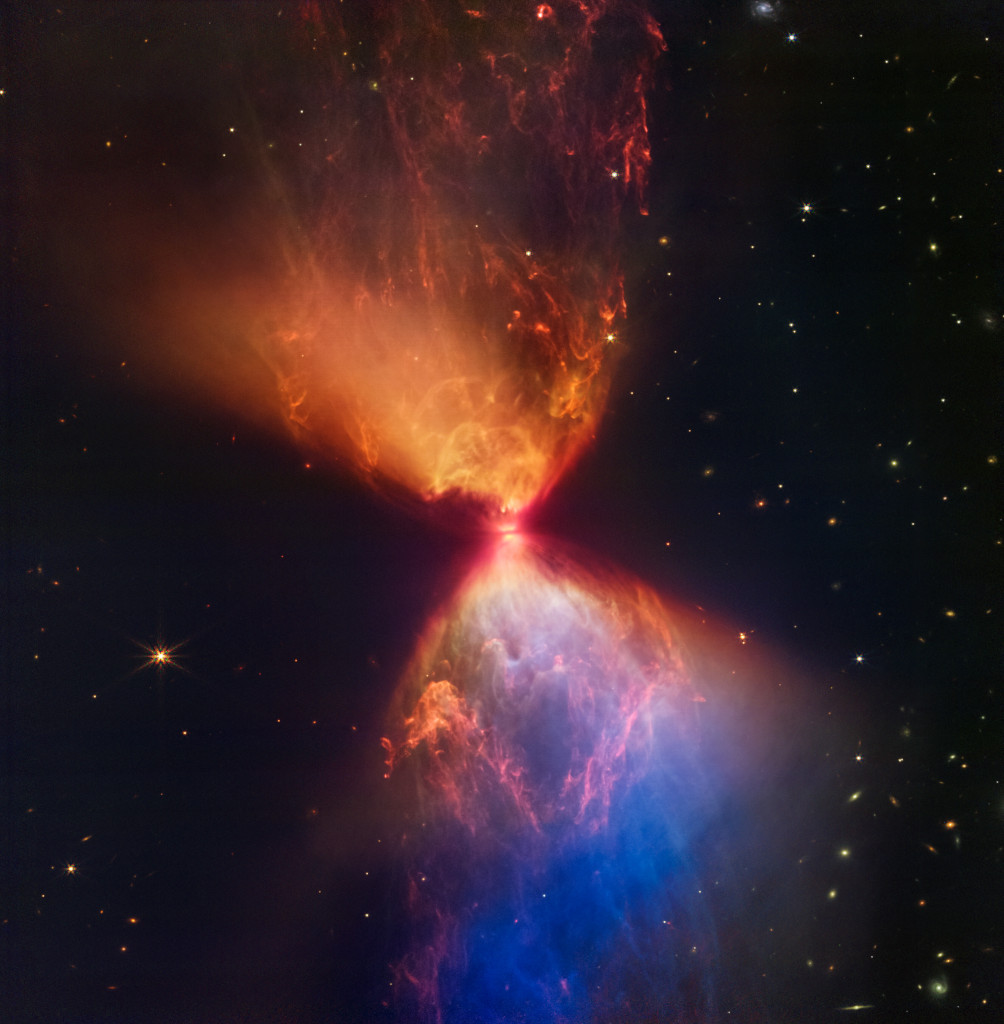
What are those strange rings? Rich in dust, the rings are likely 3D shells — but how they were created remains a topic of research. Where they were created is well known: in a binary star system that lies about 6,000 light years away toward the constellation of the Swan (Cygnus) — a system dominated by the Wolf-Rayet star WR 140. Wolf-Rayet stars are massive, bright, and known for their tumultuous winds. They are also known for creating and dispersing heavy elements such as carbon which is a building block of interstellar dust. The other star in the binary is also bright and massive — but not as active. The two great stars joust in an oblong orbit as they approach each other about every eight years. When at closest approach, the X-ray emission from the system increases, as, apparently, does the dust expelled into space — creating another shell. The featured infrared image by the new Webb Space Telescope resolves greater details and more dust shells than ever before. [via NASA] https://ift.tt/HrKpQPL

Ou4: The Giant Squid Nebula

A mysterious squid-like cosmic cloud, this nebula is very faint, but also very large in planet Earth’s sky. In the image, composed with 30 hours of narrowband image data, it spans nearly three full moons toward the royal constellation Cepheus. Discovered in 2011 by French astro-imager Nicolas Outters, the Squid Nebula’s bipolar shape is distinguished here by the telltale blue-green emission from doubly ionized oxygen atoms. Though apparently surrounded by the reddish hydrogen emission region Sh2-129, the true distance and nature of the Squid Nebula have been difficult to determine. Still, a more recent investigation suggests Ou4 really does lie within Sh2-129 some 2,300 light-years away. Consistent with that scenario, the cosmic squid would represent a spectacular outflow of material driven by a triple system of hot, massive stars, cataloged as HR8119, seen near the center of the nebula. If so, this truly giant squid nebula would physically be over 50 light-years across. [via NASA] https://ift.tt/YUxRjVO

Stars, Dust, Pillars, and Jets in the Pelican Nebula

What dark structures arise within the Pelican Nebula? On the whole, the nebula appears like a bird (a pelican) and is seen toward the constellation of a different bird: Cygnus, a Swan. But inside, the Pelican Nebula is a place lit up by new stars and befouled by dark dust. Smoke-sized dust grains start as simple carbon compounds formed in the cool atmospheres of young stars but are dispersed by stellar winds and explosions. Two impressive Herbig-Haro jets are seen emitted by the star HH 555 on the right, and these jets are helping to destroy the light year-long dust pillar that contains it. Other pillars and jets are also visible. The featured image was scientifically-colored to emphasize light emitted by small amounts of heavy elements in a nebula made predominantly of the light elements hydrogen and helium. The Pelican Nebula (IC 5067 and IC 5070) is about 2,000 light-years away and can be found with a small telescope to the northeast of the bright star Deneb. [via NASA] https://ift.tt/dB0RJDm

A Double Lunar Analemma over Turkey

An analemma is that figure-8 curve you get when you mark the position of the Sun at the same time each day for one year. But the trick to imaging an analemma of the Moon is to wait bit longer. On average the Moon returns to the same position in the sky about 50 minutes and 29 seconds later each day. So photograph the Moon 50 minutes 29 seconds later on successive days. Over one lunation or lunar month it will trace out an analemma-like curve as the Moon’s actual position wanders due to its tilted and elliptical orbit. Since the featured image was taken over two months, it actually shows a double lunar analemma. Crescent lunar phases too thin and faint to capture around the New moon are missing. The two months the persistent astrophotographer chose were during a good stretch of weather during July and August, and the location was Kayseri, Turkey [via NASA] https://ift.tt/Zg8uTsA

Auroras over Northern Canada

Gusting solar winds and blasts of charged particles from the Sun resulted in several rewarding nights of auroras back in 2014 December, near the peak of the last 11-year solar cycle. The featured image captured dramatic auroras stretching across a sky near the town of Yellowknife in northern Canada. The auroras were so bright that they not only inspired awe, but were easily visible on an image exposure of only 1.3 seconds. A video taken concurrently shows the dancing sky lights evolving in real time as tourists, many there just to see auroras, respond with cheers. The conical dwellings on the image right are tipis, while far in the background, near the image center, is the constellation of Orion. Auroras may increase again over the next few years as our Sun again approaches solar maximum. [via NASA] https://ift.tt/PjnmWvy

Two Comets in Southern Skies

Heading for its closest approach to the Sun or perihelion on December 20, comet C/2017 K2 (PanSTARRS) remains a sight for telescopic observers as it sweeps through planet Earth’s southern hemisphere skies. First time visitor from the remote Oort cloud this comet PanSTARRS sports a greenish coma and whitish dust tail about half a degree long at the upper left in a deep image from September 21. It also shares the starry field of view toward the constellation Scorpius with another comet, 73P/Schwassmann-Wachmann 3, seen about 1 degree below and right of PanSTARRS. Astronomers estimate that first time visitor comet C/2017 K2 (PanSTARRS) has been inbound from the Oort cloud for some 3 million years along a hyperbolic orbit. Schwassmann-Wachmann 3 is more familiar though. The periodic comet loops through its own elliptical orbit, from just beyond the orbit of Jupiter to the vicinity of Earth’s orbit, once every 5.4 years. Just passing in the night, this comet PanSTARRS is about 20 light-minutes from Earth in the September 21 image. Seen to be disintegrating since 1995, Schwassmann-Wachmann 3 was about 7.8 light-minutes away. [via NASA] https://ift.tt/jorW5bN

In Ganymede s Shadow

At opposition, opposite the Sun in Earth’s sky, late last month Jupiter is also approaching perihelion, the closest point to the Sun in its elliptical orbit, early next year. That makes Jupiter exceptionally close to our fair planet, currently resulting in excellent views of the Solar System’s ruling gas giant. On September 27, this sharp image of Jupiter was recorded with a small telescope from a backyard in Florence, Arizona. The stacked video frames reveal the massive world bounded by planet girdling winds. Dark belts and light zones span the gas giant, along with rotating oval storms and its signature Great Red Spot. Galilean moon Ganymede is below and right in the frame. The Solar System’s largest moon and its shadow are in transit across the southern Jovian cloud tops. [via NASA] https://ift.tt/Bfd7xrZ

NGC 4631: The Whale Galaxy

NGC 4631 is a big beautiful spiral galaxy. Seen edge-on, it lies only 25 million light-years away in the well-trained northern constellation Canes Venatici. The galaxy’s slightly distorted wedge shape suggests to some a cosmic herring and to others its popular moniker, The Whale Galaxy. Either way, it is similar in size to our own Milky Way. In this sharp color image, the galaxy’s yellowish core, dark dust clouds, bright blue star clusters, and red star forming regions are easy to spot. A companion galaxy, the small elliptical NGC 4627 is just above the Whale Galaxy. Faint star streams seen in deep images are the remnants of small companion galaxies disrupted by repeated encounters with the Whale in the distant past. The Whale Galaxy is also known to have spouted a halo of hot gas glowing in X-rays. [via NASA] https://ift.tt/9iFVX1y

Expanding Plume from DARTs Impact

What happens if you crash a spaceship into an asteroid? In the case of NASA’s DART spaceship and the small asteroid Dimorphos, as happened last week, you get quite a plume. The goal of the planned impact was planetary protection — to show that the path of an asteroid can be slightly altered, so that, if done right, a big space rock will miss the Earth. The high brightness of the plume, though, was unexpected by many, and what it means remains a topic of research. One possibility is that 170-meter wide Dimorphos is primarily a rubble pile asteroid and the collision dispersed some of the rubble in the pile. The featured time-lapse video covers about 20 minutes and was taken from the Les Makes Observatory on France’s Reunion Island, off the southeast coast of southern Africa. One of many Earth-based observatories following the impact, the initial dot is primarily Dimorphos’s larger companion: asteroid Didymos. Most recently, images show that the Didymos – Dimorphos system has developed comet-like tails. [via NASA] https://ift.tt/U29QJlk