Mount Etna Milky Way

A glow from the summit of Mount Etna, famous active stratovolcano of planet Earth, stands out along the horizon in this mountain and night skyscape. Bands of diffuse light from congeries of innumerable stars along the Milky Way galaxy stretch across the sky above. In silhouette, the Milky Way’s massive dust clouds are clumped along the galactic plane. But also familiar to northern skygazers are bright stars Deneb, Vega, and Altair, the Summer Triangle straddling dark nebulae and luminous star clouds poised over the volcanic peak. The deep combined exposures also reveal the light of active star forming regions along the Milky Way, echoing Etna’s ruddy hue in the northern hemisphere summer’s night. [via NASA] https://ift.tt/YsJighZ

A Beautiful Trifid

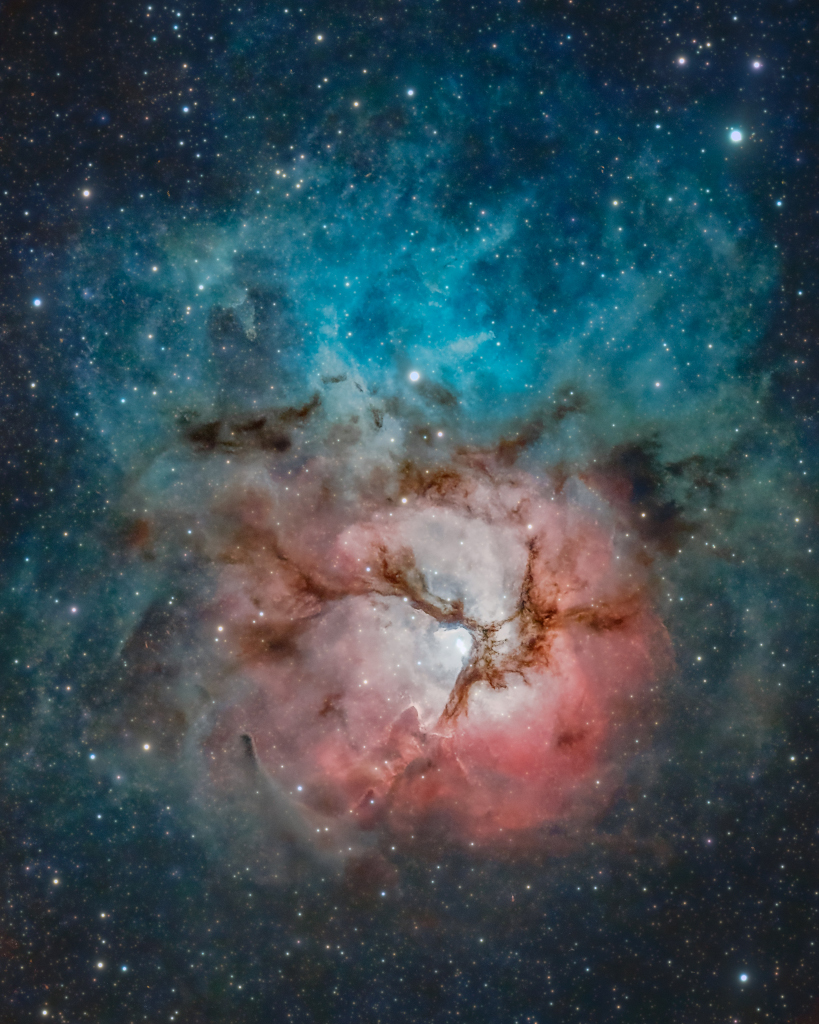
The beautiful Trifid Nebula is a cosmic study in contrasts. Also known as M20, it lies about 5,000 light-years away toward the nebula rich constellation Sagittarius. A star forming region in the plane of our galaxy, the Trifid does illustrate three different types of astronomical nebulae; red emission nebulae dominated by light from hydrogen atoms, blue reflection nebulae produced by dust reflecting starlight, and dark nebulae where dense dust clouds appear in silhouette. But the red emission region, roughly separated into three parts by obscuring dust lanes, is what lends the Trifid its popular name. Pillars and jets sculpted by newborn stars, above and right of the emission nebula’s center, appear in famous Hubble Space Telescope close-up images of the region. The Trifid Nebula is about 40 light-years across. Too faint to be seen by the unaided eye, it almost covers the area of a full moon on planet Earth’s sky. [via NASA] https://ift.tt/FaxfP6q

M83: Star Streams and a Thousand Rubies

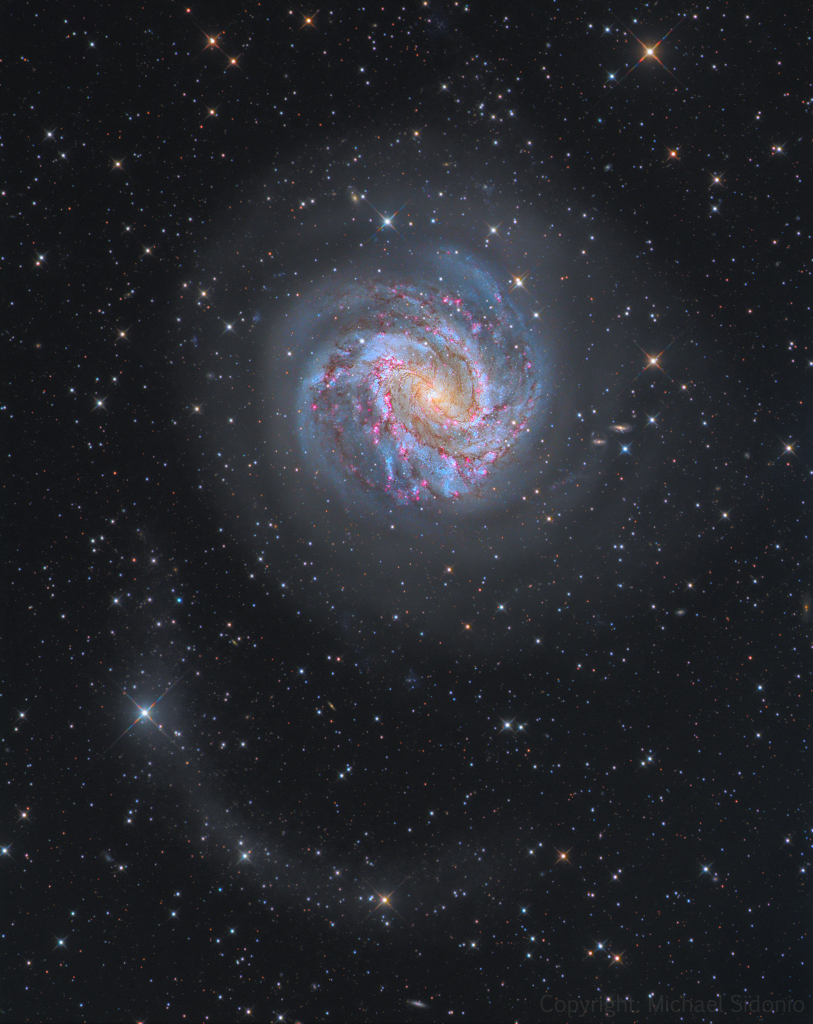
Big, bright, and beautiful, spiral galaxy M83 lies a mere twelve million light-years away, near the southeastern tip of the very long constellation Hydra. About 40,000 light-years across, M83 is known as the Southern Pinwheel for its pronounced spiral arms. But the wealth of reddish star forming regions found near the edges of the arms’ thick dust lanes, also suggest another popular moniker for M83, the Thousand-Ruby Galaxy. This new deep telescopic digital image also records the bright galaxy’s faint, extended halo. Arcing toward the bottom of the cosmic frame lies a stellar tidal stream, debris drawn from massive M83 by the gravitational disruption of a smaller, merging satellite galaxy. Astronomers David Malin and Brian Hadley found the elusive star stream in the mid 1990s by enhancing photographic plates. [via NASA] https://ift.tt/7i3k4wg

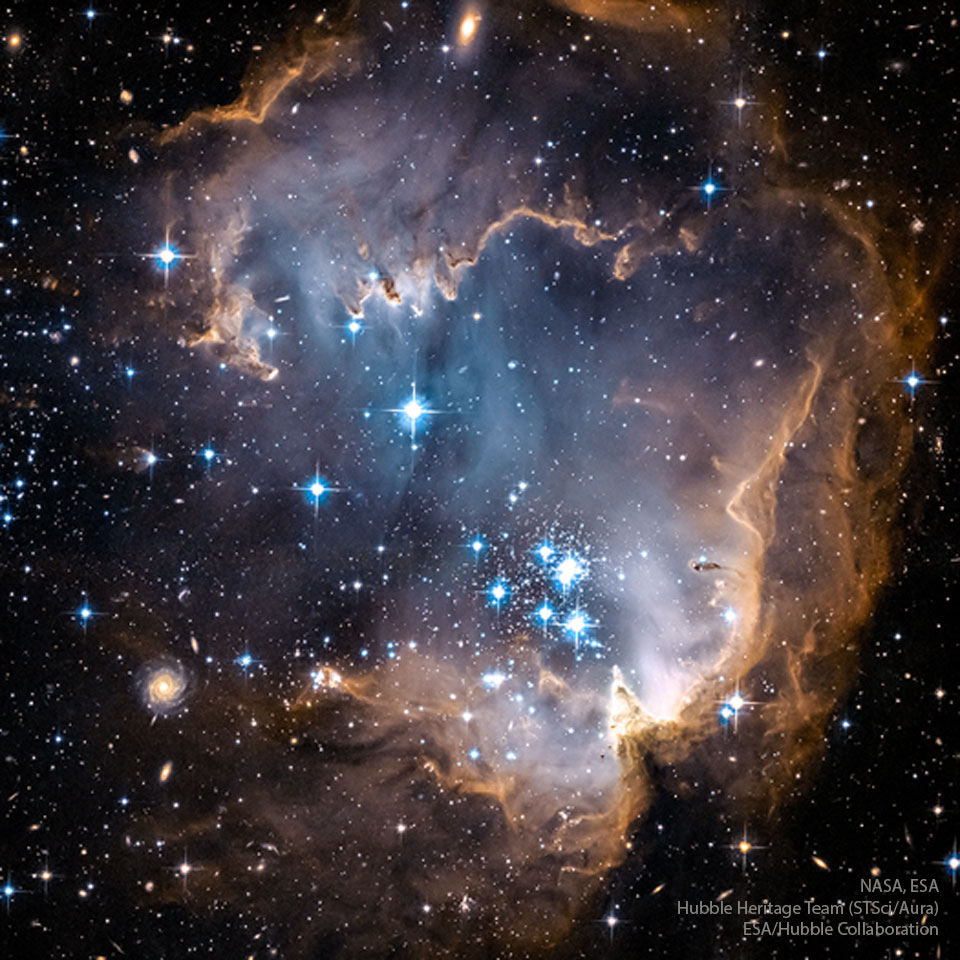
The clouds may look like an oyster, and the stars like pearls, but look beyond. Near the outskirts of the Small Magellanic Cloud, a satellite galaxy some 200 thousand light-years distant, lies this 5 million year old star cluster NGC 602. Surrounded by its birth shell of gas and dust, star cluster NGC 602 is featured in this stunning Hubble image, augmented in a rollover by images in the X-ray by the Chandra Observatory and in the infrared by Spitzer Telescope. Fantastic ridges and swept back gas strongly suggest that energetic radiation and shock waves from NGC 602’s massive young stars have eroded the dusty material and triggered a progression of star formation moving away from the star cluster’s center. At the estimated distance of the Small Magellanic Cloud, the featured picture spans about 200 light-years, but a tantalizing assortment of background galaxies are also visible in this sharp view. The background galaxies are hundreds of millions of light-years — or more — beyond NGC 602. [via NASA] https://ift.tt/wAD3it9

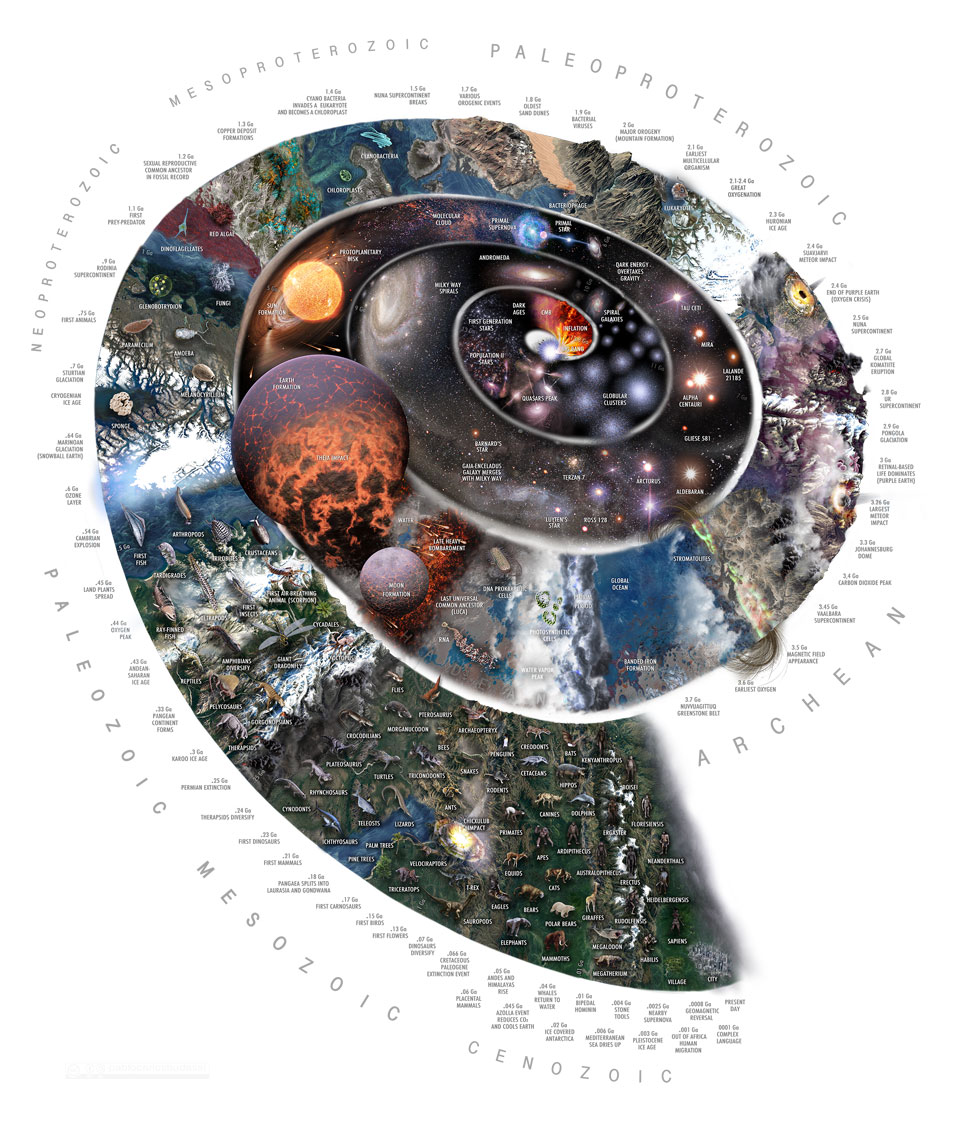
What’s happened since the universe started? The time spiral shown here features a few notable highlights. At the spiral’s center is the Big Bang, the place where time, as we know it, began about 13.8 billion years ago. Within a few billion years atoms formed, then stars formed from atoms, galaxies formed from stars and gas, our Sun formed, soon followed by our Earth, about 4.6 billion years ago. Life on Earth begins about 3.8 billion years ago, followed by cells, then photosynthesis within a billion years. About 1.7 billion years ago, multicellular life on Earth began to flourish. Fish began to swim about 500 million years ago, and mammals because walking on land about 200 million years ago. Humans first appeared only about 6 million years ago, and made the first cities only about 10,000 years ago. The time spiral illustrated stops there, but human spaceflight might be added, which started only 75 years ago, and useful artificial intelligence began to take hold within only the past few years. [via NASA] https://ift.tt/Es6wKbA

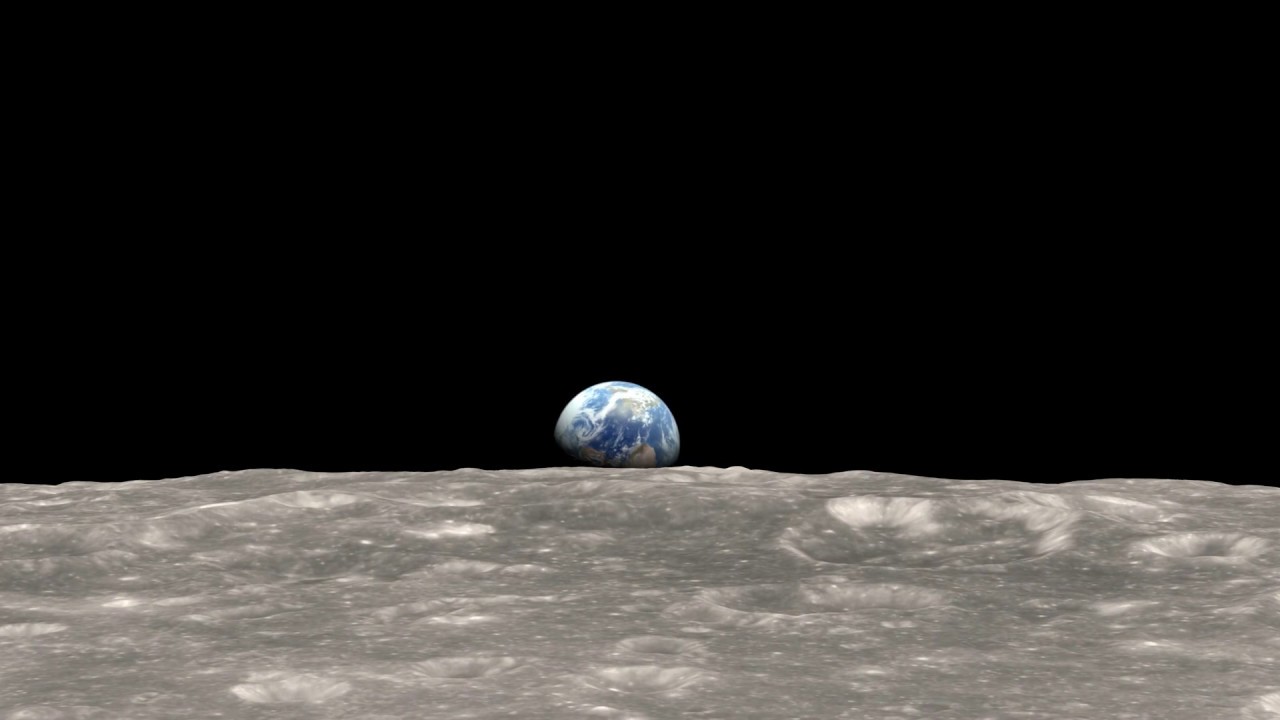
About 12 seconds into this video, something unusual happens. The Earth begins to rise. Never seen by humans before, the rise of the Earth over the limb of the Moon occurred about 55.5 years ago and surprised and amazed the crew of Apollo 8. The crew immediately scrambled to take still images of the stunning vista caused by Apollo 8’s orbit around the Moon. The featured video is a modern reconstruction of the event as it would have looked were it recorded with a modern movie camera. The colorful orb of our Earth stood out as a familiar icon rising above a distant and unfamiliar moonscape, the whole scene the conceptual reverse of a more familiar moonrise as seen from Earth. To many, the scene also spoke about the unity of humanity: that big blue marble — that’s us — we all live there. The two-minute video is not time-lapse — this is the real speed of the Earth rising through the windows of Apollo 8. Seven months and three missions later, Apollo 11 astronauts would not only circle Earth’s moon, but land on it. [via NASA] https://ift.tt/Et68FyU

A Solstice Moon

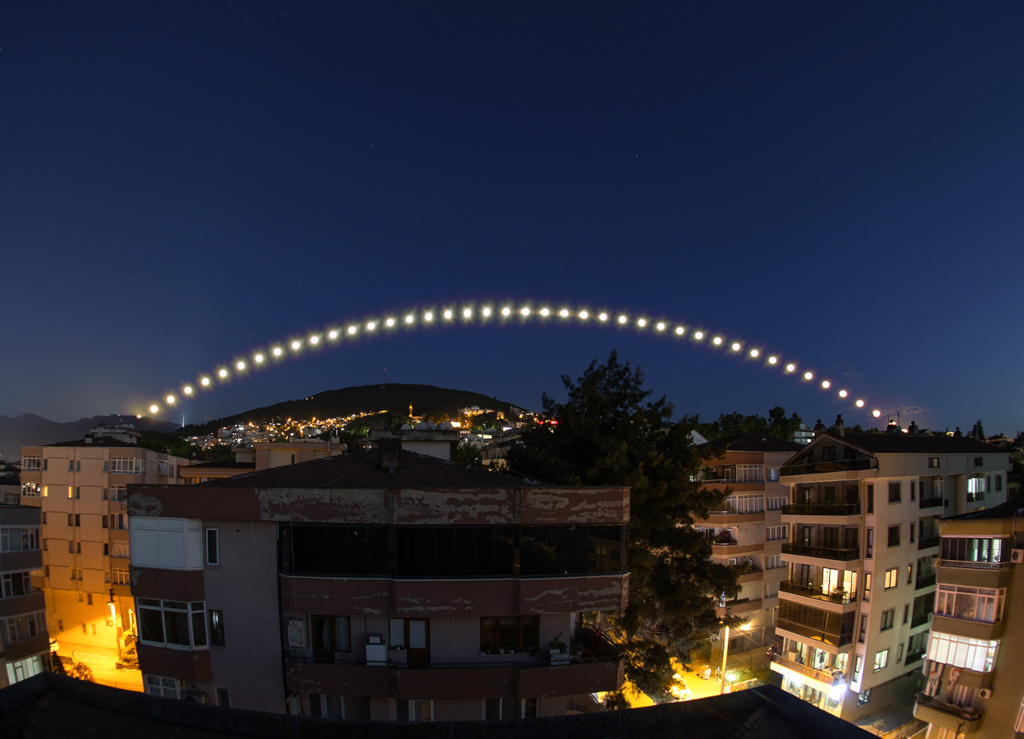
Rising opposite the setting Sun, June’s Full Moon occurred within about 28 hours of the solstice. The Moon stays close to the Sun’s path along the ecliptic plane and so while the solstice Sun climbed high in daytime skies, June’s Full Moon remained low that night as seen from northern latitudes. In fact, the Full Moon hugs the horizon in this June 21 rooftop night sky view from Bursa, Turkey, constructed from exposures made every 10 minutes between moonrise and moonset. In 2024 the Moon also reached a major lunar standstill, an extreme in the monthly north-south range of moonrise and moonset caused by the precession of the Moon’s orbit over an 18.6 year cycle. As a result, this June solstice Full Moon was at its southernmost moonrise and moonset along the horizon. [via NASA] https://ift.tt/7KJey6r

Comet 13P Olbers

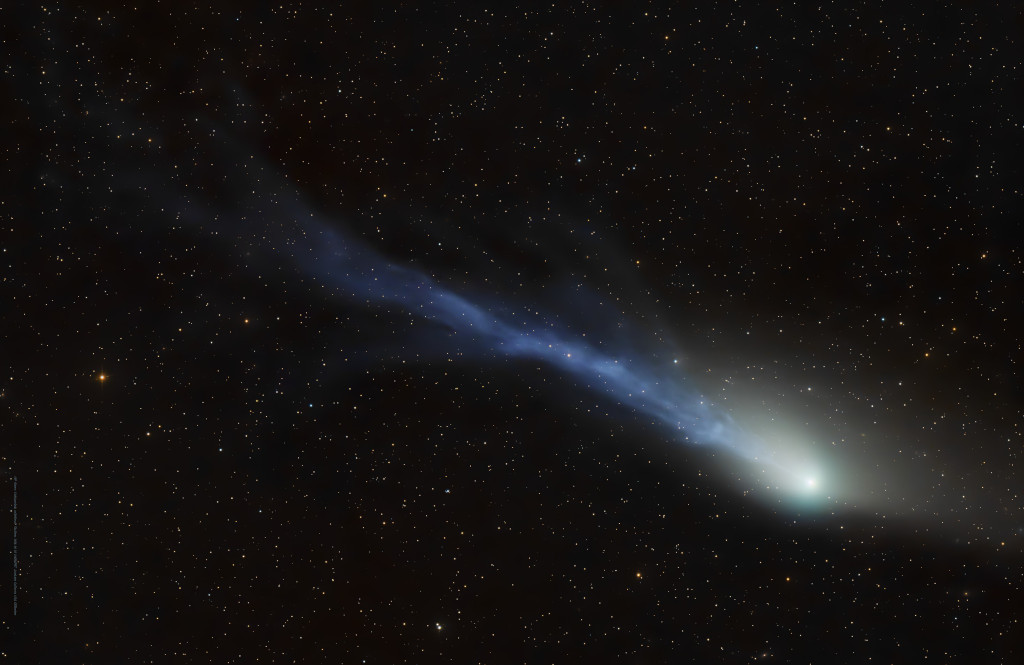
Not a paradox, Comet 13P/Olbers is returning to the inner Solar System after 68 years. The periodic, Halley-type comet will reach its next perihelion or closest approach to the Sun on June 30 and has become a target for binocular viewing low in planet Earth’s northern hemisphere night skies. But this sharp telescopic image of 13P is composed of stacked exposures made on the night of June 25. It easily reveals shifting details in the bright comet’s torn and tattered ion tail buffeted by the wind from an active Sun, along with a broad, fanned-out dust tail and slightly greenish coma. The frame spans over two degrees across a background of faint stars toward the constellation Lynx. [via NASA] https://ift.tt/TZ5yR1J

Protostellar Outflows in Serpens

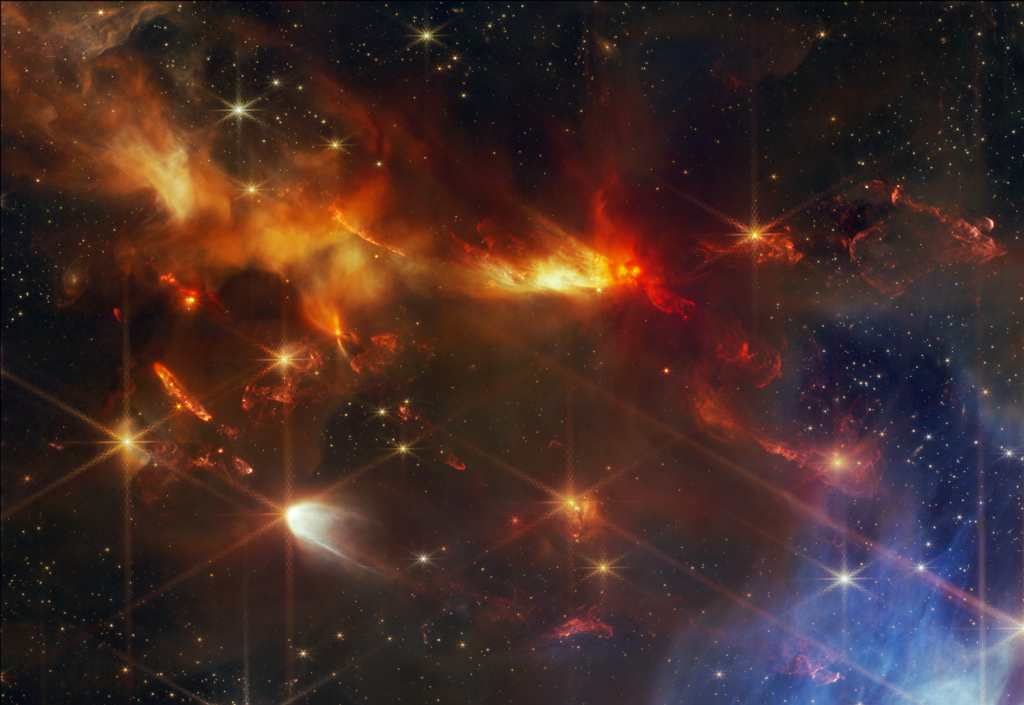
Jets of material blasting from newborn stars, are captured in this James Webb Space Telescope close-up of the Serpens Nebula. The powerful protostellar outflows are bipolar, twin jets spewing in opposite directions. Their directions are perpendicular to accretion disks formed around the spinning, collapsing stellar infants. In the NIRcam image, the reddish color represents emission from molecular hydrogen and carbon monoxide produced as the jets collide with the surrounding gas and dust. The sharp image shows for the first time that individual outflows detected in the Serpens Nebula are generally aligned along the same direction. That result was expected, but has only now come into clear view with Webb’s detailed exploration of the active young star-forming region. Brighter foreground stars exhibit Webb’s characteristic diffraction spikes. At the Serpens Nebula’s estimated distance of 1,300 light-years, this cosmic close-up frame is about 1 light-year across. [via NASA] https://ift.tt/NlZO9oY

What’s happening in the sky this unusual night? Most striking in the featured 4.5-hour 360-degree panoramic video, perhaps, is the pink and purple aurora. That’s because this night, encompassing May 11, was famous for its auroral skies around the world. As the night progresses, auroral bands shimmer, the central band of our Milky Way Galaxy rises, and stars shift as the Earth rotates beneath them. Captured here simultaneously is a rare red band running above the aurora: a SAR arc, seen to change only slightly. The flashing below the horizon is caused by passing cars, while the moving spots in the sky are satellites and airplanes. The featured video was captured from Xinjiang, China with four separate cameras. [via NASA] https://ift.tt/2WpxYF1