What if you saw your shadow on Mars and it wasn’t human? Then you might be the Perseverance rover exploring Mars. Perseverance has been examining the Red Planet since 2021, finding evidence of its complex history of volcanism and ancient flowing water, and sending breathtaking images across the inner Solar System. Pictured here in February of 2024, Perseverance looks opposite the Sun and across Neretva Vallis in Jezero Crater, with a local hill visible at the top of the frame. The distinctively non-human shadow of the car-sized rover is visible below center, superposed on scattered rocks. Perseverance, now working without its flying companion Ingenuity, continues to search Mars for signs of ancient life. [via NASA] https://ift.tt/JC8h01a

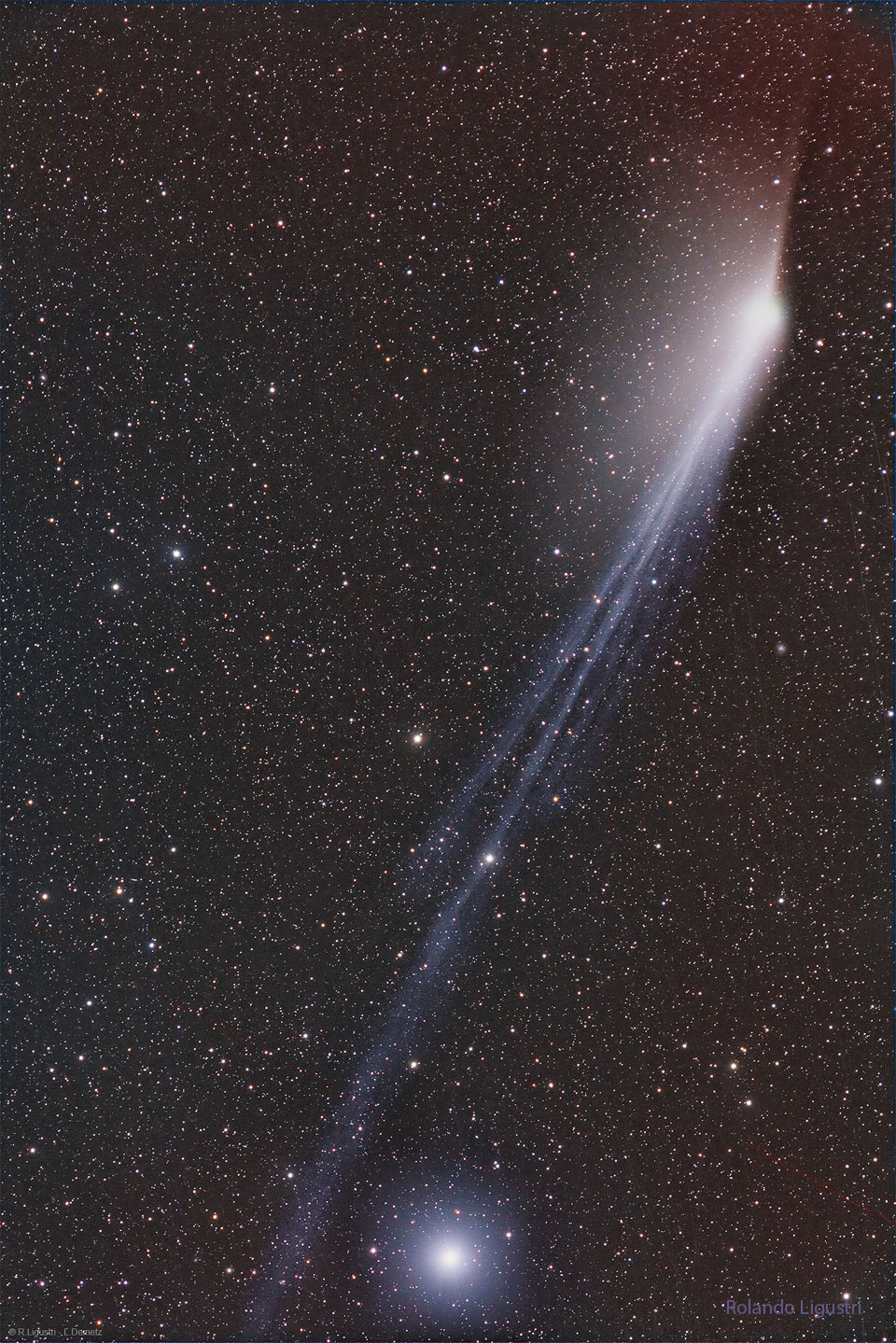
Why does Comet Pons-Brooks now have tails pointing in opposite directions? The most spectacular tail is the blue-glowing ion tail that is visible flowing down the image. The ion tail is pushed directly out from the Sun by the solar wind. On the upper right is the glowing central coma of Comet 12P/Pons–Brooks. Fanning out from the coma, mostly to the left, is the comet’s dust tail. Pushed out and slowed down by the pressure of sunlight, the dust tail tends to trail the comet along its orbit and, from some viewing angles, can appear opposite to the ion tail. The distant, bright star Alpha Leporis is seen at the bottom of the featured image captured last week from Namibia. Two days ago, the comet passed its closest to the Earth and is now best visible from southern skies as it dims and glides back to the outer Solar System. [via NASA] https://ift.tt/XMdJYV5

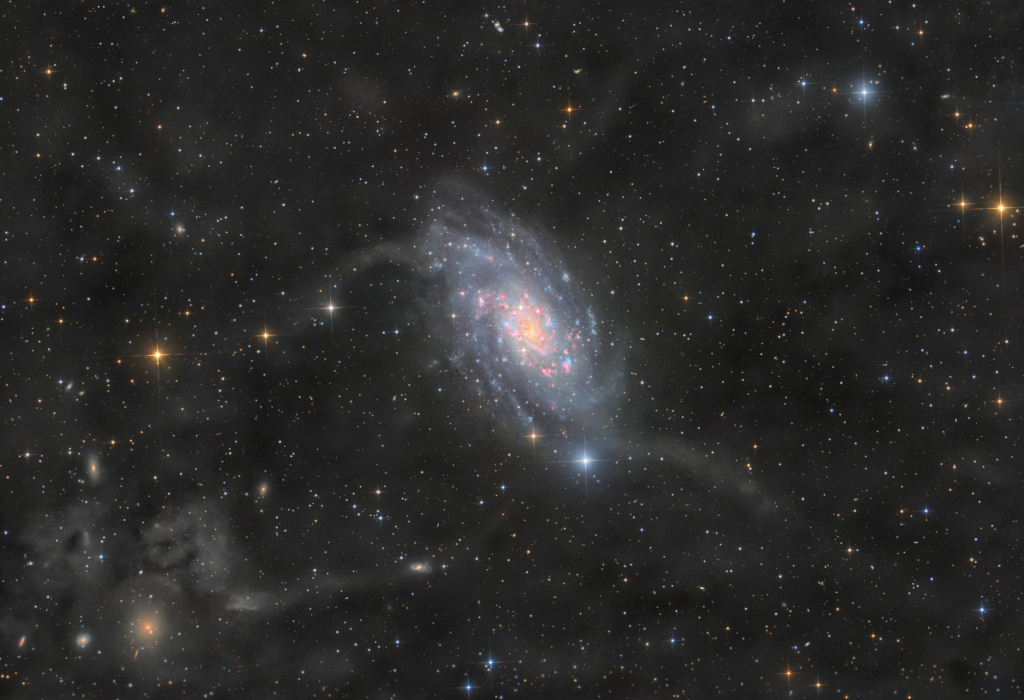
NGC 2403 in Camelopardalis

Magnificent island universe NGC 2403 stands within the boundaries of the long-necked constellation Camelopardalis. Some 10 million light-years distant and about 50,000 light-years across, the spiral galaxy also seems to have more than its fair share of giant star forming HII regions, marked by the telltale reddish glow of atomic hydrogen gas. The giant HII regions are energized by clusters of hot, massive stars that explode as bright supernovae at the end of their short and furious lives. A member of the M81 group of galaxies, NGC 2403 closely resembles a galaxy in our own local galaxy group with an abundance of star forming regions, M33, the Triangulum Galaxy. Spiky in appearance, bright stars in this portrait of NGC 2403 are in the foreground, within our own Milky Way. Also in the foreground of the deep, wide-field, telescopic image are the Milky Way’s dim and dusty interstellar clouds also known as galactic cirrus or integrated flux nebulae. But faint features that seem to extend from NGC 2403 itself are likely tidal stellar streams drawn out by gravitational interactions with neighboring galaxies. [via NASA] https://ift.tt/rgP3iMk

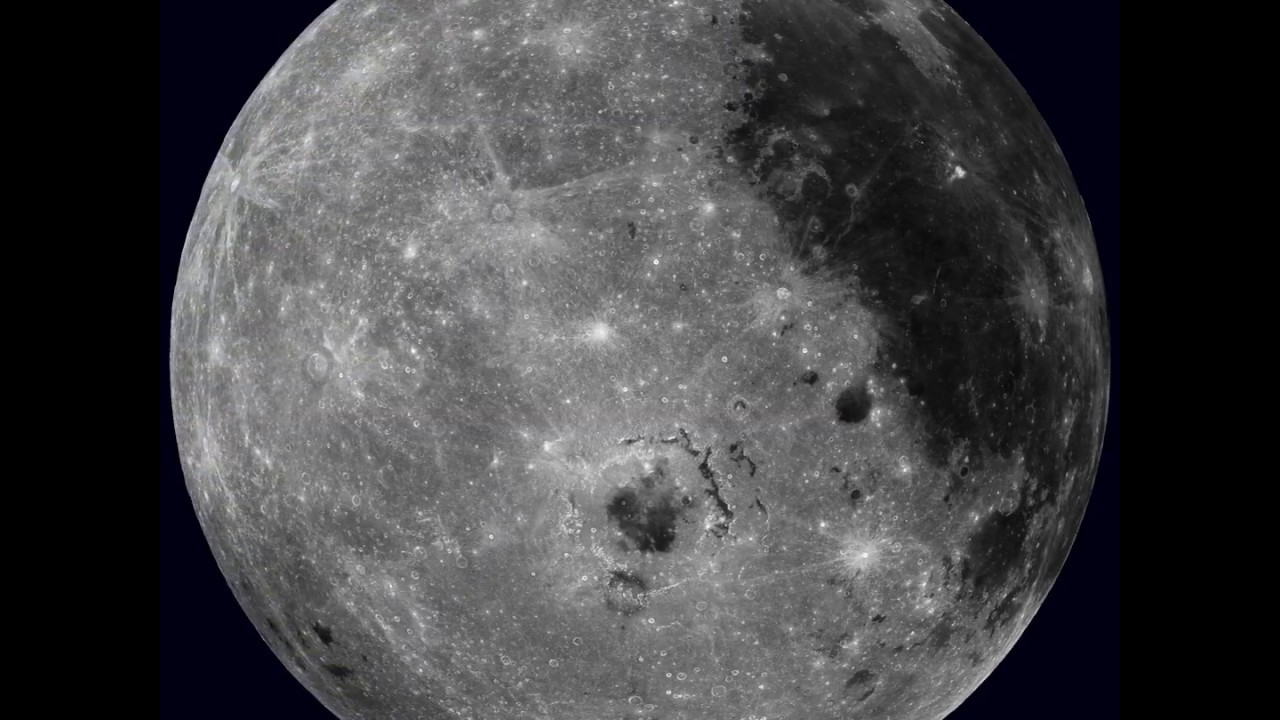
No one, presently, sees the Moon rotate like this. That’s because the Earth’s moon is tidally locked to the Earth, showing us only one side. Given modern digital technology, however, combined with many detailed images returned by the Lunar Reconnaissance Orbiter (LRO), a high resolution virtual Moon rotation movie has been composed. The featured time-lapse video starts with the standard Earth view of the Moon. Quickly, though, Mare Orientale, a large crater with a dark center that is difficult to see from the Earth, rotates into view just below the equator. From an entire lunar month condensed into 24 seconds, the video clearly shows that the Earth side of the Moon contains an abundance of dark lunar maria, while the lunar far side is dominated by bright lunar highlands. Currently, over 32 new missions to the Moon are under active development from multiple countries and companies, including NASA’s Artemis program which aims to land people on the Moon again within the next few years. [via NASA] https://ift.tt/hCej0Da

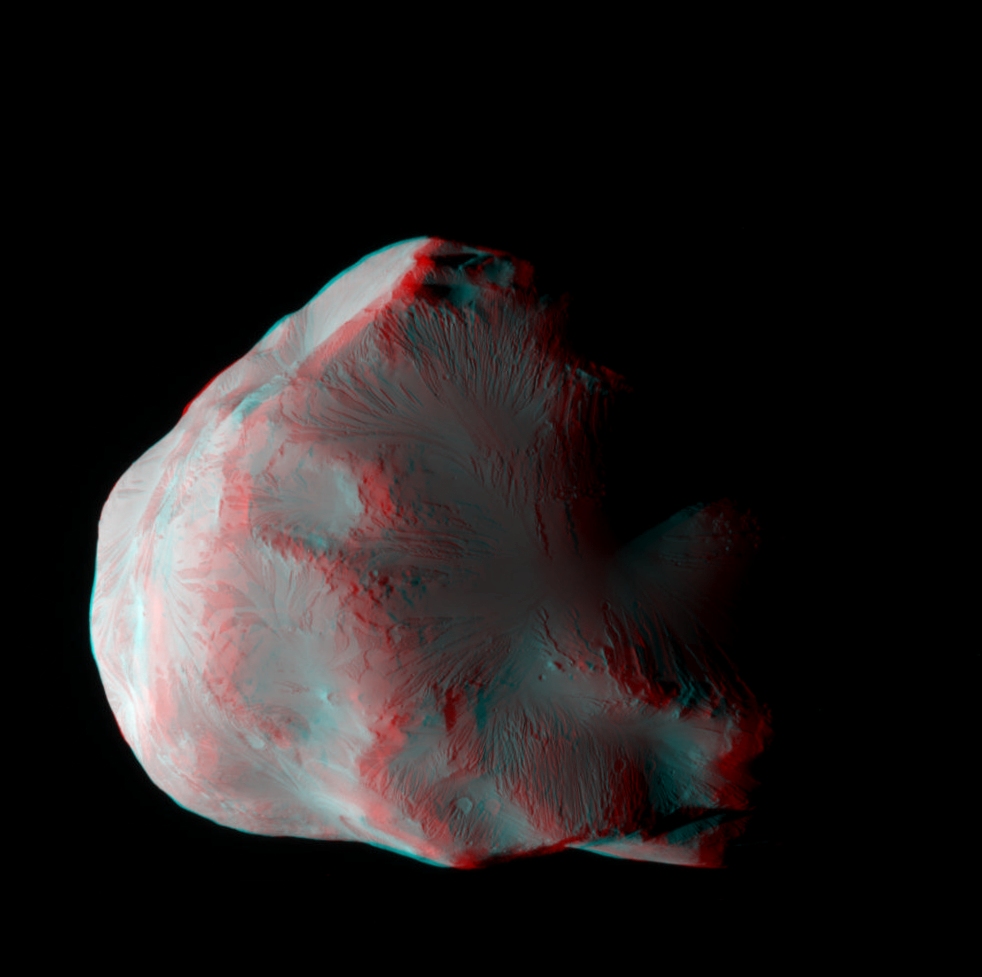
Stereo Helene

Get out your red/blue glasses and float next to Helene, small, icy moon of Saturn. Appropriately named, Helene is a Trojan moon, so called because it orbits at a Lagrange point. A Lagrange point is a gravitationally stable position near two massive bodies, in this case Saturn and larger moon Dione. In fact, irregularly shaped ( about 36 by 32 by 30 kilometers) Helene orbits at Dione’s leading Lagrange point while brotherly ice moon Polydeuces follows at Dione’s trailing Lagrange point. The sharp stereo anaglyph was constructed from two Cassini images captured during a close flyby in 2011. It shows part of the Saturn-facing hemisphere of Helene mottled with craters and gully-like features. [via NASA] https://ift.tt/rtSImlF

The Nebulous Realm of WR 134

Made with narrowband filters, this cosmic snapshot covers a field of view over twice as wide as the full Moon within the boundaries of the constellation Cygnus. It highlights the bright edge of a ring-like nebula traced by the glow of ionized hydrogen and oxygen gas. Embedded in the region’s expanse of interstellar clouds, the complex, glowing arcs are sections of shells of material swept up by the wind from Wolf-Rayet star WR 134, brightest star near the center of the frame. Distance estimates put WR 134 about 6,000 light-years away, making the frame over 100 light-years across. Shedding their outer envelopes in powerful stellar winds, massive Wolf-Rayet stars have burned through their nuclear fuel at a prodigious rate and end this final phase of massive star evolution in a spectacular supernova explosion. The stellar winds and final supernova enrich the interstellar material with heavy elements to be incorporated in future generations of stars. [via NASA] https://ift.tt/A9k2iLs

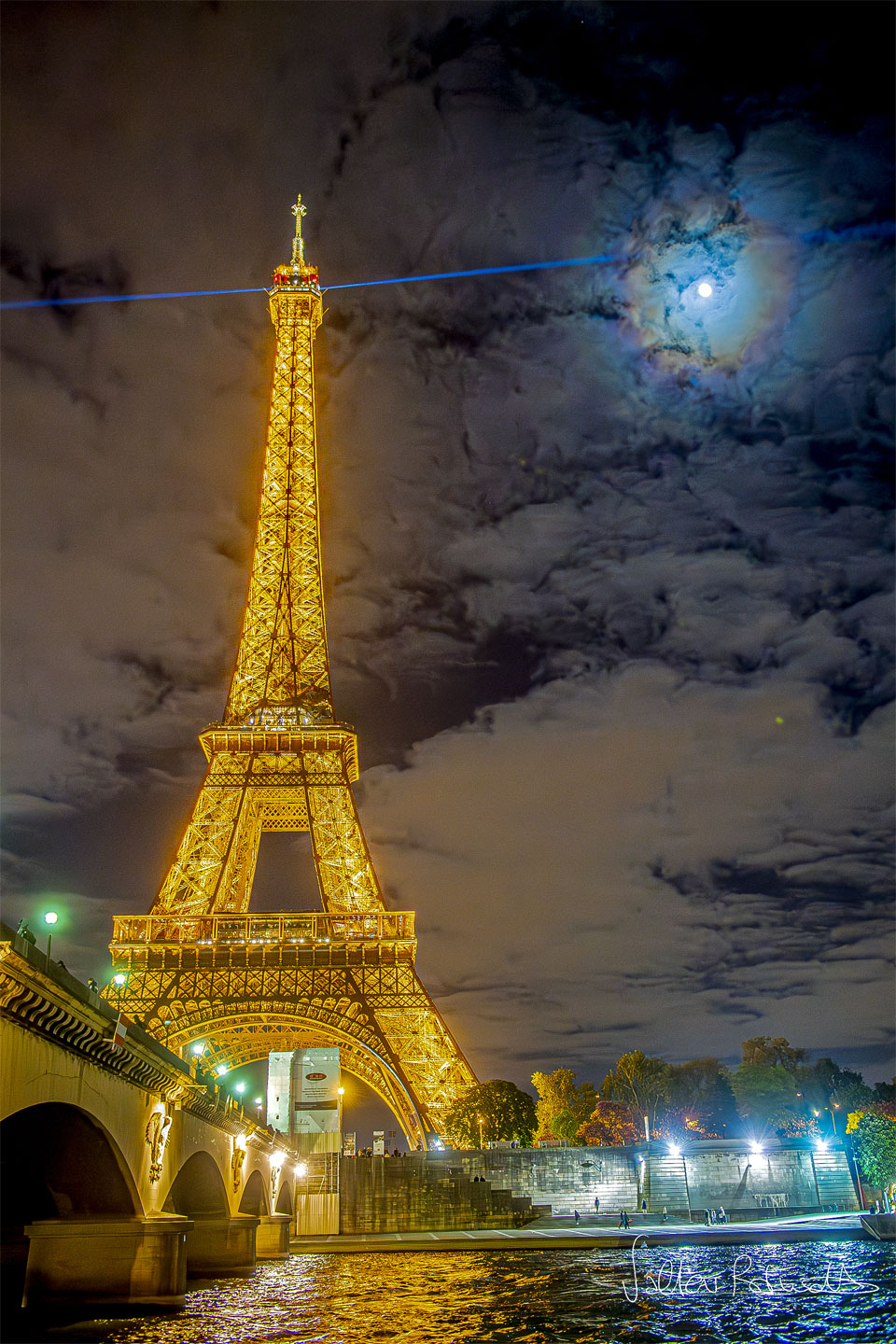
Why does a cloudy moon sometimes appear colorful? The effect, called a lunar corona, is created by the quantum mechanical diffraction of light around individual, similarly-sized water droplets in an intervening but mostly-transparent cloud. Since light of different colors has different wavelengths, each color diffracts differently. Lunar coronae are one of the few quantum mechanical color effects that can be easily seen with the unaided eye. Solar coronae are also sometimes evident. The featured image was taken last month from Paris, France. The blue beacon emanating from the Eiffel Tower did not affect the colorful lunar corona. [via NASA] https://ift.tt/pxzklX1

What happens if you ascend this stairway to the Milky Way? Before answering that, let’s understand the beautiful sky you will see. Most eye-catching is the grand arch of the Milky Way Galaxy, the band that is the central disk of our galaxy which is straight but distorted by the wide-angle nature of this composite image. Many stars well in front of the Milk Way will be visible, with the bright white star just below the stellar arch being Altair, and the bright blue star above it being Vega. The air glows green on the left, just above the yellow cloud deck. The featured image was taken last month on Portugal’s Madeira Island in the North Atlantic Ocean. Oh, and what happens after you reach the top of these stairs and admire the amazing sky is, quite probably, that you then descend down the stairs on the other side. [via NASA] https://ift.tt/1gtrYwN

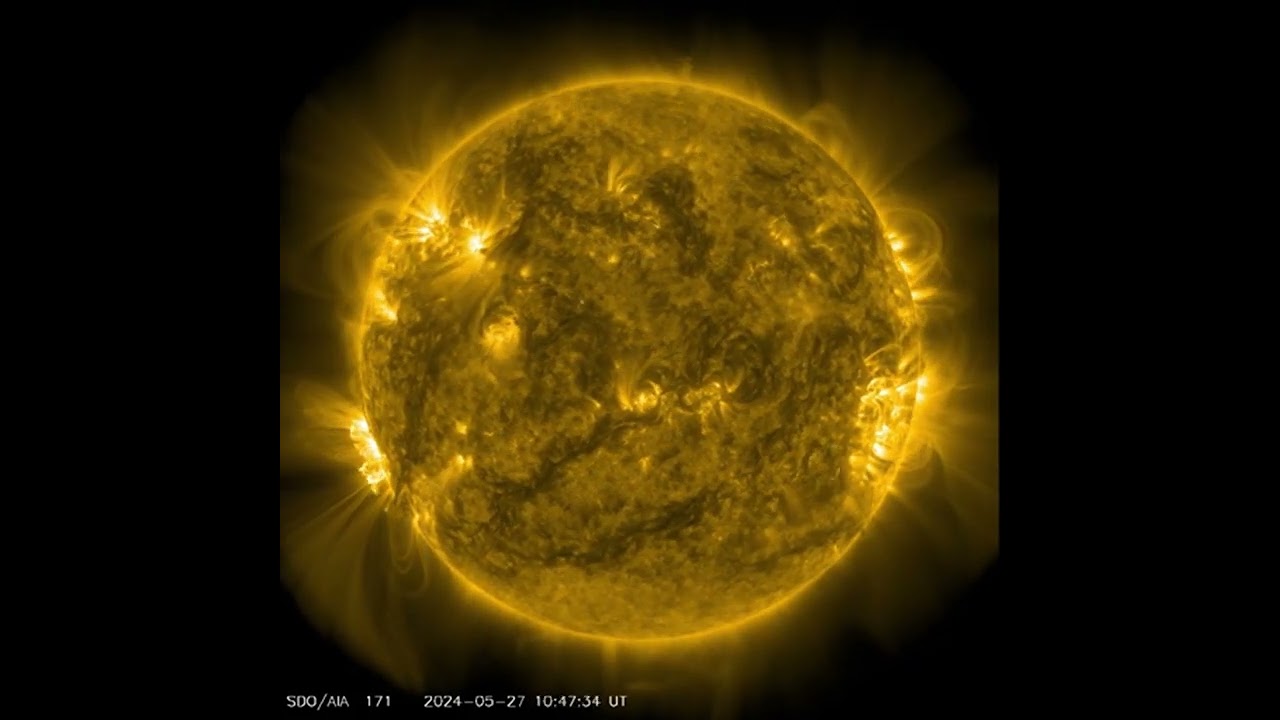
It’s back. The famous active region on the Sun that created auroras visible around the Earth earlier this month has survived its rotation around the far side of the Sun — and returned. Yesterday, as it was beginning to reappear on the Earth-facing side, the region formerly labeled AR 3664 threw another major solar flare, again in the highest-energy X-class range. The featured video shows the emerging active region on the lower left, as it was captured by NASA’s Earth-orbiting Solar Dynamics Observatory yesterday in ultraviolet light. The video is a time-lapse of the entire Sun rotating over 24 hours. Watch the lower-left region carefully at about the 2-second mark to see the powerful flare burst out. The energetic particles from that flare and associated CME are not expected to directly impact the Earth and trigger impressive auroras, but scientists will keep a close watch on this unusually active region over the next two weeks, as it faces the Earth, to see what develops. [via NASA] https://ift.tt/ZLvmirz

Chamaeleon I Molecular Cloud

Dark markings and bright nebulae in this telescopic southern sky view are telltale signs of young stars and active star formation. They lie a mere 650 light-years away, at the boundary of the local bubble and the Chamaeleon molecular cloud complex. Regions with young stars identified as dusty reflection nebulae from the 1946 Cederblad catalog include the C-shaped Ced 110 just above and right of center, and bluish Ced 111 below it. Also a standout in the frame, the orange tinted V-shape of the Chamaeleon Infrared Nebula (Cha IRN) was carved by material streaming from a newly formed low-mass star. The well-composed image spans 1.5 degrees. That’s about 17 light-years at the estimated distance of the nearby Chamaeleon I molecular cloud. [via NASA] https://ift.tt/CWqFLcT