Dark Ball in Inverted Starfield

Does this strange dark ball look somehow familiar? If so, that might be because it is our Sun. In the featured image from 2012, a detailed solar view was captured originally in a very specific color of red light, then rendered in black and white, and then color inverted. Once complete, the resulting image was added to a starfield, then also color inverted. Visible in the image of the Sun are long light filaments, dark active regions, prominences peeking around the edge, and a moving carpet of hot gas. The surface of our Sun can be a busy place, in particular during Solar Maximum, the time when its surface magnetic field is wound up the most. Besides an active Sun being so picturesque, the plasma expelled can also become picturesque when it impacts the Earth’s magnetosphere and creates auroras. [via NASA] https://ift.tt/cNDZu2O

Lunar Eclipse at the South Pole

Last May 16 the Moon slid through Earth’s shadow, completely immersed in the planet’s dark umbra for about 1 hour and 25 minutes during a total lunar eclipse. In this composited timelapse view, the partial and total phases of the eclipse were captured as the Moon tracked above the horizon from Amundsen-Scott South Pole Station. There it shared a cold and starry south polar night with a surging display of the aurora australis and central Milky Way. In the foreground are the BICEP (right) and South Pole telescopes at the southernmost station’s Dark Sector Laboratory. But while polar skies can be spectacular, you won’t want to go to the South Pole to view the total lunar eclipse coming up on November 8. Instead, that eclipse can be seen from locations in Asia, Australia, the Pacific, the Americas and Northern Europe. It will be your last chance to watch a total lunar eclipse until 2025. [via NASA] https://ift.tt/IZFpCKv

InSight’s Final Selfie

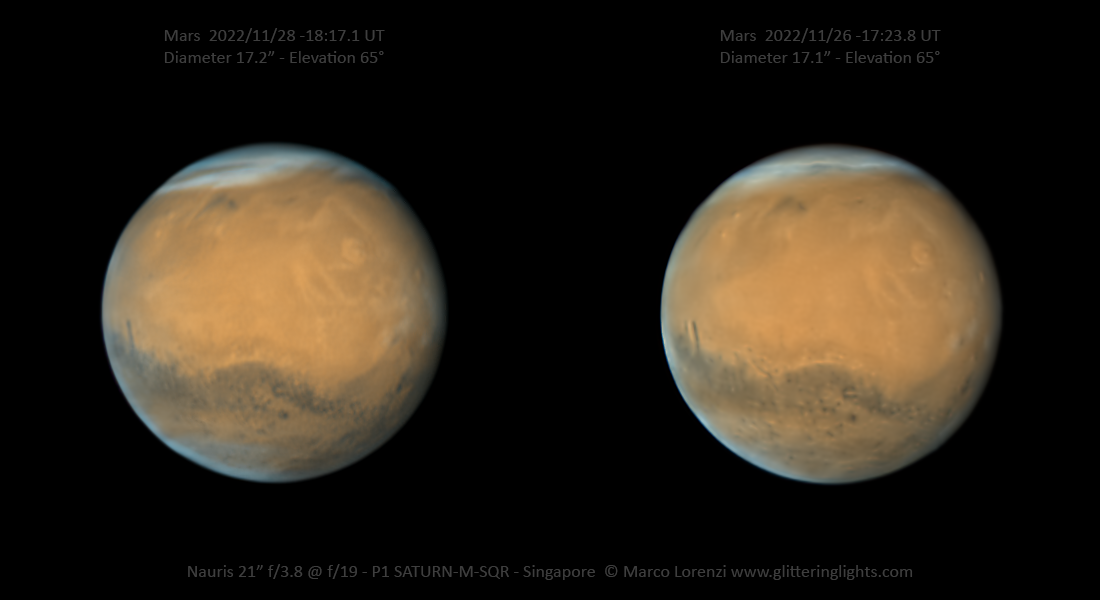
The Mars InSight lander returned its first image from the Red Planet’s flat, equatorial Elysium Planitia after a successful touchdown on November 26, 2018. The history making mission to explore the martian Interior using Seismic investigations, geodesy, and heat transport has been operating for over 1,400 martian days or sols. In that time the InSight mission has detected more than 1,300 marsquakes and recorded data from Mars-shaking meteoroid impacts, observing how the seismic waves travel to provide a glimpse inside Mars. Analyzing the archive of data collected is expected to yield discoveries for decades. But InSight’s final operational sol is likely not far off. The reason is evident in this selfie recorded earlier this year showing its deck and large, 2-meter-wide solar panels covered with dust. Kicked up by martian winds the dust continues to accumulate and drastically reduce the power that can be generated by InSight’s solar panels. [via NASA] https://ift.tt/qvrB5Fc

M33: The Triangulum Galaxy

The small, northern constellation Triangulum harbors this magnificent face-on spiral galaxy, M33. Its popular names include the Pinwheel Galaxy or just the Triangulum Galaxy. M33 is over 50,000 light-years in diameter, third largest in the Local Group of galaxies after the Andromeda Galaxy (M31), and our own Milky Way. About 3 million light-years from the Milky Way, M33 is itself thought to be a satellite of the Andromeda Galaxy and astronomers in these two galaxies would likely have spectacular views of each other’s grand spiral star systems. As for the view from the Milky Way, this sharp image combines data from telescopes on and around planet Earth to show off M33’s blue star clusters and pinkish star forming regions along the galaxy’s loosely wound spiral arms. In fact, the cavernous NGC 604 is the brightest star forming region, seen here at about the 1 o’clock position from the galaxy center. Like M31, M33’s population of well-measured variable stars have helped make this nearby spiral a cosmic yardstick for establishing the distance scale of the Universe. [via NASA] https://ift.tt/CmQAtRZ

A Partial Eclipse of an Active Sun

Watch for three things in this unusual eclipse video. First, watch for a big dark circle to approach from the right to block out more and more of the Sun. This dark circle is the Moon, and the video was made primarily to capture this partial solar eclipse last week. Next, watch a large solar prominence hover and shimmer over the Sun’s edge. A close look will show that part of it is actually falling back to the Sun. The prominence is made of hot plasma that is temporarily held aloft by the Sun’s changing magnetic field. Finally, watch the Sun’s edge waver. What is wavering is a dynamic carpet of hot gas tubes rising and falling through the Sun’s chromosphere — tubes known as spicules. The entire 4-second time-lapse video covers a time of about ten minutes, although the Sun itself is expected to last another 5 billion years. [via NASA] https://ift.tt/iEGxbkX

NGC 6357: The Lobster Nebula

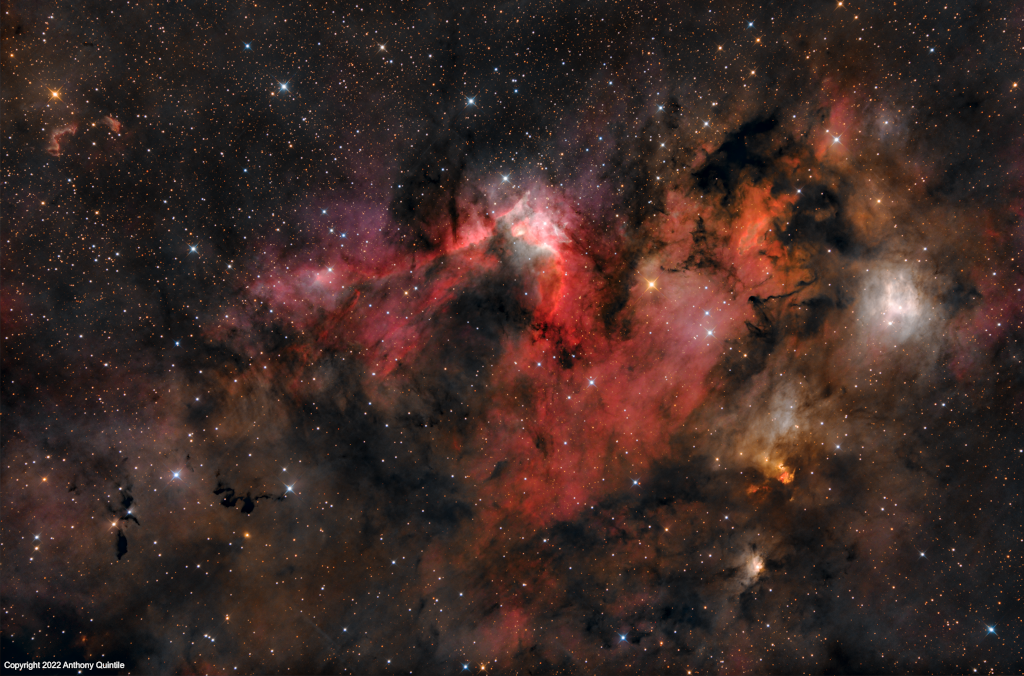
Why is the Lobster Nebula forming some of the most massive stars known? No one is yet sure. Cataloged as NGC 6357, the Lobster Nebula houses the open star cluster Pismis 24 near its center — a home to unusually bright and massive stars. The overall red glow near the inner star forming region results from the emission of ionized hydrogen gas. The surrounding nebula, featured here, holds a complex tapestry of gas, dark dust, stars still forming, and newly born stars. The intricate patterns are caused by complex interactions between interstellar winds, radiation pressures, magnetic fields, and gravity. The image was taken with DOE’s Dark Energy Camera on the 4-meter Blanco Telescope at the Cerro Tololo Inter-American Observatory in Chile. NGC 6357 spans about 400 light years and lies about 8,000 light years away toward the constellation of the Scorpion. [via NASA] https://ift.tt/CI7TkGo

LDN 43: The Cosmic Bat Nebula

What is the most spook-tacular nebula in the galaxy? One contender is LDN 43, which bears an astonishing resemblance to a vast cosmic bat flying amongst the stars on a dark Halloween night. Located about 1400 light years away in the constellation Ophiuchus, this molecular cloud is dense enough to block light not only from background stars, but from wisps of gas lit up by the nearby reflection nebula LBN 7. Far from being a harbinger of death, this 12-light year-long filament of gas and dust is actually a stellar nursery. Glowing with eerie light, the bat is lit up from inside by dense gaseous knots that have just formed young stars. [via NASA] https://ift.tt/tlU6Z4a

Night on a Spooky Planet

What spooky planet is this? Planet Earth of course, on a dark and stormy night in 2013 at Hverir, a geothermally active area along the volcanic landscape in northeastern Iceland. Triggered by solar activity, geomagnetic storms produced the auroral display in the starry night sky. The ghostly towers of steam and gas are venting from fumaroles and danced against the eerie greenish light. For now, auroral apparitions are increasing as our Sun approaches a maximum in its 11 year solar activity cycle. And pretty soon, ghostly shapes may dance in your neighborhood too. [via NASA] https://ift.tt/Co6Px5G

LDN 673: Dark Clouds in Aquila

Part of a dark expanse that splits the crowded plane of our Milky Way galaxy, the Aquila Rift arcs through planet Earth’s skies near bright star Altair. In eerie silhouette against the Milky Way’s faint starlight, its dusty molecular clouds likely contain raw material to form hundreds of thousands of stars and astronomers search the dark clouds for telltale signs of star birth. This telescopic close-up looks toward the region at a fragmented Aquila dark cloud complex identified as LDN 673, stretching across a field of view slightly wider than the full moon. In the scene, visible indications of energetic outflows associated with young stars include the small red tinted nebulosity RNO 109 above and right of center, and Herbig-Haro object HH32 below. These dark clouds might look scary, but they’re estimated to be some 600 light-years away. At that distance, this field of view spans about 7 light-years. [via NASA] https://ift.tt/qwWDhQt

Seven Years of Halley Dust

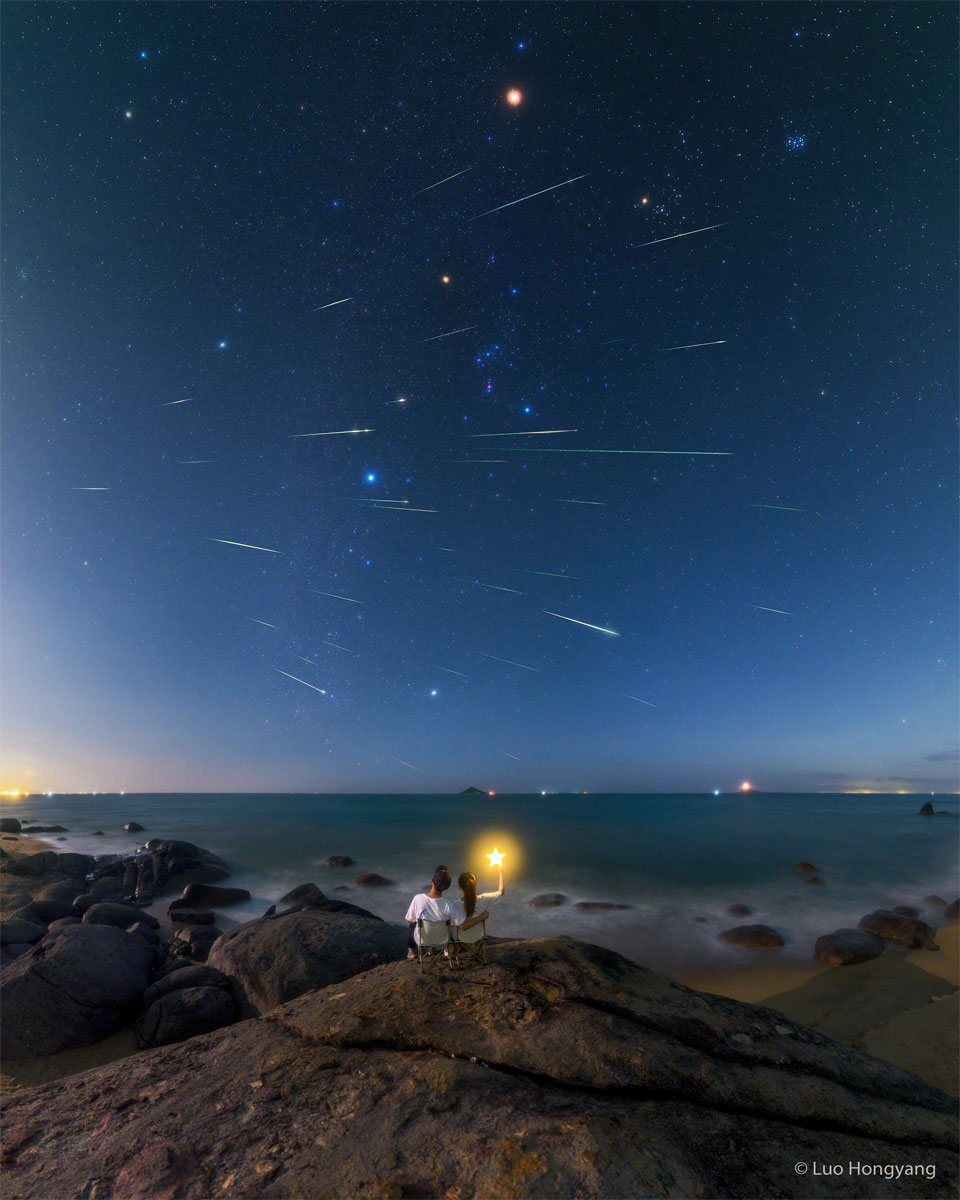
History’s first known periodic comet Halley (1P/Halley) returns to the inner Solar System every 75 years or so. The famous comet made its last appearance to the naked-eye in 1986. But dusty debris from Comet Halley can be seen raining through planet Earth’s skies twice a year during two annual meteor showers, the Eta Aquarids in May and the Orionids in October. Including meteors near the shower maximum on October 21, this composite view compiles Orionid meteors captured from years 2015 through 2022. About 47 bright meteors are registered in the panoramic night skyscape. Against a starry background extending along the Milky Way, the Orionid meteors all seem to radiate from a point just north of Betelgeuse in the familiar constellation of the Hunter. In the foreground are mountains in eastern Slovakia near the city of Presov. [via NASA] https://ift.tt/pOnCre9