Galaxies in the River

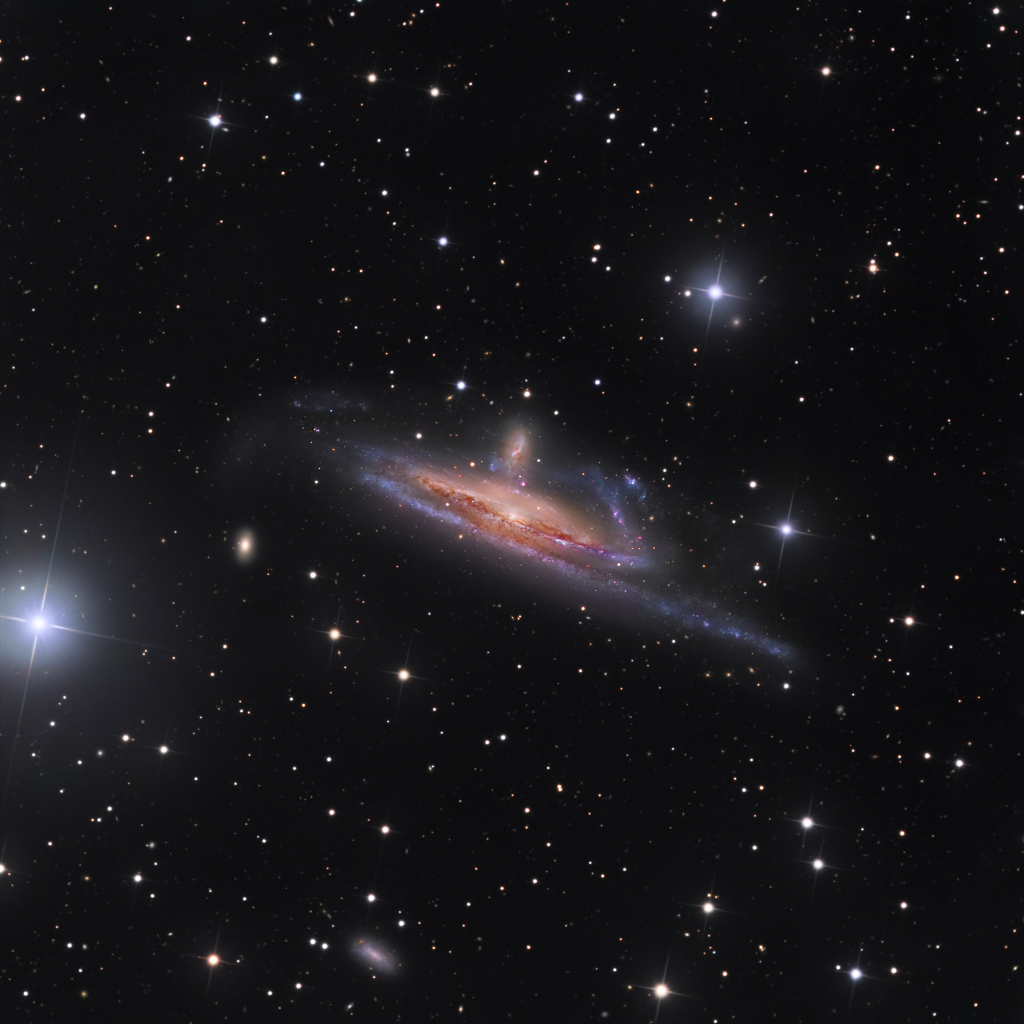
Large galaxies grow by eating small ones. Even our own galaxy engages in a sort of galactic cannibalism, absorbing small galaxies that are too close and are captured by the Milky Way’s gravity. In fact, the practice is common in the universe and illustrated by this striking pair of interacting galaxies from the banks of the southern constellation Eridanus, The River. Located over 50 million light years away, the large, distorted spiral NGC 1532 is seen locked in a gravitational struggle with dwarf galaxy NGC 1531 (right of center), a struggle the smaller galaxy will eventually lose. Seen edge-on, spiral NGC 1532 spans about 100,000 light-years. Nicely detailed in this sharp image, the NGC 1532/1531 pair is thought to be similar to the well-studied system of face-on spiral and small companion known as M51. [via NASA] https://ift.tt/35taUEc
IC 405: The Flaming Star Nebula

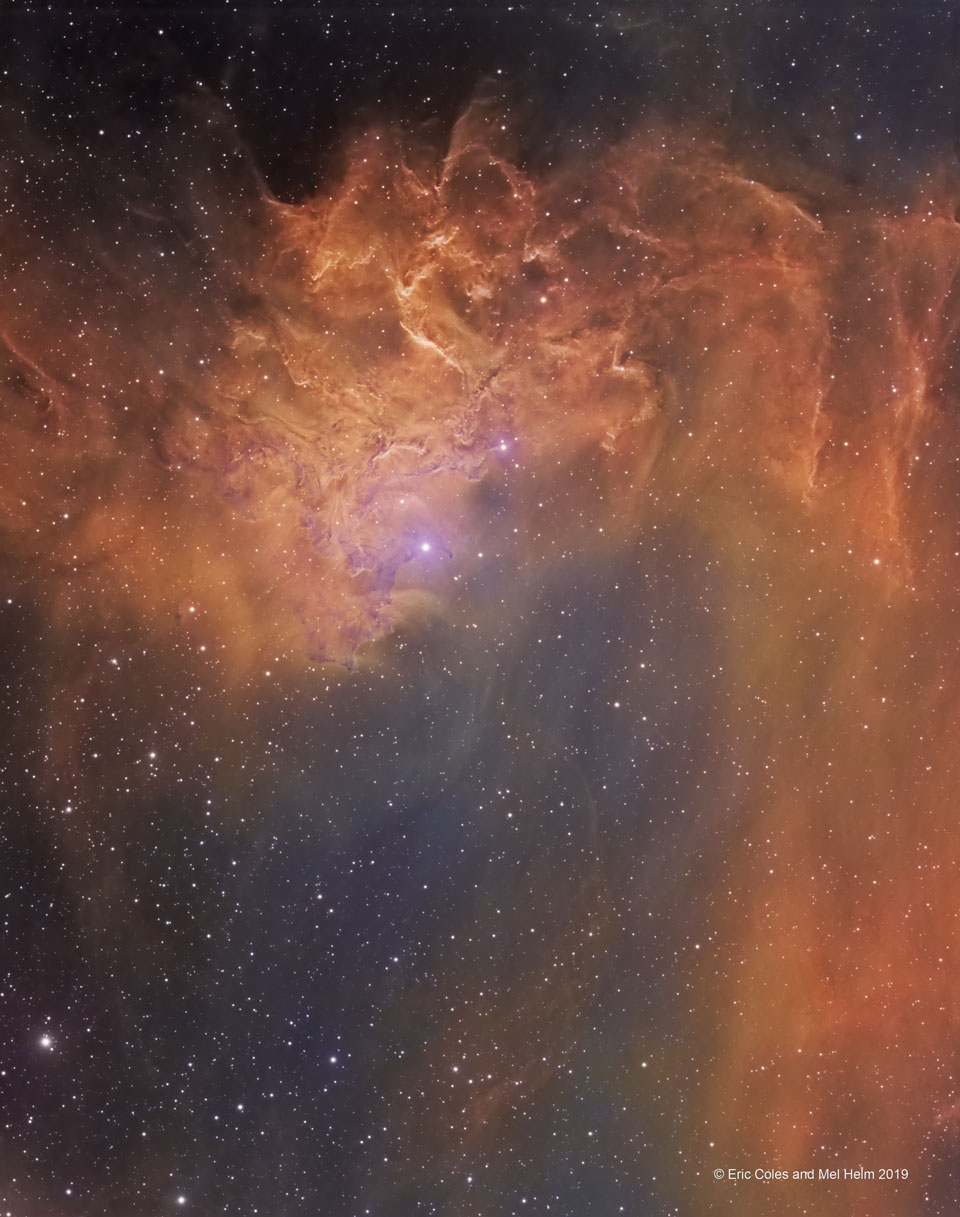
Rippling dust and gas lanes give the Flaming Star Nebula its name. The orange and purple colors of the nebula are present in different regions and are created by different processes. The bright star AE Aurigae, visible toward the image left, is so hot it is blue, emitting light so energetic it knocks electrons away from surrounding gas. When a proton recaptures an electron, red light is frequently emitted (depicted here in orange). The purple region’s color is a mix of this red light and blue light emitted by AE Aurigae but reflected to us by surrounding dust. The two regions are referred to as emission nebula and reflection nebula, respectively. Pictured here in the Hubble color palette, the Flaming Star Nebula, officially known as IC 405, lies about 1500 light years distant, spans about 5 light years, and is visible with a small telescope toward the constellation of the Charioteer (Auriga). [via NASA] https://ift.tt/35yxjjj

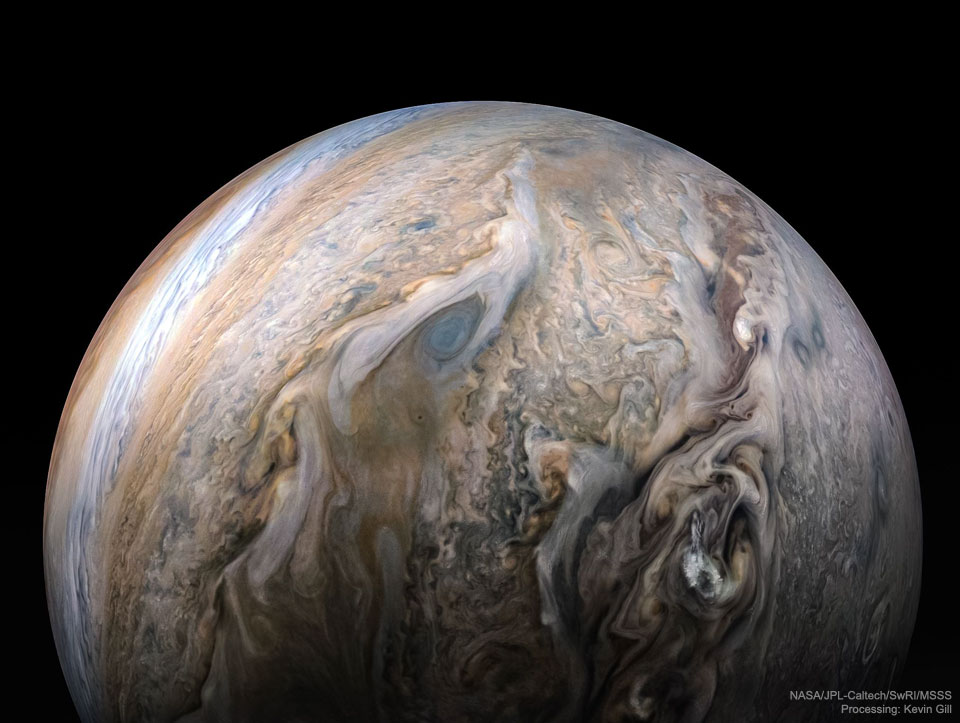
Tumultuous Clouds of Jupiter

Some cloud patterns on Jupiter are quite complex. The featured tumultuous clouds were captured in May by NASA’s robotic Juno spacecraft currently orbiting our Solar System’s largest planet. The image was taken when Juno was only about 15,000 kilometers over Jupiter’s cloud tops, so close that less than half of the giant planet is visible. The rough white clouds on the far right are high altitude clouds known as pop-up clouds. Juno’s mission, now extended into 2021, is to study Jupiter in new ways. Among many other things, Juno has been measuring Jupiter’s gravitational field, finding surprising evidence that Jupiter may be mostly a liquid. [via NASA] https://ift.tt/2QOjCHJ

A Starry Night of Iceland

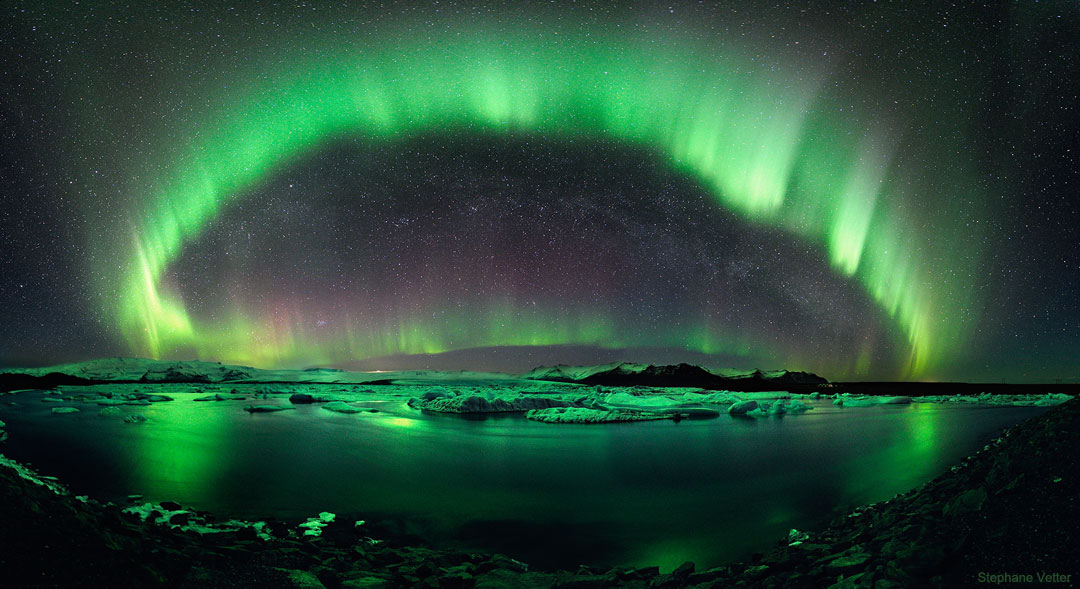
On some nights, the sky is the best show in town. On this night, the sky was not only the best show in town, but a composite image of the sky won an international competition for landscape astrophotography. The featured winning image was taken in 2011 over Jökulsárlón, the largest glacial lake in Iceland. The photographer combined six exposures to capture not only two green auroral rings, but their reflections off the serene lake. Visible in the distant background sky is the band of our Milky Way Galaxy and the Andromeda galaxy. A powerful coronal mass ejection from the Sun caused auroras to be seen as far south as Wisconsin, USA. As the Sun progresses away from its current low in surface activity toward a solar maximum a few years away, many more spectacular images of aurora are expected. [via NASA] https://ift.tt/36nMi12

Quadrantids over the Great Wall

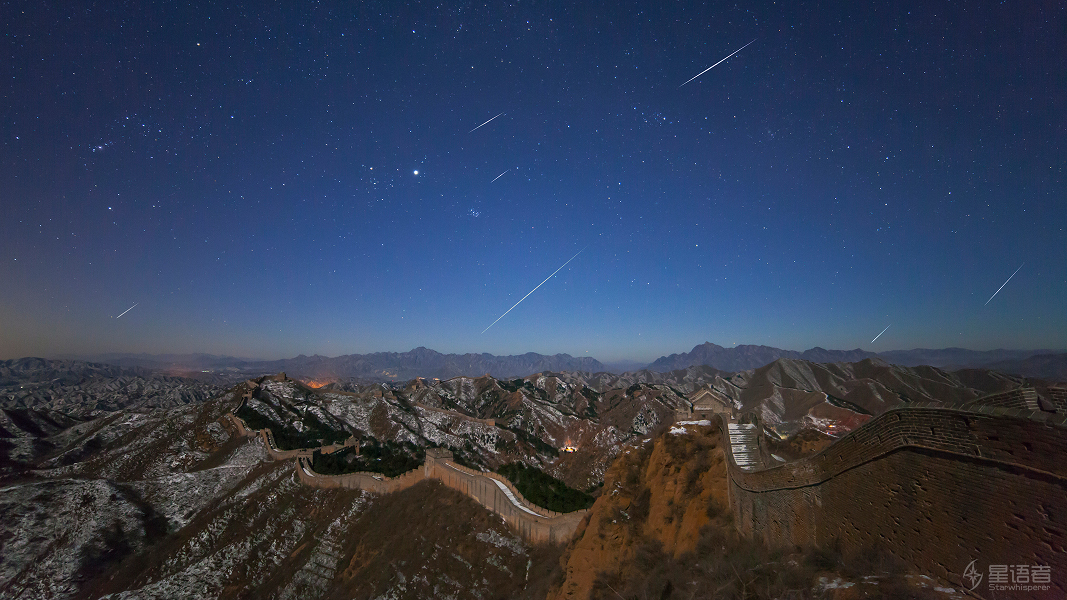
Named for a forgotten constellation, the Quadrantid Meteor Shower is an annual event for planet Earth’s northern hemisphere skygazers The shower’s radiant on the sky lies within the old, astronomically obsolete constellation Quadrans Muralis. That location is not far from the Big Dipper, at the boundaries of the modern constellations Bootes and Draco. With the radiant out of the frame at the upper right, Quadrantid meteors streak through this night skyscape composed of digital frames recorded in the hours around the shower’s peak on January 4, 2013. The last quarter moon illuminates rugged terrain and a section of the Great Wall in Hebei Province, China. A likely source of the dust stream that produces Quadrantid meteors was identified in 2003 as an asteroid. As usual, in 2020 the shower is expected to peak briefly on the night of January 3/4. Meteor fans in North America can anticpate a good show to celebrate the new year in moonless skies before tomorrow’s dawn. [via NASA] https://ift.tt/2QnocxT

The Fainting of Betelgeuse

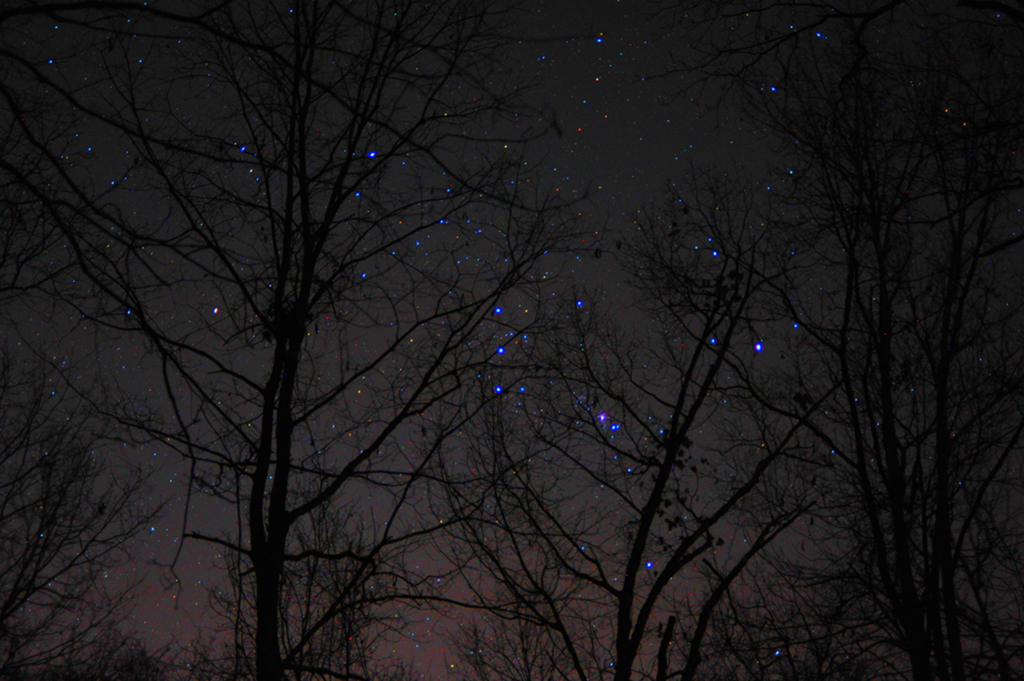
Begirt with many a blazing star, Orion the Hunter is one of the most recognizable constellations. In this night skyscape the Hunter’s stars rise in the northern hemisphere’s winter sky on December 30, 2019, tangled in bare trees near Newnan, Georgia, USA. Red super giant star Betelgeuse stands out in yellowish hues at Orion’s shoulder left of center, but it no longer so strongly rivals the blue supergiant star Rigel at the Hunter’s foot. In fact, skygazers around planet Earth can see a strikingly fainter Betelgeuse now, its brightness fading by more than half in the final months of 2019. Betelgeuse has long been known to be a variable star, changing its brightness in multiple cycles with approximate short and long term periods of hundreds of days to many years. The star is now close to its faintest since photometric measurements in 1926/27, likely due in part to a near coincidence in the minimum of short and long term cycles. Betelgeuse is also recognized as a nearby red supergiant star that will end its life in a core collapse supernova explosion sometime in the next 1,000 years, though that cosmic cataclysm will take place a safe 700 light-years or so from our fair planet. [via NASA] https://ift.tt/2SKKJpZ

Betelgeuse Imagined

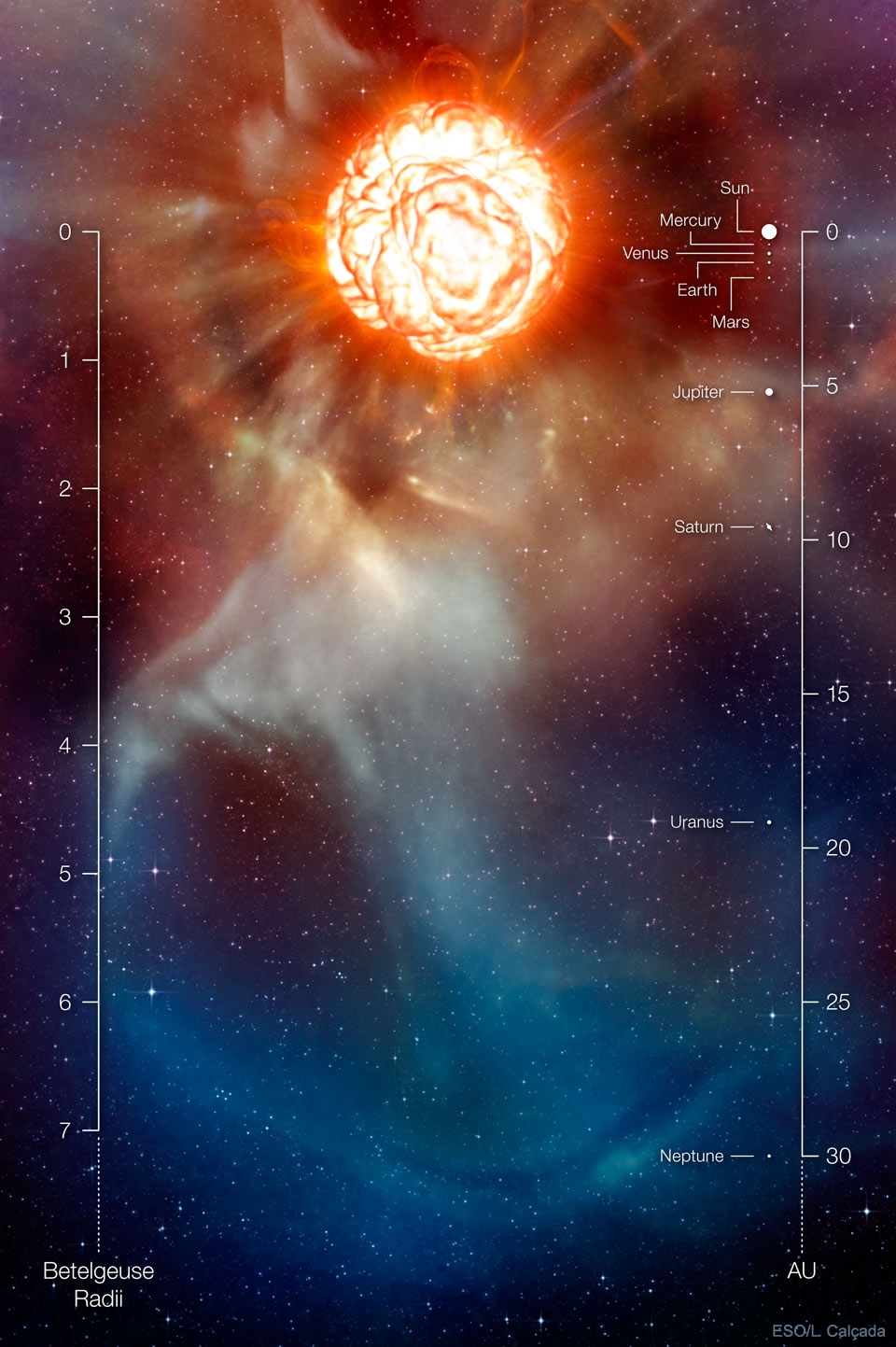
Why is Betelgeuse fading? No one knows. Betelgeuse, one of the brightest and most recognized stars in the night sky, is only half as bright as it used to be only five months ago. Such variability is likely just normal behavior for this famously variable supergiant, but the recent dimming has rekindled discussion on how long it may be before Betelgeuse does go supernova. Known for its red color, Betelgeuse is one of the few stars to be resolved by modern telescopes, although only barely. The featured artist’s illustration imagines how Betelgeuse might look up close. Betelgeuse is thought to have a complex and tumultuous surface that frequently throws impressive flares. Were it to replace the Sun (not recommended), its surface would extend out near the orbit of Jupiter, while gas plumes would bubble out past Neptune. Since Betelgeuse is about 700 light years away, its eventual supernova will not endanger life on Earth even though its brightness may rival that of a full Moon. Astronomers — both amateur and professional — will surely continue to monitor Betelgeuse as this new decade unfolds. [via NASA] https://ift.tt/2SHw3Yt

Cassini Spacecraft Crosses Saturns Ring Plane

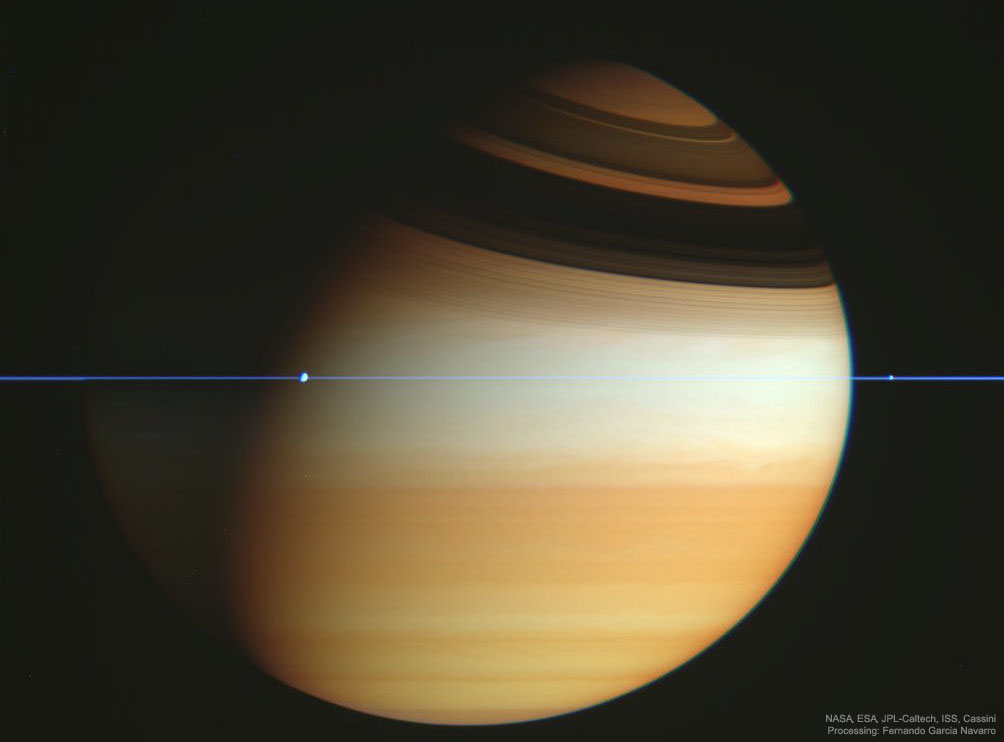
If this is Saturn, where are the rings? When Saturn’s «appendages» disappeared in 1612, Galileo did not understand why. Later that century, it became understood that Saturn’s unusual protrusions were rings and that when the Earth crosses the ring plane, the edge-on rings will appear to disappear. This is because Saturn’s rings are confined to a plane many times thinner, in proportion, than a razor blade. In modern times, the robot Cassini spacecraft orbiting Saturn frequently crossed Saturn’s ring plane during its mission to Saturn, from 2004 to 2017. A series of plane crossing images from 2005 February was dug out of the vast online Cassini raw image archive by interested Spanish amateur Fernando Garcia Navarro. Pictured here, digitally cropped and set in representative colors, is the striking result. Saturn’s thin ring plane appears in blue, bands and clouds in Saturn’s upper atmosphere appear in gold. Details of Saturn’s rings can be seen in the high dark shadows across the top of this image, taken back in 2005. The moons Dione and Enceladus appear as bumps in the rings. [via NASA] https://ift.tt/39qKEOb

A Distorted Sunrise Eclipse

Yes, but have you ever seen a sunrise like this? Here, after initial cloudiness, the Sun appeared to rise in two pieces and during partial eclipse, causing the photographer to describe it as the most stunning sunrise of his life. The dark circle near the top of the atmospherically-reddened Sun is the Moon — but so is the dark peak just below it. This is because along the way, the Earth’s atmosphere had an inversion layer of unusually warm air which acted like a gigantic lens and created a second image. For a normal sunrise or sunset, this rare phenomenon of atmospheric optics is known as the Etrucan vase effect. The featured picture was captured two mornings ago from Al Wakrah, Qatar. Some observers in a narrow band of Earth to the east were able to see a full annular solar eclipse — where the Moon appears completely surrounded by the background Sun in a ring of fire. The next solar eclipse, also an annular eclipse, will occur in 2020 June. [via NASA] https://ift.tt/362kwH2

A Partial Solar Eclipse Sequence Reflected

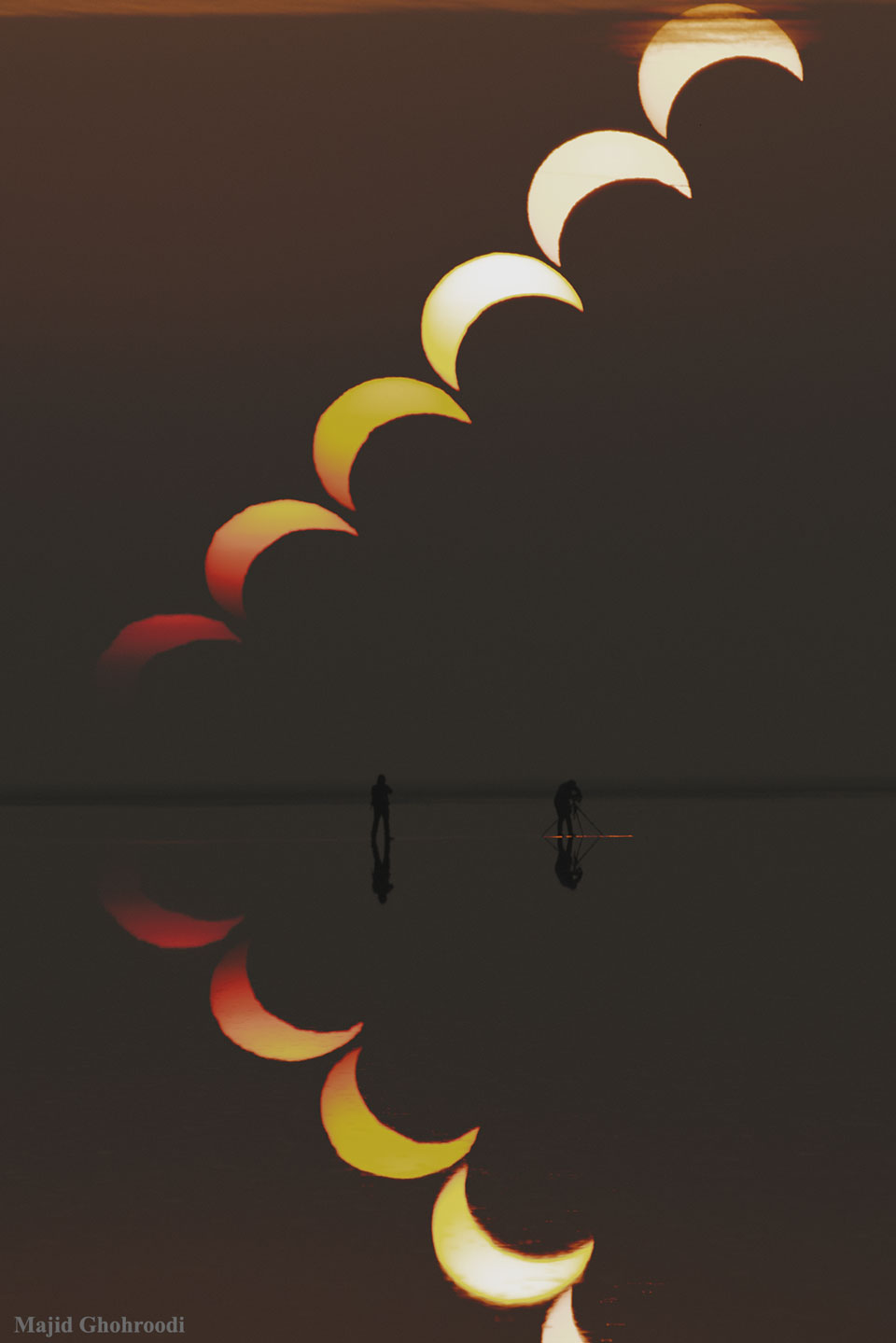
What’s happened to the Sun? Yesterday, if you were in the right place at the right time, you could see the Sun rise partially eclipsed by the Moon. The unusual sight was captured in dramatic fashion in the featured image not only directly, in a sequence of six images, but also in reflection from Soltan Salt Lake in Iran. The almost-white Sun appears dimmer and redder near the horizon primarily because Earth’s atmosphere preferentially scatters away more blue light. Yesterday’s partial solar eclipse appeared in the sky over much of Asia and Australia, but those with a clear enough sky in a thin band across the Earth’s surface were treated to a more complete annular solar eclipse — where the Moon appears completely surrounded by the Sun in what is known as a ring of fire. The next annular solar eclipse will occur in 2020 June. [via NASA] https://ift.tt/2EVjMrh